
by Fuad Shahbazaov

On February 3, 2026, senior officials of the Azerbaijan Naval Forces (ANF), led by Commander Rear Admiral Shahin Mammadov, paid a visit to Islamabad to meet their counterpart, Admiral Naveed Ashraf. The visit came amid strengthening ties between the two countries in the most strategically important fields, particularly defense. The defense partnership between the two countries recently entered a new phase when Azerbaijan, along with Türkiye and China, openly supported Pakistan against India during the clashes in May 2025.
Although local media framed Shahin Mammadov’s meeting with Naveed Ashraf as a routine engagement between partners, the visit must be understood against the backdrop of mounting geopolitical volatility in the Caspian basin and the wider Middle East. The joint United States and Israelis military campaign against Iran since February 28, and Israel’s missile attacks targeting Iranian ships in the Caspian Sea on March 18, coupled with the persistent Russian threat in the basin, have accelerated competition over international trade routes and energy resources in the landlocked sea. Within this context, maritime security is steadily emerging as a strategic priority for Azerbaijan. In recent years, Baku has significantly strengthened its naval capabilities by purchasing and modernizing vessels through close partnerships with both Israel and Türkiye.
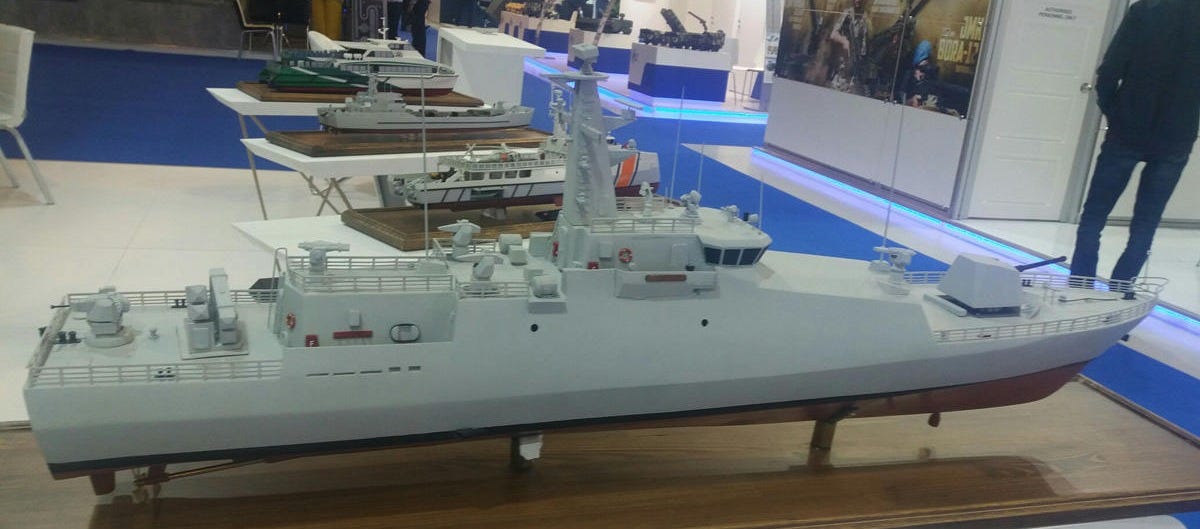
*Turkish warship design offered to Azerbaijan as part of its naval modernization program.
In 2018, Azerbaijan held negotiations with the Turkish shipyard Dearsan to jointly build four warships, while in 2025, Baku publicly showcased its Turkish-produced “Salvo” unmanned surface vessel (USV) for the first time, marking a significant step in the country’s maritime modernization efforts. Further efforts to increase military capabilities culminated in the demonstration of Baku’s most recent acquisition of Israeli-made anti-ship missiles, namely Sea Breaker, capable of hitting sea and land targets with high accuracy at ranges of 32 to 300 kilometers (km), including the Israeli-made fifth-generation Ice-Breaker anti-ship cruise missile system. For Azerbaijan, its public display effectively confirmed the system’s existence and highlighted the creation of a robust barrier on the maritime flank, significantly enhancing its coastal defense capabilities.
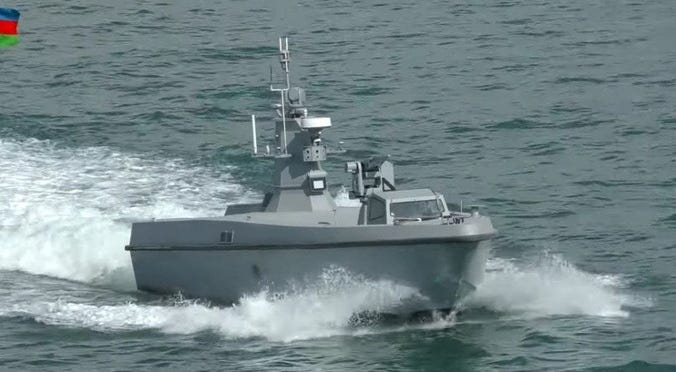
*Image: The Salvo: Azerbaijan’s first-ever Turkish-made Uncrewed Surface Vehicle (USV) naval drone in operation in the Caspian.
Considering that Azerbaijan possesses critically important energy infrastructure in the Caspian Sea, including offshore platforms and main export pipelines, which are vital to the country’s economy and Europe’s energy security, Baku’s ambitions to enhance naval partnerships and maritime security seem rational.
Russia’s frequent use of the Caspian Sea to launch missiles against Ukrainian territory since 2022, along with Iran’s transfer of Shahed drones to Russia via the Caspian route, has triggered concerns in other littoral states. Indeed, burgeoning military trade between Moscow and Tehran has further emboldened Azerbaijan to expand its outreach to Türkiye, Turkmenistan, and Kazakhstan. This engagement, pursued within the framework of the Turkic community, reflects Baku’s effort to consolidate regional partnerships at a time when Moscow and Tehran’s influence is declining.
Caspian Breeze 2025
In 2025, Baku and Astana conducted their first-ever joint large-scale naval exercises, “Caspian Breeze-2025,” in the Caspian Sea to prepare for potential asymmetric threats. Using a similar title as the former NATO-led Sea Breeze exercises in the Black Sea was perhaps no accident in the choice of the term, as other regional countries might one day join the exercise. Undoubtedly, the Caspian basin’s transformation into “a contested strategic zone” facilitated the emergence of multi-country blocs, namely Russia-Iran (with China’s muted support) and Azerbaijan-Turkic states. The latter is aimed at developing plausible means to counter emerging regional threats.
Azerbaijan’s continuous efforts to strengthen its naval capabilities and ongoing threat assessment with strategic partners form a comprehensive system for protecting the country’s energy and logistical interests. Therefore, without robust communication and coordination among the West, Türkiye, Israel, Pakistan, Kazakhstan, and Azerbaijan, powers such as Russia and Iran could dominate key regional trade routes, leading to both expansion and fragmentation across the Caspian basin.
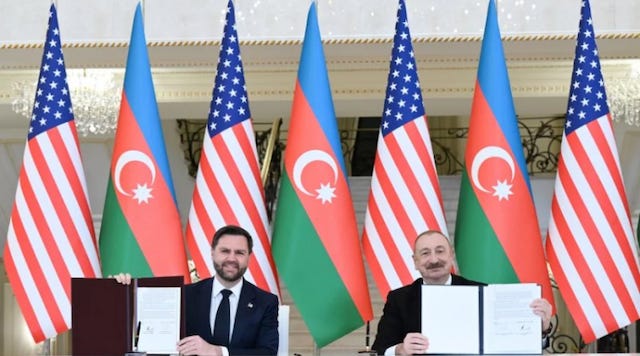
Nevertheless, the current level of engagement between Azerbaijan and other regional states with the Trump administration, culminating in Vice President JD Vance’s visit to the Caucasus and the signing of a strategic partnership document, may have convinced Baku that it has secured Washington’s vocal support. In addition, Vice-President JD Vance in his speech in Baku, emphasized that the US will supply Azerbaijan with new patrol boats to strengthen Azerbaijan’s maritime security as part of long-standing US-backed counter-terrorism initiatives with Baku. While this decision highlights the US’s core interests in the Caspian basin, it also seems a rational choice amid the eruption of the US-Iran War in March, 2026.
The ongoing confrontation between the United States and Iran has dramatically reshaped the fragile geopolitical landscape of the Gulf, inflicting severe damage on Iranian military infrastructure and unsettling the Gulf monarchies. In the wake of Tehran’s strategic setbacks, most notably the assassination of senior military and political elites and the destruction of key defense assets, Iran appears intent on widening the theater of conflict by targeting Washington’s regional partners in the Gulf. On the other hand, on March 5, reports indicated that an Iranian Arash drone struck the passenger terminal in Azerbaijan’s Nakhichivan exclave, raising alarm over the future security of critical energy infrastructure across the Caspian basin and beyond. Therefore, Azerbaijan will likely double its efforts to diversify its maritime security partnerships in order to mitigate potential risks and challenges.
Pakistan-Azerbaijan Naval Cooperation
One country that stands out for Azerbaijan in the new regional security order is Pakistan. Islamabad has critically important naval capabilities after having successfully established a sustainable manufacturing cycle in shipbuilding and naval systems. In addition, the Pakistani Navy operates COSMOS-class mini-submarines with a displacement of about 110 tons, produced at the Karachi Shipyard and Engineering Works under license from the Italian company Costruzioni Sommergibili S.p.A. These small mini-submarines are designed for sabotage and coastal operations and are well-suited for operating in the enclosed waters of the Caspian Sea. Moreover, in 2018, Türkiye announced that it delivered the second of four MILGEM corvettes to Pakistan under a defense contract.
Given Azerbaijan’s established shipbuilding infrastructure and expertise, Baku is likely to pursue joint production of military boats and frigates in partnership with Pakistan and Türkiye. Over the past decade, the Azerbaijan–Pakistan–Türkiye axis has delivered significant results, particularly in the military and defense sectors, laying the groundwork for a more comprehensive and enduring partnership. As such, the visit of Azerbaijani Rear-Admiral Shahin Mammadov to Islamabad amid heightening tensions around Iran and the buildup of American forces in the Middle East can be seen as a vital element of Baku’s extended strategy of diversification of its military-technical capabilities and a strengthening of the naval component of its national security.
Outlook
Azerbaijan steadily acknowledges that the Caspian basin is becoming an intersection of energy, transport, and military interests of regional and global powers, making efforts to boost its naval and deterrence capabilities mark a further evolution of the country’s national security interests as a growing regional power in the South Caucasus.
Moving forward, Azerbaijan’s ability to secure its offshore energy platforms and export pipelines remains a cornerstone of both domestic economic stability and European energy security. By conducting large-scale joint exercises like “Caspian Breeze-2025,” Azerbaijan is positioning itself not just as a littoral state but a country with maritime aspirations and an emerging ability to neutralize asymmetric threats in an increasingly changing security environment in the Caspian.
About the Author:
Fuad Shahbazov is a political scientist and analyst focused on regional security in Eurasia and the Middle East. He holds a master’s degree in Political Science from Vytautas Magnus University, a professional master’s degree in Terrorism and Countering Religious Radicalization from the University of Bergamo, and a master’s degree in Defense and Diplomacy from Durham University.
Thank you for your support! Please remember that The Saratoga Foundation is a non-profit 501(c)(3) organization. Your donations are fully tax-deductible. If you seek to support The Saratoga Foundation, you can make a one-time donation by clicking on the PayPal link below! You can also subscribe to our website to support our work.
https://www.paypal.com/donate/?hosted_button_id=XFCZDX6YVTVKA