
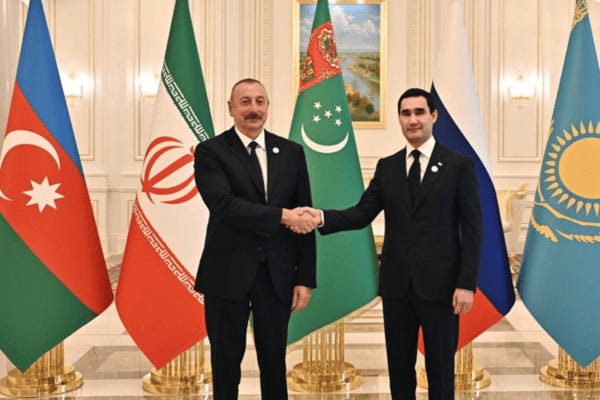
The recent two-day visit to Azerbaijan by Turkmenistan President Serdar Berdimuhamedov from June 22-23 has been hailed as a major milestone in bilateral relations. Indeed, ten years ago, not only such a warm welcome, but even a visit by Turkmenistan’s head of state would have seemed highly unlikely. The two countries have come a long way from disputing ownership of a Caspian oil field to agreeing on its joint development and symbolically naming it Dostluk (“Friendship”) - a word that carries a similar meaning in both Azerbaijani and Turkmen.
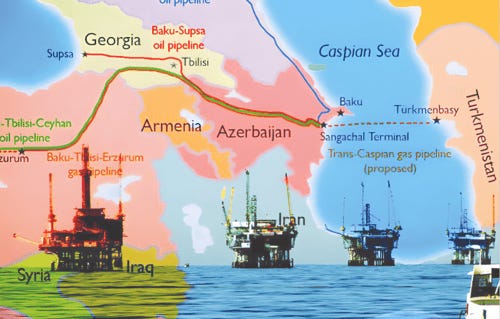
The Turkmen president’s visit to Azerbaijan has again raised hopes that the long-discussed Trans-Caspian Gas Pipeline (TCGP) project might finally gain new momentum. The recent endorsement of the Trans-Caspian corridor by U.S. Secretary of State Marco Rubio during a meeting with Turkmen Foreign Minister Rashid Meredov on May 29 has once again renewed interest in the geopolitical significance of the Trans-Caspian undersea gas pipeline, once championed by U.S. officials in the 1990s. Successive U.S. administrations have supported the idea of a Trans-Caspian energy link as a means of strengthening the sovereignty and economic independence of the South Caucasus and Central Asia, diversifying export routes, and reducing excessive dependence on any single market.
From Azerbaijan’s perspective, strengthening Trans-Caspian connectivity and capitalizing on growing international interest in the Middle Corridor remain key strategic priorities. To Baku’s dismay, Ashgabat has not shared the same level of enthusiasm.
The China Factor in Turkmen Strategy
Several objective reasons explain Turkmenistan’s reluctance to embrace the project and its proclivity to maintain an eastward orientation in its gas exports. First, Turkmenistan is a natural gas exporter, and, unlike Azerbaijan, the overwhelming majority of its proven gas reserves are located in the eastern part of the country. Second, an extensive pipeline network connecting Turkmen gas fields to China is already in place, providing a reliable and established export route. This pipeline system consists of three parallel lines that run for 1,830 kilometers across Turkmenistan, Uzbekistan, and Kazakhstan before entering China’s Xinjiang region. The combined design capacity of these three lines is 55 bcm per year (though some of this capacity is shared with smaller export volumes from Kazakhstan and Uzbekistan).
This strategic direction was reinforced in April when China National Petroleum Corporation (CNPC) signed an agreement to develop the fourth phase of the giant Galkynysh gas field, which supplies much of Turkmenistan’s approximately 30 bcm annual gas exports to China. While both countries have periodically discussed the construction of a fourth branch of the Central Asia–China gas pipeline (Line D), the project has faced repeated delays and remains uncertain.
Given these realities, it is highly unlikely that Turkmenistan would invest in a westward export pipeline to transport gas from fields developed largely with Chinese financing and intended primarily for the Chinese market. As a result, Ashgabat’s economic and infrastructure incentives continue to favor an eastward rather than a westward alignment.
Baku’s Energy Diplomacy with Ashgabat
Despite the challenges ahead, Azerbaijan is pursuing a deliberate, long-term energy strategy to engage Turkmenistan by leveraging ongoing developments in the Turkmen offshore oil sector to build support for a western vector to complement its eastern strategy. One promising area where Azerbaijani-Turkmen cooperation could deepen is the exporting of oil and gas from relatively smaller fields in the Caspian Sea.
On June 20th, Turkmenistan awarded exploration rights for Blocks 19 and 20 to Petronas. The Malaysian company already operates Block 1, which produces around 10 million cubic meters of gas per day. On its own, such production volumes are not sufficient to justify a dedicated export route. However, when combined with output from additional offshore developments, they could eventually create the scale necessary for commercially viable exports across the Caspian.
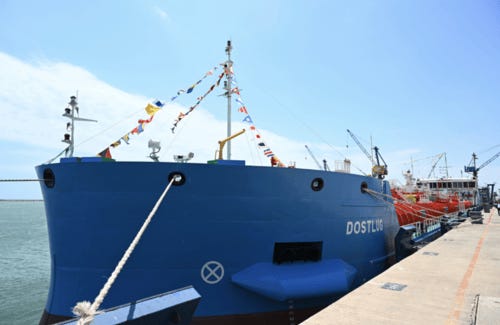
Azerbaijan is equally interested in expanding cooperation with Turkmenistan in the oil sector. In this context, one of the most symbolic outcomes of the visit was Azerbaijan’s decision to present Turkmenistan with an oil tanker. The vessel was named Dostlug—the Turkmen spelling of “friendship”—echoing the name of the offshore field that has become a powerful symbol of the rapprochement between the two countries.
Gifted by Azerbaijan to Turkmenistan, the “Dostlug” oil tanker was built at the Baku Shipyard and has an overall length of 141 meters, a width of 16.9 meters, and a draft of 4.54 meters. With a deadweight of 7,875 tons and a carrying capacity of 55,000 to 60,000 barrels, the Dostlug is a Volga-Don Max river-sea tanker specifically designed with a shallow draft to navigate the fluctuating water levels of the Caspian Sea and regional canal systems while maximizing its cargo load. Its construction not only demonstrates the development of Azerbaijan’s shipbuilding industry but also highlights Baku’s growing capacity to implement large-scale and technologically complex shipbuilding projects in its modernized shipyard.
From Baku’s perspective, increasing Turkmen oil exports through Azerbaijani infrastructure offers tangible economic benefits. Azerbaijan’s full operator-ship of the 833-kilometer (518-mile) long Baku–Supsa oil pipeline (145,000 bpd) further enhances the attractiveness of such cooperation, allowing Baku greater flexibility in marketing and transit arrangements.
Both President Ilham Aliyev and SOCAR President Rovshan Najaf have confirmed that Turkmen crude is already being transported through the 1,768 kilometer (1099-mile) long Baku–Tbilisi–Ceyhan (BTC) pipeline. According to SOCAR, approximately 230 million barrels of Turkmen oil were shipped via BTC between 2005 and 2022, averaging around 14 million barrels per year. While this is a significant volume, it remains modest compared to BTC’s current throughput capacity of approximately 400,000 barrels per day. This suggests that Azerbaijan’s transit infrastructure has ample room to accommodate additional volumes of Turkmen oil should Ashgabat choose to increase exports through the Caspian corridor.
Outlook
With the recent visit to Baku by the Turkmen President, Azerbaijani President Ilham Aliyev continues to nurture aspirations for a potential Trans-Caspian pipeline project that could once again be backed by the United States. Secretary’s of State Marco Rubio’s recent statement and meeting with the Turkmen Foreign Minister symbolize a revived level of US interest in the project, and American interest in promoting the Trump Route for International Peace and Prosperity (TRIPP) could bolster US aspirations for greater Caspian connectivity, even linking TRIPP and TCP with the Middle Corridor.
That said, the principal obstacle to the realization of the TCP gas pipeline remains Turkmenistan’s reluctance to make a strategic commitment to the project. Despite Turkmenistan’s recent rapprochement with Azerbaijan and a series of goodwill gestures from Baku, the Turkmen leadership has shown little inclination to take the decisive steps necessary to advance a Trans-Caspian energy corridor.
Instead, Ashgabat appears to be adhering to its long-standing approach: preserving multiple export options without fully committing to any specific westward project while maintaining its eastern connection with China. Projects such as the Trans-Afghanistan-Pakistan-Iran (TAPI) gas pipeline, a project designed to export Turkmen natural gas out of the Caspian basin to energy-deficient markets in South Asia, a Trans-Caspian gas connection, or expanded gas exports to Türkiye via Iran serve less as concrete strategic priorities and more as bargaining chips in negotiations with China, Turkmenistan’s dominant gas customer.
From this perspective, the value of these alternative routes lies not necessarily in their implementation but in the leverage they provide. By keeping the possibility of diversification alive, Turkmenistan seeks to strengthen its negotiating position vis-à-vis Beijing while avoiding commitments that could alter the existing balance of its export relationships. As a result, discussions surrounding westward export routes continue to generate political interest, but tangible progress remains elusive.
This would explain Moscow’s muted response to the Turkmen president’s visit to Baku. At this stage, Moscow is likely to closely observe these developments rather than react strongly, particularly given the numerous political, commercial, and logistical obstacles that continue to hinder progress on the Trans-Caspian Pipeline. From Russia’s perspective, there is still a considerable gap between the positive symbolism surrounding Azerbaijan-Turkmenistan relations and any concrete steps toward the realization of a westward export corridor.
Author Bio:
Rauf Mammadov is a senior manager at Fuld & Company, specializing in energy issues. His research focuses on energy security, global energy industry trends, and energy relations between the Middle East, Central Asia, and the South Caucasus, with a particular emphasis on the post-Soviet countries of Eurasia.
Thank you for your support! Please remember that The Saratoga Foundation is a non-profit 501(c)(3) organization. Your donations are fully tax-deductible. If you seek to support The Saratoga Foundation, you can make a one-time donation by clicking on the PayPal link below! Alternatively, you can also choose to subscribe on our website to support our work.
https://www.paypal.com/donate/?hosted_button_id=XFCZDX6YVTVKA
Thanks for reading! This post is public so feel free to share it.
The most important aspect of this article is Turkmenistan's use of leverage. It sets its geopolitical policy and hesitation to look westward.