
By Fuad Shabazov
On April 17, 2026, Azerbaijani President Ilham Aliyev met with the Syrian interim President Ahmad al-Sharaa on the sidelines of the Antalya Diplomacy Forum in Türkiye. The recent meeting between the two leaders has become a tradition in the post-Assad period, paving the way for a stronger partnership between Baku and Damascus. Indeed, diversification of partnership with particular countries like Azerbaijan and Türkiye is of strategic importance for the former war-torn country, especially amid post-war reconstruction efforts, regional volatility, and Israel’s expansion deeper into Syrian territory.
In May 2025, a high-level Azerbaijani delegation arrived in Damascus to explore opportunities for cooperation across key sectors, including the economy, energy, culture, and education. The visit underscored the deepening ties between Baku and Damascus, but it also coincided with escalating security challenges in Syria, marked by an Israeli Defense Forces incursion and subsequent violent tensions involving Syria’s Druze minority.
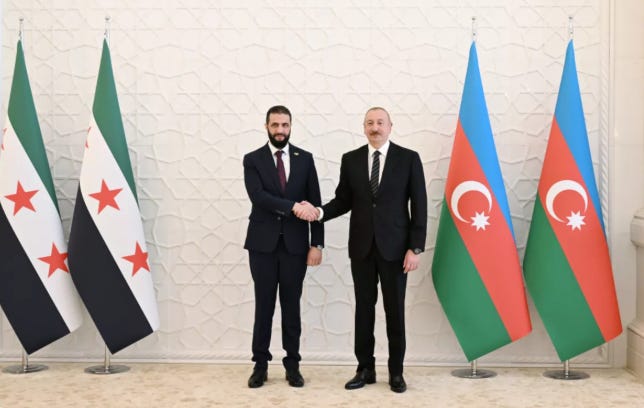
*Azerbaijan President Ilham Aliyev & Syrian President al-Sharaa in Baku in July 2025
Shortly after this visit, President al-Sharaa paid a one-day visit to Baku in July 2025, meeting his counterpart Aliyev, reportedly as Azerbaijan simultaneously launched mediation efforts between Syria and Israel in early August 2025. Although official media sources in Baku did not issue any comment or statements on this matter, diplomatic sources reported that the meeting focused on the ‘security situation, particularly in southern Syria’ — where Bedouin and Druze militants had been clashing.
Syria’s decision to turn to Azerbaijan as a reliable interlocutor in the mediation process with Israel can be traced to its longstanding strategic ties with both Israel and Türkiye. At the same time, Syrian officials increasingly view Azerbaijan as a credible actor and potential mediator between Syria and Israel, but also between Syria and Russia in April 2025. Even though the mediation efforts with Israel did not yield significant results and stopped Israeli military advancements in Syria, it opened additional horizons for the Baku and Damascus bilateral partnership.
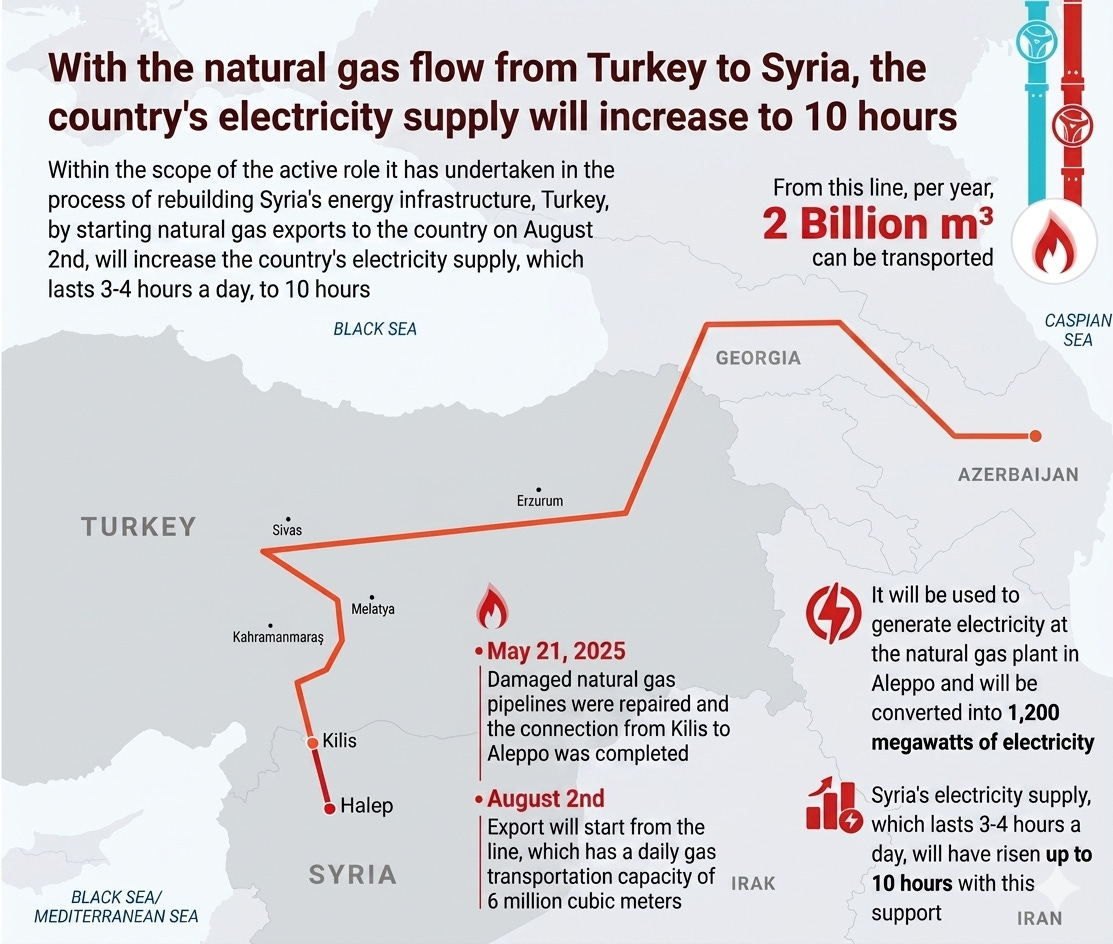
Energy map of Azerbaijan-Turkiye-Syria natural gas pipeline: Map Source:
Shah Deniz Fuels Syrian Economic Recovery
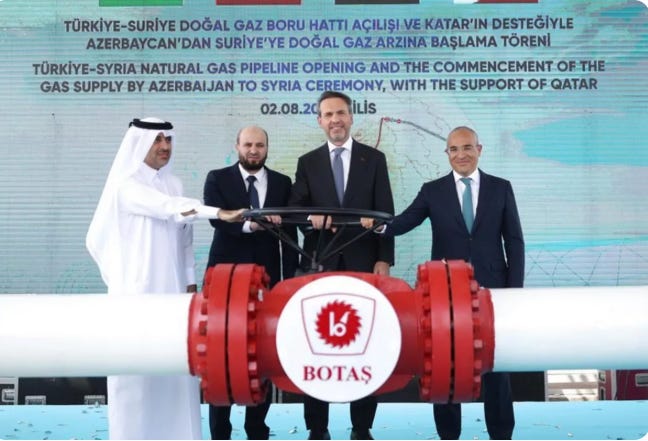
As such, in 2025, the Azerbaijani State Oil Company (SOCAR) signed a memorandum of understanding (MoU) with the Syrian government to supply natural gas to Syria, which stands to reshape the Middle East’s geopolitical and energy landscape. Under the new agreement, Azerbaijan exports 1.2 billion cubic meters (bcm) of gas annually to Syria via Türkiye from the BP-operated Shah Deniz gas field in the Caspian Sea. This supply is earmarked for Syria’s gas-fired plants, with Energy Minister Mohammad al-Bashir estimating it will boost the country’s electricity generation by about 750 megawatts, enabling some regions to receive up to 4 additional hours of electricity daily.
Overall, since diplomatic relations were restored between the two countries, Azerbaijan has announced plans to invest between $400-600 million in Syrian energy infrastructure, while a joint venture between SOCAR and Türkiye’s BOTAŞ aims to explore and develop new reserves and invest in petrochemicals. Azerbaijan’s further investment plans are essential for Syria, as the country anticipates that Baku’s investments in local infrastructure would serve as a natural shield against potential Israeli air strikes, given the nature of its relations with Tel Aviv.
Azerbaijan’s efforts to mediate between Syria and Israel have failed so far. The prospect of joint participation in the Abraham Accords, as pursued by other Arab states, also did not materialize. In response, Baku and Damascus appear to be exploring the creation of a new geopolitical axis linking Azerbaijan, Türkiye, and Syria. Strategic cooperation in this framework could open the door for Syria’s eventual engagement with the Organization of Turkic States (OTS). This would offer a significant avenue for Syria’s post-war recovery, as well as introduce Damascus to a new network of countries and trading partners in Central Asia, and even participation in the Azerbaijan-led Middle Corridor project.
As such, Syria could benefit from Azerbaijan and Türkiye’s expertise in transport and energy infrastructure development, as well as gain access to additional markets in the wider Eurasia, strengthening Syria’s regional position. On the other hand, Azerbaijan’s willingness to enhance its partnership with Syria is part of its broader strategy to recalibrate its footprint in the Middle East after 2020, enabling it to diversify its energy portfolio through investments in Israel, Syria, Türkiye, and the Gulf. If successful and resilient, gas exports to Syria could enable Azerbaijan to make inroads into Egypt’s energy market using Syria as a transit country.
Outlook
The overthrow of the Assad regime in Syria in December 2024 and the ongoing war with Iran in the Persian Gulf have led to a decline in Iranian influence in the immediate neighborhood, namely Syria, creating a vacuum that Azerbaijan is eager to fulfill. As such, Azerbaijan and Turkiye’s growing footprint in Syria, complemented by energy-related projects and infrastructure upgrades that bypass Iran, could further unsettle Tehran. Azerbaijan’s long-standing strategic partnership with Israel and recent efforts to mediate a diplomatic thaw between Syria, Israel, and Türkiye are seen as a source of threat by Tehran.
For Tehran, the emergence of such a cooperative format and axis reflects a broader pattern of geopolitical encirclement. This perception of encirclement has become increasingly pronounced amid the ongoing war and Washington’s August 2025 agreement with Azerbaijan and Armenia to establish a 42‑kilometer transit corridor, known as the Trump Route for International Peace and Prosperity (TRIPP).
Nevertheless, lingering domestic instability in Syria, the ongoing war in Iran, and a regional security gap highlight limitations for Azerbaijan in capitalizing on Iran’s preoccupation at the moment, as eventually larger energy and infrastructure projects could face serious stalemates or even delays, stretching Baku’s diplomatic capacities to build wider relations with Damascus. Regardless, the shadow of the South Caucasus energy giant, Azerbaijan. By assisting Syria in its post-war economic recovery, Azerbaijan is opening a new chapter in the post-war economic recovery of Syria, driven by the shifting energy geopolitics of the Middle East.
About the Author:
Fuad Shahbazov is a political scientist and analyst focused on regional security in Eurasia and the Middle East. He holds a master’s degree in Political Science from Vytautas Magnus University, a professional master’s degree in Terrorism and Countering Religious Radicalization from the University of Bergamo, and a master’s degree in Defense and Diplomacy from Durham University.
Thank you for your support! Please remember that The Saratoga Foundation is a non-profit 501(c)(3) organization. Your donations are fully tax-deductible. If you seek to support The Saratoga Foundation, you can make a one-time donation by clicking on the PayPal link below! You can also subscribe to our website to support our work.
https://www.paypal.com/donate/?hosted_button_id=XFCZDX6YVTVKA