
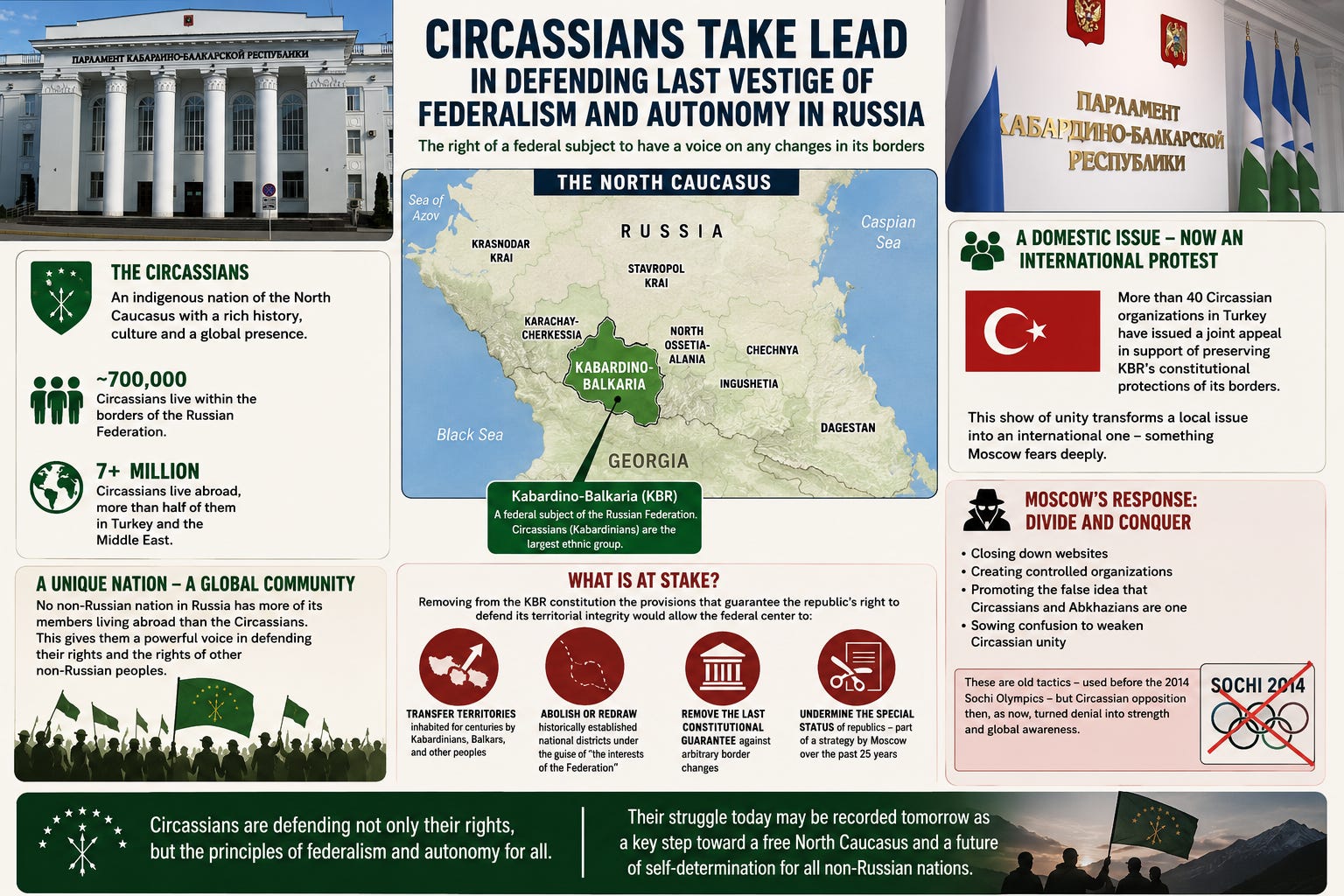
Even though they do not have a republic of their own, the Circassians both in the North Caucasus and in the diaspora communities abroad have now taken the lead in defending one of the last vestiges of federalism and autonomy in Russia: the right of a federal subject to have a voice on any changes in their republic's borders. The Circassian effort, as impressive as it is, almost certainly will not prevent Moscow from eliminating provisions protecting the rights of the people of Kabardino-Balkaria to control their own borders; but it will simultaneously help mobilize the Circassian people in that federal subject and more generally and prompt other national movements to take up this cause, a development that Moscow fears more than the actions of any republic or region by itself.
Because of such fears about this move and others suggesting that the Circassian national movement is once again on the rise, Moscow has drawn an old arrow from its quiver and sought to undermine that movement by sowing confusion among the 700,000 Circassians who live within the current borders of the Russian Federation and the more than seven million who live abroad, particularly those who live in Turkey and the Middle East.
In early June, ten leading opposition figures in Kabardino-Balkaria, most from the dominant Kabardinian (Circassian) portion of the population, issued an appeal to the KBR parliament to reject a call by the republic procuracy to take out of the republic constitution all references to the right of the republic and its people to guarantee the territorial integrity of Kabardino-Balkaria after the Moscow-imposed KBR agreed to do just that. Moreover, the declaration specifies that “the decision adopted by the Parliament is deeply flawed and poses a danger to the future of the Kabardino-Balkarian Republic as a constituent entity of the Russian Federation. We insist on preserving the constitutional guarantees of the republic’s statehood and territorial integrity.”
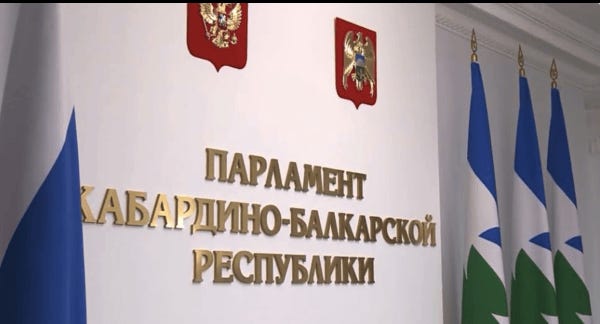
Further, it declared that: “while the President of the Russian Federation ensures the territorial integrity of the Russian Federation as a unified federal state, this does not preclude constituent entities from enshrining guarantees of their territorial integrity—as an integral part of the unified state—within their own constitutions.” And because that is the case, the ten continue, “removing the provisions establishing the principle of territorial integrity from the Constitution of the Kabardino-Balkar Republic is the most destructive aspect of the proposed amendments. If the provision regarding the inviolability of the republic’s territory is eliminated, the federal center would gain the legal authority to alter the republic’s borders unilaterally.”
“Such a turn of events could lead to the following consequences,” they point out, including the transfer of territories—inhabited for centuries by Kabardinians, Balkars, and other peoples—to neighboring constituent entities of the Russian Federation; the abolition or redrawing of historically established national districts under the guise of ‘the interests of the Federation;’ and the loss of the republic’s final constitutional safeguard against arbitrary changes to its territorial structure at the discretion of the federal center.” And they conclude with the following two points: On the one hand, they say, “we cannot allow the Basic Law of Kabardino-Balkaria to remain silent on the issue of the inviolability of the republic’s territory. This is not a matter of legal technicality, but a question of the republic’s very existence as a national-territorial community.” And on the other, they note, “the intention to remove the aforementioned provisions from the Constitution of the Kabardino-Balkarian Republic (KBR) is not an isolated event but part of a systematic effort by the federal center aimed at dismantling the special status of the republics within the Russian Federation—a strategy observed over the past 25 years.”
They were quickly joined in this protest by the leaders of more than 40 Circassian organizations in Turkey, something that has transformed a small domestic problem into an international one and made the Circassians the leader of this resistance. In a sign of just how worried Moscow is about this, the original webpage that included these declarations has been taken down; but a discussion of the content of their appeals can be found here.
No non-Russian nation within the Russian Federation has more of its members living abroad than the Circassians, and none can so quickly mobilize their co-nationals abroad when Moscow violates their rights or the rights of other non-Russians within the current borders of the Russian Federation. Indeed, this foreign base of support gives the Circassians a far greater ability to defend themselves and advance not only their causes but those of other non-Russians, a major reason why the Circassian nation could very well be among the first to escape Moscow’s control as the disintegration of the Russian Federation continues. (For a discussion of that possibility, see this author’s argument at Window on Eurasia, Dec. 1, 2024.)
Outlook
Given what is at stake, it should come as no surprise that Moscow has responded to this development and other signs of growing Circassian activism by closing down websites that carry the Circassian message. It has also revived one of its tried-and-true tactics of sowing confusion in the midst of both by setting up new organizations and media outlets that seek to undermine Circassian unity.
Once again, the Russian security agencies have sought to promote the idea that Circassians and Abkhazians are one people—an idea without historical foundation that knowledgeable Circassians reject but that enough Circassians may find persuasive enough to undermine opponents of that idea and alienate other non-Russians from them. That conclusion is strongly supported by the fact that, in recent weeks, Moscow has once again enlisted many of the same people it used before the 2014 Sochi Olympiad to undermine Circassian opposition to staging the international competition on the site where Tsarist forces carried out a genocide of the Circassians. In doing so, it has compounded the insult on the 150th anniversary of that horrific event. (The author is indebted to the distinguished Circassian historian Adel Bashqawi for calling his attention to this repetition).
Moscow was not able to derail Circassian opposition to the Sochi Olympiad; and most observers would agree that Putin’s decision to hold the games on these blood lands backfired badly on the Kremlin. It also allowed the Circassians to gain influence not only among other non-Russians inside the current borders of the Russian Federation but also among governments and experts in the West. What is now happening in Kabardino-Balkaria may lack the same drama in the short term, but it could well be recorded as an important step toward the restoration of a Circassian republic in the North Caucasus and the emergence of other non-Russian states that will no longer be under Moscow's control.
Thank you for your support! Please remember that The Saratoga Foundation is a non-profit 501(c)(3) organization. Your donations are fully tax-deductible. If you seek to support The Saratoga Foundation, you can make a one-time donation by clicking on the PayPal link below! You can also subscribe to our website to support our work.
https://www.paypal.com/donate/?hosted_button_id=XFCZDX6YVTVKA
Really eye-opening piece, and a great reminder of the multi-ethnic nature of the Russian Federation. Haven’t seen much analysis of the Circassian people, and their place in the Russian state in a long time.