
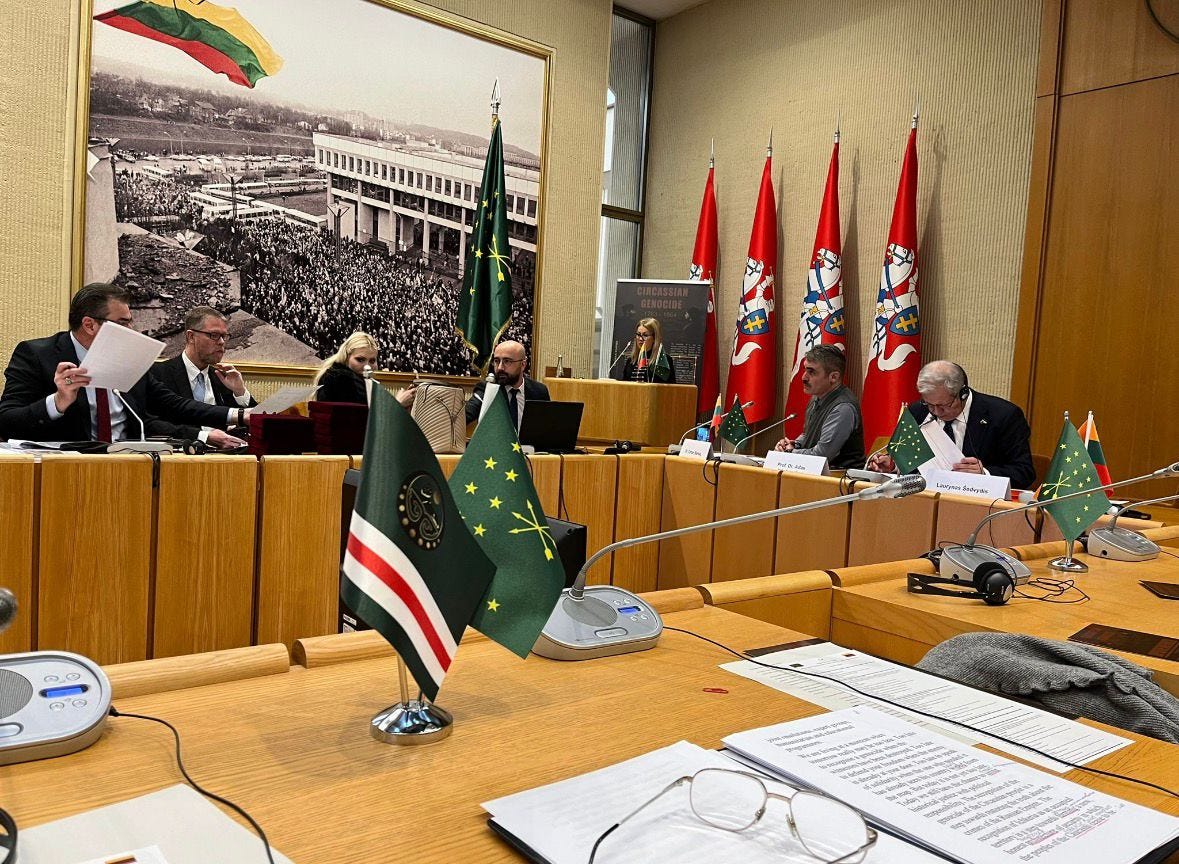
A December 2025 conference in Vilnius is proving to be a turning point in the history of the Circassian national movement, not only because representatives of the Circassian community met with parliamentarians of an EU and NATO-member country. Perhaps even more importantly, the meeting has become a model for Circassian efforts elsewhere to counter Moscow’s information war against their nation and to unify what is the largest and most divided people among the non-Russian nationalities whose homeland is inside the current borders of the Russian Federation.
If the symbolic importance of the Vilnius conference was recognized immediately not only by participants but by observers the practical impact of that meeting was not long in coming, with activists in yet another country – in this case, Azerbaijan -- moving to recognize the actions of the Russian state against the Circassians as an act of genocide and a prominent Circassian expert pointing to how the Vilnius meeting can help to unify the divided Circassian nation and show what needs to be done yet as that nation seeks to recover its rightful place in the world.
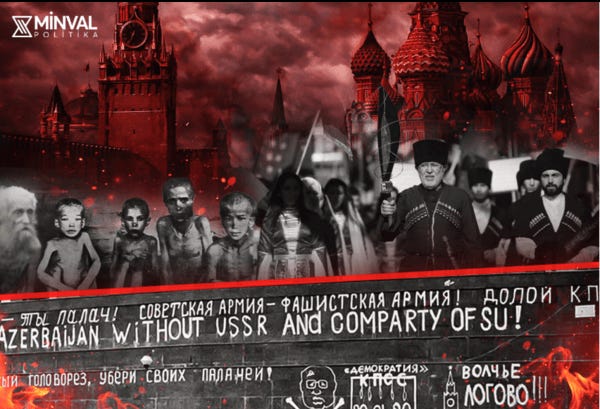
*Picture above is from the Azerbaijani website Minval and its discussion of the plight of the Circassians.
The holding of international conferences about the Circassian genocide has sometimes drawn criticism by a few because the events they focus on took place in the 19th century, even though the impact of those actions and new genocidal moves by the Russian state have taken place right up to the present. But the Vilnius meeting shows that such criticism is misplaced. Not only have two countries, Georgia and Ukraine, recognized Russian actions against the Circassians as genocides, but those recognitions have helped power the Circassian and other national movements inside the current borders of the Russian Federation.
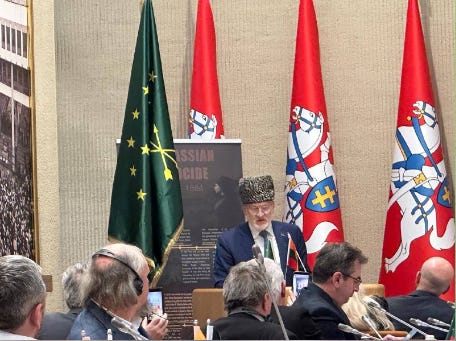
Chechen Opposition Leader Akhmed Zakayev in Vilnius
Instead, talking about the genocide in the case of the Circassians is a way of building bridges to other peoples who have been victims of Russian acts of genocide. Azerbaijanis would not have taken part in that meeting or spoken as they did about the Circassian genocide had they not experienced similar tragedies in their own national history. This demonstrates that Circassian activists who focus on the genocide are on the right track, and that their efforts create an opening for the Circassians to unite behind their cause with other nations that have suffered genocide, first and foremost at the hands of the Russian state, but more broadly as well. The implication is clear: this approach offers the Circassian movement a way to break out of the ghetto in which it has sometimes found itself and could prove even more powerful than the highly successful Circassian mobilization surrounding the 2014 Sochi Winter Olympics, which Moscow insisted on holding on what had once been the killing fields of its genocidal campaign against the Circassians.

Available for purchase 👉 here
The other lesson of the Vilnius conference was one that was drawn by Adel Bashqawi, a participant in that meeting, a distinguished historian of Circassia and the Circassians, and the irreplaceable editor of the essential website, Justice for the North Caucasus. In his remarks, which he entitled “Silencing the Circassian Exile, Bashqawi spoke about the way in which Moscow, before, during, and after the Soviet period, has worked tirelessly to keep the Circassians from uniting and speaking with a common voice to people of goodwill throughout the world.
Of all the victims of Russian imperialism, the Circassians have been the most divided, with 90 percent of their number expelled from their homeland by the original act of Russian genocide against them, and with the 10 percent who remain in the homeland divided as a result of Soviet ethnic engineering, which seeks to destroy the nation by dividing it into parts. Instead of a common Circassian nation, there are the Adygeys, the Cherkess, and the Kabards, who enjoy statehood of a kind, and other smaller groups who do not. In fact, they are all Circassians, but Moscow knows that if they come to understand that and develop the means to speak with one another, Russia’s oppressive regime in the North Caucasus will end.
Outlook
Russia has had an important advantage in its information war against the Circassians. Of the seven million abroad, many do not know Circassian but instead Arabic, Turkish, or other languages; and of the 700,000 in the homeland, while the three “recognized” nations speak mutually intelligible languages, they have been encouraged to think of themselves as different peoples. Eventually, one hopes that all the Circassians will be able to return to a restored Circassia and that they will develop the rich traditions of the Circassian language. But that is a long-term goal.
In the short term, something else is needed, something that is implied by Bashqawi’s words. What the Circassian movement needs now, as the meeting in Vilnius showed, is a common Circassian portal to which all Circassians can turn and then toggle between the languages they know today, the international languages others can use to learn about them, and the Circassia they will eventually recover.
Creating such a portal will not be easy – the tasks of compiling and editing it are enormous, and the translation tasks are not minor either – but this is the obvious next task for the Circassian national movement, one that if undertaken will drive the final nail into the coffin of Russian imperialism and the history of the genocides it has inflicted wherever it has ruled and will guarantee that the Circassians, their country and their language will flourish. Given what can be gained, as Vilnius has suggested, this is the task to which the Circassians and their supporters should now direct their efforts.
Thank you for your support! Please remember that The Saratoga Foundation is a non-profit 501(c)(3) organization. Your donations are fully tax-deductible. If you seek to support The Saratoga Foundation, you can make a one-time donation by clicking on the PayPal link below! You can also subscribe on our website to support our work.
https://www.paypal.com/donate/?hosted_button_id=XFCZDX6YVTVKA