
by Yuri Lapaiev
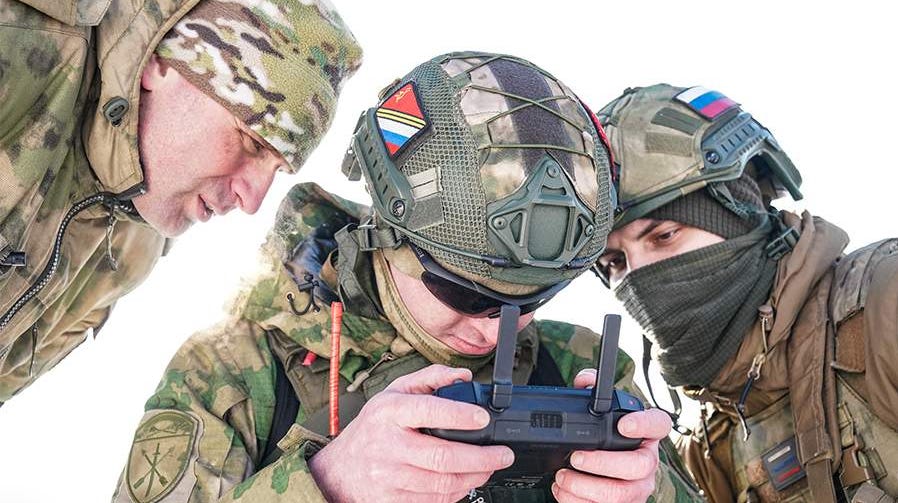
One of the enduring lessons of the Russia–Ukraine war is that battlefield advantage—and in some cases victory—can stem from an adversary’s ability to rapidly copy, adapt, and scale the most effective tactical or technological solutions of its opponent. This dynamic has been especially evident in the race to develop unmanned systems across the battlefields of Ukraine. The relatively low cost of Unmanned Aerial Vehicles (UAVs), the ease and speed of pilot training, and the precision of drone strikes have made these systems highly attractive, driving their rapid proliferation and encouraging the formation of specialized UAV units integrated into core military operations. Nowhere has this competitive adaptation been more visible than in Russia’s evolving approach to drone warfare, which initially mirrored Ukraine’s drone development but has since diverged in important ways.
The most elite and experienced units in the Russian military—special forces and airborne troops—were among the first to employ drones in combat. Similar to their use in Ukrainian formations, Russian units initially employed simple quadcopter First-Person View (FPV) drones equipped with explosive payloads. However, Russian forces reached a significant milestone with the development and widespread use of the Lancet loitering munition, which became one of their key strike systems used during their response to Ukraine’s 2023 counteroffensive, which initially proved to be highly effective. Lancet drones, in addition to their exclusively military significance, also served a propaganda function: the Russian Federation exaggerated the scale of production through selectively edited strike footage and visual effects, while omitting evidence of unsuccessful attacks.
The situation changed dramatically in February 2024, when the Armed Forces of Ukraine (AFU) announced the creation of its Unmanned Systems Forces (USF). Eleven months later, Russian Defense Minister Andrei Belousov reacted to this development by unveiling plans in December 2024 to establish a Russian analogue to the USF. By January 2025, the first specialized Russian UAV units had been formed, most notably the 7th UAV Regiment within the Central Military District. The regiment was expected to consist of approximately 1,300 personnel. It is organized into 102 reconnaissance and strike drone crews and is equipped with Lancet, Supercam, and Orlan-30 UAVs. The unit was officially presented to the Russian public on May 9, 2025, during Moscow’s annual Victory Day parade.
By November 2025, the Russian military had formally announced the creation of a new branch of the armed forces—the Unmanned Systems Forces—explicitly modeled on the Ukrainian example. Beyond forming combat units, the deputy commander of the new branch, Colonel Sergei Ishtuganov, also announced plans to establish a specialized higher military educational institution to train personnel to man these forces.
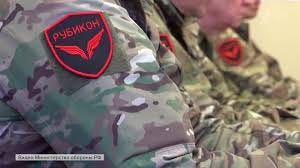
The Birth of Rubicon
At the forefront of Moscow’s most effective—and perhaps best-known—newly formed UAV units is the Rubicon Center for Advanced Unmanned Technologies. Established by order of Russian Defense Minister Andrei Belousov in August 2024, Rubicon was designed as a model elite unit while also serving an experimental role. As a result, it is staffed primarily with the best specialists in their respective fields and receives preferential funding compared to other units of the Russian Armed Forces. The Center also appears to employ modern, business-style project management practices rather than what exists within the traditional Russian military bureaucracy, which tends to hinder development. Just the opposite has occurred within Rubicon. Its units operate much faster in adaptation and are more innovative than other units of the Russian army.
According to investigations by journalists and OSINT specialists, one of the possible locations for the Center is the Patriot Congress and Exhibition Center in the Moscow region. The location was identified thanks to a video by well-known Russian propagandist Vladimir Solovyov. Hall D and part of Hall C of the Patriot Exhibition Center, located in the southern part of the complex, have been allocated for the Rubicon Center. At the same time, it cannot be ruled out that the location was deliberately shown in order to mislead Western experts about the actual whereabouts of the Center.
A key factor driving Rubicon’s success is its doctrinal emphasis on integrated drone warfare and advanced operator training. Beyond conducting combat missions, Rubicon instructors disseminate advanced UAV tactics across other Russian units, accelerating force-wide adaptation. The Center is also prioritized for access to the latest equipment and emerging technologies—particularly systems incorporating artificial intelligence and machine vision—many of which are experimental platforms used to test concepts and refine tactics before broader scaling.
Rubicon’s advantages include its elite status, direct subordination, operational flexibility and independence, business-style approaches to project management, strong financing, and superior provision of personnel and equipment. In addition, it functions as a showcase state Russian project, and a personal initiative of Defense Minister Belousov, who—following scandals associated with his predecessor, Sergei Shoigu—has sought a clear success story; and the rapid growth of Rubicon has provided him with one.
Rubicon’s activities extend beyond UAV systems. The Center maintains a specialized department dedicated to the development of Uncrewed Surface Vessels (USVs), comparable to Ukraine’s Magura and Sea Baby maritime drones. Russian USVs first appeared publicly during the July 2025 July Storm naval exercises in the Baltic Sea, and in August 2025, a Russian USV was used to strike a Ukrainian vessel on the Danube River, marking their operational debut.
Equally important is Rubicon’s close cooperation with private defense manufacturers, mirroring elements of the Ukrainian innovation model. This partnership enables rapid feedback from the battlefield and the swift incorporation of design improvements. In parallel, Rubicon operates its own research and development division focused on enhancing drone effectiveness, integrating AI into control systems, and advancing robotics integration. The Center also studies the physiological and operational demands placed on drone pilots, to improve long-term performance while mitigating stress and other harmful effects on operators.
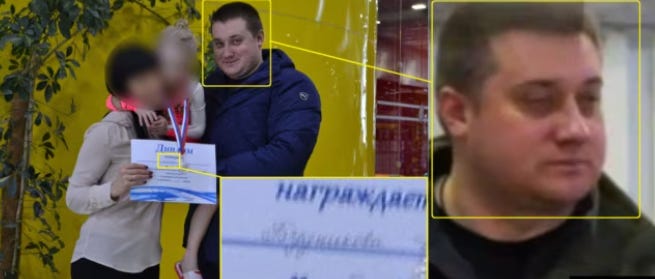
*Photograph of current Rubicon commander: Colonel Sergei Budnikov
Leadership
Little public information exists on the leadership of Rubicon. According to Russian media, the current commander of the Rubicon Center is Colonel Sergei Budnikov. His background is in the Russian artillery and naval infantry, and one of his primary responsibilities is integrating drone operations into conventional military forces. In the spring of 2025, there were seven publicly known Rubicon units, each consisting of approximately 130–150 personnel. By the fall of 2025, that number had expanded to 12 units, while overall personnel increased from an estimated 1,000–1,500 to approximately 5,000. Current Russian plans are to establish a Rubicon group within each military formation: North, Center, West, South, East, and Dnepr.
Each detachment within the unit has its own area of specialization, like aerial reconnaissance (Orlan, Zala, Skat, SuperCam), strike UAVs (FPVs, Lancet, Molnia, KVN etc), and anti-drone air defense. Although the structure of the Rubicon Center is fairly typical, its success is attributed to the support of its founder, Minister Belousov, and Evgeny Shmyrin (head of the Department of Prospective Interdisciplinary Research and Special Projects of the Russian Ministry of Defense).
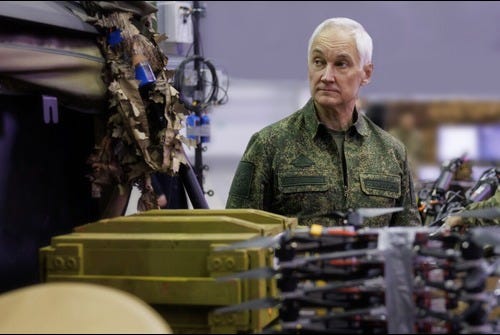
*Photograph: Founder of Rubicon: Russian Defense Minister Andrei Belousov
In addition, thanks to its subordination to the Main Directorate of the General Staff of the Russian Federation (formerly the GRU), the Center receives advanced technologies, increased funding, and up-to-date intelligence on the most important targets, as well as almost complete independence and autonomy in its actions. On the other hand, this model allows the Center to operate not only as a drone strike and reconnaissance force, but also as an intelligence - supported unit capable of rapid sensor - to - shooter cycles.
Rubicon’s high visibility inside Russia is attributed to the extensive attention it receives from the Russian media. The unit is extremely active in the information domain, maintaining its own Telegram channel where it publishes strike results and updates about the Center, while also using the platform for advertising and recruitment. In addition, the Russian information resource Lostarmour—which tracks and analyzes Ukrainian losses in the war. operates a separate section specifically dedicated to Rubicon, publishing data on the Center’s claimed damage and statistics. Rubicon’s media activity serves a dual purpose: supporting recruitment efforts and exerting psychological pressure on the Ukrainian military by cultivating the image of an omnipresent and highly dangerous unit.
Rubicon’s Role as Frontline Fire Brigade
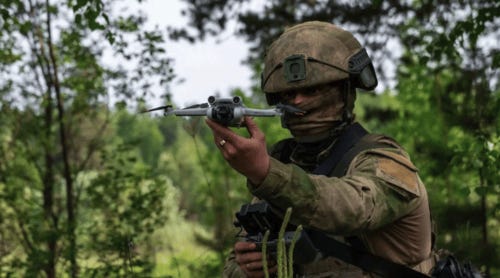
The main difference in Rubicon’s tactics is its focus on several key areas. The first is the destruction of Ukrainian UAVs (primarily strike and heavy bombers such as the Vampire, but also reconnaissance drones). Like the Ukrainians before them, the Russian command understands that clearing the airspace of enemy drones is critical to protecting personnel and equipment and, ultimately, to carrying out combat missions. The second is hunting down the crews of AFU UAVs. Training a truly experienced and effective pilot takes a long time, and unlike the drones themselves, they cannot be quickly replaced. Therefore, the loss of drone pilots is a key factor for both sides.
But the most painful thing for the AFU was Rubicon’s focus on cutting off Ukrainian logistics. The Russian tactic was to flank the AFU units to form a semi-encirclement with one or two accessible logistics routes. Each of these routes was taken under fire control by Rubicon’s UAV crews. This strategy used by Rubicon is similar to the use of artillery for fire control, but it provides more accurate strikes and, with effective reconnaissance, almost immediate conducting of the “detection-attack” cycle. This makes it virtually impossible to deliver supplies and reinforcements to frontline Ukrainian units, as well as to evacuate wounded soldiers or damaged equipment to the safe zones. The first place Rubicon utilized this tactic was during its deployment during the Russian counteroffensive in the Kursk region last year. At that time, Rubicon managed to practically cut off the main Ukrainian transport artery between Yunakivka and Sudzha, which was used to supply and evacuate Ukrainian forces operating in the Kursk region. Rubicon’s successful use of these tactics was one of the main reasons for the withdrawal of Ukrainian forces from the region.
Following its successes in the Kursk direction, the Russian high command extended this tactic to other critical areas of the Ukrainian frontlines by utilizing Rubicon as a form of rapid response fire brigade. For example, Rubicon is currently attempting to cut off the critically important Izyum-Slovyansk highway, which is one of the main supply routes to Ukrainian forces in Donbas. Rubicon’s units have also begun operating in the Kupiansk and Pokrovsk directions. Since May 2025, Rubicon has been operating mainly in the Donetsk region, supporting the Russian Federation’s offensive in the Pokrovsk-Kostiantynivka area.
Rubicon’s drone crews have also been spotted in the Kupiansk, Lyman, Sumy, Novopavlivka, and Zaporizhzhia areas as they extend their operational capabilities against the Ukrainian frontlines. The geographical scope of the divisions’ drone warfare activities is likely expanding in line with the growth of the Center itself and the formation of new territorial units, as mentioned earlier. The probable goal is to transform the Center from being a “fire brigade” that is frequently transferred from one frontline area to another on request by Russian commanders, into a full-fledged structure able to simultaneously operate on all areas of the Russian frontlines.
Countering Rubicon
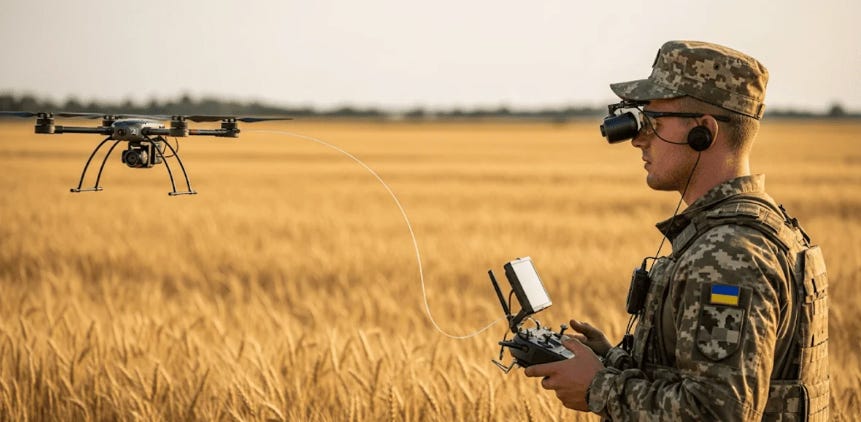
Rubicon’s effectiveness has not gone unnoticed by Ukrainian commanders and experts, many of whom have expressed serious concern about the unit’s operations. Among the recommended responses are a close study of Rubicon’s methods and the development of targeted countermeasures. Maria Berlinska, head of the Victory Drones project, which focuses on strengthening Ukraine’s Security and Defense Forces through technology, has identified three main steps to counter Rubicon's effectiveness. The first step would be to create specific, dedicated Anti-Rubicon units tasked with identifying and neutralizing Rubicon crews; second, the adoption of Rubicon’s most effective operational practices; third, the designation of personnel within each brigade responsible for collecting, refining, and scaling successful technological solutions. Some of this work is likely already underway, as reports have begun to emerge of Rubicon crews and command posts being destroyed by Ukrainian precision strikes.
At the same time, Rubicon appears to be encountering growing challenges related to its expansion, including potential shortages of qualified personnel, particularly in analysis and development roles. Sustaining the growth of an elite, high-technology unit also requires substantial and continuous funding. Moreover, the operational independence of Rubicon units may not be fully acceptable to more conservative Russian army or corps commanders with whom they must coordinate. Finally, Rubicon’s demonstrated effectiveness has made its crews and command posts priority targets for Ukrainian precision strikes.
Outlook
The Rubicon Center for Advanced Unmanned Technologies represents the cutting edge of Russian efforts to catch up to Ukraine in its innovative use of drones in the war following the Kremlin’s 2022 re-invasion. Moscow continues to professionalize, innovate, and institutionalize drone warfare. Russia’s drone arm has evolved from initial experiments with simple quadcopters to the use of sophisticated platforms like the Lancet, Supercam, and Orlan-30. Rubicon has made significant strides by combining elite personnel, cutting-edge AI-enabled systems, and business-style project management to accelerate adaptation and battlefield effectiveness. Its role extends far beyond combat operations to training, doctrinal development, R&D, and integrated use of USVs in its recent drone attacks on the Danube.
Despite operational successes, including disrupting Ukrainian logistics and neutralizing opposing UAVs, Rubicon faces challenges in sustaining rapid expansion, ensuring adequate skilled personnel, and mitigating vulnerabilities to Ukraine’s increased use of precision strikes to neutralize its effectiveness. Looking ahead, Rubicon is poised to evolve from its former role as a frontline fire brigade into a permanent, multi-domain force capable of operating simultaneously across all of Russia’s operational sectors in its ongoing war against Ukraine. Its true test will be whether it can fully integrate into the broader Russian military—initially skeptical but increasingly recognizing Rubicon as a frontline necessity.
About the Author
Yuri Lapaiev is currently the editor-in-chief of Tyzhden (The Ukrainian Week) magazine. He graduated from the Ivan Kozhedub Air Force University in Kharkiv with an MA in computer network engineering. Between 2006 and 2011, he served in the Ukrainian Defense Intelligence, including as an analyst. In 2011-2015, Lapaiev worked as a marketing analyst in the head office of one of Ukraine’s largest mobile operators. From 2015 to 2016, he served in the Ukrainian Special Operations Forces and participated in the Anti-Terrorism Operation (ATO) in eastern Ukraine.
Thank you for your support! Please remember that The Saratoga Foundation is a non-profit 501(c)(3) organization. Your donations are fully tax-deductible. If you seek to support The Saratoga Foundation, you can make a donation by clicking on the PayPal link below! Alternatively, you can also choose to subscribe on our website to support our work.
https://www.paypal.com/donate/?hosted_button_id=XFCZDX6YVTVKA
Thanks for reading! This post is public, so feel free to share it.