
By David Kirichenko
In recent weeks, Ukraine and Russia have traded strikes on one another’s data storage facilities. The damage to Russia, however, appears far worse due to its centralized infrastructure. Attacks on data centers are not a new phenomenon. In the early weeks of Russia’s full-scale invasion, Russian forces targeted a governmental Ukrainian data center, but Ukraine had already prepared for such attacks by backing up its critical data with the help of Western partners. Similarly, Iranian drones in the ongoing Gulf War have also targeted Western data centers, signaling that these attacks on IT hubs are becoming part of a broader trend in drone warfare.
On September 11, Russia hit a data center in Kyiv, and escalated again on September 23, as the Kremlin hit a few more Ukrainian data centers and internet providers in Kyiv. In addition to the capital, Dnipro and Odesa were also targets during these attacks.
Moscow’s strategy is to target civilian infrastructure and exert maximum pressure on the civilian population in the hope that Ukraine’s leadership will give up. “Throughout the full-scale invasion, Russia has repeatedly struck civilian infrastructure to pressure the population, trying to make normal life uncomfortable enough that people break. That strategy has failed so far, so Russia keeps looking for new pressure points,” said Dmytro Zhluktenko (callsign “Liber”), a former drone operator and now an analyst with the 413th RAID Unmanned Systems Regiment.
The “Digital Detox” Campaign
Meanwhile, the Russian Ministry of Defense has branded the data center attacks as a part of its mandatory “Digital Detox“ campaign by posting an image of an Iranian-designed Geran drone flying over a burning city. Over the coming months, Russia is expected to continue targeting Ukrainian data centers. The Kremlin started data center warfare, which has now exposed its vulnerabilities to centralization. “Two can play this game. We started hitting Russian centralized data centers in the European part of Russia,” said Zhluktenko. “That symmetry is the main reason for the spike in intensity.”
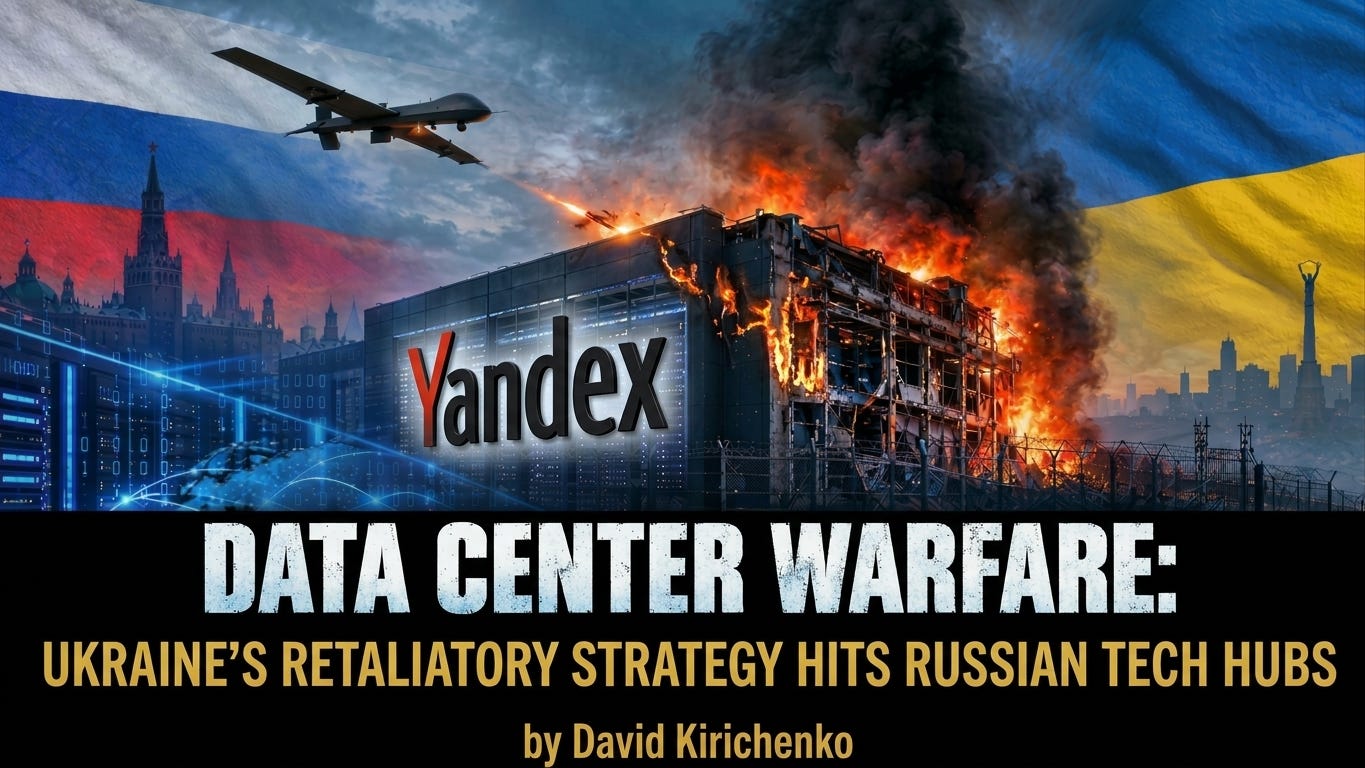
On October 8, Ukrainian drones struck a Yandex data center in Sasovo, in Russia’s Ryazan region. The facility reportedly houses two of the three supercomputers used to train Yandex’s AI models. Further strikes targeted Yandex facilities in Kaluga on October 9 and Vladimir on October 11. Following the Ukrainian drone attacks Russian business began complaining of losing access to online services, while Yandex fell 4% on the Moscow stock exchange. Yandex is extremely important to the IT sector because it accounts for 70% of the Russian search engine market. Yandex services across Central Asia were affected as well. “This war moved from a purely battlefield fight into an economic and industrial contest a long time ago,” noted Zhluktenko.
On October 11, Dima Pirogov, head of Yandex’s fintech division, published a statement on social media stating: “This morning, another Yandex data center—our services’ home—was damaged. Because of this, many of you still can’t check your balance, pay for a purchase, or transfer your money.” Fire Point, the Ukrainian defense company whose drones are being used to strike the data centers, trolled Yandex, writing, “Dima, have you tried turning it off and on again?”
On October 12, Yandex reported that its “Cloud platform is operating in a limited mode.” The Russian newspaper Kommersant indicated that it could take months to replace the data center equipment damaged by Ukrainian drones. “Yandex’s data centres and cloud services support a wide range of civilian and critical facilities, as well as countless small businesses that Russians rely on daily,” said defense analyst Olena Kryzhanivska and authors of the Ukraine Arms Monitor newsletter. “When they go down, delivery apps, taxi services and even Alice, Yandex’s voice assistant on smart speakers, stop working.”
According to Zhluktenko, who worked in the tech industry before the war, Ukraine’s internet is decentralized, with thousands of small providers and services distributed across different hosting companies. Since 2022, much of the country’s government and commercial data has been moved to cloud infrastructure abroad.
“Although the Russian strikes caused infrastructure damage, financial losses to companies and short-term internet disruptions for users, long-term service disruptions were avoided thanks to prior decentralization and the use of foreign infrastructure on which some of the servers are hosted,” said Serhii Kuzan, chairman of the Ukrainian Security and Cooperation Center.
Kateryna Chernohorenko, the former deputy minister of defense for digital transformation, noted Ukraine has already been moving more of its digital infrastructure underground to protect it from Russian attacks, but not everything can be moved underground.
Will Moscow Move its Digital Data Centers Offshore?
Russia, by contrast, has concentrated much of its infrastructure among a handful of domestic providers. “A system built so that a few nodes control everything is also a system where a few strikes break everything,” Zhluktenko said, underscoring that the strike on Yandex’s Sasovo facility disrupted services used by Russian Railways, MegaFon, and several media outlets. Western sanctions and global demand for AI hardware also make replacing damaged equipment difficult. “Centralization is a vulnerability you cannot patch quickly,” he warned.
Furthermore, bringing these facilities back online could be hampered by Western sanctions, according to Kuzan, who pointed out that “The restoration of damaged facilities is also complicated by sanctions restricting official supplies of modern server equipment, network components and Nvidia accelerators, which are required, in particular, for training neural networks.”
Kremlin efforts to control its society had led to greater centralization efforts, making the data center strikes more impactful for Ukraine, “Moscow has attempted to create its own ‘sovereign internet’, similar to the ‘Great Firewall of China,’ said Kuzan. “Federal Law No. 152-FZ requires that key operations involving the collection and storage of Russian citizens’ personal data be carried out using databases located within the country.”
Another outcome of the Ukraine drone strikes on the data center has been claims of Russian bot traffic falling off after the Yandex strikes. Ukraine in turn is actually implementing its own “digital detox” campaign against Russia. With the data centers being down, Russian bots reportedly have lost access to important Application Processing Interface (APIs) endpoints that help them translate and distribute mass propaganda, according to one analyst.
Meanwhile, Ukrainian President Zelensky also weighed in on the data center campaign, noting: “By the way, when we started responding to the Russian operation against our data centers, and when our strikes reached Yandex’s data centers, suddenly it became a little easier to breathe on many social networks.” He also noted: “Many people, a lot of people noticed this. And there was less hatred, less discord, and less provocations, because there were fewer bots. And it’s quite clear where these bots came from.”
Outlook
Similar to Ukraine’s drone strikes on the Wildberries warehouses, its recent attacks across Russia demonstrate the failure of the Russian state. In fact, Kryzhanivska believes the data center strikes have delivered a major blow to Russian digital sovereignty. “They show that the state has failed to protect its citizens from the spillover of a war it started,” noted Kryzhanivska. In a major admission of its own failure, she added that: “The Russian state was unable and perhaps even unwilling to defend these critical facilities, and it has largely shifted responsibility for protecting them and restoring operations onto Yandex itself.”
In May, the Carnegie Russia Eurasia Center highlighted that Russian businesses were increasingly being forced to pay for their own defenses against Ukrainian drone attacks. Russian President Vladimir Putin signed a decree in August allowing the government to temporarily take control of critical infrastructure operated by businesses that failed to protect their facilities as a result of Kyiv’s drone strikes. Consequently, Russia is also now considering the deployment of AI data centers in friendly countries, which would require a revision on current data restrictions.
Taken together, Russia’s data center war—a campaign that it started—has put the Kremlin on its back foot. As Ukraine’s symmetrical response inflicts greater damage, it is yet another sign that Putin’s invasion has been a disaster, and that the war’s fallout continues to be felt by an ever-increasing number of Russians.
About the Author
David Kirichenko is a Ukrainian-American freelance journalist who has been covering Russia’s full-scale war against Ukraine since 2022 and is an Associate Research Fellow at the Henry Jackson Society. He can be found on X/Twitter @DVKirichenko.
Thank you for your support! Please remember that The Saratoga Foundation is a non-profit 501(c)(3) organization. Your donations are fully tax-deductible. If you seek to support The Saratoga Foundation, you can make a one-time donation by clicking on the PayPal link below! You can also subscribe to our website to support our work.
https://www.paypal.com/donate/?hosted_button_id=XFCZDX6YVTVKA