
By Roza Bayramli
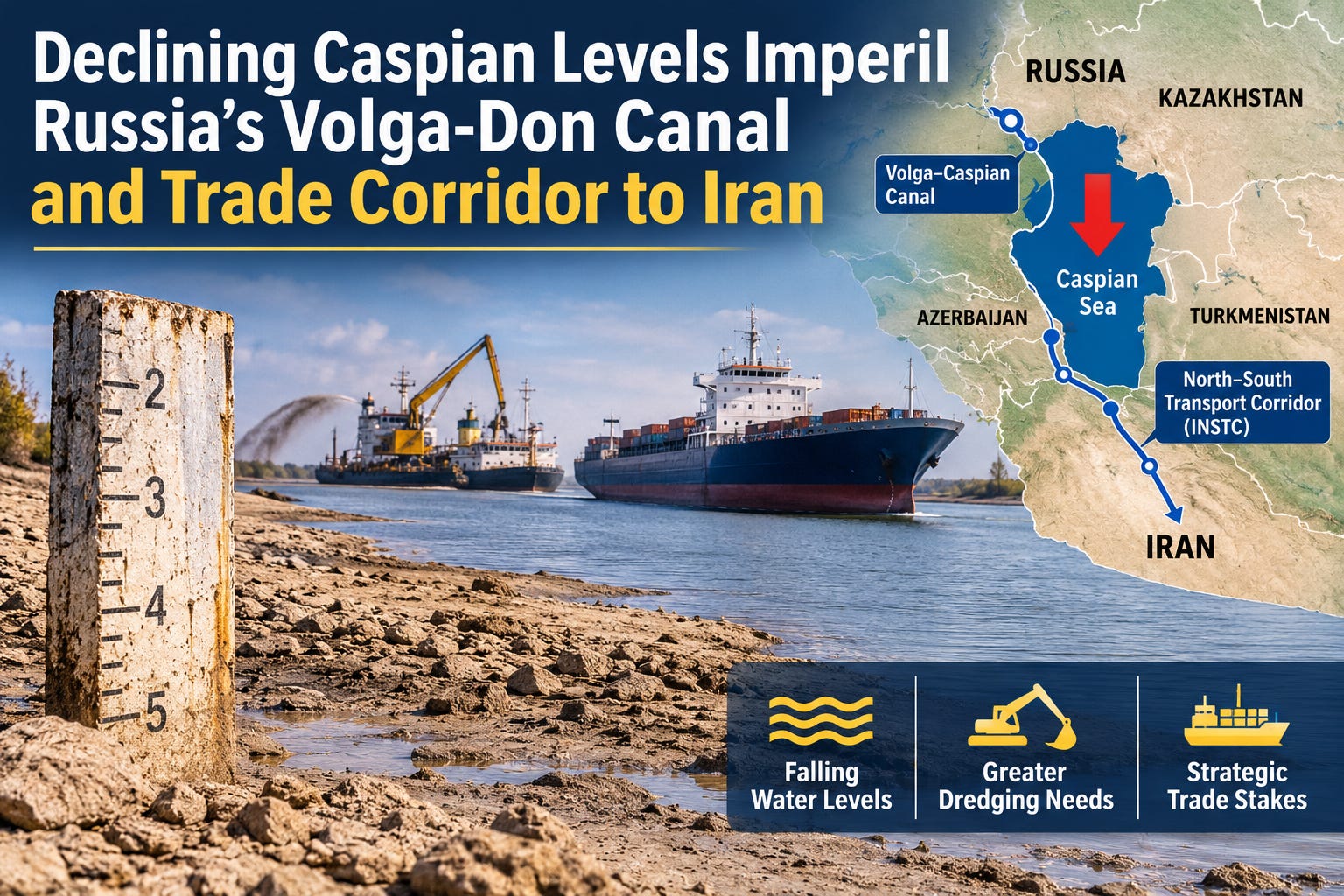
Falling water levels in the Caspian Sea challenge all five littoral states, but Russia is particularly vulnerable along its shallow northern coastline. Receding waters disrupt connectivity with Russia’s inland waterways while complicating Moscow’s broader push to deepen military and trade ties with Iran and reach other Eurasian markets. As Western sanctions make these southern corridors increasingly vital, lower water levels force costly dredging and tighten infrastructure bottlenecks, hindering efforts to maintain and expand transit links.
The declining Caspian Sea poses a particular challenge for Russian transport infrastructure, as key experts on Eurasia like Paul Goble have recently observed that siltification creates a major long-term problem for Moscow. These pressures come at a sensitive moment, when reliable access to southern markets has become increasingly important and as Moscow strengthens its trade and military ties with Iran through the ‘Caspian Express’ in an effort to assist its ally in the ongoing US blockade in the Persian Gulf. Meanwhile, the development of alternative transport routes across Eurasia is changing the regional environment in which Russia operates.
Russia’s Caspian Bottleneck
The Caspian Sea’s declining water levels are becoming a growing challenge for Russia’s maritime transportation network due to the hydrological challenge caused by declining water levels. For example, according to the OECD, sea levels fell by approximately 2.5 meters between 2006 and 2024. The consequences are particularly pronounced in the northern Caspian, where the average water depth is only 5–6 meters, compared with 192 meters in the central basin and 344 meters in the southern basin. These geographical differences make Russia’s Astrakhan port and the approaches to Kazakhstan’s maritime terminals especially vulnerable to declining navigable depths and increasing dredging requirements.
The Caspian Sea has experienced periods of decline and recovery throughout its recorded history. However, experts increasingly point to human activity alongside natural climatic factors as a major contributor to the current decline. The Volga River, which supplies most of the sea’s river inflow, is particularly important. Extensive agricultural water withdrawals, along with river regulation and reservoir operations in Russia, have also contributed to changes in the amount of water reaching the Caspian. Combined with rising temperatures and increased evaporation, these pressures have made the sea’s declining water levels a more persistent challenge. Despite repeated calls for more effective management of the Volga’s water resources, Moscow has yet to demonstrate a willingness to address the problem on the scale required.
The sheer magnitude of Russian intervention in the Volga River system is considerable. Eight major hydroelectric stations were built along the river during the twentieth century, creating a cascade of reservoirs that fundamentally altered its natural flow. Research indicates that the Volgograd Dam, completed in 1959, reduced peak discharge in the lower Volga by approximately 22 percent and changed sediment transport patterns, contributing to the silting of secondary channels downstream. Average Volga inflow into the Caspian subsequently declined by approximately 12 percent between 1991–2005 and 2006–2020, although this reduction reflects both climatic and human influences, including water withdrawals and river regulation. While determining the impact of damming to declining Caspian levels remains difficult to determine, Russia’s extensive modification of the Volga has contributed to the pressures now affecting its own maritime infrastructure and is in effect creating a self-inflicted wound on its navigation capabilities. In this respect, Moscow’s Caspian vulnerability is partly a consequence of its own water-management decisions.
The growing urgency of the problem prompted a major regional response at the first Caspian Environmental Summit in Avaza in October 2026, where the five littoral states agreed to establish a commission tasked with identifying the causes of declining sea levels and coordinating measures to address their consequences. First proposed by Azerbaijani President Ilham Aliyev in 2022, the initiative marks a step toward institutionalized cooperation, with the commission’s first meeting scheduled to take place in Azerbaijan in the first half of 2027. However, differences over the causes of the decline, particularly the human factor, could complicate efforts to translate this agreement into effective action.
The Volga-Don Canal and its Impact on Russia’s Caspian Connectivity
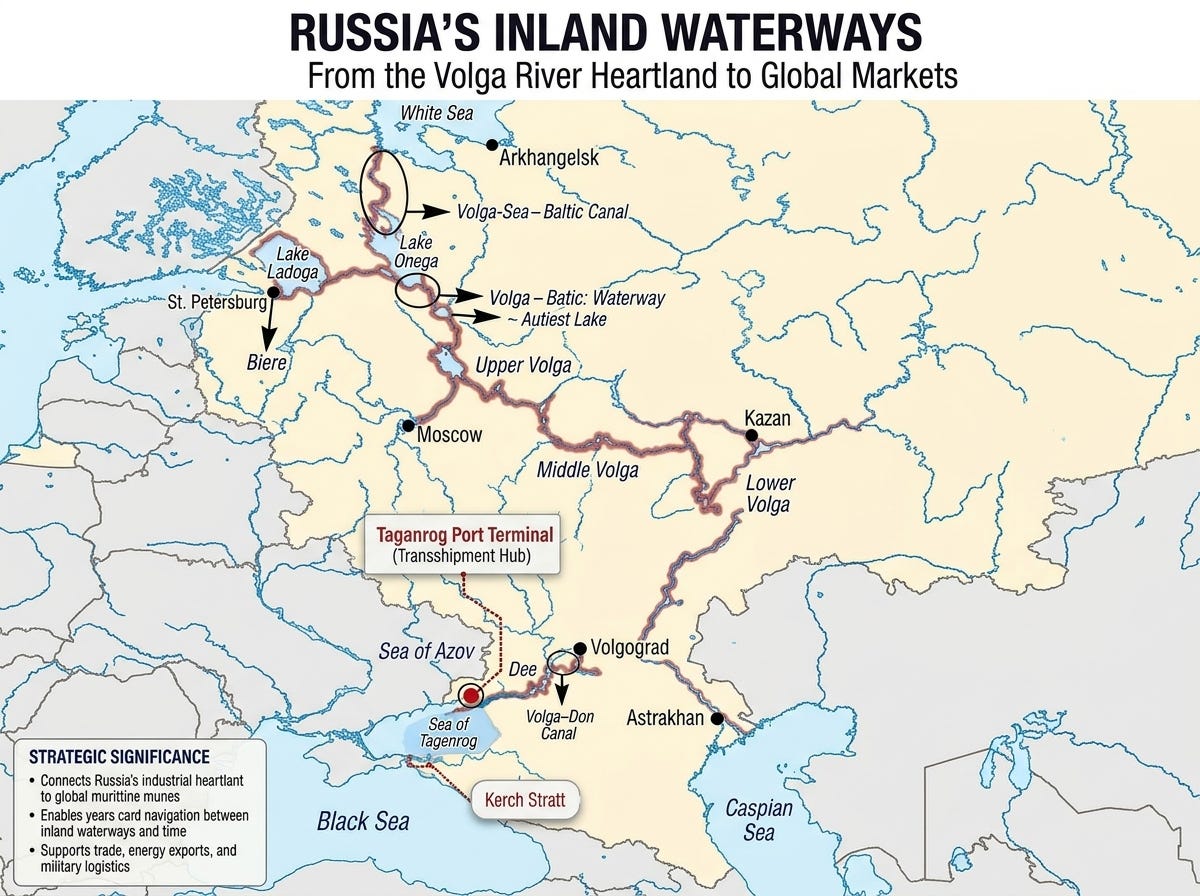
The Volga–Caspian Shipping Canal is particularly important in this discussion due to its strategic importance to Russia because it connects the Caspian Sea with Russia’s extensive inland waterway network. Through the Volga–Don Canal, this system also provides access to the Sea of Azov and the Black Sea, making it a highly important strategic component of Russia’s transport connections between its domestic regions and external markets. Consequently, any disruptions along the Volga–Caspian route could have major strategic repercussions beyond individual port operations, potentially affecting the reliability of a wider interconnected transport system.
These vulnerabilities became evident in June 2026, when navigation through the Volga–Caspian Shipping Canal was temporarily suspended between June 19 and 22. According to the Russian Ministry of Transport, sediment accumulation affected approximately 1.5 kilometers of the canal, following severe spring flooding, strong currents, and winds against the backdrop of declining Caspian water levels. Around 75 vessels were reportedly awaiting passage, while navigable depths in affected sections fell to 3.2–3.7 meters against a designed depth of 4.5 meters. Russia’s state-owned maritime infrastructure operator, Rosmorport, deployed seven dredgers to remove accumulated sediment, extracting more than 148,000 cubic meters of material from the affected section of the canal. Although navigation resumed, the incident demonstrated how environmental pressures and infrastructure constraints can disrupt a strategically important transport artery.
However, Russia also retains a strategic alternative in Makhachkala, its ice-free deep-water commercial port on the Caspian Sea, which benefits from more favorable navigational conditions than Astrakhan, even as aging infrastructure and transport limitations constrain its potential. More importantly, Makhachkala cannot replace Astrakhan’s direct connection to Russia’s inland waterways, leaving the broader Volga–Caspian transport system exposed to navigational disruptions.
For Moscow, the challenge is to keep its Caspian transport routes reliable and competitive at a time when Russia is becoming increasingly dependent on these corridors. As Western sanctions drive Russia to expand its trade with Iran, declining Caspian water levels and infrastructure constraints also complicate its efforts to maintain these existing routes and develop alternatives.
Iran and the Changing Dynamics of the North–South Corridor
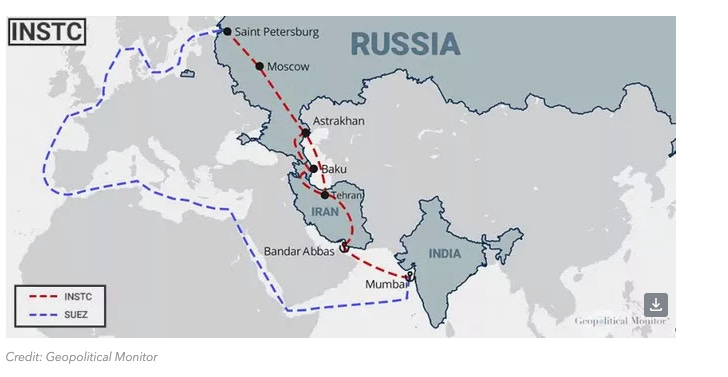
One of the strategic repercussions caused by the shallowing of the northern Caspian as a result of Russian damming on the Volga is its potential impact on the International North–South Transport Corridor (INSTC). Originally conceived to link Russia, Iran, and India, the INSTC has gained renewed importance as Moscow seeks access to markets in the Persian Gulf and South Asia in an effort to help Iran bypass the Strait of Hormuz.
The INSTC corridor comprises three principal branches: a maritime route across the Caspian Sea, a western overland route through Azerbaijan, and an eastern route through Kazakhstan and Turkmenistan. However, all three face infrastructure constraints and logistical bottlenecks that limit their efficiency and reliability.
Freight activity through the corridor in recent years has continued to grow. According to Russian Railways, rail freight volumes along the INSTC reached 8.9 million tons between January and September 2026, an increase of 9.6 percent year-on-year. The western branch through Azerbaijan recorded 9.2 percent growth, while the Trans-Caspian branch registered a 19.3 percent increase.
Yet expanding freight volumes do not necessarily mean that Russia has overcome the corridor’s structural limitations. The western route still lacks a continuous railway connection through Iran because the 162-kilometer Rasht–Astara section remains unfinished. In November 2026, Russia and Iran signed documents granting access to land for engineering surveys, although construction has yet to begin.
For Moscow, the expansion of overland connections offers greater flexibility, but their development remains dependent on infrastructure investment and cooperation with transit countries, including Azerbaijan.
The Changing Balance of Eurasian Transport Routes
The challenges facing Russia’s Caspian transport network are unfolding alongside a separate but equally significant development: the diversification of Eurasian trade routes. Azerbaijan occupies an important position in this changing landscape, serving both the western branch of the International North–South Transport Corridor and the Middle Corridor connecting Central Asia with Europe through Georgia and Türkiye.
This role is reflected in rising freight volumes. According to Azerbaijan’s Ministry of Digital Development and Transport, transit cargo exceeded 12 million tons in January–September 2026, reaching a five-year high. East–West transit increased by 20.2 percent, while North–South transit grew by 19 percent. Meanwhile, the Astara freight terminal in Iran, operated by Azerbaijan Railways, handled more than 631,000 tonnes, a 33 percent year-on-year increase.
The expansion of Azerbaijan’s transport infrastructure further strengthens its position. Container throughput at the Port of Baku reached 100,000 TEU in the first nine months of 2026, up 29 percent. Planned port expansion would increase annual freight capacity from 15 million to 25 million tons, while modernization of the Baku–Tbilisi–Kars railway has raised its annual capacity to 5 million tons.
Declining Caspian water levels have also prompted Azerbaijan to invest in maintaining navigable depths, particularly in Baku’s efforts to improve its maritime trade with neighboring Turkmenistan. In 2025, the Azerbaijan Caspian Shipping Company (ASCO) carried out more than 130,000 cubic meters of dredging using its vessels “Muhendis Balarza Memmedov” and “Narva”, including operations in Baku Bay and the approach channel to Baku Shipyard. Azerbaijan has also sought to expand its dredging capacity through the construction of a new CSD 650 vessel in cooperation with the Dutch company Damen, intended for use at the Port of Baku. These investments are important for maintaining safe navigation and supporting East–West trade across the Caspian, particularly as declining water levels create operational challenges for ports and ferry services connecting Azerbaijan with Turkmenistan. Azerbaijan and Turkmenistan have also discussed coordinating dredging and port development, particularly at Turkmenbashi, where declining navigable depths have already reduced ferry carrying capacity on the Baku–Turkmenbashi route.
These developments are particularly important for the Middle Corridor, which provides Central Asian countries with access to European markets without crossing Russian territory. According to the World Bank, coordinated investments and operational improvements could significantly increase trade along the route. Azerbaijan’s expanding infrastructure and participation in both East–West and North–South networks place it in a stronger position to benefit from the diversification of Eurasian trade.
The Broader Geopolitical Implications
Russia’s transport links remain important, with freight volumes along the North–South Corridor continuing to grow. Yet maintaining navigation in the Caspian Sea is becoming more difficult, while Azerbaijan and the Central Asian states are developing routes that bypass Russia. This does not mean Russian transit is losing its relevance, but neighboring countries now have more options.
Azerbaijan is particularly important for Moscow. Russia needs its cooperation to develop the western branch of the North–South Corridor, while Baku is also strengthening East–West connections between Central Asia and Europe. These two roles are not necessarily in conflict, but they give Azerbaijan greater freedom in its transport partnerships and could gradually limit Moscow’s influence over regional transport choices.
These connectivity developments are extremely important to the United States because they offer the Trump Administration an opportunity to strengthen economic connections across Eurasia without requiring regional countries to distance themselves from Russia. At the October 19 C5+1 ministerial meeting in Samarkand, US Secretary of State Marco Rubio emphasized the development of Trans-Caspian trade infrastructure as a priority for cooperation with Central Asia. The February 2026 US–Azerbaijan Strategic Partnership Charter identified the Middle Corridor as a priority, while the November 7 launch of trilateral US–Azerbaijan–Armenia technical planning groups on transportation and electricity transmission marked progress toward implementing the Trump Route for International Peace and Prosperity (TRIPP).
The next challenge is to turn these diplomatic commitments into practical results, particularly through improved customs procedures, stronger railway connections, and greater private investment in regional transport infrastructure. Such progress would give Central Asian countries more trade options while strengthening the US economic presence in the region.
Outlook
The coming years will test Russia’s ability to adapt its transport infrastructure to the changing conditions of the Caspian Sea. Declining water levels present a long-term challenge that cannot be resolved through emergency dredging alone. Maintaining reliable maritime access will require sustained investment, while developing alternative overland connections will depend on infrastructure improvements and cooperation with neighboring countries.
Growing freight volumes along the North–South Corridor suggest that demand for Russian transport connections will persist despite these challenges. Yet the expansion of East–West routes through Azerbaijan is giving Central Asian countries additional options without necessarily displacing Russian transit. Moscow’s longer-term position will therefore depend not only on maintaining existing infrastructure but also on its ability to compete within a more diversified regional transport network.
The Caspian Sea’s declining water levels will not remove Russia from Eurasia’s transport networks. They will, however, make it more difficult and costly for Moscow to sustain its southern trade connections. With Azerbaijan and Central Asian countries developing routes in several directions, Russia can no longer rely on its geographical position alone to secure its place in regional trade.
About the Author:
Roza Bayramli is a Senior Advisor of the Center for Analysis of International Relations and Multiculturalism (AIR Center).
Thank you for your support! Please remember that The Saratoga Foundation is a non-profit 501(c)(3) organization. Your donations are fully tax-deductible. If you seek to support The Saratoga Foundation, you can donate by clicking on the PayPal link below! Alternatively, you can also choose to subscribe to our website to support our work.
https://www.paypal.com/donate/?hosted_button_id=XFCZDX6YVTVKA