
By Andrew McGregor
Since French troops and business interests were expelled from France’s former colonies in the Sahel after a series of Russian-inspired anti-colonial military coups, Paris has sought means of restoring its status as an influential player in Africa. One route has passed through Nairobi, where French president Emmanuel Macron joined a summit of African political and business leaders in mid-May amid deepening military ties with Kenya.
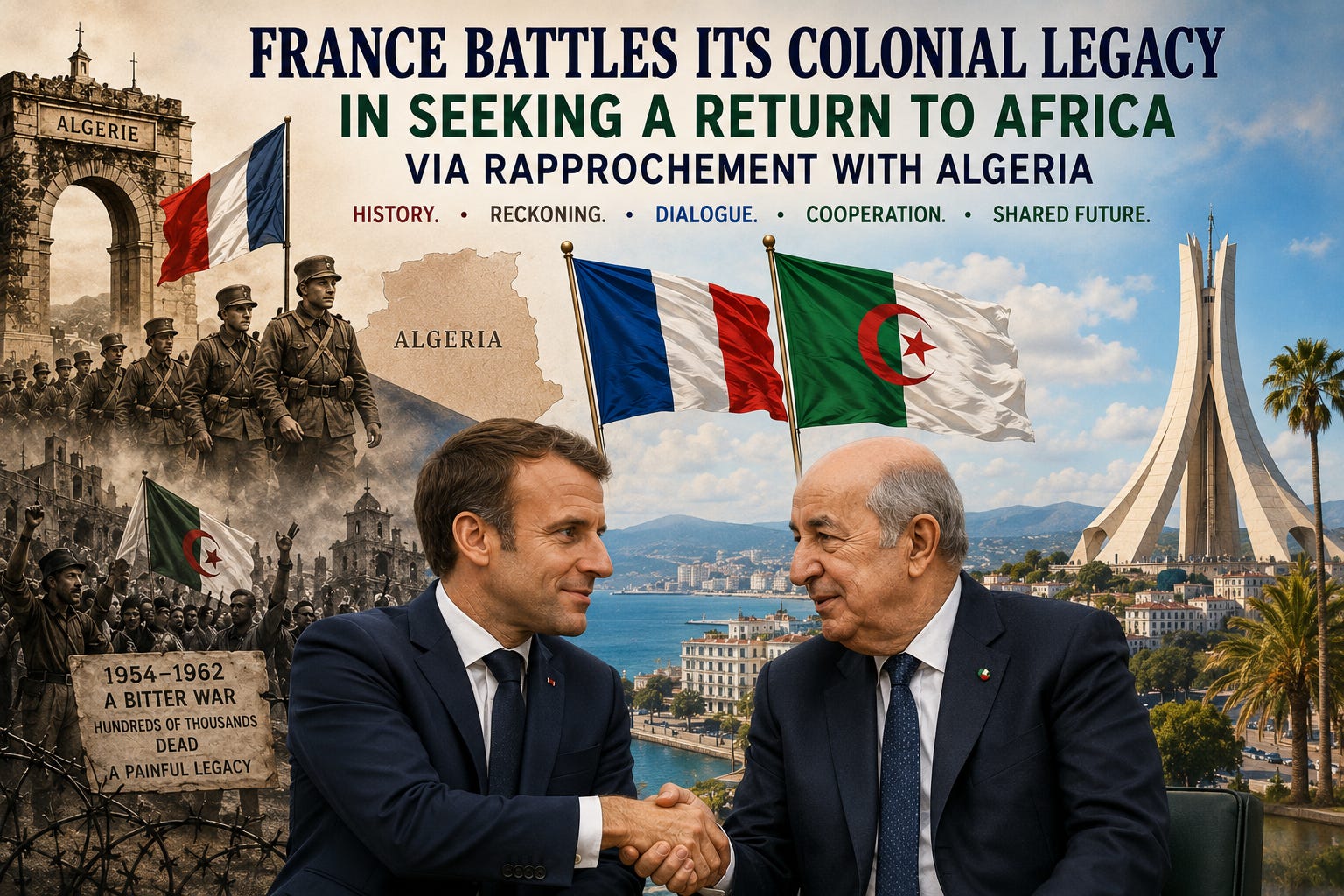
A second, more challenging path is represented by mutual efforts in recent months by both France and its former colony of Algeria to create a rapprochement after decades of hostility, efforts opposed by powerful political elements in both nations.
The Colonial Legacy
Algeria’s transition to independence was far from peaceful, with 132 years of French colonization coming to an end only after a bitter eight-year war (1954-1962) that finished with the death of hundreds of thousands of Algerians and the expulsion from the newly independent nation of French settlers (the pied-noirs) and Algerian collaborators with the colonial regime (the harkis). Algeria’s new regime perceived itself as a Marxist-influenced global center for anti-colonial ideology that had no place in its foreign relations for France, which had declared the integration of Algeria with mainland France as early as 1848.
Franco-Algerian relations, never good, were inflamed in July 2024 when France joined the US and Israel in recognizing Morocco’s sovereignty over the disputed former Spanish colony of Western Sahara, whose Polisario independence movement is supported by Algiers. After Algiers and Paris withdrew their respective ambassadors, Algeria’s National People’s Congress (the lower house of parliament) expressed its displeasure with France’s abandonment of its neutrality on the issue by passing a law in December 2024 decreeing French colonialism a “state crime,” with demands for an official apology and massive reparations.
In France, the education system has been instructed to emphasize the positive aspects of French colonialism, while Algerians frame attitudes to France through a lens of colonial repression, including massacres, summary executions, unwanted nuclear tests and the forced exile of dissidents from the homeland. These perceptions lay behind the Algerian legislation, which also called for the return of historical relics seized by French forces and the criminalization of “glorification” of French colonialism.
The French foreign ministry declared the legislation “manifestly hostile, both to the desire to resume Franco-Algerian dialogue and to calm, constructive work on issues of historical memory.” Conservative French senator Max Brisson rejected what he perceived as a narrowness of historical perception embodied in the Algerian legislation: “The Algerian regime may pronounce as many condemnations as it wishes - it will not erase history. That history has both its dark and its lighter chapters.” Macron made similar remarks in October 2016: “Yes, there was torture in Algeria, but there was also the emergence of a state, or wealth, of a middle class. This is the reality of colonialism. There are elements of civilization and elements of barbarism.”
By February 2017, Macron had changed his tone in remarks made in Algeria, asserting that French colonialism was “genuinely barbaric,” constituting “a part of our past that we have to confront.” With the possibility of a mutually beneficial rapprochement with France looming, Algeria’s upper house, the Council of the Nation, approved a revised version of the legislation in March, dropping the demands for an apology and reparations. According to French foreign minister Jean-Nöel Barrot, what matters most is creating conditions in which France can neutralize drug traffickers, expel Algerians living in France illegally and create new markets for France’s powerful agri-food industry. Barrot, however, did not aid the cause of rapprochement when he reaffirmed his support for Moroccan sovereignty over its “southern provinces” (the Western Sahara) in May of this year.
Mutual Suspicion
Macron’s willingness to engage in a reconciliation process has something less than broad support within France and may be seen by some as a willingness to increase immigration from Algeria. Others suspect Algerian president Abdelmajid Tebboune of trying to create an ultra-nationalist base amongst the five-million-plus French residents of Algerian descent that would enable him to influence French foreign policy. Some Algerian leaders have suggested the French government’s concern over migration issues is a craven attempt to gather domestic political support and appease the French right. Algerian authorities are also troubled by France’s role as a host for Algerian opposition figures as well as fugitives who have absconded with state funds and property obtained through administrative corruption.
A February visit to Algiers by French interior minister Laurent Nuñez led to the reactivation of a dormant framework for security coordination, including cooperation in intelligence matters and the delicate question of repatriating illegal migrants. Counterterrorism coordination was a special feature of the talks, with Algeria sharing a border with Niger and Mali, Sahelian nations that recently expelled French forces fighting Islamist extremists in favor of Russian troops acting under the direction of the Russian Defense Ministry. Two more French ministers have made visits to Algiers in recent months, and French ambassador Stéphane Romatet returned to Algiers in May.
French attitudes towards the rapprochement fall into two camps: the “pragmatists” who favor improved relations with Algeria (as represented by President Macron and his ministers) and the “power struggle” camp (represented by opposition leaders like Bruno Retailleau and Jordan Bardella), who have accused the Macron government of “incredible naiveté” in its dealings with Algeria. The growing rapprochement was described in the Algerian press as the “softening of relations between Algiers and Paris after a long period of freezing fueled by the racist and xenophobic discourse of a part of the French political class.”
Despite this “softening of relations,” Algiers has implemented new policies designed to eventually remove Algeria from the French cultural orbit. Algerian schools have reduced the time spent in class learning French in favor of English language instruction. Last year, for example, English replaced French in Algerian medical schools. The number of students learning French is in steady decline, as government-controlled agencies have switched to the use of Arabic and English in their documents. Le Monde notes that Air Algérie and Algérie Télécom have switched to the use of English and Arabic rather than French for tickets, billing, and receipts. Both are state-owned entities.
This development appears to be part of a gradual transition away from French in education and administration that has not yet been accompanied by any official decrees regarding a full-scale shift to English. The reasons for a gradual rather than abrupt and disruptive switch to English are described by an Algerian researcher as part of a deeper struggle over Algeria’s postcolonial identity, global integration, and the politics of language.
Conclusion
The leaders of both nations have come to the conclusion that a state of permanent estrangement benefits neither. The role of history in defining the quality of Franco-Algerian relations is so vital that Macron created a joint commission of French and Algerian historians to examine historical memory and commissioned a report by historian Benjamin Stora in 2021 to help guide attempts to build a new relationship, a recognition that the course of the present and future cannot be determined without acknowledgement of the burden imposed by history.
It is difficult for both Paris and Algiers to allow their foreign policies to stray very far from public sentiment, which tends to be deeply entrenched in an historical interpretation of the desirability of improved relations. The Algerian regime has benefited in the past from strict adherence to an anti-colonial ideology while blaming Algerian misfortunes on an allegedly hostile France. This may explain the antagonistic approach to improving relations taken by the government-controlled Algerian press, even as diplomatic initiatives for improvement are underway. Elements of French media have also promoted an aggressive suspicion of Algerian motives, suggesting that an Algerian presence in France is tied to toleration of crime and disorder. For both Algeria and France, nothing can be achieved in terms of the sought-after mutually beneficial rapprochement without reference to a contentious past.
About the Author:
Dr. Andrew McGregor is director of Aberfoyle International Security, a Toronto-based consultancy specializing in the security issues of Africa and the Islamic world.
Thank you for your support! Please remember that The Saratoga Foundation is a non-profit 501(c)(3) organization. Your donations are fully tax-deductible. If you seek to support The Saratoga Foundation, you can make a one-time donation by clicking on the PayPal link below! You can also subscribe to our website to support our work.
https://www.paypal.com/donate/?hosted_button_id=XFCZDX6YVTVKA