
By Vasif Huseynov
The sixth Azerbaijan International Defence Exhibition (ADEX 2026), which opened at the Baku Expo Center on September 30 and lasts until October 2, was the largest in the event’s history. According to the Office of the President of Azerbaijan, 277 companies from 30 countries took part in ADEX 2026 and its sister event Securex Caspian. As many as 59 foreign delegations from 39 countries registered, and 14 countries set up national pavilions. Record demand for the event forced organizers to open an additional pavilion, and for the first time an entire hall was reserved for Azerbaijan’s own national exposition.
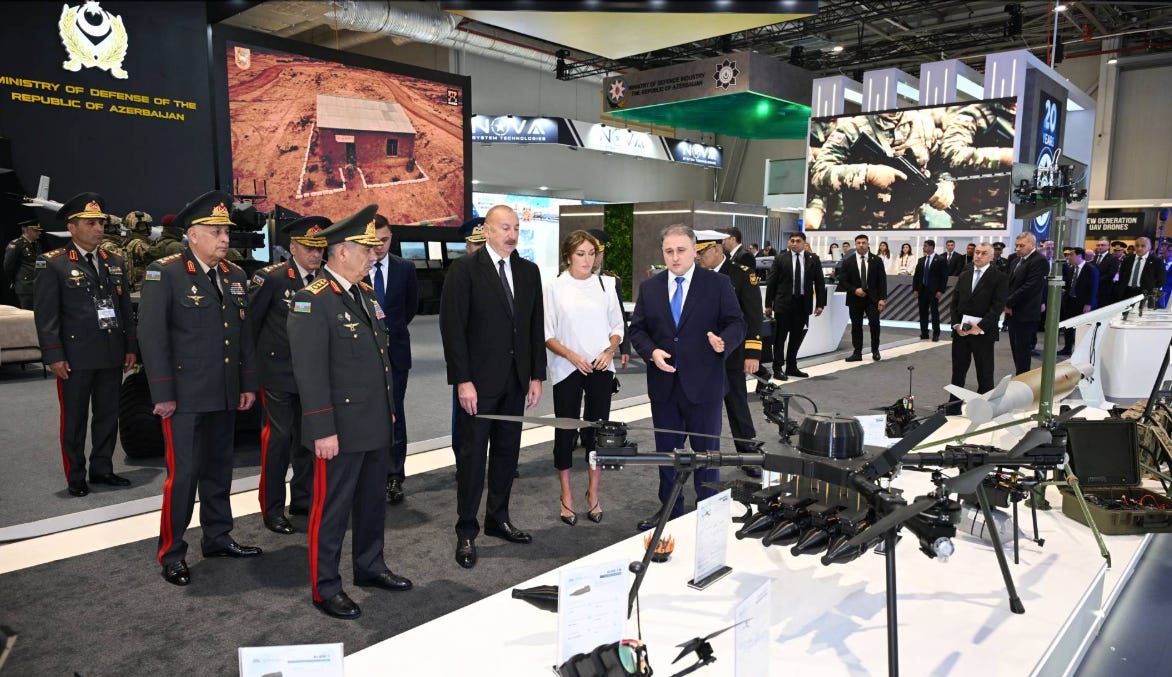
President Ilham Aliyev toured the exhibition on opening and was briefed by Defense Minister Zakir Hasanov and Minister of Defense Industry Vugar Mustafayev. In his address to the participants, Aliyev stated that the country’s defense industry “has now entered a qualitatively new stage” and that its products stand out for their competitiveness in international markets. The exhibition floor offered evidence for both claims, but it also carried a more pointed message about the future direction of Azerbaijani air power.
Defense Industry Consolidation and Expansion
The clearest change since earlier expositions was the weight given to Azerbaijan’s growing defense industrial capabilities. At the center of the national exposition stood Azersilah, the defense industry holding created under the Ministry of Defense Industry by presidential order in 2023. The presidential press service describes its mandate as organizing the production, sale, and export of weapons, expanding production capacity, and building international partnerships. Its consolidation of scattered state plants into one entity able to form joint ventures reflects a deliberate industrial policy rather than exhibition showmanship.
The second shift is the role of private capital. Speaking at the opening ceremony, Defense Industry Minister Vugar Mustafayev noted that more than 20 local private companies are presenting products at ADEX and that most of these firms already supply the Armed Forces, while several have begun exporting weaponry. He tied this directly to the lessons of the 2020 Karabakh War, arguing that a strong national defense industry cannot rest on state-owned enterprises alone and needs the flexibility and investment capacity of the private sector.
The product line on display follows those battlefield lessons. Azerbaijani media pointed to the locally built Tufan mine-resistant vehicle, the ITX-15 and ITX-20 armored personnel carriers, including Fireforce, described as the country’s first domestically produced air defense laser system. According to official information, Azerbaijan now produces more than 1,000 types of military products and exports them to over 30 countries. Several new systems made their public debut. Azersilah presented the MGK MK-82 “SkyDiver”, a 250-kilogram laser-guided bomb produced in Azerbaijan in 2026, as well as armed unmanned ground vehicles carrying remote weapon stations with heavy machine guns or grenade launchers, the “kamikaze robots” the Ministry of Defense Industry had announced ahead of the show. Domestic producers also unveiled the QIRAT and ARROW series of reconnaissance and kamikaze drones, while Bayraktar Teknoloji Azerbaijan, the local subsidiary of Baykar that began production in the Sumgayit Industrial Park in 2025, debuted the KASIRGA, a vertical take-off drone that can either strike as a loitering munition or return from a reconnaissance mission.
Baku’s Growing List of Foreign Defense Partners
The guest list at ADEX 2026 is itself a statement of Azerbaijan’s multi-vector defense diplomacy. Türkiye is the most widely represented country, with Baykar, Aselsan, Roketsan, and the shipbuilder Dearsan among the stands the President visited, according to the official account of the visit. The same account lists Israel’s IAI, Rafael, and Elbit Systems, Italy’s Leonardo, Germany’s Rheinmetall, the UAE’s EDGE Group, the Czechoslovak Group, Slovakia’s national pavilion, and the Pakistan Aeronautical Complex, which co-produces the JF-17 with China.
Two Western newcomers particularly stand out. Several prestigious American companies participated in ADEX for the first time, and the United Kingdom arrived with a Ministry of Defence stand that includes BAE Systems and a 14-company delegation from the Cambridge Chamber of Commerce. When President Aliyev received UK Minister of State for Defence Lord Vernon Coaker, he described defense industry cooperation as a new chapter in the bilateral partnership and raised the prospect of joint ventures in Azerbaijan, not just purchases.
The ADEX exhibition also produced several concrete agreements. Azerbaijan’s Defense Minister Hasanov and Haluk Görgün, head of Türkiye’s Defense Industry Agency, oversaw the signing of contracts with Turkish companies worth more than $500 million. The package includes 14 Hürkuş-II trainer aircraft from Turkish Aerospace, which Görgün said will begin arriving later this year, a purchase that matters for pilot training as the Air Force transitions to new combat jets. It also covers Baykar’s Mızrak smart loitering munitions and Antidot systems, Roketsan’s Barbaros coastal defense system, and a framework agreement on Aselsan’s ALP-100 radars.
Several deals went beyond mere procurement. Aselsan and the Azerbaijani company NOVASIS signed a term sheet to set up a production facility in Nakhchivan for laser guidance kits, TOLUN precision-guided munitions, and KORKUT air defense systems, while MKE, Otokar, Kayı Defense, and Boğaziçi Defense concluded cooperation agreements with Azerbaijani firms Miras and NOVASIS. Azerbaijan’s Ministries of Defense Industry and of Science and Education also signed a memorandum with Türkiye’s Defense Industry Agency and Council of Higher Education on joint training of engineers and research, alongside a separate memorandum on personnel training and technology for the defense industry.
The largest localization project announced at the show came from Central Europe. The Czechoslovak Group said it will form a second joint venture in Azerbaijan in December 2026 for the gradual local production of self-propelled howitzers, with manufacturing to start in 2027 and business worth €1.8 billion ($2.03 billion) over seven years. It follows VEXA DS, a venture set up earlier this year to repair and modernize armored vehicles.
Uzbekistan signed a Bilateral Military Cooperation Plan for 2027 with Azerbaijan the same day, with Defense Minister Shukhrat Khalmukhamedov signing on behalf of Tashkent. ADEX 2026 took place in parallel with the “Power of Unity 2026” joint exercise of Azerbaijan, Türkiye, and Uzbekistan, which opened on September 22 in the Karabakh region. According to the Ministry of Defense, its large-scale phase on October 1 involved 3,579 military personnel, 135 unmanned aerial vehicles, 27 aircraft, and 25 naval assets, and was monitored by observers from nine different countries, including Pakistan, Georgia, Iran, and the United Arab Emirates (UAE). The ministry described it as the first exercise of its kind and scale held on Azerbaijani territories liberated from Armenian occupation.
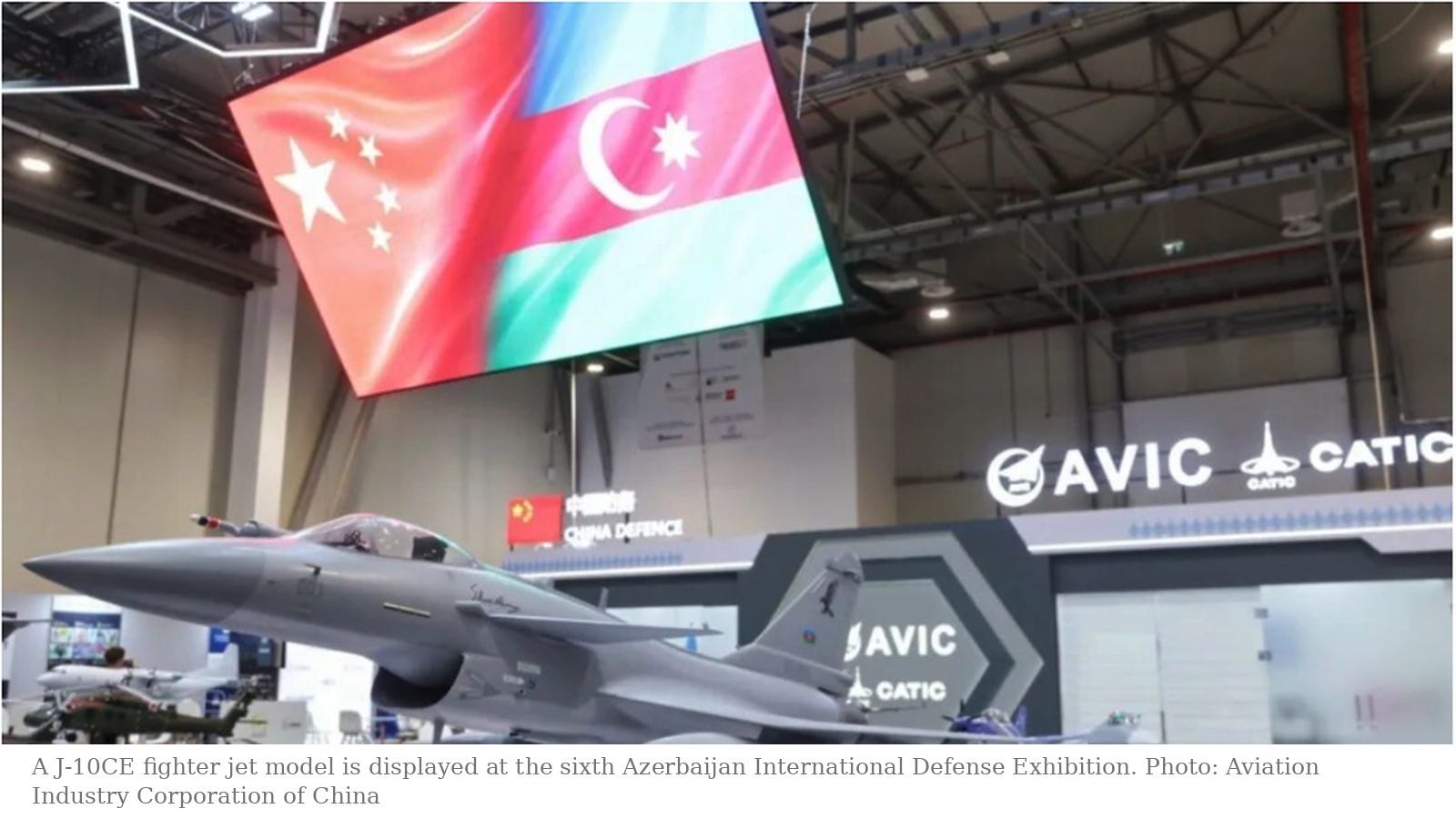
Baku’s New Jet Fighter: China’s J-10CE in Azerbaijani Colors
One of the most widely discussed objects at ADEX 2026 was the display of a full-scale model of the Chinese-made J-10CE fighter, the export variant of the Chengdu J-10C, which was displayed by China’s AVIC in Azerbaijani Air Force insignia. The presidential press service of Azerbaijan confirms that China National Aero-Technology Import and Export Corporation, AVIC’s export arm, is among the exhibitors.
The display did not come out of nowhere. In November 2024, Air Force Commander Lieutenant General Namig Islamzade inspected the J-10CE at the Zhuhai Airshow and met his Chinese counterpart; the Ministry of Defense reported that they discussed the state and prospects of military-technical cooperation between the two air forces. Since then, Baku has acquired the Chinese-Pakistani JF-17 Block III, and its neighbor Uzbekistan has publicly unveiled its own J-10CE into its air fleet. In late August 2026, Uzbekistan’s Ministry of Defense released footage of the jets, which it described as modern fighters guarding the country’s air borders, making it the aircraft’s second foreign operator after Pakistan.
The J-10CE would be a major qualitative improvement and sit above the JF-17 in Azerbaijan’s fleet, not replace it. Baku is already the largest export customer of the JF-17: the Government of Pakistan announced in June 2025 that Azerbaijan expanded its order from 16 to 40 aircraft in a deal valued at $4.6 billion. Moreover, in a sign of their military significance, the Chinese-made fighter jets flew over Baku in the November 2025 Victory Day parade.
A two-tier fleet of JF-17 Block IIIs and J-10CEs would give Azerbaijan its most capable air force since obtaining independence in 1991. The JF-17s would carry the bulk of routine air policing and strike missions at an affordable cost per flight hour, while a smaller J-10CE force would cover the JF-17’s weaknesses in speed, payload, and air combat. Operating two aircraft from the same Chinese-Pakistani industrial and weapons ecosystem, including the PL-15E and PL-10E missiles, would also simplify training, logistics, and munitions stocks.
The geography of that capability matters. With the Armenia-Azerbaijan peace process advancing, Baku’s air power planning is no longer framed solely by the South Caucasus. Azerbaijan’s energy platforms, pipelines, and the Middle Corridor ports on the Caspian Sea form some of the most valuable infrastructure in the wider region. Protecting that airspace requires fighter aircraft with the range and speed to reach threats quickly outside Azerbaijan’s national airspace. Moreover, the addition of the J-10CE fighters would be a meaningful step forward for Azerbaijan in obtaining regional air superiority over its sector of the Caspian.
Outlook
In conclusion, ADEX 2026 suggests that Azerbaijan’s defense industry is moving beyond its traditional role as a buyer of foreign equipment toward becoming a producer, exporter, and increasingly sophisticated partner in international defense cooperation. The financial commitment is quite robust: the draft 2027 state budget, for example, allocates 8.8 billion manats (about $5.2 billion) to defense and security, a 1.1 percent increase over 2026, and the Prime Minister has said these items will remain among the largest expenditures next year.
Should this trajectory continue, Azerbaijan’s defense industry will become an increasingly important component of its broader foreign policy and regional security posture, linking domestic production, military modernization, exports, and partnerships across the South Caucasus, Central Asia, Türkiye, Europe, and the wider Caspian region.
Author’s Bio:
Dr. Vasif Huseynov is the head of the Western Studies department at the Center for Analysis of International Relations and Multiculturalism (AIR Center) in Baku, Azerbaijan.
Thank you for your support! Please remember that The Saratoga Foundation is a non-profit 501(c)(3) organization. Your donations are fully tax-deductible. If you seek to support The Saratoga Foundation, you can make a one-time donation by clicking on the PayPal link below! You can also subscribe to our website to support our work.
https://www.paypal.com/donate/?hosted_button_id=XFCZDX6YVTVKA