
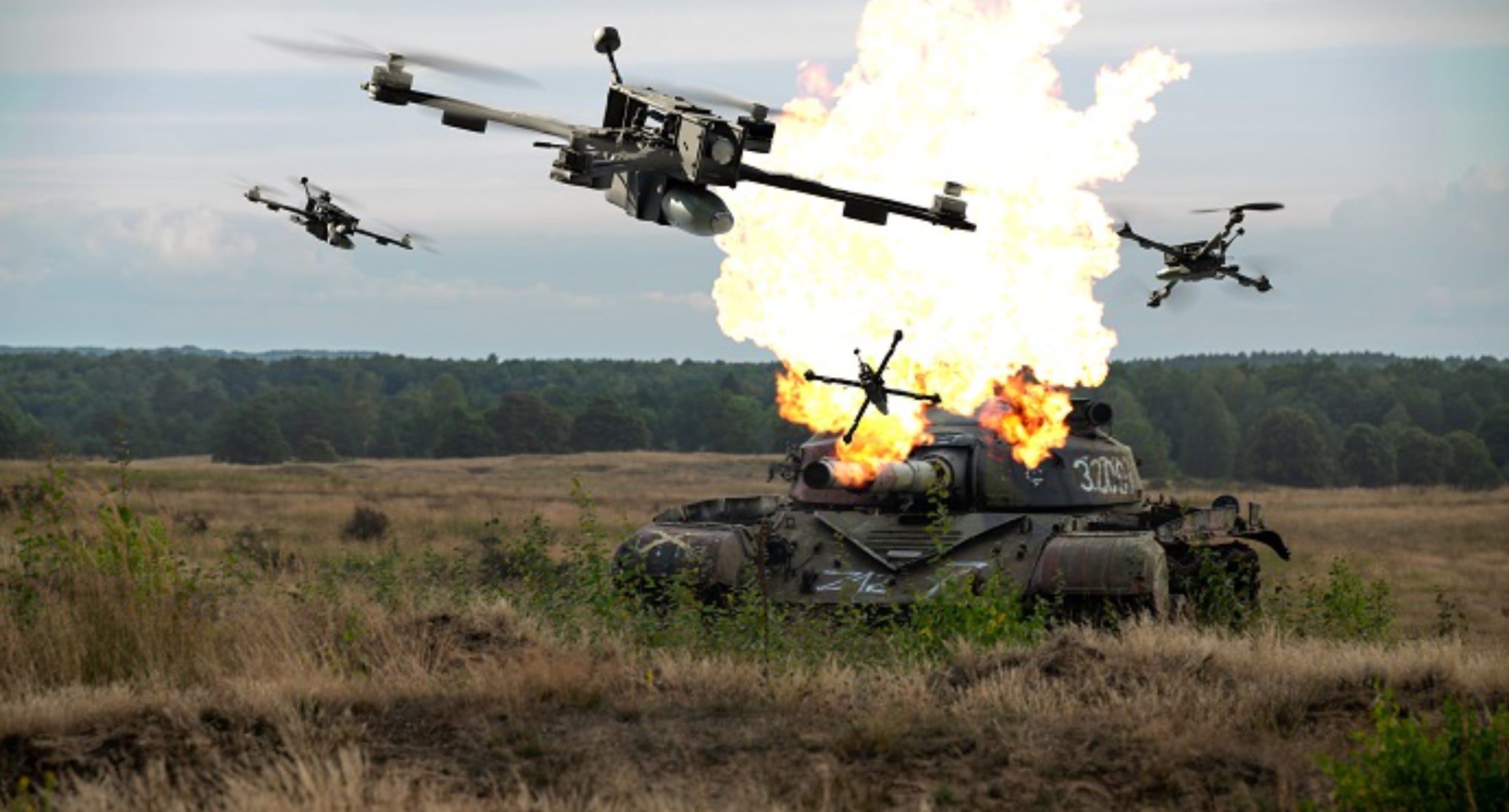
The war in Ukraine has evolved into a complex geopolitical conflict while demonstrating the transformative role that drone technology has played in shaping the course of the war. Following the Russian invasion of Ukraine in 2022, the Ukrainian Armed Forces began to actively embrace modern warfare technology, especially the use of First-Person Drones (FPVs) which were critical in inflicting grave damage on Russian forces using ‘meat grinder’ tactics to storm Ukrainian front line positions.
In the past two years, Ukrainian forces have used FPV drones for real-time intelligence and reconnaissance of Russian positions and troop movements while also deploying cost-effective “kamikaze” drones to target Russian recruits, tanks, howitzers, and other armored vehicles. Although drone technology is now a core part of Ukraine’s struggle against Russian intervention, Kyiv initially faced an acute shortage of unmanned aerial vehicles (UAVs) in the early stages of the war, while the requirements of its frontline forces were partially met by civilian drones, mostly produced by the Chinese company DJI. During that time China has risen to become the dominant force in the supply of low-cost commercial drones being supplied to the global market in the past two decades to use that leverage increasingly over the worldwide supply chain. According to some estimates DJI controls as much as 70 percent of the world’s global commercial drone market.
Following the Russian invasion of Ukraine in early 2022, Ukrainian officials became adamant about their need to purchase as many drones as possible on the global market. Former Ukrainian Prime Minister Dennys Shmyhal, for example, hoped that by 2023, his country could procure up to 60% of the world’s DJI Mavic production, a statement that was fiercely criticized by DJI as “overrated numbers.”
Ukraine’s purchase of Chinese drones in 2022 were described as no longer a systematic process, but a rather chaotic one in its race to acquire as many civilians drones as possible on the global market. Throughout 2023-2024, Kyiv purchased thousands of Chinese UAVs and components primarily through Western intermediary companies thanks to Chinese commercial exports to Europe. China’s close alliance with Russia and refusal to condemn Russian intervention in Ukraine created a rather tense diplomatic confrontation between Beijing and Kyiv over its acquisition of Chinese drones from third parties in Europe. During this time Ukraine and its Western allies frequently accused China of providing military-technical support to Russia and strategically significant “dual-use” technologies, such as semiconductors and drone engines.
China Tilts the Drone Divide
China halted its exports of DJI Mavic drones to Ukraine in May 2025, creating a major supply chain crisis after Moscow reportedly increased pressure on Beijing to “prevent its drones from being used in warfare.” an oblique reference to China’s role in shaping the drone dimension of the war. Chinese officials on the other hand publicly stated that it had stopped sending drones to both sides despite a vast amount of evidence that contradicted Chinese claims that it had suspended commercial drone sales to Russia.
Recently the drone divide between Ukraine and Russia has significantly widened. According to recent reports Chinese shipments of fiber-optic cables and lithium-ion batteries to Russia surged in the second half of 2025. This influx of supplies has boosted Russian production of fiber-optic drones and increased their capability to hit enemy targets 20-30 kilometers deep behind Ukrainian lines. The sudden surge in Chinese exports of fiber-optic drones have significantly undermined Ukraine’s ability to reinforce its frontline positions, particularly in the recent fighting around the besieged city of Pokrovsk in Donbas. Fiber optic drones are strategically important because they are almost impenetrable to jamming by Ukrainian electronic warfare (EW) systems,. The arrival of this new fiber-optic technology marks a significant stage in the use of drones to shape the battlefields of eastern Ukraine.
Ukraine’s Drone Dependence on China
Ukraine’s reliance on the import of Chinese drones and other technologies is not a new phenomenon, as currently it is virtually impossible to assemble a drone anywhere in the world unless it has some form of Chinese components inside. Moreover, the irony is that despite Beijing’s announced “neutrality” in the Russo-Ukraine War, China de facto remains a key actor, influencing the warring parties through its control over the military technology supply chains directed to the war. In this vein, Beijing likely estimates that it has the capability to alter the balance of power in the Russia-Ukraine war conflict by simply restricting the flow of drones and their components to Russia and Ukraine simultaneously.
Due to geographic and economic factors, both countries have a strong interest in each other’s survival. In addition, the protracted Russo-Ukraine war gives China room to blame Kyiv’s Western allies for dispatching weapons and military aid to support Ukraine. From Beijing’s perspective, the full-scale war in Ukraine is a “good case” to monitor the conflict and derive key lessons learned from the war while adhering to the view that a Ukrainian military victory over Russia will likely embolden its Western allies to turn their full-scale attention to China.
For this reason, China appears to have given tacit approval to Chinese national commercial drone manufacturers to help Russian UAV manufacturers expand their production and develop components specifically designed for combat applications against Ukraine. Unlike Russia, Ukraine’s drone industry remains constrained by its limited access to critical components and manufacturing capacity, making purchases from China vitally important. Notwithstanding the firm support of wealthy NATO member countries to give a battlefield advantage to Ukrainian forces, a significant portion of Ukraine’s domestic drone production still greatly depends upon Chinese components for its Unmanned Aerial Systems (UAS). Ukrainian data indicates that nearly 89 percent of its UAS-related imports by value were still originating from China in the first half of 2024 — a slight decline from 97 percent during the first year of the war. Hence, despite these efforts many Ukrainian drone factories continue to primarily rely upon Chinese drone parts in assembling their drones rather than produce the parts domestically.
Conclusion
In the current critical phase of the war Ukrainian efforts to develop its drone independence are becoming a critical test of its military resilience. The West’s continued support in purchasing Chinese drones without addressing Ukraine’s core supply chain vulnerabilities, runs the risk of strengthening the Russia-China alliance. Moreover, Beijing’s selective restrictions regarding FVP drones and components have largely bolstered Moscow’s drone capabilities and could ultimately change the course of the war in Russia’s favor.
Nowhere is this more visible than in the surge of Russian drone and missile attacks against Ukraine since 2024. The number of Russian strikes and Shaheed suicide drone attacks have more than quadrupled in 2025 against Ukrainian positions, armaments, and critical infrastructure due to the flow of Chinese drone parts. Consequently, as long as China maintains a decisive grip over the global drone supply chain, Kyiv’s battlefield effectiveness and the broader geopolitical balance will continue to hinge upon Beijing’s supply of dual-use components to each of the combatants.
About the Author:
Fuad Shahbazov is a political scientist and analyst focused on regional security in Eurasia and the Middle East. He holds a master’s degree in Political Science from Vytautas Magnus University, a professional master’s degree in Terrorism and Countering Religious Radicalization from the University of Bergamo, and a master’s degree in Defense and Diplomacy from Durham University.
Thank you for your support! Please remember that The Saratoga Foundation is a non-profit 501(c)(3) organization. Your donations are fully tax-deductible. If you seek to support The Saratoga Foundation, you can make a donation by clicking on the PayPal link below! Alternatively, you can also choose to subscribe on our website to support our work.
https://www.paypal.com/donate/?hosted_button_id=XFCZDX6YVTVKA