
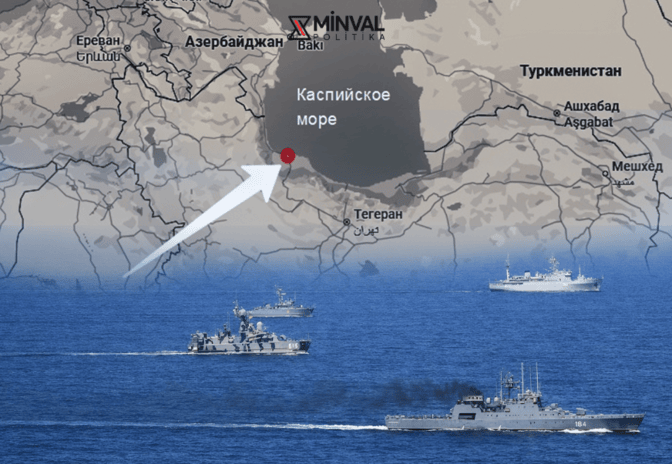
On March 18, Israeli military planes carried out attacks on Bandar Anzali, headquarters of Iran’s Northern Fleet and its largest port on the Caspian. Reports about the air strikes the following day noted that the Israeli Defense Forces (IDF) hit the port and other adjoining areas, destroying infrastructure and at least five Iranian naval vessels and merchant ships during the nighttime attack.
Not only did the air strike signal to Tehran and the Iranian people that US-Israeli attacks would no longer be limited to Iran's southern portions of that country—effectively eliminating any safe havens—but it also threatened to spill over into Azerbaijan, Kazakhstan, the Russian Federation, and Turkmenistan, as well as their trading partners in China and Europe. By suggesting that north-south and east-west trade corridors, which make use of shipping via the Caspian Sea, are now at risk, the incident sparked a foreign ministry protest in Moscow and still silent anger elsewhere.
In the wake of these attacks, some analysts and officials in the region are already suggesting that this could lead to shifts in these trade corridors away from one’s dependent on the use of the Caspian Sea to the use of overland land routes, benefiting a few countries but harming others. But all who have offered commentaries on these attacks agree that the Israeli move has brought the Iranian war to the Caspian and that even if there are no further strikes in the near term, the littoral countries as well as their trading partners must be alert and ready to respond to such attacks in the future, lest those attacks drag in one or more of the countries involved into a broader war around Iran.
In addition, regional commentators are also warning of other, less obvious but potentially equally or even more disastrous consequences from strikes like this, including both the triggering of an ecological disaster for the Caspian or even possibly the revival of the Islamic State movement (ISIS), which operates in the region and would threaten not only the neighboring states but the world as a whole.
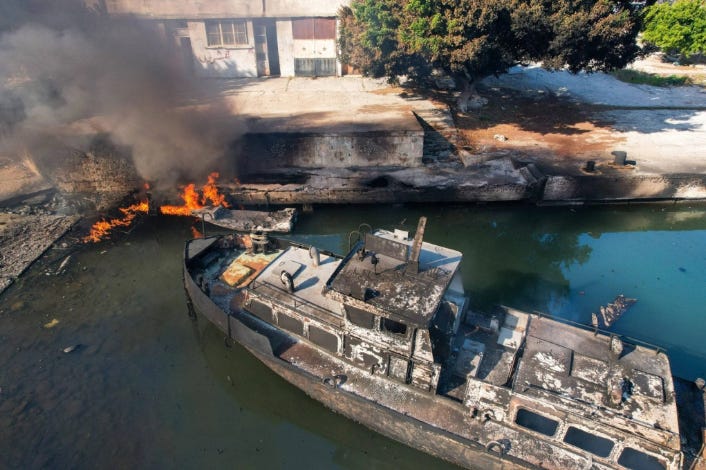
*The photo above is a damaged ship after the Israeli air strike on Bandar Anzali on March 18.
The Israeli attack on the Caspian port damaged at least five ships at the headquarters of Iran’s Northern Fleet, and also caused significant damage to the port itself, the surrounding military facilities, and the ships, but it involved no casualties. What it did do was send important messages to the Iranian government and people, to the governments of the littoral states, and to all countries and international corporations involved in both east-west and north-south trade in the Caspian region.
The March 18 air strike on Bandar Anzali clearly demonstrated to the Iranians that the Israel, and potentially the United States, are quite prepared to expand their attacks beyond Iranian nuclear facilities and southern economic infrastructure and that no one in Tehran or Iran as a whole should count on their being any safe havens where people and officials can go about their business with little need to fear a military attack. Clearly, that was the primary reason for the attack, although Israeli officials suggested that what they really wanted to do was degrade trade between Iran and its supporters in Moscow, given that the Caspian has been a major channel for such trade, especially in sanctioned items and weaponry, as it becomes part of a Russia-Iran arms corridor.
Regional Repercussions
All things considered, if the Israeli attack was directed in the first instance at Iran, it also sent shockwaves through the other four Caspian littoral states and the governments and businesses that are seeking to develop both east-west and north-south trade routes via the Caspian, given the existing political difficulties and infrastructure shortages in both Central Asia and the South Caucasus. Moscow has been especially outraged by the Israeli action because it challenges the 2018 accord on the delimitation of the Caspian signed by all five littoral states (but not yet ratified by Iran) that specifies that none of the countries will allow other states any military presence on that body of water. However, what Israeli planes have done is to show how hollow that accord is.
But more than that, this attack has shown that plans to use the Caspian for either north-south trade between Russia and the Indian Ocean via Iran or east-west trade from China and Central Asia to Europe via the South Caucasus are not as well-situated as the Kremlin has insisted. Instead, all countries involved are now waiting to see what happens next, thus casting doubt on both these corridors: the Russian-led route and the one backed by China and the West. The Israeli attack has, at a minimum, put these plans on hold for moving forward and quite possibly may have derailed them permanently.
Azerbaijan and Turkmenistan have been seeking to develop land routes for each of these corridors, and now are certain to press the advantage that the caution the Israeli attacks have instilled in the other littoral states and businesses, and their policies may lead outside actors to focus more on railway and pipeline construction through or from them than at any point in the recent past. If Israel pursues any additional attacks, then there certainly could be a fundamental reordering of the geo-economic and geo-political order in Central Asia and the Caucasus, a reordering that will call into question recent assumptions about Russian retreats and American gains in both places.
Threat to TRIPP?
The Israeli move in the Caspian is a significant development—despite the limited attention it has received in the Western media. It may also be a potential turning point for the wider region and might even have repercussions as far east as China and as far west as the United States. It also raises a level of uncertainty concerning the future of the US-backed Trump Route for International Peace and Prosperity (TRIPP) should there be additional airstrikes on Iranian ports and vessels in the Caspian as the specter of a wider war threatens the Caucasus. After all, TRIPP was one of several reasons that promoted US Vice President J.D. Vance to visit the region only the month before.
Finally, in addition to these changes, two other developments are likely to cast a far larger shadow than anyone is currently prepared for. On the one hand, the Israeli attack has released a variety of poisonous materials into the Caspian, a sea that is closed off to the rest of the world and one that will suffer greatly if these materials are not contained and cleaned up quickly. And on the other hand, what Israel has done might give aid and comfort to those who want to restart the Islamic State (ISIS), a group quite prepared to take its message and its terrorism far beyond where they come from. Such people may see the instability that is now spreading to the north of Iran as a result of the ongoing military campaign by Israel and the United States as a perfect time to come back together and launch new attacks. That one can even think about such a possibility is one more reason why both the campaign and the Israeli attack on northern Iran is likely to have deleterious consequences, however tempting it may have been as a military target.
Thank you for your support! Please remember that The Saratoga Foundation is a non-profit 501(c)(3) organization. Your donations are fully tax-deductible. If you seek to support The Saratoga Foundation, you can make a one-time donation by clicking on the PayPal link below! You can also subscribe to our website to support our work.
https://www.paypal.com/donate/?hosted_button_id=XFCZDX6YVTVKA