
By Vusal Guliyev
Amid intensifying competition over Eurasian connectivity, Japan is positioning itself as a consequential partner in the digital modernization of the Middle Corridor—formally known as the Trans-Caspian International Transport Route. At a moment when traditional trans-Eurasian logistics are increasingly constrained by geopolitical tensions, sanctions regimes, and structural vulnerabilities from the conflict in Ukraine and the ongoing conflict in the Persian Gulf, the Middle Corridor is emerging as a new corridor for trade and connectivity.
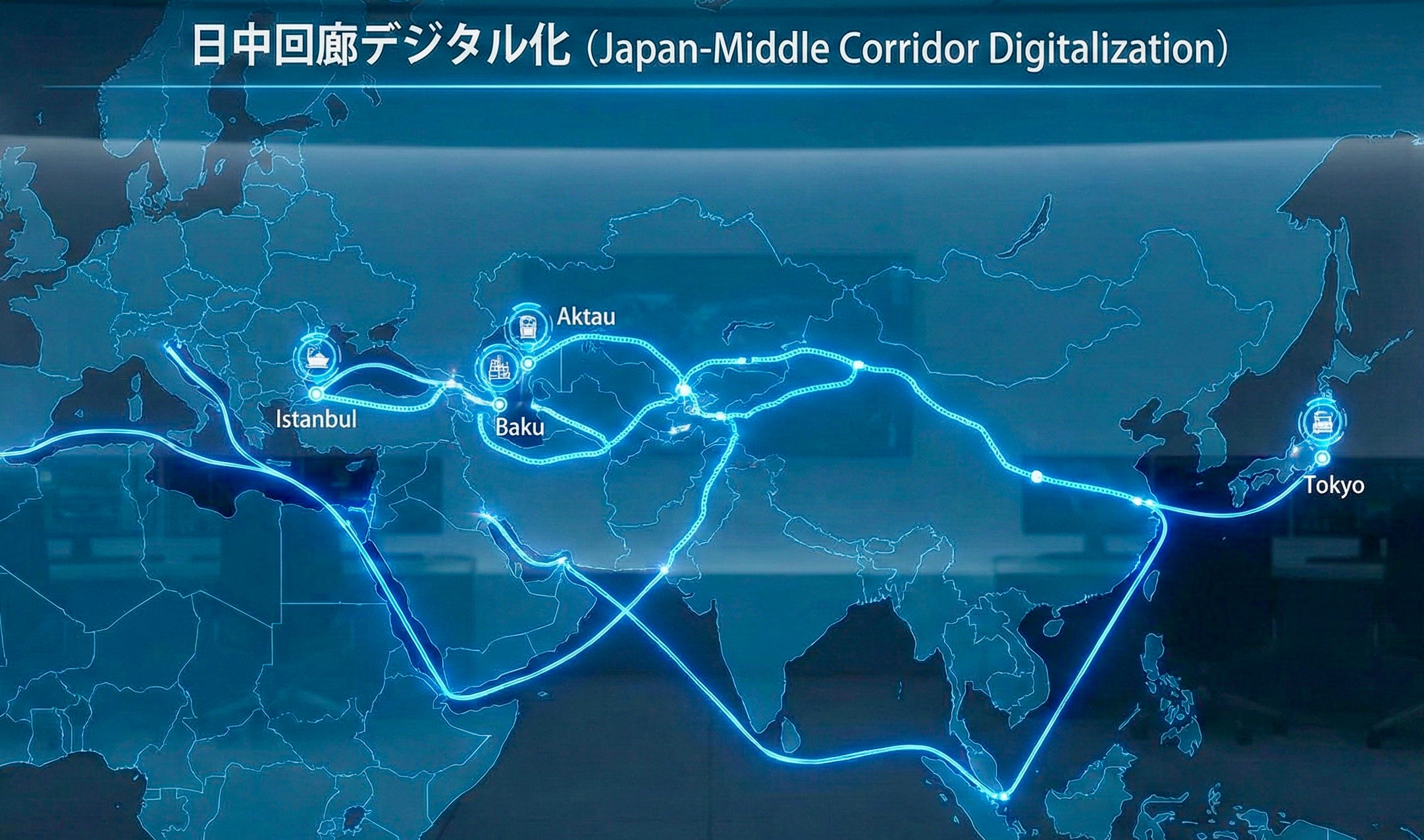
Stretching from East Asia through Kazakhstan, across the Caspian Sea, and onward via Azerbaijan and Georgia to Europe, the Middle Corridor has gained renewed strategic relevance not only as an alternative to geopolitically exposed maritime routes such as the Suez Canal, but also to overland arteries like the Trans-Siberian Railway, whose reliability has been fundamentally undermined since the Russian invasion of Ukraine. Its contemporary importance, however, comes not from geography alone, but from its capacity to adapt to a fragmented logistics environment through accelerated digital transformation.
Historically, trade flows between East Asia and Europe have relied predominantly on maritime routes via the Suez Canal or on overland transit across Russia along the Trans-Siberian Railway, commonly referred to as the Northern Corridor. The route’s potential was underscored in 2018, when the first Japanese rail cargo shipment crossed Russian territory with official backing from both Tokyo and Moscow, reflecting early efforts to diversify transport options beyond sea and air freight. The Kremlin’s war in Eastern Europe, however, has fundamentally reshaped this landscape. What once constituted a viable logistical alternative has increasingly become a strategic liability, as sanctions, geopolitical tensions, and heightened uncertainty have rendered reliance on Russian transit routes progressively impractical.
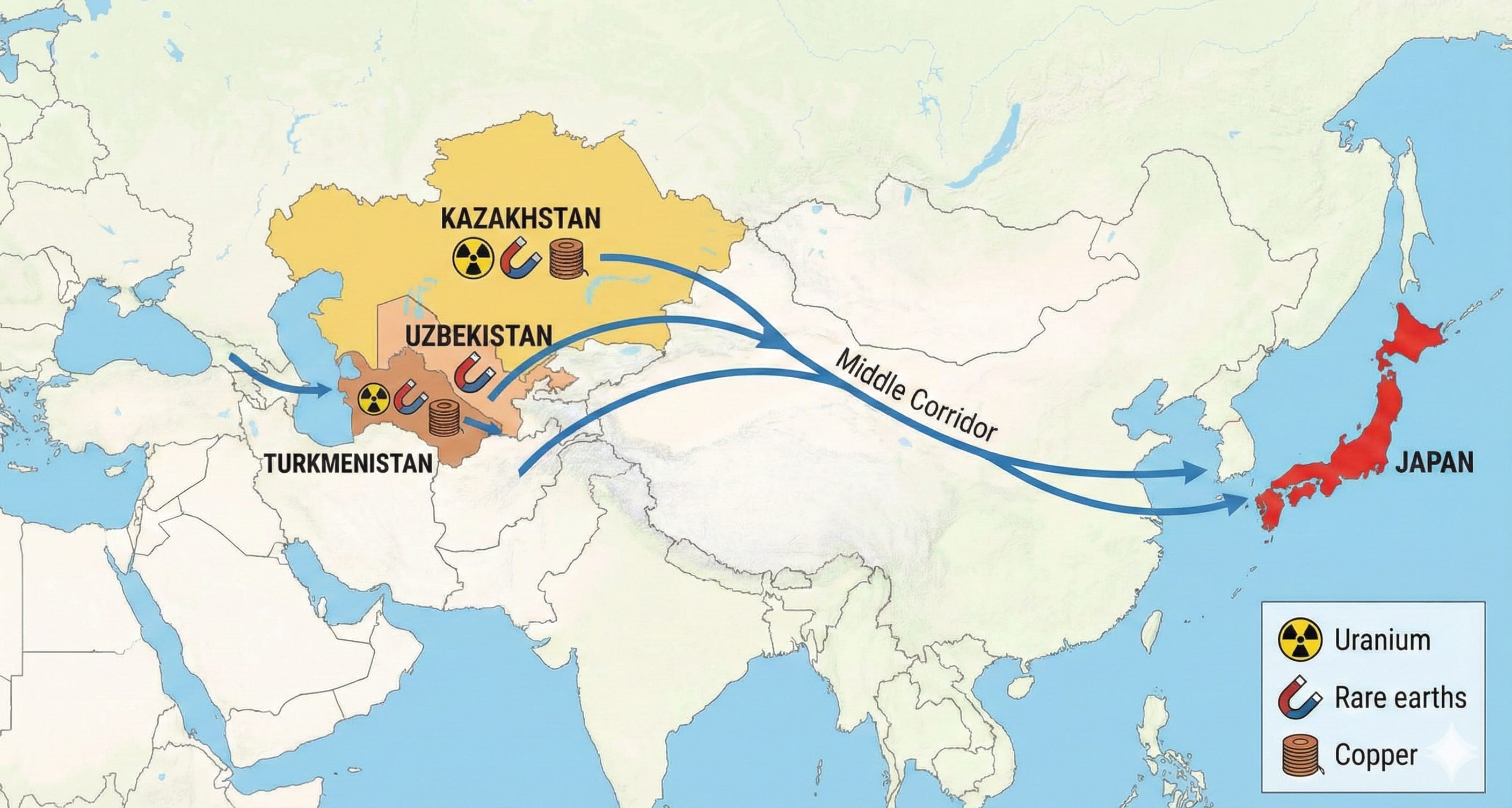
Against this backdrop of heightened complexity and uncertainty, Japan has advanced its own connectivity agenda, seeking to strengthen resilient transport, energy, and digital linkages across Eurasia while reducing exposure to geopolitical risk and supply-chain disruption. Tokyo’s interest in modernizing Eurasian connectivity is closely tied to its broader economic and resource-security objectives, particularly the need to secure reliable access to critical raw materials sourced from regions traversed by the Middle Corridor. As a resource-poor economy with limited domestic reserves, Japan depends heavily on stable external suppliers for energy, critical minerals, and industrial inputs. Central Asia—especially Kazakhstan, Uzbekistan, and Turkmenistan—has therefore assumed growing strategic importance, given its substantial reserves of oil, natural gas, uranium, rare earth elements, and non-ferrous metals that underpin Japan’s energy security, manufacturing base, and high-technology sectors.
Beyond resource availability, Central Asia offers Japan an opportunity to diversify supply chains away from over-reliance on politically sensitive, congested, or vulnerable routes and markets. Uranium imports from Kazakhstan remain integral to Japan’s nuclear fuel cycle, while copper, zinc, and other metals support its electronics, automotive, and green technology industries. In the context of the global energy transition, the region’s prospective role as a supplier of minerals critical to batteries, renewable energy systems, and hydrogen technologies further enhances its long-term strategic relevance.
Ensuring that these strategically important resources can move reliably from Central Asia to global markets, however, depends on the efficiency and resilience of the transport corridors linking the region to East Asia and Europe. As global supply chains become increasingly data-driven and risk-sensitive, the Middle Corridor’s competitiveness hinges less on physical capacity alone than on the deployment of smart customs systems, electronic transit documentation, real-time cargo tracking, and interoperable digital platforms that integrate rail, port, and maritime operations across multiple jurisdictions. Japan’s growing engagement reflects a strategic recognition that, under conditions of disrupted trans-Eurasian logistics, leadership in standards, software, and systems can be as consequential as investment in hard infrastructure.
This emphasis on digital connectivity is most evident in Japan’s push for customs digitalization, where operational bottlenecks undermine the corridor’s credibility as an alternative to disrupted Eurasian routes. Customs modernization is an area where targeted interventions can yield disproportionate strategic returns. In this context, Japan pledged in August 2025 to support the upgrading of customs services at Kazakhstan’s Port of Aktau, a critical maritime hub linking Central Asia’s rail networks with Caspian Sea crossings along the Middle Corridor.
By supporting smart customs systems, automated risk-management tools, and electronic documentation, Japan seeks to reduce clearance times, limit bureaucratic friction, and enhance the predictability of cross-border movements along a corridor whose attractiveness depends fundamentally on reliability amid widespread logistical disruption elsewhere in Eurasia.

Japan’s MUFG Finances the Nakhchivan-Kars Railway
At the same time, Japan’s engagement extends beyond digital governance and technical assistance to encompass substantive financial support for strategic infrastructure that reinforces the corridor’s physical continuity. In this context, Japan’s largest financial institution, Mitsubishi UFJ Financial Group (MUFG Bank), has committed to financing the Nakhchivan–Kars railway route—an initiative aimed at enhancing direct rail connectivity between Azerbaijan’s Nakhchivan exclave and Türkiye. This commitment forms part of a $2.6 billion external financing package led by MUFG Bank, in partnership with Sweden’s EKN and Austria’s OeKB export credit agencies, as well as the Islamic Development Bank.
The Nakhchivan–Kars rail line is expected to deepen the integration of the South Caucasus segment of the Middle Corridor and further consolidate Türkiye’s role as a gateway to European markets. MUFG’s involvement demonstrates that Japan’s participation in the Middle Corridor is not merely diplomatic or conceptual in nature, but anchored in substantial financial instruments that support the corridor’s long-term structural development and resilience.
Importantly, developments along the South Caucasus segment of the Middle Corridor have also complemented Tokyo’s broader strategic calculus. In April 2023, the Port of Baku concluded a cooperation agreement with Qingdao Port—one of China’s largest maritime hubs—to deploy advanced digital solutions aimed at enhancing operational efficiency, security, and competitiveness. Beyond reciprocal visits and institutional knowledge exchange, the agreement established a logistical channel enabling cargo from Japan and South Korea to transit through Qingdao and onward to Baku via the Middle Corridor. This arrangement effectively embeds East Asian supply chains more directly into the Trans-Caspian network and complements Japan’s parallel push for customs digitalization and interoperable logistics systems across Central Asia.
Even before these institutional consolidations, Japan had tested the corridor’s operational feasibility. In early 2025, Japan successfully conducted a trial shipment via the Middle Corridor, transporting cargo from Japanese ports to Türkiye through a combination of rail and maritime links across Central Asia and the Caspian Sea. The journey was completed in just over 20 days and was coordinated by Danish shipping and logistics company Maersk. The pilot demonstrated that Japanese goods can traverse this land–sea route efficiently and within competitive timeframes despite multiple border crossings and modal shifts. Beyond its symbolic significance, the shipment underscored the operational feasibility of integrating Japanese supply chains into the Trans-Caspian network. It also illustrates how improvements in customs digitalization, electronic documentation, and logistics coordination are mitigating risks that have intensified since disruptions to established Eurasian corridors.
These operational and financial initiatives were further embedded within a broader diplomatic architecture in December 2025. At the inaugural Summit of the Central Asia plus Japan Dialogue (CA+JAD), held in Tokyo, participating leaders adopted the Tokyo Declaration, elevating connectivity and logistics modernization to a shared strategic priority in response to evolving geopolitical risks. Within this framework, advancing the Middle Corridor emerged as a central element of the summit’s connectivity agenda. Moreover, to support business development and interstate trade, Japan set a ¥3 trillion (approximately $19 billion) target for business projects in Central Asia over the next five years under the Tokyo Initiative. The meeting also launched the Japan–Central Asia Partnership for AI Cooperation, signaling Japan’s intention to apply advanced digital tools to the practical challenges of Eurasian transit. Envisaged applications include AI-enabled cargo tracking, predictive logistics planning, and more advanced customs risk-management systems.
Nevertheless, the corridor’s long-term viability depends on addressing the structural complexities inherent in multimodal transport. Reliance on rail networks, maritime crossings over the Caspian Sea, and onward rail connections to Europe requires a level of coordination that paper-based systems cannot provide, particularly amid heightened regulatory scrutiny and geopolitical fragmentation. Each modal transition introduces additional documentation requirements, compliance checks, and scheduling risks. Accordingly, Middle Corridor-involved states have increasingly prioritized digitizing multimodal data exchange, harmonizing electronic documentation, and adopting international standards that enable real-time information sharing across borders.
Outlook
Within this context of heightened strategic volatility, Japan’s connectivity agenda represents a deliberate effort to manage geopolitical risk and reinforce supply-chain resilience. By prioritizing customs modernization, interoperable digital systems, and emerging AI-driven logistics solutions, Japan is addressing the Middle Corridor’s most persistent operational constraints while reinforcing its strategic value as a diversified Eurasian trade route. This approach moves beyond conventional infrastructure assistance toward shaping the standards, governance practices, and technological norms that underpin long-term corridor performance. For the Central Asian states, Japanese involvement complements domestic digital reforms and enhances corridor reliability amid geopolitical uncertainty.
Meanwhile, Tokyo is directly advancing its economic security objectives by embedding resilience, predictability, and diversification into its transcontinental supply chains, thereby reducing exposure to persistent disruptions in trans-Eurasian logistics and strengthening access to alternative East–West transit corridors. As competition over connectivity intensifies, the evolution of the Middle Corridor suggests that the future of Eurasian trade will be defined as much by digital integration and institutional coordination as by the physical routes themselves.
About the Author:
Vusal Guliyev is a Sinologist, TCSOL Specialist, and Policy Analyst specializing in the geopolitical affairs of Eurasia and the Indo-Pacific region. He currently works as a Leading Advisor at the Baku-based Center of Analysis of International Relations (AIR Center) and serves as the Head of the Shanghai Office at AZEGLOB Consulting Group.
Additionally, he holds affiliations as a Geopolitical Analyst and Associate Expert with several policy research institutes, including the Topchubashov Center, the Caspian-Alpine Society, Khazar University China Studies Center, and the European Geopolitical Forum. A graduate of Shanghai International Studies University, he previously held long-term Visiting Research Fellowships at Ankara University, Harvard University, and Boğaziçi University.
He has authored numerous academic and analytical articles in Azerbaijani, Turkish, English, and Chinese, examining the socio-political, socio-economic, and scientific-technological dynamics of Wider Eurasia, with a particular focus on the South Caucasus, Central Asia, Greater China, and the broader East Asia region.
Thank you for your support! Please remember that The Saratoga Foundation is a non-profit 501(c)(3) organization. Your donations are fully tax-deductible. If you seek to support The Saratoga Foundation, you can make a donation by clicking on the PayPal link below! Alternatively, you can also choose to subscribe on our website to support our work.
https://www.paypal.com/donate/?hosted_button_id=XFCZDX6YVTVKA