
By Mairbek Vatchagaev and Glen E. Howard
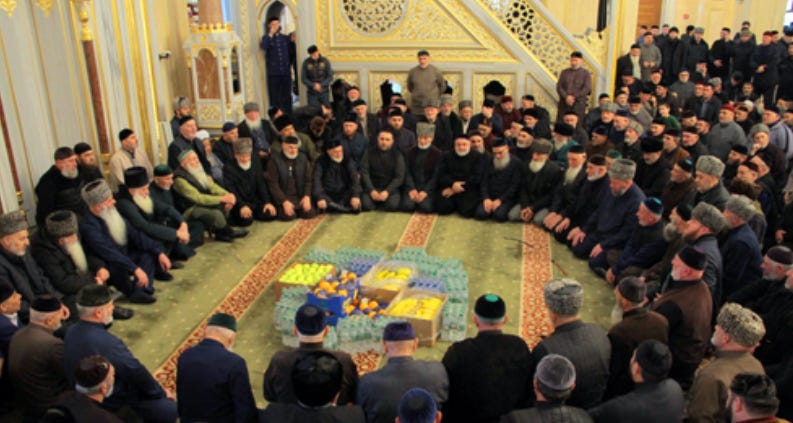
*Picture above: Chechens in Grozny commemorating the Day of Memory of Kunta-Khadji Kishiev.
Introduction
In late January during a recent meeting at the Kremlin between United Arab Emirates President Sheikh Mohamed bin Zayed Al Nahyan and Russian President Vladimir Putin, Ramzan Kadyrov the Russian installed leader of Chechnya, called for Russia to bring the war in Ukraine to a final end. By Kadyrov’s definition of the term, this means ending the war on Moscow’s terms: ‘denazification’, the cession of conquered territories, the designation of Russian as a state language, etc.
As the head of one of Russia’s largest Muslim republics Kadyrov’s statement is important because he seeks a level of legitimacy among Russia’s Muslims and Moscow has endlessly used this as a bridge to the Arab Gulf countries and the rest of the Muslim world building on the notion of Chechens as great fighters. At the same time Kadyrov has militarily backed the Kremlin war against Ukraine to the point of deploying Chechen units to fight against Ukraine since the outbreak of he war. Kadyrov’s calls for an end on such terms is out of the ordinary because Kadyrov is also a murid, or follower, of a famous Sufi sheikh known as Kunta Haji Kishiev. Sufism is the dominant form of Islam in the North Caucasus republic and the fundamental philosophy of Sufism is not predicated on resolving issues through military means. In fact, Sufism prioritizes the internal moral struggle and rejects war as an end in itself; armed conflict is acknowledged as permissible only under specific conditions—namely, for the purpose of defense against an enemy.
Kadyrov’s call for the end to the war on Kremlin terms raises a major question as to how the Chechen strongman attempts to motivate Chechens, who as Sunni Muslims, are being called upon to fight a “holy war” against Ukraine on behalf of Russia. Since the majority of Chechens adhere to Sufi philosophy (referred to in Chechnya as “traditional” Islam), how does this relate to their participation in the war and is this policy succeeding? Furthermore, how does Kadyrov manipulate Islam in a struggle alongside Russia, given the fact that Chechnya militarily resisted Russian rule in the 19th century and fought two wars of independence against Moscow in the 1990s?
Western policy audiences should keep in mind that everything Kadyrov says reflects his personal loyalty to the Kremlin. At the same time, however, he also expresses his support for the war through the use of religious motifs—primarily those associated with so-called “traditional Islam,” which in modern Chechnya draws upon their Sufi heritage. An analysis of public statements, visual symbols, and institutional support from the official clergy suggests that this is less a matter of theology than the use of religion as an instrument of propaganda to support and promote Kremlin narratives about the war in Ukraine. Kadyrov’s exploitation of religion cannot be fully understood without first examining the historical roots and structure of Sufism within Chechen society, which continue to shape both Chechnya’s religious identity and political mobilization today.
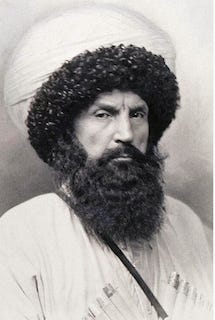
*Image of Sheikh Imam Shamyl who led the North Caucasus resistance movement i the 19th century
Sufism in the Chechen Tradition: An Overview
During the last two centuries, Islam in Chechnya has historically developed in the form of the two major Sufi tariqats, or orders, known as the Naqshbandiyya and Qadiriya orders. These groups are the two most predominant Sufi religious orders in the Northeast Caucasus. Experts and observers tend to assume that most residents of Chechnya and Ingushetia are adherents of Sufism, which is an esoteric branch of Islam. However, for those who are unfamiliar with Sufism, a tariqat is an organized spiritual order that provides a structured path in the way of Sufism of discipline, guided by a teacher, to achieve direct knowledge of God, which is conductd through the two dominant orders, the Naqshbandiyya and Qadiriya.
Prominent Muslim leaders and organizers of the national liberation movement, the most prominent of whom was the military commander Imam Shamyl, who opposed the Russian army’s conquest of the North Caucasus for nearly three decades. Imam Shamyl was preceded by others in the first half of the 19th century, such as Sheikh Magomed Yaraginsky, Sheikh Dzhemaludin Kazikumukhsky, Imam Ghazi-Magomed Gimrinsky, Sheikh Tashu-Haji Sayasan, and others. All of whom were notably Sufis. One of the most important propagators of the Qadiri tariqat was the famous Chechen Sheikh Kunta-Haji Kishiev Ilsikhanurtovsky.
One of the distinctive features of Sufism in Islam is that its teachings are passed on from the teacher (ustaz, sheikh) to the student (murid). The teacher gives his murids a virde. By doing so, he relies on a particular spiritual method called tariqa, which translates from Arabic as “path.” Even during periods of armed resistance in the 19th century, the Sufi tradition viewed violence as a necessary defense rather than a universal religious duty. Historical examples exist of Sufis participating in wars, for example, in 1516 in the Ottoman Wars, or the murids of the first and second imams of Dagestan who fought in the late 1820s and early 1830s. Conversely, during the collapse of the Russian Empire, Sufi sheikhs and murids were frequently active in the political processes taking place in the North Caucasus and were also active in the 1990s in Chechnya as well as during the two wars of Chechen independence fought against Russia.
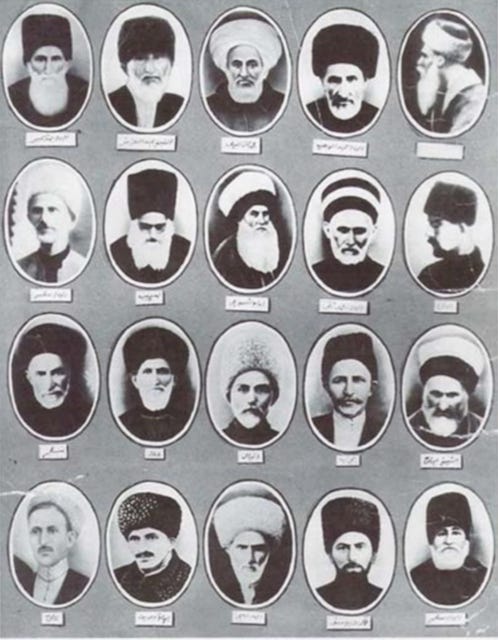
*Note: Chart of major Sufi Sheikhs of Chechnya
State and Islam in Chechnya: Kadyrov’s Embrace of Sheikh Kunta-Haji
As an adherent of Sheikh Kunta-Haji’s Sufi brotherhood, Ramzan Kadyrov constantly seeks to strengthen his personal authority in the republic by cultivating the image of his spiritual teacher (ustaz) Kishiev. In addition to Kunta-Haji Kishiev, there are several dozen other notable sheikhs inside Chechnya, of both the Qadiri and Naqshbandi tariqats. Therefore, Kadyrov’s actions cannot be universally approved because the cult of Kunta-Haji is not entirely acceptable in the republic simply because there are at least six other Sufi brotherhoods of the Qadiriya order and 22 brotherhoods of the Naqshbandi order in Chechnya. For each of them, their own sheikh is far more authoritative than all the others.
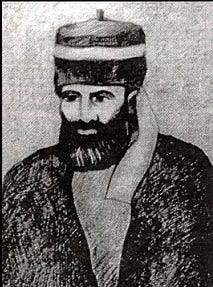
Sheikh Kunta Haji Kisheiv
Contemporary politicians in Chechnya today use the cult of Sheikh Kunta-Haji Kishiev to justify and sanctify their reconciliation with Russia. In an effort to suggest that they adhere to the sheikh’s supposed main tenet of “non-resistance to force” they often compare Kishiev to Russian writer Leo Tolstoy or Indian nationalist leader Mahatma Gandhi. However, no such tenet exists in the sheikh’s works; he does not advocate resigning oneself to the fate of the conquered. On the contrary, the sheikh supports the notion of strengthening one’s inner peace for the purpose of fighting foreign oppressors.
Through Kadyrov’s state-sponsored program, Sheikh Kishiev has emerged as a respected figure among much of the republic’s population, while the Chechen strongman has deliberately leveraged the Sheikh’s influence to strengthen his own power base. However, because Islam in the republic is institutionally subordinate to the executive branch—with salaries paid to imams, qadis, and mufti employees —the muftiate’s financial dependence on Chechen authorities effectively undermines its autonomy. This suggests that religious leaders have become part of the vertical structure of the Chechen government.
By placing the official clergy on a par with local officials and within the category of “legitimate” Islam in Russia, the republic has effectively suppressed or repressed all alternative interpretations of Islam. Consequently, independent Sufi brotherhoods and Salafism existing outside the muftiate are considered illegal. In other words, at the government level we have “official (traditional) Islam,” whose main function is to legitimize political decisions rather than provide religious guidance. For example, not a single mosque exists in Chechnya that could even be remotely associated with Salafism. However, there are mosques of this kind in the neighboring North Caucasus republics of Dagestan and Ingushetia.
Moreover, when Kadyrov learned that there were followers of Sufism among the Chechens who were engaged in self-mutilation—similar to that propagated in Iraq among the followers of the teachings of the Kurdish Sheikh Muhammad al-Qasnazi—the head of the republic “exposed” them in front of the cameras live on a local television channel television channel. In doing so, he declared that he would not allow such teachings to be practiced in Chechnya; this was not a mere wish, but an order that no one could discuss or protest.
At the same time, no theological discussions were permitted in the region, and no one has even cited classical Sufi texts or recognized Islamic legal opinions (fatwas) to justify the need for Chechens to fight in the Russian war against Ukraine. Consequently, only the variety of Islam that Kadyrov considers correct and acceptable for all Chechens has the right to exist in the republic. No element of choice exists; rather, it is a matter of necessity to accept this as dogma. Therefore, due to the absence of public debate, it is impossible to have a public discussion about everything that is happening in Ukraine. Fear and forced conformity dominate the political discourse in the republic.
Chechen authorities are more than eager to send any critics to the war in Ukraine, and if such critics are unavailable because they reside in Western European countries, the burden of guilt is then placed on the relatives of those who criticized the actions of Chechen authorities. The rhetoric used stands in direct contradiction to the Sufi tradition, in which the cult of power and ostentatious violence is incompatible with Sufi asceticism—not to mention that the war is not justified by Sharia law and that religious forms are reduced to mere ritual trappings. In fact, today Chechen Sufism is reduced to little more than cultural décor, deprived of its rich inner content.
Sufi Rhetoric in the Context of the Ukraine War
On March 16, 2022, shortly after the Russian invasion of Ukraine, a conference was held in Vladikavkaz, the capital of North Ossetia, where the spiritual leaders of Russian Muslims supported Russian President Vladimir Putin by adopting a fatwa supporting his war known as: “On those who died defending the Fatherland and civilians during the Russian military operation in Ukraine to force the aggressor to peace.” The fatwa stated that all those who were killed in the war in Ukraine would be considered martyrs who died in the holy path of Islam.
Inside Chechnya, “jihad”, or “holy war”, has become the main “argument” in the campaign to attract residents to participate in the ongoing Ukraine war. Magomed Daudov, chairman of the republic’s parliament once boasted this in a video posted on Ramzan Kadyrov’s Telegram channel. Chechens participating in the Russian invasion of Ukraine are “defending Islam,” he said.
Under the control of the muftiate and security forces, mass nightly prayers are organized in the republic to support the Russian army in its war against Ukraine, utilizing state administrative resources. Employees of state institutions have reported that under various pretexts they are also frequently forced to participate in collective night prayers at Chechen mosques. According to employees of the Chechen organization “Vayfond,” women were sometimes taken from their homes and transported “by the busload” to the mosque, which usually resulted in prayers lasting three hours, after which the women were taken home. In fact, the degree of government involvement even had reached the point where school-age children were being forced to attend nightly prayers in the republic’s mosques as well. In fact, this initiative was organized by Ramzan Kadyrov’s daughters.
Kadyrov’s “Murids”
The Chechen leader went a step further in the fall of 2022 by announcing that the Sufi brotherhoods in Chechnya could begin organizing their own named units, meaning that they should be named after their ustadz (sheikhs). “All murids (followers) should unite into groups, create and name their battalions, companies, and detachments, naming them after their ustadz“ (teachers, founders of Sufi movements). This decision was related to Russian manpower concerns and the need to search for people to send to the Russian front lines to fight in Ukraine. The results, however, failed to meet Kadyrov’s expectations. By August 2022, the speaker of the republican parliament, Magomed Daudov, who is one of Kadyrov’s closest associates, stated that it was impossible to find people willing to go to war, even with promises of payment. For example, in the Chechen city of Argun, out of 412 low-income families, only three men had agreed to serve in the new regiment, despite the lack of other work. Kadyrov then ordered those who refused to be deprived of their benefits.
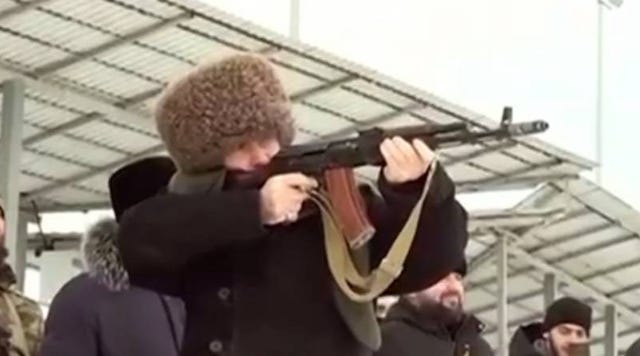
Russian Propaganda Portrays Chechen Imams undergoing military training in Chechnya which later proved to be fake news.
Here, too, we see an element of propaganda—a desire to show how the war against Ukraine is supported at all levels in the republic. Kadyrov announced that “it is necessary to create units named after each Chechen ustaz in the republic. We need to study military affairs and prepare for the possibility that the special military operation may be prolonged,” he said at a meeting with representatives of law enforcement agencies in Grozny on November 15, 2022.
Following this announcement, more than 300 imams and qadis (a qadi is a judge in a Muslim community who interprets and renders binding decisions based on Islamic religious law) of the Chechen clergy, led by the Mufti of Chechnya, Salah-Haji Mezhiev, were forced to undergo seven days of military training at the so-called “special forces university” located outside Grozny in the nearby city of Gudermes. According to Kadyrov, the training included the safe handling of weapons, basic tactical and firefighting skills, and first aid.
Once completed, Salah-Haji Mezhiev stated that “theologians are ready, if necessary, to go to the zone of special military operations (as the Russian authorities call the war in Ukraine) in Ukraine to make their contribution to the victory of our state over the servants of Satan,” Ramzan Kadyrov wrote on his Telegram channel. Moreover, in his sermons, Mezhiev referred to the war in Ukraine as “sacred” and “blessed” for Muslims. Russian propaganda channels covered these events and claimed that a battalion of imams would soon be sent to war, led by the Mufti of Chechnya, Salah Mezhidov, which ultimately turned out to be nothing more than a publicity stunt.
Regardless, this did not prevent the mufti from becoming a “hero of Chechnya“ in February 2024 - “for his personal contribution to the achievement of the goals and objectives of the Russian led Special Military Operations (SMO) in Ukraine. According to some Chechen imams, Mezhiev transformed himself from a respected Chechen spiritual leader before his election as mufti into an official backer of the Kadyrov regime. For reasons that are unclear, the Chechen leadership proved to be unable to organize units from among Chechen imams and murids from the Sufi brotherhoods, setting out to actively “rescue” the Ingush murids of Sheikh Batal-Haji Belkhoroev. Russian authorities have been persecuting members of this brotherhood for many years, accusing its “military wing” of organizing the murder of a high-ranking official of the Ministry of Internal Affairs of the Republic of Ingushetia.
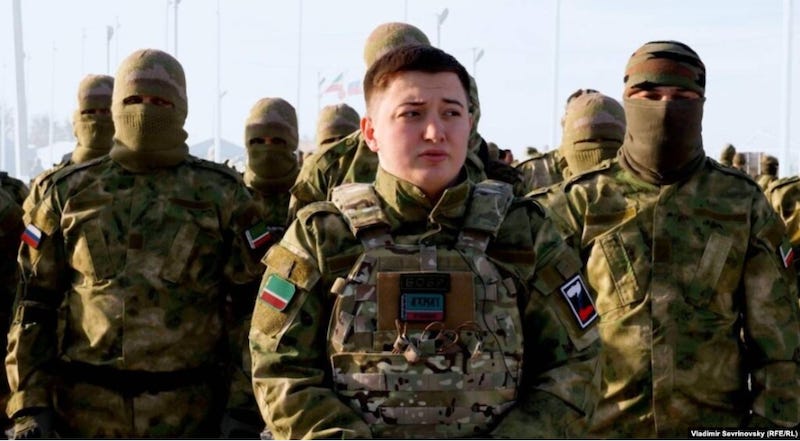
*Picture depicts members of Ingush Sufi Batalkhajin unit sent to Ukraine
Kadyrov Intervenes to Protect the Sufi Batalkhajin Brotherhood
Ironically, Kadyrov has also sought use his influential ties to the Kremlin in a positive way to protect regional Sufi groups that the Kremlin is weary of, notably in neighboring Ingushetia. Following reports of the Sufi Batalkhajin Brotherhood being involved in attacking Kremlin-backed Ingush government officials, Kadyrov intervened to help protect one of these groups.
On December 31, 2018, the great-great-grandson of Sheikh Batal-Haji, Ibrahim Belkhoroev, was killed in Ingushetia. The Batalkhajins believe that Ibrahim Eljarkiev—head of the Ingush Center for Countering Extremism and a member of the security forces—may have been behind the assassination. Eljarkiev was subsequently killed in Moscow in November 2019.
From that moment onward, the entire Sufi branch of this brotherhood faced intense pressure from Russian law enforcement. Since much could be forgiven in Russia for those who volunteered to fight in Ukraine, Kadyrov intervened and found a way to resolve the situation by suggesting to Moscow that the Batalkhajins could atone for their ‘sins’ by forming their own military units and depart for the Ukraine front. After this, the Batalkhajin Rapid Response Unit (BOBR) became part of the Akhmat special forces and began participating in Russian military operations, as confirmed by the head of Chechnya on December 13, 2025. The Batalkhajin Rapid Response Unit consists of only 31 persons and underwent training at the Russian Special Forces University in Gudermes (a city in Chechnya, outside Grozny), after which they were then deployed to the front in Ukraine.
In this way, the members of the Batalkhajin brotherhood sought to avoid conflict with the security forces, which began after the murder of the head of the Ingush Center “E.” But this did not help them. Regardless, Russian officials remain convinced that the Brotherhood has a “military wing.” Consequently, some members of the mystical wing Ingush Sufi branch were declared a terrorist organization in Russia, which illustrates how Kadyrov cleverly sought to use his role to save the Sufi group from Kremlin retribution. Neverthless, Kadyrov ultimately failed when it came to preserving at least the mystical wing of the Batalkhajin from the wrath of the Russian security services.
Conclusion
Chechnya’s Sufis remain a resilient force inside Chechnya, and for that matter, throughout the entire Northeast Caucasus and Ramzan Kadyrov has cleverly tried to manipulate Chechnya’s Islamic heritage in his rhetoric to strengthen his rule even though it has no theological basis. What is happening today is not the Islamization of war, but the militarization of Chechnya’s religious identity. For this reason state propaganda in Chechnya continues to depict Kadyrov as “a servant of the Holy Quran, a hero of Islam, and a defender of the Sunnah of the Prophet Muhammad.” On the contrary, he acts the exact opposite. He often sharply criticizes manifestations of intolerance towards Islam, especially abroad, while he himself systematically ignores violations of Muslims’ rights inside Russia, including those held in Russian detention facilities.
To legitimize his power, Kadyrov uses rituals, fatwas, and symbols instead of resorting to theological discussions. Prayers and public religious justification of the war have served as a useful tool for mobilization. Moscow’s support for the Chechen leader’s actions serves its own self interests. No other Russian regional leader has been able to repeat or even come close to what Kadyrov is doing to mobilize his population to fight in the war against Ukraine.
In the final analysis, Ramzan Kadyrov’s actions are aimed at demonstrating his complete solidarity with the Russian president in Moscow, the republic’s residents, and the Russian political establishment. Regardless of what Kadyrov does or says, all his actions have one goal: to demonstrate his unconditional loyalty to President Vladimir Putin. Kadyrov performs this role by exploiting “traditional Islam” in Chechnya, using it as a tool of control, subjugating it to his will. Islam functions here as an institutional resource, with the Chechen clerical establishment becoming completely dependent on him.
It continues to be a matter of political exploitation of the republic’s religious heritage, which leads to the discrediting of the Sufi tradition, the destruction of the boundary between faith and violence, and ultimately will cause long-term damage to religious consciousness in Chechnya, which will lead to a future departure from Sufi traditions by Chechen society.
Given the long history of Sufi resistance to Russian rule in the North Caucasus, religious developments in Islam in Chechnya have important long-term implications for regional stability. On the one hand, they weaken Chechen nationalism; on the other, they solidify Kadyrov’s hold on power. Hence, controlling the Sufi movement is an important goal in helping Moscow fulfill its imperial agenda. No other region in the North Caucasus—or in Russia more broadly—affects Russian stability more than Chechnya. Developments there, particularly regarding the Sufi movement, can play a dramatic role in igniting the North Caucasus powder keg by spilling over into neighboring Dagestan and Ingushetia. Accordingly, keeping the Sufis in check is a vital element of the agenda of both Kadyrov and the Kremlin and is something that haunts Putin and other Russian policymakers, having fought two wars in Chechnya in the 1990s.
About the Author:
Mairbek Vatchagaev is a Senior Fellow at The Saratoga Foundation and one of the world’s leading experts on Islam in the North and South Caucasus and Russian nationalities issues. He is the author of Chechnya: The Inside Story, From Independence to War, a chronicle of the dramatic events that took place in Chechnya during the 1990s following the collapse of the Soviet Union and the Chechen war for independence.
Glen E. Howard is the President and Chairman of The Saratoga Foundation.
Thank you for your support! Please remember that The Saratoga Foundation is a non-profit 501(c)(3) organization. Your donations are fully tax-deductible. If you seek to support The Saratoga Foundation, you can make a one-time donation by clicking on the PayPal link below! You can also subscribe to our website to support our work.
https://www.paypal.com/donate/?hosted_button_id=XFCZDX6YVTVKA