
By Emil Avdaliani
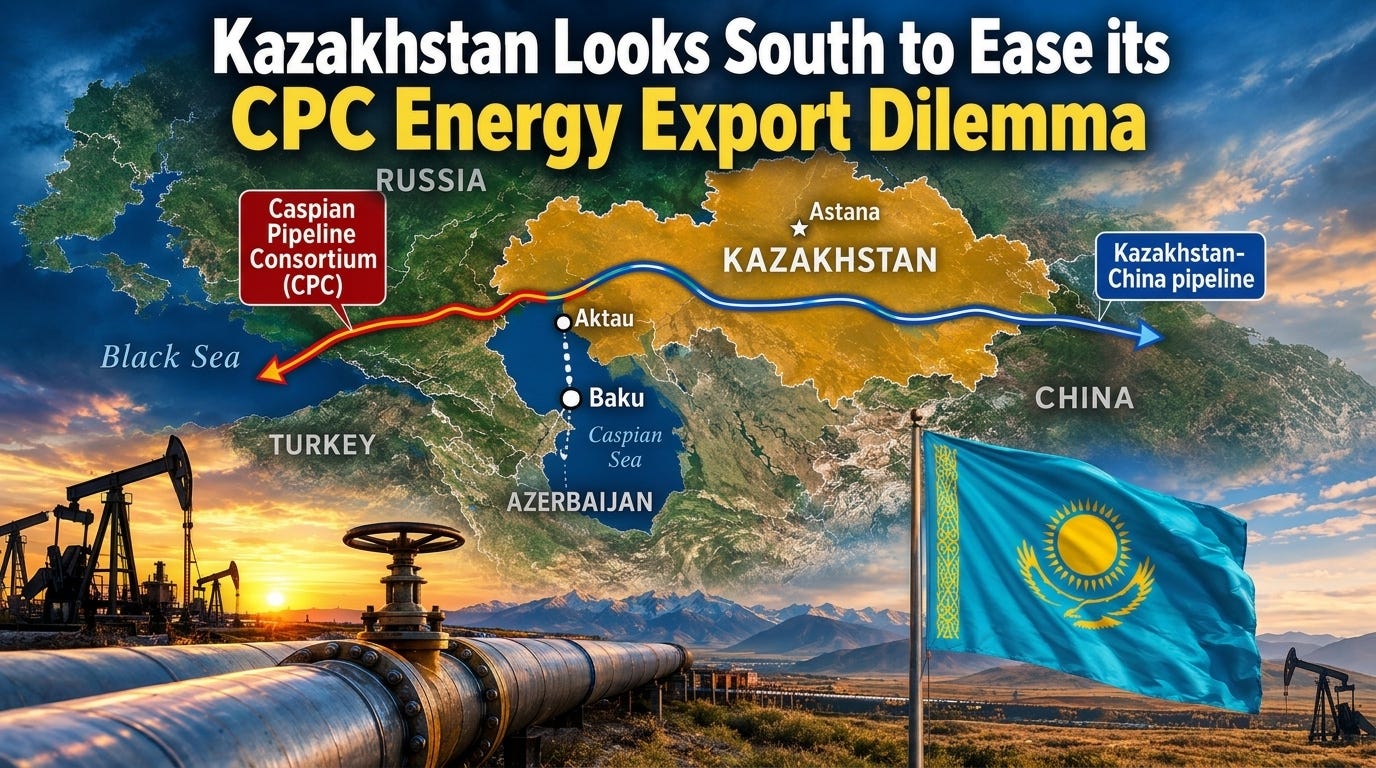
Kazakhstan is actively seeking to diversify its export routes, particularly for oil. Currently, around 80 percent of its oil flows through the Caspian Pipeline Consortium (CPC), a 1,500-kilometer pipeline linking the landlocked Central Asian country to Russia’s Black Sea port of Novorossiysk. Recent disruptions in oil exports through Novorossiysk during July and August 2026, caused by Ukrainian aerial and drone attacks on the Black Sea port, have exacerbated Kazakhstan’s geopolitical and economic vulnerabilities. Chief among these is the dependence of its oil industry on a single export corridor passing through Russian territory.
Yet, Kazakhstan has found few alternatives. One option is through China, while the other two possibilities are to send its oil via Iran to the Gulf region and via Pakistan to the Arabian Sea. None is fully developed, nor efficient enough from an economic perspective. As a result, Astana is exploring multiple export options simultaneously. Consequently, the so-called Middle Corridor, which runs through the South Caucasus to Georgia’s Black Sea ports and onward to the European Union (EU), emerges as the most realistic route capable of absorbing a significant portion of Kazakhstan’s CPC-bound exports.
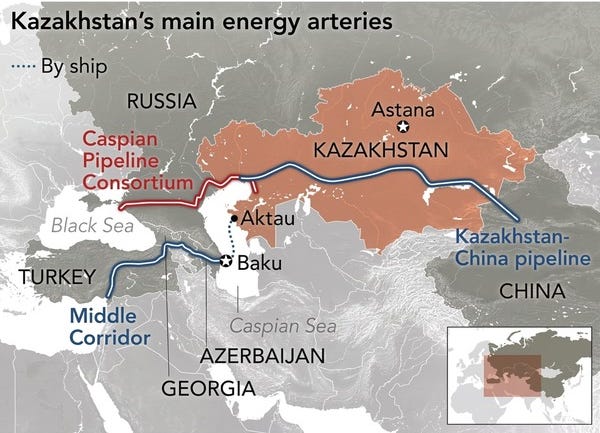
The Middle Corridor has existed since the 1990s but remains limited in scope due to geographic constraints and the lack of proper infrastructure. This started to change in the 2000s with the emergence of a range of infrastructure projects in the region linking the Caspian with the Black Sea. From railways to roads to pipelines, the Caspian Sea and, by extension, Central Asia grew closer to the South Caucasus and the Black Sea basin. Yet this too has not shifted connectivity patterns, as transit through Russia to Europe remained strong. None of this changed until 2022, when Russia launched its war against Ukraine and the Central Asian countries intensified their search for alternative routes. The Middle Corridor gained strategic importance as a viable route situated between the war in Ukraine and ongoing instability in the Middle East.
Astana Pivots to the BTC
No wonder then that Astana announced in August that it was considering increasing exports via the Baku-Tbilisi-Ceyhan (BTC) and Baku-Supsa pipelines. Specifically, KazMunayGas, Kazakhstan’s national oil and gas company, announced in 2026 it would expand oil exports via the BTC pipeline by some 31 per cent to reach 1.7 million tons. Though the pipeline’s capacity stands at about 50 million tons of oil per year, the increase in Kazakhstan’s oil exports through this route is nevertheless significant.
Diversification, however, would not be efficient without attempting to shape geopolitics on the ground. This is where Kazakhstan has made major moves in the past year with a special focus on Georgia and Azerbaijan. In April, Kazakhstan’s Foreign Minister Yermek Kosherbayev flew to the Georgian capital of Tbilisi to discuss regional connectivity. Georgia and Kazakhstan then signed a Strategic Partnership Agreement on June 29, elevating their relationship to a higher partnership level. Meanwhile, bilateral relations between Baku and Astana have expanded to the level of strategic partnership following Azerbaijan’s admission as a full member of the Central Asian Consultative Meetings.
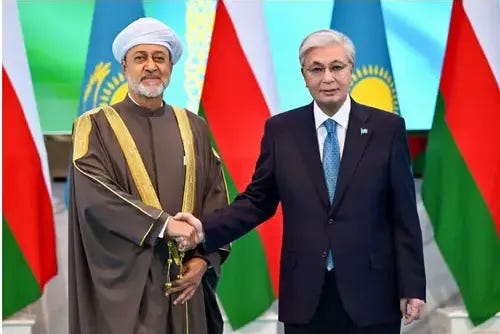
Image above: President Kassym-Jomart Tokayev and the Sultan of Oman Haitham bin Tariq Al Said (source: Astana Times)
Kazakhstan Forges Closer Economic Ties with Iran, Oman, and the Gulf
Kazakhstan’s search for alternatives through the South Caucasus should also be viewed from a broader perspective. For Astana, the Middle Corridor is valuable, but Kazakh officials understand that the route cannot serve as the main artery for the country’s goods and exports. This is driving Kazakhstan to seek further regional diversification. In late June, four months into the US-Israel-Iran war, the Iranian Ports and Maritime Organization reached an agreement to transfer land to Kazakhstan at the Shahid Rajaee Port in the Persian Gulf. The document will allow for the construction of a transport and logistics terminal. The agreement is set to be effective for 27 years: two years for the terminal’s construction and the next 25 years for its operation. Commercial operation is planned to begin in the third year.
In an effort to build stronger economic ties with countries in the Persian Gulf, Kazakhstan has significantly expanded its relations with Oman. This is no coincidence. Oman’s geography offers prospects of Kazakh goods reaching the Indian Ocean. To that end, in April Oman and Kazakhstan signed a preliminary agreement to establish a strategic partnership. The two countries have been in talks for some time on establishing a transport route through Iran to be overseen by a joint Kazakh-Omani logistics company. This was followed by the first-ever visit to Astana by Oman’s Sultan Haitham bin Tariq Al Said. The joint statement, among other topics, covers developing connectivity between the two countries. As part of this broader push to deepen Gulf economic partnerships, Kazakhstan—along with Uzbekistan and the UAE—signed a memorandum in early October to study a railway corridor passing through Afghanistan to Pakistani ports.
Limitations and Technical Challenges
Despite its best efforts for regional diversification, it is unlikely that Kazakhstan will fully eliminate its dependence on the CPC. Geography remains a key obstacle, and there are business efficiency issues that complicate switching to other routes. CPC requires no additional loading, and it avoids the transportation challenges created by the multimodal Middle Corridor. This route, however, requires passing via the Caspian Sea, where transportation tankers are much smaller in size than those that traverse the world’s oceans. The CPC is also more cost-effective and represents a well-developed infrastructure. Nor is Astana willing to fully abandon the CPC because exporting via Russia in itself is part of the strategic resilience that Kazakhstan attempts to build by diversifying its trade routes.
Technical issues as well hinder the switch to the BTC. Crude quality matters because the pipeline transports predominantly Azeri Light, and its operators enforce specifications intended to preserve the commercial characteristics of the export blend. Consequently, Kazakhstan cannot just inject substantially larger quantities of crude into the system without additional technical and commercial agreements.
What emerges from the discourse among Kazakh analysts and officials is that export options through China increasingly appear unviable for two reasons. First, Kazakhstan does not want to become overly dependent on China. Second, logistically speaking, shifting exports eastward is economically inefficient because Kazakhstan’s major oil fields are located far from the Chinese border. Ideally, two principal options could be considered to substantially expand Kazakhstan’s oil transportation capacity across the Caspian Sea: the construction of a subsea pipeline connecting Kazakhstan with Azerbaijan or the development of a significantly larger fleet of oil tankers, but none of these options appear to be part of Astana’s search for a solution.
Either option could eventually provide transportation capacity of up to 35 million metric tons annually, equivalent to more than half of Kazakhstan’s current exports through the CPC and nearly 30 times the volume presently transported across the Caspian Sea. However, both alternatives would pose considerable financial, technical and logistical challenges. For example, a subsea pipeline would require immense upfront investment, complex environmental approvals and long-term commercial commitments, while the tanker option would necessitate expanding the Caspian fleet, upgrading loading facilities in Kazakhstan and increasing reception capacity at Azerbaijani ports. Moreover, both solutions would require corresponding investments in onward transportation infrastructure through Azerbaijan, Georgia and Turkey. Although the tanker option offers greater flexibility and could be implemented incrementally, a subsea pipeline would potentially provide more predictable, large-scale transportation over the longer term. Neither alternative is likely to emerge as a fully operational replacement for CPC in the near future.
Outlook
Regardless of these challenges, the emphasis on the Middle Corridor will increase as the war in the Black Sea rages on. Indeed, a recent report by Reuters, based on insights from two sources, claims that Kazakhstan will ship an additional 168,000 tons of oil via the BTC pipeline in October, up from 130,000 tons in September. The bulk of this volume (150,000 tons) will come from the Tengiz field, with the remaining 18 000 tons coming from the offshore Kashagan oil field in the Caspian.
What makes the trans-Caspian route more appealing is also the issue of declining Azerbaijani production, which means that the BTC and Baku-Supsa would have greater throughput capacity in the future. Therefore, the likeliest scenario is that the Middle Corridor and the CPC will coexist as dual export routes for Kazakhstan. They will remain complementary, with the majority of Kazakh oil exports still passing through the CPC.
In the final analysis, Kazakhstan will likely pursue a gradual diversification strategy rather than an expensive attempt to replace the CPC entirely. Its immediate priorities will likely involve increasing contracted volumes through Azerbaijan, expanding Caspian tanker capacity, improving railway and terminal infrastructure in Georgia, and incrementally strengthening west-to-east pipeline connections for exports to China. Astana will simultaneously seek closer coordination with American and European investors whose commercial interests give them incentives to defend the uninterrupted operation of CPC.
About the Author:
Emil Avdaliani is a professor of international relations at the European University in Tbilisi, Georgia, and a scholar of Silk Roads. He can be reached on Twitter/X at @emilavdaliani.
Thank you for your support! Please remember that The Saratoga Foundation is a non-profit 501(c)(3) organization. Your donations are fully tax-deductible. If you seek to support The Saratoga Foundation, you can make a one-time donation by clicking on the PayPal link below! You can also subscribe to our website to support our work.
https://www.paypal.com/donate/?hosted_button_id=XFCZDX6YVTVKA