
By Alexander Melikishvili
Speaking at the XXII Forum of Interregional Cooperation in Omsk on July 25, Kazakhstan’s President Kassym-Jomart Tokayev for the first time suggested to his Russian counterpart that the war in Ukraine be frozen. He characterized the war as an “interstate conflict” and emphasized that its nature was “not entirely clear to many, including us.” Tokayev also categorically rejected the idea of Kazakhstan as a mediator between Russia and Ukraine. The Kazakh leader’s choice of venue could not have been better, as Russia has such a close level of cooperation at the regional level only with select countries in its “near abroad,” including Armenia, Belarus, and Uzbekistan.
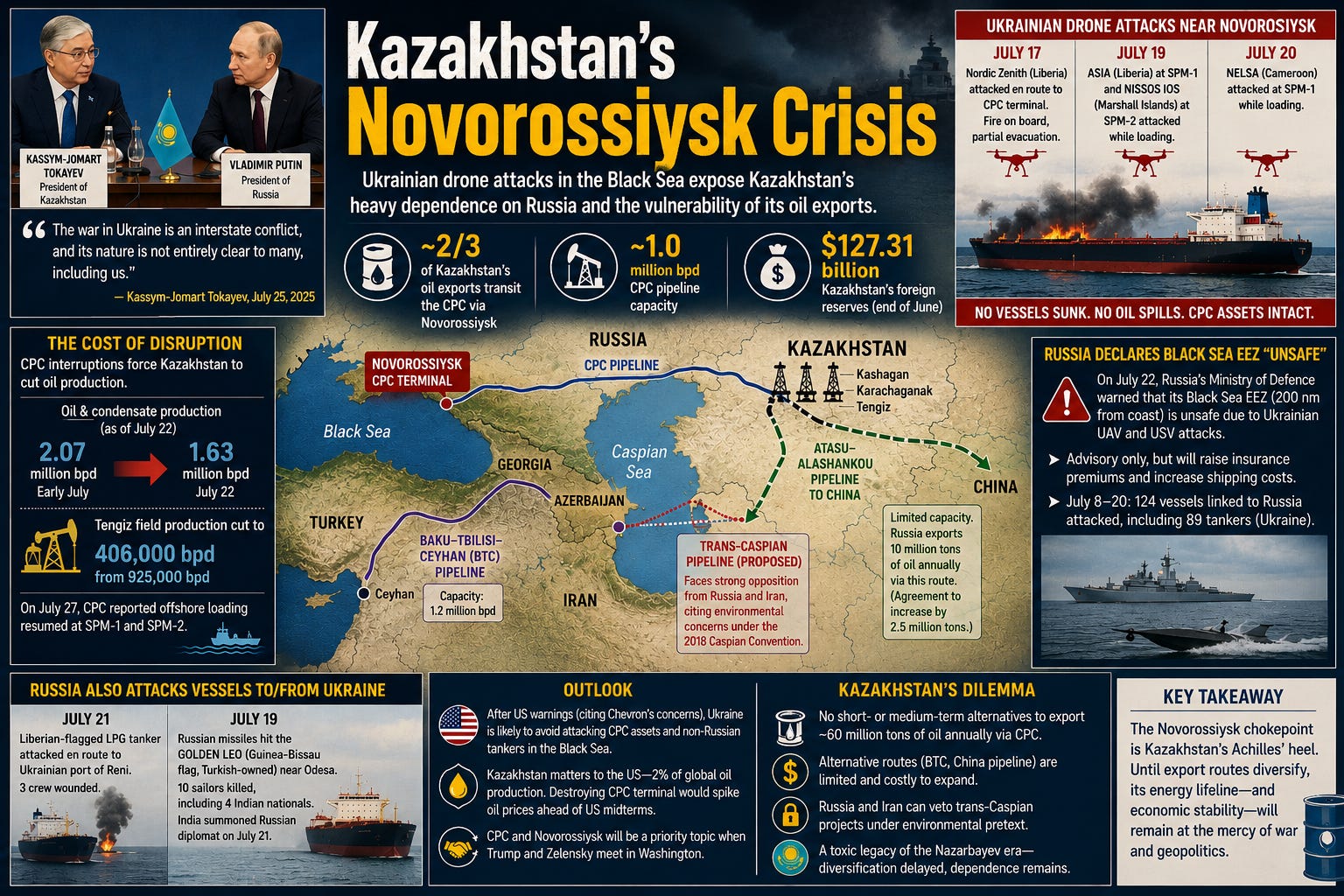
The timing of Tokayev’s remarks reflects the urgency that Kazakhstan feels due to the adverse impact the war has on the operations of the Caspian Pipeline Consortium (CPC) at Russia’s Black Sea port of Novorossiysk. Kazakhstan is vitally dependent on the uninterrupted operations of the CPC’s Yuzhnaya Ozereyevka terminal near Novorossiysk because roughly two thirds of its oil exports reach global energy markets (mainly Europe) through that chokepoint.
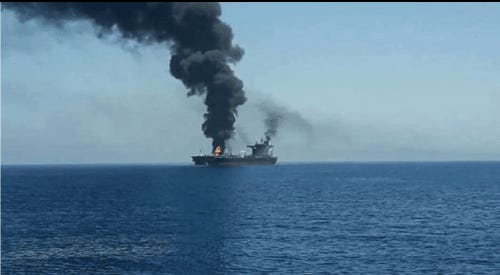
On July 17, a news report, citing the CPC’s Telegram channel, noted that the ExxonMobil-chartered tanker Nordic Zenith (sailing under the Liberian flag) was attacked by two drones en route to the CPC terminal, where it was scheduled to load Kazakh oil. The drones caused a fire aboard the vessel, leading to the partial evacuation of the crew, but the vessel remained afloat. On July 19–20, more tankers came under Unmanned Aerial Vehicle (UAV) attacks, according to two press releases issued by the CPC. On July 19, the Liberian-flagged ASIA and Marshall Islands-flagged NISSOS IOS were attacked by UAVs while they were loading from the CPC’s single point moorings (SPMs) 1 and 2. On July 20, the Cameroon-flagged tanker NELSA was attacked by UAVs as it was loading at SPM-1. None of these attacks resulted in any sunk vessels, oil spills, or damage to the CPC’s assets, including SPM-1 and SPM-2. Interestingly, neither the CPC press releases nor the press statement released by Kazakhstan’s Ministry of Foreign Affairs on July 19 mention Ukraine by name.
Kazakhstan’s Black Sea Nightmare
The attacks prompted the CPC to temporarily suspend its operations. However, because Kazakhstan is so dependent on Novorossiysk for its oil exports, any disruptions at the CPC terminal imply that oil production at its three main oil fields—Kashagan, Karachaganak, and Tengiz—must be reduced. On July 23, Kazakhstan’s Ministry of Energy announced that a “controlled adjustment” of production levels had been introduced without specifying its scale. Nonetheless, two anonymous industry sources told Reuters that, as of July 22, the extraction of oil and gas condensate in Kazakhstan had contracted to 1.63 million barrels a day (compared to the daily average of 2.07 million since the start of the month). Per these accounts, daily oil production at the Tengiz field had to be lowered to 406,000 barrels on July 22, instead of 925,000.
On July 27, Reuters reported that CPC interruptions resulted in oil production being halved in Kazakhstan. Chevron owns a 15% stake in the CPC and a 50% stake in the Tengizchevroil international consortium that is developing the Tengiz field, which explains why Chevron raised its concerns with the Trump administration, as reported by The Wall Street Journal on July 24.
Kazakhstan can certainly withstand short-term CPC interruptions, even if they stretch into weeks or months, because it has ample foreign currency and gold reserves, which, as of the end of June, stood at $127.31 billion, according to the National Bank of Kazakhstan. Commenting on the CPC interruptions on July 24, the Chairman of the National Bank, Timur Suleymenov, stated that Kazakhstan’s central bank was ready to stabilize the exchange rate, if necessary. It appears that the crisis has been averted, as Kazakhstan’s Ministry of Energy reported on July 27 that the offshore loading of tankers had resumed at the CPC’s SPM-1 and SPM-2. In particular, the Liberian-flagged tanker SEA MAJESTY and the Greek-flagged tanker Milos were receiving Kazakh oil (belonging to Tengizchevroil) without any interruptions. While Kazakhstan and US energy majors can breathe a sigh of relief, their critical dependence on the CPC remains unchanged.
No short- or even medium-term solutions exist to fix this problem, as Kazakhstan sends about 60 million tons of oil for export via the CPC on an annual basis. Given the existing pipeline topography in the region, namely that the Baku–Tbilisi–Ceyhan (BTC) and/or Atasu–Alashankou pipelines (to China) are limited in their export capabilities, it is simply not possible to reroute this much oil via these energy outlets. BTC capacity is 1.2 million barrels per day (bpd), while the CPC pipeline is 1 million bpd, and any effort to reroute additional oil from this overland pipeline to Azerbaijan via the Caspian is virtually impossible.
These logistical bottlenecks are further exacerbated by the surprising announcement of the Russian Ministry of Defense on July 22, according to which Russia’s exclusive economic zone (EEZ), extending 200 nautical miles from the coast, has been declared unsafe for commercial navigation due to attacks by Ukrainian UAVs and seaborne USVs (unmanned surface vehicles). Although this announcement is advisory and does not prohibit vessels from entering Russia’s EEZ in the Black Sea, it will definitely increase insurance premiums, making maritime transportation of all cargo, including oil, more expensive. It reflects the continuously deteriorating maritime security situation in the northern part of the Black Sea, where, according to the Ukrainian military, 124 vessels linked to Russia were attacked between July 8 and July 20, including 89 tankers, as quoted by Bloomberg on July 23.
Meanwhile, Russia is also not sitting idly by. It is regularly attacking vessels carrying cargo to and from Ukraine. On July 21, for example, it attacked a Liberian-flagged LPG tanker en route to the Ukrainian port of Reni, wounding three crew members, Agence France-Presse reports. On July 19, in the gravest maritime attack to date, Russia launched three Kh-59/Kh-69 cruise missiles against the Guinea-Bissau-flagged (and Turkish-owned) bulk carrier GOLDEN LEO (carrying grain) in close proximity to the port of Odesa, killing ten sailors, including four Indian nationals, and prompting the Indian government to summon the Russian Chargé d’Affaires, Mr Vladimir Ladanov, on July 21.
Outlook
Following the formal warning that Ukrainian authorities reportedly received from the Trump administration late last week not to attack CPC assets and non-Russian tankers in the Black Sea due to concerns expressed by the CEO of Chevron, Mike Wirth, it is very likely that Ukraine will comply. Officials in Ukraine are eager to capitalize on the US commitments made after the NATO summit in Ankara on July 7–8, including the license to manufacture interceptor missiles for Patriot air defense systems that are vital for shooting down Russian missiles. Thus, Kyiv would not want to jeopardize this positive momentum in its at times tumultuous relations with Washington.
Kazakhstan greatly matters to the United States because it accounts for 2% of global oil production. Knocking Kazakhstan’s oil exports offline by destroying the CPC terminal (all three SPMs) would increase oil prices, which is something that the White House is keen to avoid, especially ahead of the contentious midterm elections in the United States in November. It is almost certain that the CPC and Novorossiysk are a priority issue to be discussed by Trump and Zelensky when they met in Washington earlier today.
As for Kazakhstan’s options, there is a trans-Caspian pipeline project that would leave Russia out, connecting Kazakhstan to Azerbaijan across the Caspian seabed, but here the biggest impediments will be Russia and Iran. The Caspian littoral states abide by the 2018 Convention on the Legal Status of the Caspian Sea, which contains clauses that both Russia and Iran interpret as allowing them to veto any trans-Caspian projects under the pretext of environmental concerns.
Russia will do everything within its power to derail any pipeline project that would reduce Kazakhstan’s dependence on the CPC and Novorossiysk. This includes Kazakhstan’s oil pipeline to China, which has limited throughput capacity and would have to be significantly expanded, requiring considerable capital investment. More importantly, at present Russia uses the Atasu–Alashankou pipeline to export 10 million tons of oil annually to China via Kazakhstan. In fact, Kazakhstan and Russia signed an agreement only recently to increase this volume by 2.5 million tons.
Lastly, Kazakhstan’s predicament is the toxic legacy of Nursultan Nazarbayev, Kazakhstan’s First President, who failed to see the wisdom of maintaining diverse oil export routes. Although Tokayev has consistently spoken of the need to diversify oil export routes since assuming the presidency in 2019, little has been done in practice apart from the modest volumes sent in transit via the Baku-Tbilisi Ceyhan pipeline.
About the Author:
Alex Melikishvili is a senior country risk analyst with more than a decade of experience working in the private sector (S&P Global, IHS Markit) with a focus on Eurasian security. Alex holds a master’s degree in International Affairs from the George Washington University’s Elliott School of International Affairs.
Thank you for your support! Please remember that The Saratoga Foundation is a non-profit 501(c)(3) organization. Your donations are fully tax-deductible. If you seek to support The Saratoga Foundation, you can make a one-time donation by clicking on the PayPal link below! You can also subscribe to our website to support our work.
https://www.paypal.com/donate/?hosted_button_id=XFCZDX6YVTVKA