

BRIEFS
Russian Tourists Flock to China as Blagovechensk Creates Cable Car Crossing to Heihe
The Russian newspaper Novaya Gazeta recently featured a candid discussion with Boris Beloborodov, the business ombudsman for the Amur Region, that sheds light on the lopsided tourism relations emerging between Russia and China in recent months in the key Siberian border city of Blagoveshchensk. One of the most striking revelations from the article is the dramatic surge in Russians flocking to China as tourists, while Chinese tourism is cooling.
According to the latest figures from 2025, outbound trips by Russians to China climbed by 33.6%, fueled largely by the introduction of a mutual visa-free regime. In the Amur Region specifically, the imbalance is stark; during the recent New Year holiday period, approximately 22,000 Russians crossed into China via Blagoveshchensk, while only about 8,000 Chinese visitors made the trip in the opposite direction. Despite the one-sided tourism flow, trade connectivity between Blagoveshchensk and the Chinese border city of Heihe remains a critical pillar of the regional economy. The cross-border highway bridge continues to ensure a steady flow of cargo even as personal travel patterns shift. Cross-border ties will be further inter-connected with the launching of the world’s first cross-border cable car, potentially transporting up to 2.5 million passengers a year.
Moscow Breaks Record with Largest Ever Chinese New Year Celebration
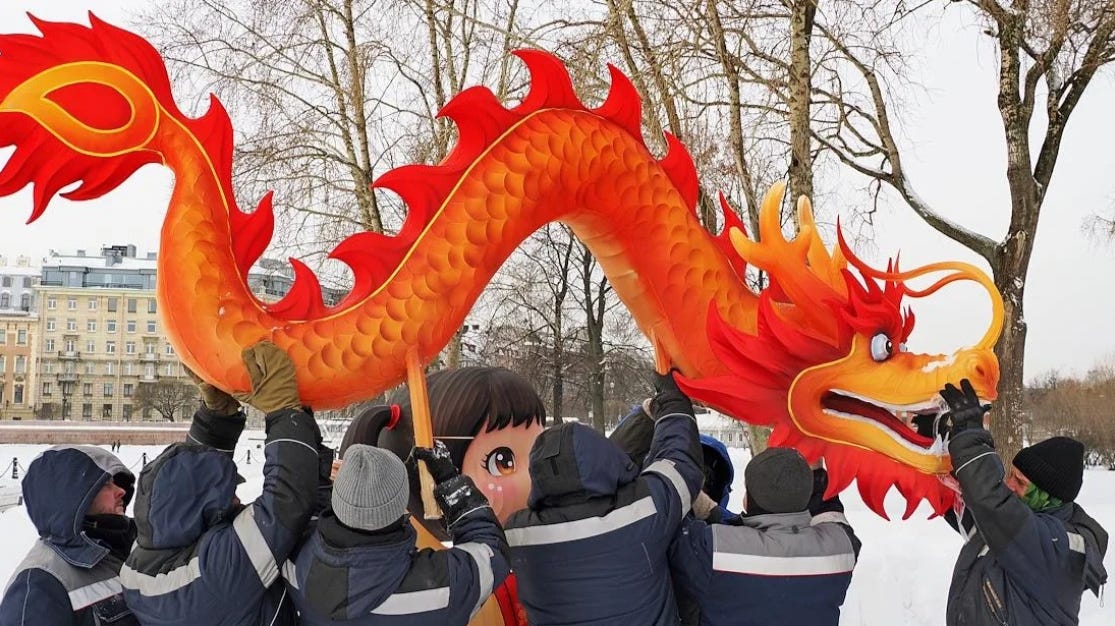
In February Moscow hosted its largest ever celebration of the Chinese (Lunar) New Year, drawing unprecedented numbers of Russian residents and visitors to the capital’s streets and public spaces. The annual “Chinese New Year in Moscow” festival — now in its third year — has rapidly expanded into a major international cultural event, featuring traditional performances, martial arts displays, tea ceremonies, street parades, and themed installations across dozens of venues throughout the city.
City officials reported that previous editions of the festival drew approximately 1.5 million attendees, roughly double the turnout from its inaugural year, making it one of Moscow’s most popular cultural gatherings. Residents and tourists alike embraced the vibrant festivities, while Russian diplomatic and cultural figures highlighted the event as a symbol of deepening ties between Russia and China. The celebration coincides with broader public interest in the Spring Festival; recent surveys indicate millions of Russians now engage with Chinese New Year traditions, reflecting growing cultural Sinicization of Russian elites.
Moscow’s VAT Reform Accelerates “Kitaizatsiya” of Siberia and the Far East
To extract more money from the Russian people to pay for Putin’s war in Ukraine, the Russian government announced at the end of last year that beginning in 2026, it would no longer allow small and mid-sized businesses to avoid paying Value Added Tax (VAT). This move caused many companies in Moscow and other large Russian cities to become unprofitable and even pushed some into bankruptcy, a development that sparked protests by the firms and their customers who could no longer go to their favorite restaurants or bakeries.
The new tax measure, however, has had a far more serious impact on Russian businesses east of the Urals because now they are being forced to pay VAT and must raise their prices. These businesses are increasingly being driven into bankruptcy by Chinese firms, who, being importers, are not subject to this tax. There have been some protests in that region as well, but these have received less attention than those in the capitals. The Kremlin has done nothing in response, something that ensures in the short term that Chinese firms will see their profits in Russia rise and over time will form an even larger share of the economy in Siberia and the Russian Far East, —an as yet unacknowledged and, in this case, rapid further Kitaizatsiya of Russia.
Under the new tax regime, many of the thousands of Russian entrepreneurs who operated under a simplified tax structure will now have to behave the way their larger counterparts have done up to now. In Moscow and St. Petersburg, that has led to closures and bankruptcies; but in Russia east of the Urals, it has had an even more dramatic consequence. Goods produced in China and then exported to the Russian Federation are not subject to VAT and thus can be priced well below what equivalent products of Russian outlets are. Both Russian businessmen and Russian consumers are upset and demanding that the government intervene to make the rules of the game fair.
According to the Nakanune portal, Russian officials are currently looking for a solution that will involve either imposing VAT on imports or modifying plans to require ever smaller Russian firms to pay this tax. However, imposing VAT on Chinese imports would be very unpopular with Beijing and thus threaten Moscow’s ties with China. Delaying the imposition of VAT on domestic firms would prevent the Kremlin from raising the money it needs for its military operations. Consequently, doing anything about this apparently unintended consequence of the change in Russian tax law is unlikely to happen anytime soon. And many Russian firms are likely to be replaced by Chinese ones in the period before Moscow can make a decision or even recognize what is happening.
This situation is only going to become worse for Russian firms and better for Chinese ones in the coming years unless the center changes its approach. That is because Moscow’s tax rules specify that the amount Russian firms have to earn will continue to decline, hitting more and more Russian small businesses, especially in the consumer area, where, as Russian officials in the region acknowledge, the Chinese have even more advantages. After all, they are service-oriented and operate on the basis of the principle that the customer is always right. That makes such Chinese firms even more welcome in Russian areas, even as it infuriates Russian businesses who see their market share shrink or even disappear altogether. Officials are trying to put the best face on things, saying that the influx of Chinese businesses has slowed; but what Moscow has done with VAT suggests that such propaganda efforts are unlikely to be believed, that Russian businesses are likely to be more alienated from the Kremlin over time, and that managing the influx of Chinese businesses into Russia is going to be an ever-increasing problem for both Moscow and Russian governments in the regions.
Conclusion
Russian firms in Siberia and the Russian Far East are especially outraged that the Chinese firms, who have been undercutting them in price are seeking to boost their sales in those regions by offering their sales representatives unprecedentedly high bonuses for acquiring new clients. Russian firms have never been in a position to match them, and with the new taxes in place, they are even less so. Consequently, what may have begun as part of a Kremlin plan to obtain more money for the war in Ukraine is rapidly developing into what many Russians may find undesirable, but that Moscow apparently cannot do anything about: the replacement of Russian firms by Chinese ones on what is today Russian territory. This is exactly the kind of Kitaizatsiya of a large swath of the Russian Federation that Moscow says it is against but is wittingly or unwittingly promoting through its policies.
Kamchatka: From “Pacific Bastion” to China’s Near Abroad
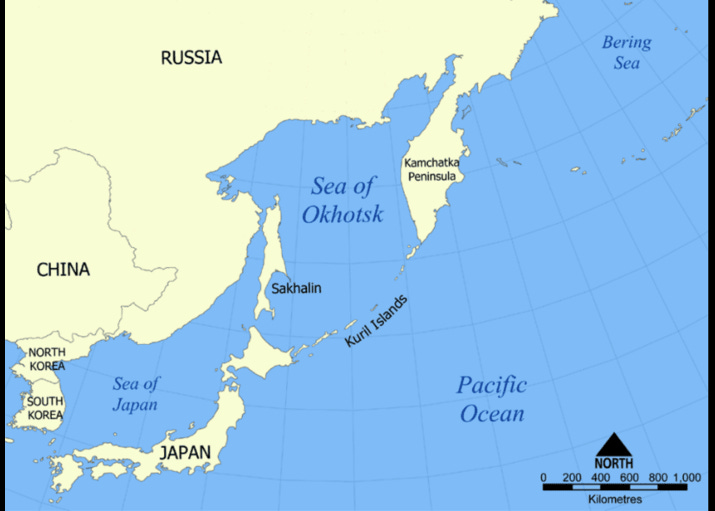
Kamchatka occupies a uniquely significant place in Russia’s strategic calculus. The peninsula anchors Russia’s eastern maritime frontier, serving as a gateway to Indo-Pacific markets and key Pacific sea-lanes vital for trade and resource access. Kamchatka’s fishing, maritime, and natural resource sectors remain core elements of the regional economy, underpinning Russia’s Far Eastern development agenda in the post-2022 period. Though remote, this highly strategic region in the Far East holds economic, logistical, and geopolitical importance for several reasons:
First, geostrategically, Kamchatka sits astride the Bering Strait–Pacific axis, which means that control over its adjacent waters enables Russia to oversee northern approaches to the Pacific and project influence between the Arctic and Asia-Pacific theaters. This positioning is critical for Moscow’s broader northern strategy, which integrates Arctic and Far Eastern defense priorities.
Second, from a military-security perspective, Kamchatka hosts critical installations of the Russian armed forces. The Petropavlovsk-Kamchatsky naval base underpins Pacific Fleet operations, and the region’s remoteness has long made it an ideal site for strategic assets such as the Kura Missile Test Range. These facilities strengthen Russia’s second-strike capabilities and secure its eastern deterrent posture. Historical episodes of defense – such as resistance to Anglo-French forces (August–September 1854) during the Crimean War – underscore the peninsula’s enduring role in safeguarding national security and sovereignty.
Overall, Kamchatka’s significance for Russia derives from its economic resources, critical transit and maritime geography, and its embedded role within Moscow’s defense architecture, making it a linchpin of Russian strategic depth in the Far East.
Since the outbreak of the Ukraine war in 2022 and the onset of Western sanctions, the Kamchatka region has emerged as a strategic linchpin in Russia’s Northern Sea Route (NSR) and an integral component of Moscow’s eastward pivot. At the same time, Chinese dominance in the region has become increasingly pronounced, as Beijing effectively assumes the role of an indispensable partner in several key economic sectors in Kamchatka.
Despite Russia’s apparent willingness to allow China to expand its footprint and deepen its involvement in the regional economic landscape, the nature of Chinese leverage over Moscow’s Pacific outpost is becoming increasingly complex. This raises a central question: is Chinese influence in Kamchatka strengthening to the point of creating strategic vulnerability for Russia — and, if so, what steps is Moscow taking to mitigate or counterbalance this emerging risk?
China’s Fishing Sector Pivot from the EU to Kamchatka
On January 15, China’s General Administration of Customs authorized thirteen additional Russian fishing companies to supply products to the Chinese market. Notably, three of these companies are based in Kamchatka. According to data from Rosselkhoznadzor, Russia exported more than 1.5 million tons of fish and seafood in 2025, with over half of that volume (843,000 tons) destined for China, resulting in a 13 percent y-o-y growth. At the same time, China has reduced its seafood imports from the European Union (EU) and the United States (US), citing tariff disputes and rising shipping costs driven by higher fuel prices.
What this emerging trend symbolizes is that China is starting to consolidate its position as Kamchatka’s dominant external market, logistical partner, and technological substitute. While Moscow retains formal ownership of strategic assets, Beijing is expanding its role across key economic sectors, which is evolving into tangible leverage. The following analysis below reveals the primary industries where Chinese involvement has intensified most notably and evaluates whether this growing footprint represents a form of managed collaboration or the development of a permanent structural dependency.
First, logistics – presence without ownership. After 2022, Kamchatka has increasingly been viewed as a potential transshipment and service hub for the Northern Sea Route (NSR) in the context of growing Chinese logistical interests. These interests primarily concern ship repair, cargo transshipment, and the use of its warehouses. A notable practical step in this direction was the signing of a memorandum on September 4, 2024, at the Eastern Economic Forum (EEF) between the Kamchatka Chamber of Commerce and Industry, the Kamchatka-based company Torsiotest, and China’s NewNew Shipping Line Co., Ltd.
The agreement envisions the development of ship repair facilities in Petropavlovsk-Kamchatsky and the organization of cargo transshipment along NSR routes through Kamchatka. Despite the notable media attention surrounding the agreement, its practical significance appears to be quite limited. The document was explicitly framed as a “memorandum of intent”, which by definition does not entail binding strategic commitments from either side. Rather, it signals exploratory cooperation and a willingness to consider future projects, without formalizing investment obligations or operational timelines. Moreover, as of early 2026, there have been no widely reported follow-up announcements in the Russian media regarding the concrete implementation of the original Kamchatka–Torsiotest–NewNew Shipping Line agreement. In this context, the memorandum appears more indicative of political signaling and strategic positioning than of immediate structural change in Kamchatka’s maritime infrastructure landscape.
Another notable trend that may limit China’s ability to influence Kamchatka`s logistical capabilities is a clear trend in Moscow’s efforts to strengthen its control over the local port as part of a hedging strategy to prevent China from acquiring too much influence. To illustrate this point, Russian sources recently reported a number of cases when related port assets were transferred into state ownership, with several key facilities being placed under the direct management of Rosatom-affiliated structures in a pre-emptive move aimed at warding off Chinese economic encroachment. In 2025, for example, the FESCO transportation group assumed management of the Kamchatka Shipping Company and the Petropavlovsk-Kamchatsky Commercial Sea Port. This suggests that Moscow’s strategic approach to the Chinese presence in Kamchatka’s logistical structure is governed by the principle of “participation minus legal authority.” Under this framework, Chinese involvement is strictly limited to service contracts, cargo handling, and joint logistical projects. This structure ensures that while Beijing provides essential operational support, it is prevented from acquiring formal authority or jurisdiction over critical regional infrastructure.
Second, fisheries: where dependence might become leverage. As noted earlier, Kamchatka is one of Russia’s most significant fisheries regions, and China is its top customer. In the post-2022 period, Russia has undertaken a major effort to further increase these exports, acting primarily through local officials. For instance, the governor of Kamchatka personally promoted regional fish products and potential investments during his 2023 trip to the China Fisheries & Seafood Expo in Qingdao.
The situation in this instance appears to resemble an elaborate chess game being played between Moscow and Beijing. China, on the one hand, appears intent on securing effective control over the value chain surrounding Kamchatka’s seafood exports, while Russia seeks to preserve its room for maneuver to prevent Beijing from deepening its structural presence in the region. Since 2022, Beijing has concentrated on consolidating the most critical elements of processing and logistics infrastructure on its own territory rather than on Kamchatka itself. This includes transportation nodes, customs corridors, and reception hubs—most notably in Hunchun and Shanghai—which have been specifically calibrated for the specific purpose of processing Kamchatka-originated seafood.
In effect, the higher value-added stages of processing, distribution, and re-export are increasingly anchored within China’s domestic infrastructure network. Kamchatka, by contrast, remains primarily a source of raw material. This configuration allows Beijing to exercise influence not through asset ownership in Russia, but through its command over downstream logistics, processing capacity, and market access. Notably, Russian language sources do not report any major new Chinese capital investments in Kamchatka-based fisheries logistics since 2022. Instead, China is concentrating its efforts on placing critical logistical nodes—such as the Hunchun checkpoint in Jilin Province—in other words, on Chinese territory.
Russia’s Upstream Sovereignty versus China’s Downstream Influence
While China has emerged as the largest buyer of Russian fish and crab products, Moscow seeks to retain the decisive lever of control: authority over the extraction of resources. Russia aims to prevent Chinese firms from establishing a direct foothold in this upstream segment, as control over production remains the cornerstone of its resource sovereignty. Yet, due to the fact that Moscow’s position vis-à-vis China has weakened, Beijing has been given a more potent form of leverage. By consolidating its position as the primary end market and the hub of downstream processing, Beijing has secured structural influence over the entire value chain, placing Moscow at a tremendous disadvantage.
This trajectory, however, is not predetermined. A hypothetical partial normalization of Russia’s relations with the United States and other Indo-Pacific actors could reopen alternative export channels to markets such as the U.S., Japan, and South Korea. Such a shift would dilute China’s current leverage and restore a degree of strategic flexibility to Kamchatka’s fisheries industry.
Third, energy resources and related infrastructure. Kamchatka does not have a significant amount of fossil fuels and hydrocarbons; yet, its potential role and place in China’s energy mix should be seen as very promising and is occasionally overlooked by experts in the West. In this regard, two types of opportunities should be examined more closely:
Kamchatka’s elevation as a critical node in the Sino-Russian LNG trade. Following the outbreak of the Russia-Ukraine war in 2022, Russia reprioritized the idea of turning Bechevinskaya Bay into a major logistics “node” linking Arctic LNG with Indo-Pacific markets, with reported interest from China. Mid-2024 saw Russian sources claim that notable progress in the infrastructure buildup had been achieved. However, the following year, Russian information outlets pointed to an emerging gap between actual progress and intent. For instance, Russia’s Accounts Chamber warned of risks regarding revised deadlines, citing delays and documentation problems. As of early 2026, Russian experts claimed that while the export dimension has not lost its importance, key stakeholders (Gazprom and Novatek) agreed to focus more on Kamchatka’s internal gas infrastructure development. This means the LNG terminal’s operational logic is no longer fully concerned with export logistics—an issue of major domestic political sensitivity, especially in the face of upcoming elections.
Geothermal energy. This is where Kamchatka has huge and largely unexplored potential. In late 2025, following the Russian-Chinese Energy Business Forum, several Chinese firms reportedly indicated interest in taking part in geothermal projects in Kamchatka. While there have not been any public confirmations of Chinese financial involvement, this idea matches broader patterns of overseas Chinese investment in projects related to green and renewable energy.
Conclusion: Is Kamchatka China’s New Near Abroad?
In the final analysis, three aspects regarding Kamchatka’s important role in Sino-Russian relations should be addressed:
First, Russia’s post-2022 trajectory creates the conditions for growing strategic asymmetry, which poses structural risks for the Russian Far East broadly and for Kamchatka in particular. As Moscow’s access to Western markets, capital, and technology has declined, its bargaining position vis-à-vis Beijing has correspondingly weakened. This has increased the likelihood of a lopsided partnership. Kremlin efforts to restrict formal Chinese ownership of strategic assets – while being a prudent hedging mechanism – do not eliminate this vulnerability. On the contrary, limiting equity participation while expanding trade, financial exposure, infrastructure integration, and technological dependence risks producing a de facto dependency without de jure control. Such an arrangement would constrain Russian autonomy while providing few enforceable safeguards against long-term leverage. In case Russia is unable to (at least partially) normalize or diversify economic and political ties with alternative centers of growth and trade, dependence on China is likely to assume more pronounced and potentially destabilizing forms. Under these conditions, Kamchatka could increasingly fall within China’s near abroad, functioning as part of Beijing’s expanding economic periphery, with significant demographic, political, and security repercussions for the Russian state.
Second, despite China’s growing role as the principal destination for goods produced in Kamchatka, so far, Russia has prevented economic dependence from evolving into formal institutional subordination, for now. Moscow has systematically constrained the depth of Chinese penetration by nationalizing critical infrastructure, tightening regulatory oversight, and maintaining state control over strategic assets. As a result, despite expanding trade asymmetries and Beijing’s increasing economic weight, Kamchatka has not emerged as an uncontested zone of Chinese influence. Instead, it is evolving into an economically dependent export appendage with limited diversification options and constrained access to alternative markets. While preserving nominal sovereignty and institutional control, this arrangement leaves the region structurally dependent on Chinese demand and pricing power—an asymmetry with enduring strategic consequences for Russia’s Far Eastern periphery.
Third, there are signs that Moscow is increasingly aware of the long-term risks of ceding economic space in Kamchatka to China. On January 4, Aleksey Chekunkov, Minister for the Development of the Russian Far East and Arctic, publicly invited international investors to “fully utilize the new investment-attraction mechanism of the International Advanced Development Zones (IADs).” This preferential regime, which came into effect on January 1, 2026, aims to diversify capital inflows and reduce dependence on a single external partner. The IAD framework covers Primorsky Krai, Khabarovsk Krai, Amur Oblast, Zabaykalsky Krai, and the Jewish Autonomous Oblast. Notably, however, Kamchatka was absent from this list—a deliberate omission with potentially significant strategic implications. On one hand, it may reflect Moscow’s desire to maintain tighter centralized control over a peninsula of high military and geopolitical value, particularly given its role in Russian posture in the Pacific. On the other hand, excluding Kamchatka from the preferential regime risks reinforcing its narrow export focus and continued reliance on Chinese demand. In effect, while the Kremlin signals awareness of the dangers of overdependence on Beijing, its selective application of diversification tools may inadvertently deepen the very structural imbalances it seeks to address.
Thank you for your support! Please remember that The Saratoga Foundation is a non-profit 501(c)(3) organization. Your donations are fully tax-deductible. If you seek to support The Saratoga Foundation, you can make a donation by clicking on the PayPal link below! Alternatively, you can also choose to subscribe on our website to support our work.
https://www.paypal.com/donate/?hosted_button_id=XFCZDX6YVTVKA
Thanks for reading! This post is public, so feel free to share it.