
BRIEFS
Pipeline in Limbo: Putin Fails to Convince Xi for 5th Time in 4 Years to Back Power of Siberia-2 Gas Project
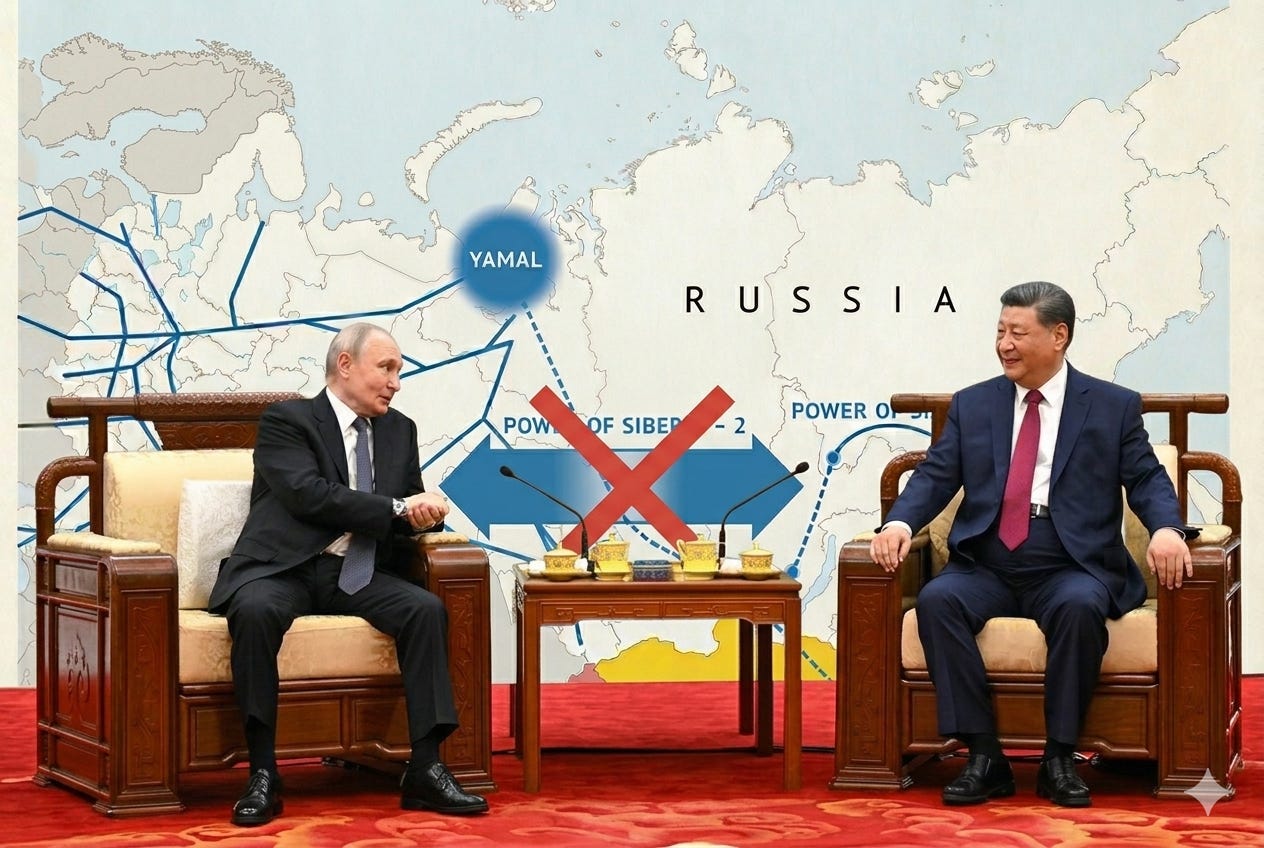
Russian President Vladimir Putin’s highly anticipated May 19-20 visit to China failed once again to reach a breakthrough on the “Power of Siberia 2” gas pipeline project. Despite the pomp and high-level engagement characteristic of the Putin-Xi summit between President Putin and Chinese leader Xi Jinping, the discussions surrounding the critical energy infrastructure project remained stalled by deep-seated commercial disagreements.
The Power of Siberia 2 pipeline has been under discussion for over a decade and is envisioned as a central pillar of the Russia-China energy axis. Designed to transport 100 billion cubic meters of natural gas annually from Siberia to China, the project is seen as a lifeline for Russia’s state-owned energy giant, Gazprom. Following the loss of its lucrative European gas market in the wake of the invasion of Ukraine, Moscow has become increasingly desperate to pivot its energy exports eastward.
However, despite Putin bringing a massive delegation to Beijing—which included five deputy prime ministers, eight ministers, and the heads of key state-owned enterprises such as Gazprom and Rosneft—the talks failed to produce the necessary signatures. Dmitry Peskov, the presidential press secretary, acknowledged the impasse, noting that while the “basic parameters of understanding” and the physical route of the proposed pipeline have been finalized, the project’s critical timeline remains unresolved.
“Some nuances remain to be ironed out,” Peskov told reporters. “There’s nothing clear yet. This is commercial information, after all. But it’s quite a significant achievement.” This rhetoric stood in stark contrast to the tangible results of the trip. According to the Kremlin.ru website, Moscow and Beijing successfully signed 40 bilateral documents during the visit. But a review of the Kremlin’s official list reveals a striking omission: not a single document pertains to the Power of Siberia 2 project or new cooperation in the oil and gas sector.
The Price Stumbling Block
The fundamental deadlock centers on the price of the gas. According to sources familiar with the negotiations, China is utilizing its leverage as the only viable major buyer for Russia’s diverted gas volumes to demand substantial price concessions. Beijing is reportedly pushing for a price point close to the domestic Russian market, which is roughly $50 per thousand cubic meters. This demand is staggering compared to current market realities; it is five times lower than what Beijing currently pays for Russian gas ($258) and more than eight times lower than the prices Gazprom secures from other international customers ($420). For Gazprom, which has faced severe financial strain following its decoupling from Europe, accepting such a price would be a major economic blow. However, analysts suggest that Moscow has very few alternatives, leaving the Russian side in a weak negotiating position.
Strategic Hedging by Beijing
Beyond the immediate financial friction, broader strategic concerns appear to be complicating the deal. Sources indicate that Beijing is increasingly cautious about committing to further long-term gas purchase obligations. There is a growing concern among Chinese policymakers that domestic gas demand in China may have already peaked, or is close to doing so, as the country accelerates its transition toward renewable energy sources. China currently imports 38 billion cubic meters of gas from Russia annually. While this already accounts for a significant portion of Gazprom’s total exports to non-CIS countries, the prospect of nearly tripling that dependency via the new pipeline carries risks that Beijing seems hesitant to take on without more favorable economic terms.
“Limitless” Rhetoric vs. Economic Reality
During his stay in Beijing, President Putin spoke grandiosely of the “limitless prospects” of Russian-Chinese cooperation and pledged “uninterrupted” exports of oil, coal, and gas to the Chinese market. However, the lack of movement on the pipeline highlights the inherent asymmetry in the bilateral relationship. While Russia is eager to deepen the partnership to offset Western sanctions and isolation, China remains a pragmatic actor focused on securing energy supplies at favorable prices while avoiding over-reliance on a single, geopolitically exposed source. As the Russian delegation departed Beijing, the absence of an agreement on the pipeline cast a long shadow over the visit, serving as a reminder that for all the talk of a “no-limits” partnership, the pragmatic demands of economics continue to act as a significant brake on Russia’s geopolitical ambitions.
Putin Pivots to Chinese AI During Visit to China
According to the Moscow Times, Russia is increasingly turning to Beijing to bridge a widening gap in the global artificial intelligence race, with the country’s largest lender, Sberbank, explicitly signaling its intent to adopt Chinese semiconductor technology for its AI models. The disclosure came during President Vladimir Putin’s recent May 19-20, 2026, visit to China, where Sberbank CEO Herman Gref accompanied the Russian delegation. While Gref noted that Sberbank’s proprietary neural network, GigaChat, does not yet rely on Chinese hardware, he confirmed that the bank is actively planning to incorporate Chinese chips as development moves forward.
Putin’s pivot marks a tactical response to the major technology constraints Russia has faced since the onset of Western sanctions, which have effectively severed the country’s access to the high-end semiconductors and advanced computing components necessary to compete with the United States and China. Russian strategy appears to be moving beyond simple procurement. Meanwhile, Russia is also attempting to leverage its natural resource advantages to entice Chinese investment in the digital sector. Kirill Dmitriev, head of the Russian Direct Investment Fund (RDIF), is actively promoting Russia as a destination for Chinese-backed data centers.
The Moscow Times newspaper reported that Dmitriev has argued that Russia offers the world’s cheapest energy for high-intensity computing, further noting that building these facilities in the country’s northern regions provides a “free” cooling advantage, negating the massive air conditioning costs typically associated with data centers. Last year, the Russian government integrated the construction of eight massive data centers into a comprehensive, state-mandated infrastructure development plan that runs through 2036. By inviting Chinese partners to build on its soil—and power that infrastructure with cheap domestic energy—Moscow hopes to turn its geographic and energy-related strengths into a lifeline for its struggling domestic AI sector.
Sakha Turns to China for Planes and Irkutsk for Schools When Moscow Can’t Deliver

*Image: A Russian school teacher in Irkutsk appeals to China for help with schools while addressing Russian President Vladimir Putin
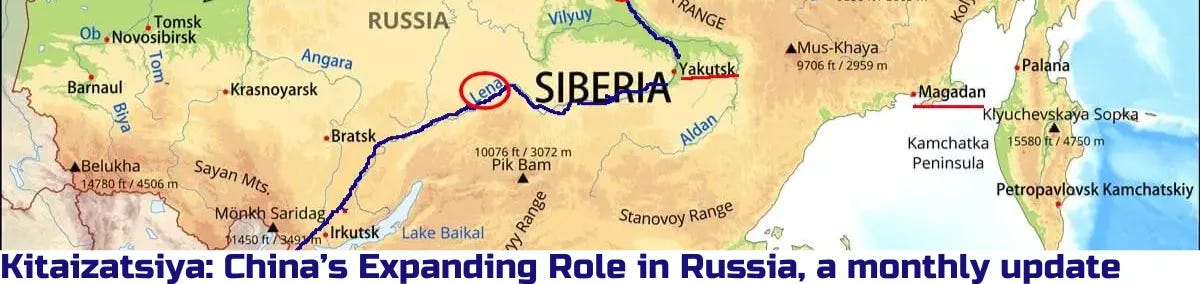
Two cases this month – one in Sakha (Yakutia) and a second in Irkutsk Oblast – highlight a new reality that is certain to be increasingly disturbing to the Kremlin and Russians more generally. In each of these, as in others earlier, when Moscow cannot or will not meet its promises to these regions, their peoples and governments are increasingly turning to China for help. This represents a shift in focus that accelerates Chinese influence and involvement inside the borders of that enormous region, despite the problems some earlier Chinese projects there have faced. Moreover, these two latest cases will only encourage those Chinese analysts who say that while Moscow still can block any moves by these regions and republics toward independence, that is likely going to change, something both Beijing and Moscow need to pay more attention to as their own bilateral relations develop.
The differences between what is happening in Sakha and what is occurring in Irkutsk underscore just how widespread this regional “turn to China” is. In Sakha, officials are outraged that Moscow has not provided them with the type of cold-weather planes they need to cover the enormous republic, with a territory larger than the area of all the countries of the European Union combined. With few options, they have begun negotiations with Beijing for the purchase of planes from China, a move that would further depress the already hard-hit Russian aircraft manufacturing sector and give Beijing both expanded profits and influence in the northern half of Russia east of the Urals.
Moscow analysts are worried that this shift could “lead to the loss of sovereignty over the airspace of Russia” and argue that the Kremlin has only itself to blame because it has not delivered on its numerous past promises. To be sure, this is hyperbolic language, but significantly, it is a clear indication that if Moscow cannot or simply will not supply Siberia and the Russian Far East with what people, businesses, and governments there need. However, these regions do have the option of turning to China, something Moscow can block only at the cost of further economic decline inside Russia and at the risk of offending its key ally in Beijing.
The situation in Irkutsk Oblast is quite different, but if anything is more disturbing as far as Moscow and Russian nationalists are concerned, precisely for that reason. Residents of the Beyozovy micro-district in Irkutsk sent a video appeal to Vladimir Putin in which they said that officials have promised them a new school for five years but not delivered, and asked that the Kremlin leader direct Russian Foreign Minister Sergey Lavrov to ask China to help out, given that it is increasingly apparent that “the Russian Federation is not in a position to do so.” They said that the failure of officials to keep their promises about building a new school meant that their children had to travel by bus to schools in neighboring villages and that local people who had been thinking about having more children, something Putin is pushing, were rethinking any such plans as a result. “How you intend to increase the birthrate in such a situation is for us an enormous mystery,” the residents told Putin.
According to them, “the active expansion of cultural ties with China is the only possibility for us to help Russian parents and their children. To sweeten the deal as far as China is concerned, the Irkutsk Oblast residents said, they were ready to learn Chinese. That would enable these Russians to engage in trade with China and perhaps allow some to move to China or work with Chinese firms already in the Trans-Baikal. None of that can be music to Putin’s ears as he visits Beijing to build his alliance with China.
Outlook
Russian officials are likely going to reassure themselves and the Kremlin that neither of these developments is all that serious. On the one hand, they are certain to point out that Sakha’s purchasing of planes may help the economy of that republic within the borders of the Russian Federation to develop in ways Moscow wants. On the other hand, they have every reason to highlight the fact that the Irkutsk residents did not appeal directly to China but instead asked Moscow to do so on their behalf. Moreover, in both cases, they may point to the problems China has had in fulfilling its promises to the regions and republics east of the Urals and thus say that, however much media attention such actions receive, they are unlikely to lead to the threatening outcomes some in China and the Russian Federation have projected.
But such arguments, while perhaps they will reassure Putin, miss the point. They ignore the fact that people, businesses, and governments in Russia’s federal subjects east of the Urals are hurting and that ever more of them are now asking not that Moscow help them as they have traditionally done in the past but rather have come to view China as their salvation, even if they still ask the central Russian government to help them interact with Beijing. That is “a turn to the east” quite different from the one Putin has sought to execute – and one that suggests a very different future for Moscow, Beijing, and those who live in what is now the Russian Federation east of the Urals.
From Border Region to Chinese-Oriented Logistical Hub: The Strategic Reorientation of Khabarovsk Krai
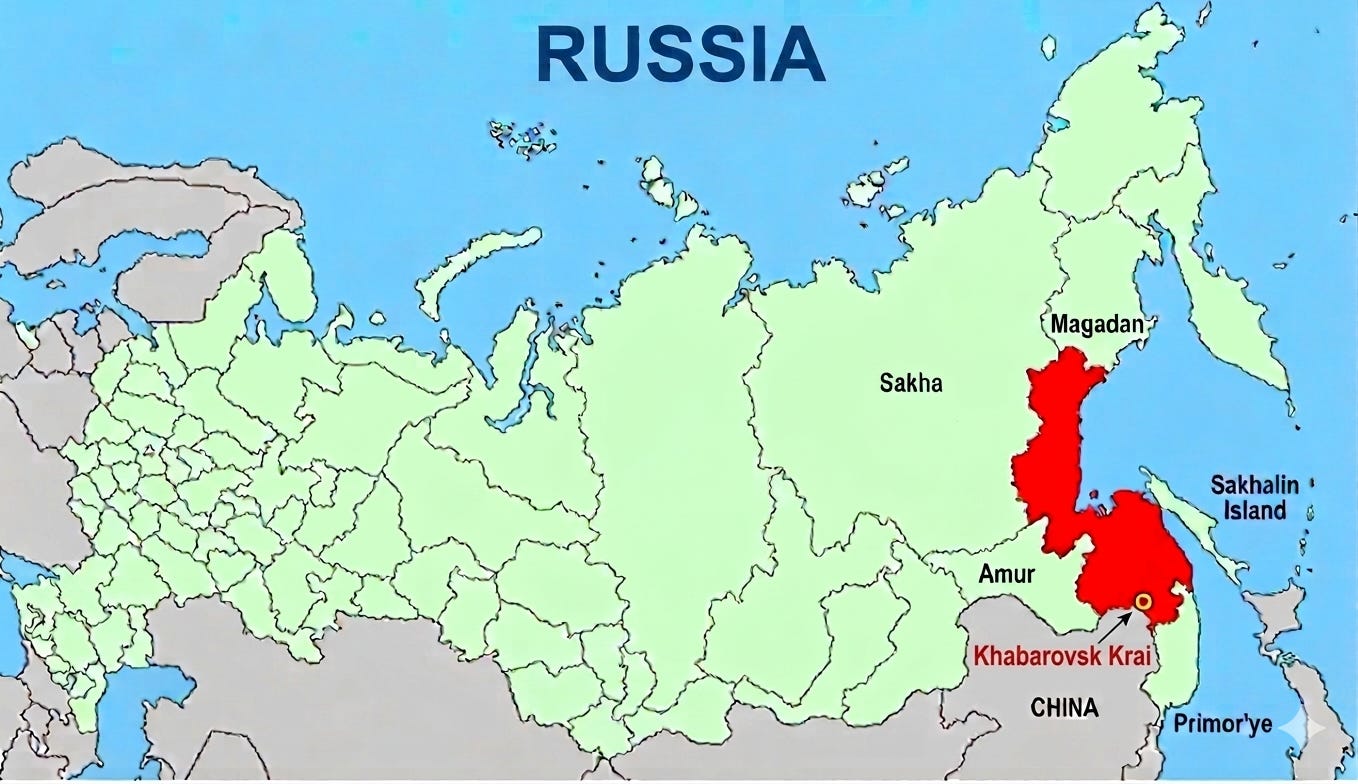
Khabarovsk Krai became part of the Russian Empire during the mid-nineteenth century through treaties with the Qing dynasty in China (1644-1912) and has long held strategic importance for Russia because of its position in the Far East, linking Siberia to the Pacific region and bordering China along the Amur River. Its unique location provided Russia with access to key transportation routes, natural resources, and trade opportunities with Asia-Pacific countries, while the city of Khabarovsk developed into a major industrial and administrative center.
At the same time, the region carries significant geopolitical importance, strengthening Russia’s military presence and political influence in East Asia while helping secure its eastern borders. Historically and ideologically, Khabarovsk Krai symbolizes Russia’s nineteenth-century expansion across Siberia and the Far East, reinforcing the image of Russia as a Eurasian power stretching from Europe to the Pacific Ocean.
Against this strategic backdrop, Khabarovsk Krai has emerged as one of the clearest examples of Russia’s accelerating dependence on China since the invasion of Ukraine in 2022. Prior to the full-scale invasion, Moscow sought to balance Chinese participation in the Russian Far East (RFE) with Japanese and South Korean investment. However, the post-2022 period has fundamentally altered this equation in China’s favor. Beijing has since become the dominant external actor capable—and selectively willing—to finance, supply, and logistically sustain development in the RFE. In this context, Khabarovsk Krai is becoming less integrated into all-Russian development networks centered on Moscow and increasingly oriented toward Chinese transport, trade, and industrial systems linked to Heilongjiang Province and, more broadly, northern China. Formally, the region remains firmly under Russian political control; however, its economic and logistical orientation is progressively becoming more China-focused.
Speaking at the Eastern Economic Forum in Vladivostok in September 2024, Vladimir Putin described the Far East as Russia’s “flagship in the new global economic reality” and specifically underscored the importance of Khabarovsk Krai as a strategic linchpin in Sino-Russian relations that could drive the development of the broader Russian Far East. In practice, however, this “new reality” increasingly signifies a deepening asymmetrical structural dependence on China as Khabarovsk Krai become one of the clearest examples of the erosion of Moscow-centered economic integration in the Russian Far East.
China’s Emerging Presence in Regional Governance and Strategic Planning
One of the clearest indicators of China’s growing foothold in Khabarovsk Krai is the institutional scaling-up of bilateral cooperation mechanisms. Since 2022, regional authorities have significantly intensified cooperation with Chinese provinces, state corporations, logistics firms, and investors. This trend is visible in two principal ways.
First, at the macro level, the trend was exemplified by the Russia-China Forum held in Khabarovsk in May 2025. The event – attended by delegations from the Chinese provinces of Heilongjiang, Liaoning, Guangdong, and Shaanxi – brought together more than 1,000 participants and resulted in dozens of agreements related to logistics, industrial production, transport corridors, tourism, and infrastructure. The forum increasingly appears to be performing important functions more closely associated with governance and strategic coordination rather than purely diplomatic engagement. For example, there are growing indications that Russian and Chinese ministries are de facto jointly coordinating regional infrastructure planning through permanent bilateral mechanisms. What is particularly noteworthy is that following Vladimir Putin’s visit to Beijing in May 2024, Moscow and Beijing signed a “unified concept” for the joint development of Bolshoy Ussuriysky Island near Khabarovsk.
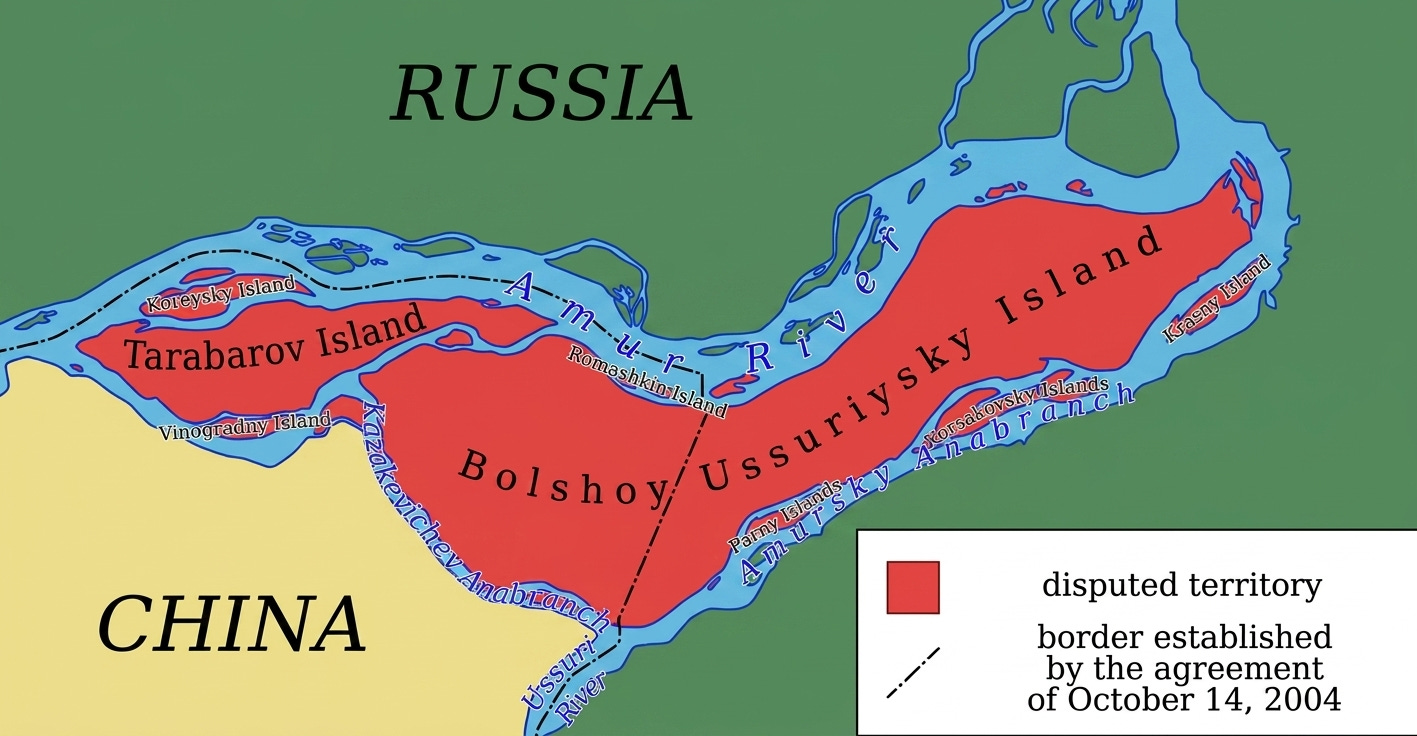
Russian cooperation with China over Bolshoy Ussuriysky Island (known as Heixiazi Island in China) is particularly relevant in terms of its history due to its role in the Sino-Soviet conflict of the 1960s when it became a regional flashpoint during the border conflict with Beijing. Soviet forces occupied the entire island during the 1929 Sino-Soviet conflict and the dispute over the island’s unresolved ownership contributed heavily to the broader 1969 border clashes that erupted along the Ussuri River.
Bolshoi Ussuriysky Island is strategically important because it lies near Khabarovsk at the junction of the Amur and Ussuri Rivers, giving it major value for border security, transportation, and Russian influence in the Far East. The island first surfaced as a source of tension between Russia and China after nineteenth-century treaties between the Russian Empire and Qing China left parts of the frontier unclear, later turning it into a symbol of the Sino-Soviet border dispute during the Cold War. Russia and China formally divided the island through agreements signed in 2004 and implemented in 2008, ending one of their last major territorial disputes. However, controversy resurfaced in 2023 when China’s new official map appeared to show the entire island as being part of Chinese territory, leading to a diplomatic demarche and renewed concerns in Russia about Chinese influence in the Far East.
Therefore, cooperation between China and Russia over the formerly contested island is quite symbolic. The significance behind the unified concept to develop the Island is stipulated by the fact that it effectively institutionalizes Chinese participation in regional development planning inside the RFE. In this context, another important aspect deserves attention. While China’s growing presence in Khabarovsk Krai is indisputable, Moscow’s position and the behavior of local elites appear unusual and difficult to reconcile with the pre-2022 model of Kremlin–regional relations.
Chinese advances in the Khabarovsk region have been strongly facilitated by the position of Governor Dmitry Demeshin (in office since September 13, 2024) who strongly lobbied for the Russia–China Forum to be held in Khabarovsk in its eventual format and contributed to the establishment of mechanisms for developing Bolshoy Ussuriysky Island and strengthening Khabarovsk’s role as a China-centered logistical hub.
Second, the Chinese side is growing increasingly involved in the strategic urban planning and development of Khabarovsk itself. In spring 2026, a delegation from China’s Guangdong Province visited Khabarovsk Krai to explore investment opportunities in several major regional projects. Chinese investors reportedly expressed particular interest in the “Khabarovsk-City” development project, Bolshoy Ussuriysky Island, the Khekhtsir tourism cluster, and a range of infrastructure initiatives in the city of Khabarovsk. Significantly, this reflects a shift beyond the traditional focus on trade and raw materials toward the growing involvement of Chinese capital in urban development, infrastructure modernization, and real estate projects in the Russian Far East. This development points to an important emerging trend: China is not only becoming more deeply involved in urban planning and infrastructure initiatives in Khabarovsk, but a specific Chinese province (Guangdong) is increasingly assuming the role of a quasi-sponsor for the development of one of Russia’s most strategically important border regions.
From Border Zone to Chinese-oriented Logistical Hub
The transformation of border infrastructure in Khabarovsk Krai is particularly significant. Historically, the Russian-Chinese border in this area was designed primarily for seasonal crossings and characterized by relatively limited trade ties. Since 2022, however, the trajectory has shifted toward the permanent integration of Russian and Chinese transport and logistical systems with the center of these operations being located in Bolshoy Ussuriysky Island, due to its role as a key maritime transport hub on the Ussuri River.
In September 2024, Vladimir Putin announced that a major Russian-Chinese logistics project on the island would begin operating as early as 2025. Notably, the joint venture consists of a complex network of dry ports, customs terminals, warehousing facilities, transport corridors, and new border checkpoints integrated with Chinese infrastructure on the opposite side of the border. Moscow has portrayed this development as “a model for working with our [Russia’s] foreign partners.” This shift could carry significant long-term consequences since the new infrastructure is not intended to connect Khabarovsk more closely with European Russia; rather, it physically embeds the region into the transport and logistical networks oriented toward northeastern China. Although Russian official discourse avoids openly framing Sino-Russian cooperation around Bolshoy Ussuriysky Island as a challenge, Russian-language discussions – including among Cossack organizations[1] and nationalist groups – have increasingly revealed concerns about the long-term strategic implications of China’s expanding presence near Khabarovsk.
Special Economic Zones and the Expansion of Chinese Financial Capital
Another major driver of Chinese influence in the Khabarovsk Kari is Moscow’s creation of preferential legal regimes tailored specifically to Chinese investors. The central place is occupied by the so-called “international territories of advanced development” (MTORs) – which officially began operating in 2026 and include Primorsky Krai, Amur Oblast, Zabaykalsky and Khabarovsk Krai, and the Jewish Autonomous Oblast (JAO). In this regard, two aspects should be highlighted
First, the emergence of MTORs reflects the growing lack of alternatives for Moscow and the Kremlin’s inability to attract any other form of financial capital except for Chinese investment. Secondly, Chinese firms are rapidly acquiring a level of leverage that few external actors have enjoyed since the end of the Russian Civil War that concluded in 1920.[2] In effect, Russian authorities are adapting legislation, taxation, customs regulations, and investment protections to meet Chinese requirements—an unprecedented development.
Particularly notable in this trend is that China has shifted from its traditionally cautious approach to a far more assertive posture, increasingly attaching demands and conditions for its participation in these projects. Namely, regional media reported that the Chinese side requested that local authorities impose “additional confidentiality protection” as a key condition for their participation in projects in these zones in a bid to restrict access to commercial information concerning the participants in the International Territory of Advanced Development (MTOR). This could be facilitated through the creation of a closed registry of residents and by limiting disclosure of information in the Unified State Register of Legal Entities (EGRUL). The curious request could be related to a Chinese fear of Western sanctions against Beijing for participating in these projects.
Regardless of the motivation behind these requests, this trend creates long-term structural risk for Moscow: the deeper Chinese companies become embedded in Russian logistics, industry, warehousing, trade, and infrastructure, the harder it becomes for the federal center to reverse this dependence. Over time, local economic elites may become more interested in maintaining stable relations with Chinese investors rather than in following directives and priorities dictated by Moscow.
Industrial Ties: Khabarovsk as China’s “gateway” to Russia’s Far East
Khabarovsk Krai’s growing integration into China-oriented transport and energy corridors further reinforces the broader trend of the region’s gradual economic reorientation toward China. In the energy sector, China’s expanding presence in Khabarovsk Krai has increasingly evolved from primarily commercial trade toward long-term infrastructural and industrial projects. The most notable development is the planned construction of a Chinese-backed LNG plant in the region, announced in 2025 and oriented primarily toward exports to northeastern Chinese provinces. This project illustrates how the regional energy sector is becoming progressively integrated into supply chains driven by Chinese demand and capital.
In the realm of energy-related industrial cooperation, the trend toward China’s expanding footprint is arguably even more significant and far-reaching. Chinese companies such as Pry Engine China Co., Ltd. and Taizhou Jinte Electromechanical Co., Ltd. are moving to expand small-scale power generation and engine manufacturing in Khabarovsk Krai. Although the initiative currently remains at the level of declared intent and a final agreement has yet to be formally approved, local sources already emphasize its anticipated spillover effects on related sectors, including metalworking, logistics, and engineering, as well as the prospect of new jobs and additional regional budget revenues. Importantly, local reports note that workforce training is expected to be conducted by Chinese specialists.
This development may carry broader structural implications. First, it suggests that products manufactured in the region could increasingly conform to Chinese industrial and technological standards, effectively adapting segments of Khabarovsk Krai’s manufacturing base to Chinese domestic requirements. Second, the training of Russian workers by Chinese specialists symbolically reflects a broader reversal of historical roles. During the Soviet era, Soviet engineers and technical experts trained Chinese personnel and transferred industrial expertise to China. Today, however, the direction of technological and industrial transfer is increasingly reversing.
For Moscow, the longer-term implications may prove particularly sensitive. Unlike the Soviet-era transfer of expertise to China, which largely took place on a transactional basis, contemporary Chinese involvement increasingly appears aimed at embedding parts of the Russian Far East into industrial, logistical, and technological systems centered on China. In this sense, knowledge transfer and standards harmonization are becoming instruments of structural influence that gradually reduce Moscow’s exclusive economic and managerial control over border regions such as Khabarovsk Krai.
Conclusion
One of the major strategic problems for Moscow created by these developments is that they do not merely reinforce the growing asymmetry in Sino-Russian relations in the Far East, but they also contribute to a broader structural transformation in which Russian regions increasingly function as providers of cheap natural resources, land, and industrial space for Chinese commercial activity. At the same time, the Russian Far East is becoming progressively more dependent on Chinese markets, logistics networks, financing, and demand, while its economic ties with the rest of Russia continue to erode.
For the time being, the Kremlin appears willing to accept this trade-off because China remains indispensable both to Russia’s wartime economy and to mitigating the effects of international isolation. Over the longer term, however, Moscow may find it increasingly difficult to restore sovereign influence over a region that is becoming structurally integrated into Chinese-centered economic and logistical networks. Moreover, resistance to any future attempt at recentralization could emerge not only from Beijing, but also from local elites and segments of the regional population in the Far East whose economic interests are becoming increasingly tied to continued cooperation with—and growing dependence on—China.
Lastly, this process is likely to intensify as the political leadership of Khabarovsk Krai becomes increasingly proactive in its efforts to compete with other regions of the Russian Far East to attract Chinese investment and expand cross-border industrial cooperation.
Endnotes
[1]Cossacks once played a central role in the Russian Empire’s expansion into the Far East by leading military expeditions, building fortifications, and securing control over territories along the Amur River. In the seventeenth century, Russian Cossack explorers such as Yerofey Khabarov traveled through the Amur region, mapped the territory, and established early Russian settlements and trading posts. Their campaigns helped Russia strengthen its claims against Qing China and opened the region for later imperial expansion and settlement. The city of Khabarovsk, founded in 1858 and named after Khabarov, became a symbol of how Cossack exploration and military activity helped bring the region under lasting Russian control.
[2] Foreign intervention in the Russian Far East (1918 – 1923) during the Russian Civil War involved not only military operations but also substantial economic and business activity between local authorities, merchants, and foreign expeditionary forces from countries such as Japan, the United States, and Britain. In regions including Khabarovsk Krai and Vladivostok, foreign troops protected railways, ports, and warehouses while private companies and traders expanded exports of timber, fish, coal, and other raw materials to Asian and Pacific markets. Japanese influence was especially significant, as companies from Japan invested heavily in transport, resource extraction, banking, and trade networks across the Russian Far East, leading many Russians to fear long-term economic domination alongside military occupation. Although this foreign economic engagement temporarily stimulated trade and local business activity, critics argued that it deepened regional instability and allowed outside powers to exploit the weakness of the Russian state during the civil war.
Thank you for your support! Please remember that The Saratoga Foundation is a non-profit 501(c)(3) organization. Your donations are fully tax-deductible. If you seek to support The Saratoga Foundation, you can make a donation by clicking on the PayPal link below! Alternatively, you can also choose to subscribe to our website to support our work.
https://www.paypal.com/donate/?hosted_button_id=XFCZDX6YVTVKA