
BRIEFS
Tuva Seeks Chinese Backing for Railway Linked to Rare Earth Deposits
Officials in Russia’s Tuva Republic, according to the Russian newspaper Kommersant, are exploring the involvement of Mongolian and Chinese companies in building the long-planned Kuragino–Kyzyl railway, with a possible extension to the Mongolian border. In exchange, Chinese investors would gain access to Tuva’s rare and rare-earth metal deposits, reviving an “infrastructure for resources” model commonly used by China abroad. The railway is envisioned as part of the Central Eurasian Transport Corridor linking Russia, Mongolia, and China.
Tuvan officials argue that transport infrastructure is critical for developing nearby lithium, niobium, and tantalum deposits and for supporting a planned rare-earth processing cluster in southern Siberia. However, experts warn that Chinese partners are primarily interested in securing raw materials rather than supporting the creation of rare-earth mineral processing centers inside Russia. Given China’s dominance in rare-earth technologies and recent export controls, critics caution that such arrangements could leave Russia dependent on China while capturing limited value beyond infrastructure and raw material extraction. For an in-depth analysis of the Sinicization of Tuva, please see 👉 Sergey Sukhankin’s article in issue #4 of Kitaizatsia.
Moscow Borrows Chinese Yuan for First Time to Fill "Hole" in Russian Budget
For the first time, the Russian government will issue public debt in Chinese yuan to cover a federal budget deficit projected at 5.7 trillion rubles ($71 billion), nearly five times higher than the original plan. The Ministry of Finance plans to sell yuan-denominated bonds worth 300–400 billion rubles ($3.75-$5 billion) on the Moscow Exchange, with maturities of 3–10 years, potentially in three to four tranches of about 100 billion rubles ($1.25 billion) each. The move targets a wide range of investors, including individuals, banks, and management companies. Past attempts to issue yuan bonds in China failed due to restrictions on panda bonds, which cannot be repatriated. The issuance may allow state corporations with yuan revenues, such as Rosneft and Lukoil, to finance the deficit. The decision follows steep revenue shortfalls: oil and gas revenues dropped 20%, customs duties fell 19%, and tax collections lagged behind expectations. Yuan-denominated corporate bonds are already popular among Russian exporters, who increasingly rely on Chinese currency after Western sanctions limited their access to foreign capital.
Russian Expert Fears China is Building Transit Corridors to Bypass Russia
Forbes.ru published an extensive commentary criticizing Chinese efforts to bypass Russia, indicating Moscow is becoming increasingly concerned that Central Asian states, attracted by faster, cheaper, and more reliable routes, will shift their economic and political dependence toward Beijing. The author noted that this is leading to a loss of transit revenue as fewer cargoes go through the Trans-Siberian Railway, ports in the Far East, and Russian-Kazakh transport hubs. These reduced transit volumes, in turn, are weakening Russian leverage within the Eurasian Economic Union, limiting Moscow’s ability to use transportation as a geopolitical tool.
Despite these efforts, China’s systematic development of the Middle Corridor, Caspian Sea linkages, and southern bypass routes signals a structural long-term shift, potentially marginalizing Russia in Eurasian trade and undermining its historical role as the primary intermediary between China and Europe. The China-Kyrgyzstan-Uzbekistan railway, which began construction in December 2024 and is expected to be fully operational by 2028–2030, offers a 900-kilometer shorter route to Europe. According to the author, Russia views this as a direct economic threat, potentially reducing transit revenue from the Trans-Siberian Railway and Far Eastern ports and impacting rail-related industries and regional employment. The route strengthens China’s influence in Central Asia and challenges Russia’s ability to control regional logistics and trade.
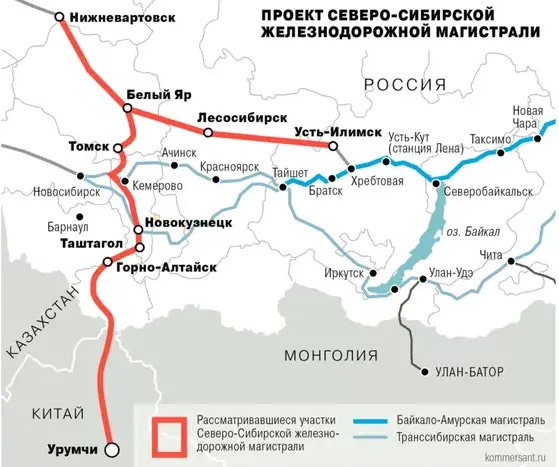
*Map of the Suspended Northern Siberian Rail Line Magistrate (in Red)
Russia Puts China-Oriented Rail Projects to Europe on Hold as War Costs Mount
Putin’s expanded war not only helped power Russia’s turn toward China, a shift that has accelerated the Sinification of Russia, but Moscow’s need to raise money for that conflict has forced the Kremlin to postpone for some time major railway routes across Russia between China and Russia. Once that war is over, a prospect some currently believe is near, Moscow, with Beijing’s help, may well return to these two railway projects, and the Sinification of Russia will resume its earlier pace. For the time being, however, the postponement of these projects highlights the difficulties Russia faces, given its need to fund its Ukraine war and its shortage of key infrastructure, which is likely to force China to pursue even more vigorously its railway routes through the countries of Central Asia.
East of the Urals in particular, Russia has an extremely sparse rail network, with many places not connected by rail at all, and the two most important lines – the Trans-Siberian and the Baikal-Amur Mainline (BAM) –are slow-moving because they are overloaded and in places have only single rather than double-tracked ways, not too mention have been subject to Ukrainian sabotage efforts to destroy those lines. Not surprisingly, since Stalin’s time, Russian leaders have been talking about expanding the network in particular to link it to the Arctic Ocean in the north and China in the south, specifically by constructing a rail line from Nizhevartovsk to Bely Yar northward (often referred to as the North-Siberian line) and from Tashtagol to China’s Urumchi southward.
But despite much hype from Putin on down over the last two decades, the difficulties of building these routes, given the difficult terrain in both and the melting of permafrost in the former, have slowed these plans. And now their combined costs, which Russian officials suggest may be as much as 50 trillion rubles ($600 billion), have forced Moscow to halt planning efforts to develop these projects.
Moscow’s suspension of both these projects throws a serious monkey wrench into the trade plans of both Russia and China, reducing Russia’s ability to export coal and other natural resources to China and limiting even more dramatically China’s ability to use Russia as a transit corridor westward. That is obvious in the case of the direct rail line between Urumchi and Tashtagol, but it is true of the northern rail line, which would allow China to move goods northward and put them on ships on the Northern Sea Route to the west of where the Arctic still ices up most of the year. Indeed, the suspension of plans for the construction of this northern rail route thus puts on hold Putin’s plans to create a Chinese-style “one belt, one route” corridor through Russia.
China, which could easily finance the construction and operation of a least the southern branch of Russia’s railway plans where the bottleneck most often mentioned is the lack of two tunnels in Russia’s Altai mountain region, has instead led to a reduction in trade through Russia to avoid sanctions and expanded its efforts to ensure that it can use railways through Central Asia to the West, including most recently the modernization and development of a railway and shipping hub in western Kazakhstan. And it has done so even though its moves have reduced its influence on Russian officials in regions east of the Urals and likely in Moscow as well.
These developments are especially noteworthy because they call into question what is an increasingly assumed assumption in many Western capitals. There, many leaders assume that Russia’s turn to the east is exclusively the result of Putin’s war in Ukraine and that when that war ends, Russia will not only again turn to the West but ally itself with the West against China. In reality, the situation is far more complicated than that, both now and likely in the future as well. Now, the costs of the war and the West’s sanctions regime against Russia are slowing the Sinicization of Russia on the ground. In the future, the removal of sanctions and the opening up of new rail and other transportation networks between Russia and China are almost certain to dramatically increase Chinese influence in Russia, precisely the opposite of what many in Western capitals think and expect.
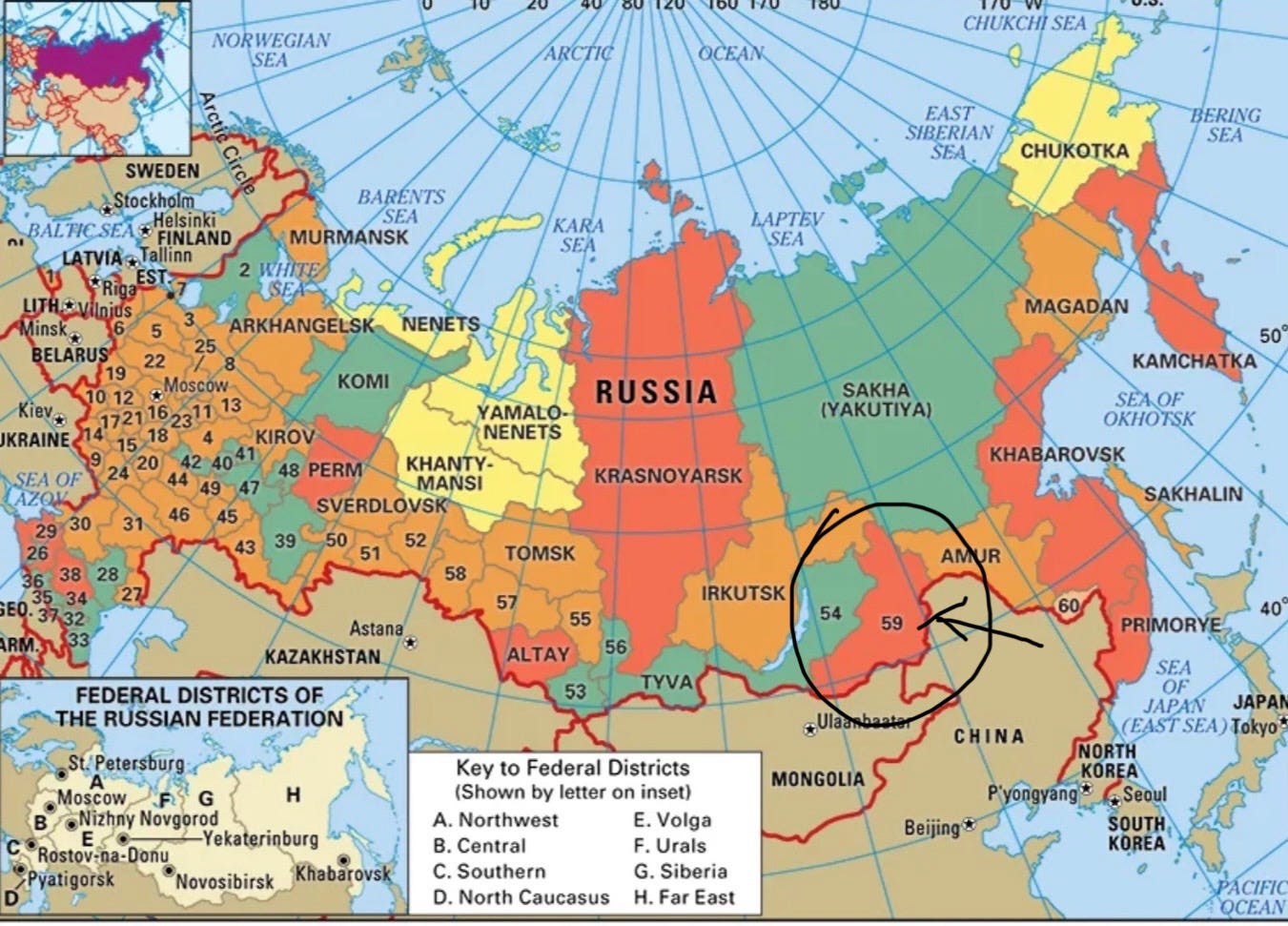
*Map of Russian Federal Districts: Transbaikal #59. Source: Encyclopedia Britannica
China’s Gateway to Siberia: The Sinicization of Transbaikal and Russia’s Demographic Challenge
The fall of 2025 was marked by two notable developments in the Russian Far East that appear to signal a new phase in China’s expanding influence in Russia’s Transbaikal region, known by its administrative name as Transbaikal Krai in the Far Eastern province of Chita.[1] The first occurred on September 8, when the Chinese company Changsha Lanhu Chemical Co., Ltd, and the Corporation for the Development of the Far East and the Arctic (KRDV) signed an agreement to launch a project in Transbaikal, involving the construction of a mining and processing plant. The initiative includes approximately 2.5 billion rubles (approximately $32.5 million) in declared investment and is expected to create around 100 jobs. Another Chinese agreement was signed in November, with regional authorities announcing the conclusion of a cooperation arrangement with two universities in the Chinese city of Xian (Shaanxi Province) to establish joint educational and exchange programs.
Together, these developments mark a new chapter in China’s increasingly diversified engagement in the Transbaikal region. While Chinese economic initiatives in the region were largely frozen before 2022, Beijing’s interests now extend into the cultural and educational spheres, thereby expanding both its economic footprint and soft-power influence. Despite the consistently optimistic tone in Russia’s official reporting, the Foreign Intelligence Service of Ukraine offers a much more sobering interpretation. The Ukrainian services argue that China’s growing economic and cultural involvement is far from being equally mutually beneficial. Instead, it primarily serves as a means for China to secure access to local resources at minimal cost – de facto fueling Sinicization – while local communities fail to receive the promised revenues and employment opportunities.
Sinicization of Transbaikal Before the Sino-Russian Honeymoon
The sensitive topic of the Sinicization of Transbaikal regularly resurfaces in the Russian media during expert discussions about the Far East. The term typically refers to a set of processes associated with the growing Chinese demographic, economic, and cultural presence in the region bordering the People’s Republic of China (PRC). Transbaikal Krai, hereafter referred to as Transbaikal, is one of the key segments of the Sino-Russian land border and represents an important link in the broader “Siberia – Far East – China” corridor. These discussions were particularly prominent between 2008 and 2019, when the Russian economy reached its highest level of development since 1991, and the country’s economic and political dependence on China was much less significant than after 2022.
During this period, Russian domestic discourse on the Sinicization of Transbaikalia coalesced around three principal themes. The first concerned demographic trends. The rapid increase in the number of Chinese nationals in the region not only expanded the presence of foreign labor but also contributed to what many Russian experts characterized as an “evolution of the ethnic structure of the population” in Russia’s border territories. While acknowledging the economic need for foreign labor, analysts also highlighted serious risks that could occur and undermine the region’s long-term socio-economic stability. One local source, writing in 2009, argued that an ongoing demographic collapse—driven by a mass exodus of local residents and persistently high mortality rates—was unfolding alongside a “creeping [Chinese] expansion” that might, under certain circumstances, lead to Russia’s gradual loss of these territories. The article claimed that in the first eight months of 2009, at least 6,500 Chinese nationals had officially registered in the region, while the unofficial number, it suggested, could be “25 to 30 times higher.” Although such unofficial estimates were likely exaggerated, the key takeaway from this reporting was the undeniable rapid rise in the number of Chinese nationals migrating to the region.
Second, Chinese economic expansion. While local analysts described Chinese involvement as an important stabilizing factor for regional markets, they also warned that the trajectory of such involvement carries significant risks. A 2019 article explicitly noted the danger of Transbaikal becoming a “raw-material appendage […] a peripheral supplier of unprocessed resources […] without gaining high-value industries of its own.” It also highlighted additional concerns: the environmental damage associated with Chinese extraction practices and “public concern about foreign influence,” which, if not properly managed, could impede cross-border cooperation. Earlier Russian studies already classified Transbaikal as a “border region” whose foreign-trade relations were heavily oriented toward China, reinforcing its structural dependency on its southern neighbor.
Third, risks posed by Chinese cultural influence. Prior to the current Sino-Russian honeymoon, Russian nationalists and some ultra-conservative groups frequently warned about the growing spread of Chinese cultural practices and Mandarin-language instruction in Russia’s border regions, particularly Transbaikal.
The complexity of Sino-Russian relations in and around Transbaikal before 2022 is illustrated by the controversy surrounding one episode that involved a proposed Chinese land lease initiative in Transbaikal Krai. This effort became perhaps the most prominent symbol of alleged Sinicization in the region. In June 2015, regional authorities signed a memorandum of intent with the Chinese company Huae Xinban (a subsidiary of Zoje Resources Investment). The document envisioned a 49-year lease of 115,000 hectares of fallow agricultural land and pasture across several districts, with the possibility of expanding the area to approximately 315,000 hectares if the first phase was successfully implemented. In public (extremely heated) discourse, this proposal was widely portrayed as the “sale of Transbaikal” and the creation of a “little China” in the region. The public outcry resulted in the regional administration having to come up with an official statement arguing that no formal lease agreement had ever been concluded and that the parties had signed only a memorandum of intent.
The Current Stage of Sinicization
To assess the post-2022 phase of Sinicization in the Transbaikal region, this section examines three principal lines of analysis.
First, demographic trends. As noted earlier, Russian experts observed that since the early 1990s, Transbaikal has been mired in a chronic demographic crisis—a condition that has further deepened since 2022. Persistent population decline and labor shortages have compelled local authorities to rely on foreign migrant labor across multiple sectors of the regional economy. According to official sources, China remains the principal non-CIS supplier of foreign labor in the Russian Far East. A study by the Institute for Demographic Research on International Labor Migration in the Far East found that, based on regional quota requests for 2022, Chinese workers accounted for nearly 99 percent of all non-CIS foreign laborers in both the Republic of Buryatia and Transbaikal Krai.
At the same time, Russian authorities have sought to curb excessive dependence on foreign labor —primarily Chinese— by gradually reducing overall quotas. According to the Ministry of Labor of Transbaikal Krai, the number of work permits issued declined from 3,806 in 2020 to 2,585 in 2023; for 2024, the quota was reduced further to 2,305 permits, representing a 10.8 percent decrease compared to the previous year.
A related development has been Russia’s deliberate effort, beginning in 2024 and continuing into 2025, to reduce its reliance on Chinese labor. In 2024, regional head Aleksandr Osipov reported that 56–60 percent of the region’s demand for construction workers was already being met by local specialists, whereas in 2018, no local residents were even employed on construction sites. He further noted that China’s COVID-related border restrictions made the importation of Chinese workers temporarily impossible, forcing the region to recruit labor from other Russian regions and neighboring countries.
By 2025, the Union of Builders of Transbaikal Krai reported that the monthly wage for a Chinese manual worker had reached approximately 250,000 rubles (about $3,200), rendering such labor economically unsustainable. As a result, the Union announced plans to recruit workers from Bangladesh, India, and Myanmar, where labor costs are significantly lower. Overall, Russian open-source analysis suggests that the primary demographic challenge facing Transbaikal is not “Chinese expansion,” but rather the continued out-migration of local residents. Nevertheless, from 2024 onward, regional authorities have—at least officially—sought to diversify foreign labor sources by increasing recruitment from Central and Southeast Asia. Unlike the pre-2022 period, however, local media coverage and public discourse on demographic Sinicization have remained relatively muted, aside from occasional warnings in the media about China’s expanding presence.
Second, economic trends. After 2022, Chinese economic penetration into both Buryatia and Transbaikal intensified sharply. Once viewed as Russia’s “remote periphery,” these regions have increasingly emerged as a central overland corridor for Sino-Russian trade. According to Albina Koreshkova, the Minister of Planning and Economic Development of Transbaikal Krai, by the end of 2024 more than 60 percent of all Russia–China overland trade was transiting through border crossing points in the region.
This transformation has translated into expanding Chinese influence across multiple segments of Transbaikal’s regional economy. Chinese economic predominance in the Siberian region can be broken down into four principal areas:
A. Logistics and transportation. This sector experienced rapid growth in cross-border cargo flows to and from China. At the Transbaikal road checkpoint alone, freight turnover reached 2.5 million tons in 2024. By 2025, large-scale reconstruction was underway, including the expansion of trucking lanes to 28 to accommodate rising volumes of Chinese and Russian cargo. At the same time, new road and rail infrastructure is being developed—an effort that regional authorities characterize as a strategic advantage. Exporters using the Transbaikal corridor save approximately 3,000 kilometers compared to routing goods through Russian Far Eastern ports, positioning Transbaikal as China’s primary overland gateway to Siberia and the Ural Mountains.
B. Grain-related mega-projects. This trend is best exemplified by the “New Russia–China Land Grain Corridor”, which was launched between 2022 and 2023 and is expected to supply China with a large quantity of soybeans and grain (up to 8 million tons per year) over the next 12-year period. Between 2023 and 2024 implementation of this project was supplemented by the construction of linear elevators along the Trans-Siberian Railway, further integrating Russia’s Far Eastern grain production with long-term Chinese demand.
C. Retail and trade. This area has become particularly visible in the consumer sector: one study showed that in the Far Eastern Federal District, the share of Chinese-made vehicles in the new-car market rose from 15 percent (2022) to 65 percent in early 2025. Transbaikal Krai – a territorial-administrative unit that comprises the Transbaikal region was identified as the “most loyal” region in Russia to Chinese automakers, while Buryatia ranked among the top four regions in terms of rising demand for Chinese brands. This indicates that Chinese firms now control a dominant portion of local markets for vehicles, services, spare parts, and auto financing, making the region overwhelmingly dependent on China. Transbaikal’s growing economic and trade dependency on China is visible in yet another way: by the end of 2024, the Buryat Ministry of Economics publicly advised entrepreneurs to adjust their procurement and logistics schedules to the Chinese New Year, explaining how the 2–3-week shutdown of factories in China affects supply chains in Buryatia. This clearly shows that the “China factor” is now embedded not only in raw-material exports but also in a broad range of commercial practices of Small and Medium-Sized (SMEs) businesses.
D. (Emerging) Digital dependence. In 2024, Ulan-Ude hosted the international forum “Online Trade — Access to Export,” organized by regional authorities. A key partner for the event was Alibaba e-commerce platform, through which Buryatia aims to promote exports to China. While this component of Transbaikal-China trade is relatively new and hard data on the region’s exact level of dependence on Chinese e-commerce platforms remains limited, it is clear that local businesses are increasingly pivoting toward these channels.
Third, the humanitarian dimension. In contrast to the demographic and economic spheres, Chinese influence in the humanitarian domain appears—at least for now—to be less pronounced. One reason is that both constituent regions of Transbaikalia have long maintained close cultural ties with China, dating back to the early 1990s. In Transbaikal Krai, several schools currently offer Mandarin-language instruction, although these programs remain limited in scope and largely niche in their impact.
Buryatia, by comparison, maintains significantly deeper cultural and educational ties with China. In addition to numerous joint initiatives and exchange programs, the republic hosts a Confucius Institute at Buryat State University (BSU). Established in 2007 as a joint project between BSU and the Changchun University of Science and Technology, the Institute serves as the primary institutional promoter of Mandarin in the republic and organizes the majority of China-related cultural, educational, and academic events in the region.
Conclusion
Following the scandal surrounding the “land lease” affair in 2015, Chinese engagement with Transbaikal largely receded from public and policy discourse inside Russia. However, developments after 2022—and particularly in 2025—indicate a renewed and more sustained Chinese interest in the region. This resurgence is occurring against the backdrop of Transbaikal’s continued demographic decline alongside its significant abundance of natural resources. Current evidence suggests that Beijing’s renewed focus on Transbaikal is primarily economic in nature. Rather than relying on transactional import–export arrangements, Chinese actors appear increasingly interested in embedding themselves more deeply into the regional economy. This shift points toward a strategy aimed at establishing a systemic, long-term economic footprint, potentially spanning resource extraction, infrastructure, logistics, and related services. At the same time, developments in the cultural and humanitarian sphere – though secondary to economic engagement – should not be overlooked.
Emerging initiatives and exchanges suggest a gradual expansion of China’s soft-power presence, indicating an interest in fostering closer societal and cultural linkages between Transbaikal and neighboring Chinese regions. Taken together, these trends indicate China is pursuing a more comprehensive and multidimensional strategy, where economic penetration is complemented by softer forms of influence aimed at anchoring China’s long-term presence in the region.
Notes
[1] The Transbaikal region is located east of Lake Baikal in southeastern Siberia. Geographically it consists of the following Russian territories: Transbaikal Krai and parts of the Republic of Buryatia.
Thank you for your support! Please remember that The Saratoga Foundation is a non-profit 501(c)(3) organization. Your donations are fully tax-deductible. If you seek to support The Saratoga Foundation, you can make a donation by clicking on the PayPal link below! Alternatively, you can also choose to subscribe on our website to support our work.
https://www.paypal.com/donate/?hosted_button_id=XFCZDX6YVTVKA
Thanks for reading! This post is public, so feel free to share it.
Thank you for responding to our recent Kitaizatsia newsletter. Dr. Sukhankin appreciates your thoughtful response and had this to say. Based upo my perspective I see the transportation bottleneck as largely structural rather than temporary, even though it is currently intensified by war-related costs and sanctions. The shift from transactional trade toward systemic economic embedding (through logistics hubs, grain corridors, and infrastructure tailored to Chinese demand) creates long-term path dependence that will be difficult to reverse. Although Transbaikal has emerged as an important overland corridor for Sino-Russian trade, persistent capacity constraints, rising transportation costs, and labor-market distortions limit its scalability.
As a result, China is unlikely to rely exclusively on any single route. Instead, it will likely pursue a dual-track strategy: maintaining Russia-specific corridors for resource inflows while simultaneously expanding and prioritizing Central Asian routes to ensure diversification and sanctions resilience. This approach is consistent with China’s broader strategic behavior, particularly in the energy sector (best case in my view!), where Beijing deliberately sources different types of non-renewable energy from multiple suppliers to avoid over dependence on any one partner - a blunder that was committed by the EU when it came to Russian energy.