

BRIEFS
Moscow Sees a Major Surge in Chinese Real Estate Purchases
Chinese buyers are rapidly expanding their footprint in Moscow’s residential property market, particularly in the luxury suburban segment, where their share has risen from 0.5% to 7% over the past year, according to Russian real estate officials. Demand is concentrated in high-end country homes in the Moscow region, especially along the Novorizhskoye Highway, with price ranges typically around 350–400 million rubles ($3 to $4 million). Buyers are largely Chinese businessmen already living and operating in Russia, whose rising wealth has driven interest in country residences as symbols of success.
The shift marks a broader trend of growing Chinese participation in Russian real estate. Chinese buyers now account for an estimated 8–10% of all foreign transactions in Moscow. Purchases vary by demographic: wealthier clients tend to buy premium apartments in districts such as Khoroshevo-Mnevniki and Moscow-City, while students favor more affordable areas near universities. Cash transactions dominate, making up roughly 80–90% of purchases, partly due to banking and transfer constraints between Russia and China.
Preferences in housing design and location also reflect a mix of practical and cultural factors. Buyers tend to favor modern European-style architecture and turnkey properties in well-connected residential communities. RIA-Novosti noted that Feng shui principles subtly influence preferences, including orientation, entrance design, and the presence of water features such as ponds or streams.
Additional considerations include proximity to Chinese-language services, diaspora communities, and bilingual or international schools. Symbolic numerology also plays a role, with the number “8” viewed positively and “4” avoided by Chinese homebuyers. According to industry experts, Chinese citizens can purchase residential property in Russia on the same terms as Russian citizens, provided they have legal residency in the country and submit a basic set of required documents
Four Chinese Citizens Found Guilty of Organizing Illegal “Rally” in Komsomolsk-on-Amur, Sentencing Remains Unclear
According to Mediazona, a Russian court in the Far Eastern city of Komsomolsk-on-Amur has finally sentenced four Chinese citizens for organizing a public protest by Chinese workers over unpaid wages on April 12. The Central District Court of Komsomolsk-on-Amur reviewed the four cases under one of the “rally” statutes and, in a rare instance, found Chinese citizens: Jing Junpeng, Zhou Zhaodang, Guo Guanbei, and Feng Ao guilty of organizing a mass gathering of citizens in a public place, resulting in a disturbance of public order (Part 1 of Article 20.2.2 of the Code of Administrative Offenses).
Earlier, Chinese citizen Xing Qi, who works as the deputy director for administrative affairs at Petro-Hehua, a Chinese contractor used by Rosneft, was fined 50,000 rubles ($664.00) under the same article. He was held accountable for the company’s employee march held on April 12. The actual sentences imposed by the court are not yet known, but they are placing Moscow in a difficult position with Beijing (for more details on the two days of Chinese protests, see Paul Goble’s analysis below).
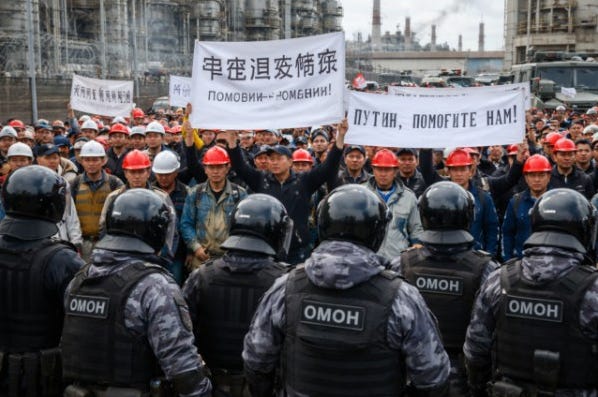
*Image: “Putin Help Us.” Chinese workers protesting in Komsomolsk on the Amur
Chinese Workers in Russian Far East Protest Over Wage Arrears Force Moscow into a Difficult Position
The failure of Russian companies to pay wages in a timely fashion in Russia not only has now reached the highest level in that country since the 2008 wage arrears crisis (which created a major downturn in the Russian economy as part of the 2008-2009 global financial crisis), but has also involved 200 Chinese workers in a refinery construction site in the Russian Far East.
On April 12 local time (April 11 in Moscow), in the city of Komsomolsk on the Amur more than 200 Chinese nationals employed at a Russian refinery construction site owned by Putin protégé Igor Sechin and his Russian oil company Rosneft took to the streets to protest the fact that their Russian employer had not paid them back wages. The action was quietly dispersed but continued the following day as a sit-down strike in the district where the Chinese workers live.
The local Russian militia did not engage in sweeping arrests on the first day, and Russian interior forces known as the Otryad Militsii Osobovo Naznacheniya (Special Purpose Police Detachment), or OMON, who were brought in on the second day of the protests. However, the OMON units did not attack or attempt to disrupt the protesting Chinese workers either. Instead, they simply blocked their way into the city lest the protests continue. Nonetheless, at least five individuals were arrested and fined, rather than given jail time that has typically followed strikes by Russian workers over back pay.
This mixed outcome reflects the unique dilemma Russian officials face. On the one hand, they need Chinese workers to carry out various projects, but are not allowed to challenge firms with close ties to Moscow elites including Putin’s close ally, Igor Sechin and even Vladimir Putin. The Kremlin also cannot afford to anger the Chinese government on whom the Russian government is increasingly dependent. But on the other hand, they cannot afford to suggest to ethnic Russians there and elsewhere that Moscow and its agents in the regions will treat Chinese workers differently and far more softly lest that spark Russian anger not just at the Chinese but at Moscow as well. This could potentially have explosive consequences not only in the run-up to the upcoming September 2026 Duma elections but even more generally for Russia’s “no-limits” partnership with China and its relations with its regions, especially those located east of the Urals.
It is much too early to say whether the compromise response of officials to this protest will satisfy both those who want to use Chinese workers and expand ties with China and those who are opposed to seeing an influx of Chinese migrants whom the Russian government will treat better than it treats its own citizens.
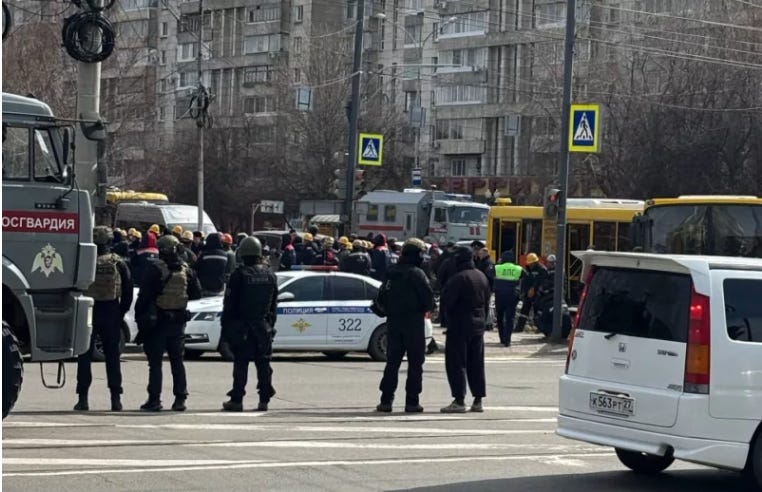
Image Above: Russian Omon Units Monitoring Chinese Protesters in Komsomolsk on the Amur during Easter Protests
Why Did Moscow Call in the OMON?
Because so many interests - Russian and Chinese - were involved, the events in the Russian border city of Komsomolsk on the Amur have received more attention than almost any other labor action in the Russian Federation in recent months. Another additional factor is that Chinese workers at the same plant owned by Sechin protested in 2019 about the same issue and were mollified only when the Russian authorities, working with Beijing, not only sought to have their back pay delivered but also to return to China. This has prompted speculation as to whether Moscow would act differently now than it did then, given its increasing dependence on China and its increasing need to avoid further angering Kremlin elites and ordinary Russians living in the Far East.
By the end of the first day of the Easter protests, all 200 plus of the demonstrators had gone home. While local police forces monitored the first day of protests, officials allowed the police to follow them but did not seek to disperse them with force, only encouraging them to return to their homes in the Chinese settlement there. The company involved said it did not owe the workers anything because it had torn up the contract with them and demanded that the police protect their facilities from any actions by the protesters.
The following morning, however, two things happened: On the one hand, many of those who had protested in the city’s center staged a sit-down strike in their own settlement over the same issues; and on the other, the authorities called in the OMON forces to block any further attempt by the protesters to march into the city, something it does not appear they tried to do and might be interpreted as a sign of distress or panic by the Kremlin. Nonetheless, five of the demonstrators who were arrested, have now been tried and let off with relatively small fines rather than being given jail sentences, which Russian courts routinely hand out in such cases.
Outlook
As Western analysts and Russian officials assess the Chinese protests, the real story behind these events is less about what the protesters wanted and did but how Russian and Chinese officials responded. Officials in the city initially sought to negotiate with the protesters, apparently with the support of the Chinese consulate there. However, they were rapidly overridden by Sechin and his Moscow allies, who did not want to give an inch on the question of back pay. That in turn could have presaged the kind of crackdown Russians are familiar with. But a closer analysis of the situation has shown that the Russian authorities, both in the region and in Moscow, while committed to defending Sechin and his allies, recognized that they could not afford to anger either the Chinese or the broader ethnic Russian community.
Hence, the intriguing compromise: only a few detentions and no jail sentences, and the promise to investigate the backpay issue while at the same time showing their willingness to use force in the form of the OMON to dissuade any repetition of the protests in an effort to suggest that the Chinese in Russia are not beyond the reach of Russian law. That combination reflects the difficulties Moscow faces as the Kitaizatsiya (Sinicization) of Russia continues both between the two countries and between Russians at the official level and in the population. As such, these Easter protests over back pay provide a remarkable window into just how serious those difficulties now are.
Locked In: Trade, Infrastructure, and China’s Expanding Influence in Amur Oblast
In early January 2026, Xinhua News Agency reported that Russia had expanded preferential investment regimes in the Far East, explicitly encouraging Chinese participation in the economies of the five Far Eastern regions. This is being pursued via long-term strategic projects in infrastructure, agriculture, and logistics – with Amur Oblast being named among them. Russia’s policy move reflects two interdependent trends. In a broader sense, it underscores once again the ongoing structural reorientation of Russia’s Far Eastern regions toward China as their primary economic partner. In the case of the Amur region, this shift is becoming nearly absolute: by 2025, between 65 to 76 percent of the region’s foreign trade was tied to China. This concentration creates a structural imbalance by deepening the region’s structural economic dependence on China, which is driven by three reinforcing dynamics: trade concentration, infrastructure lock-in, and production specialization. Together, these dynamics are fundamentally reshaping the region’s economic trajectory, limiting its long-term flexibility and rendering it overwhelmingly dependent on China.
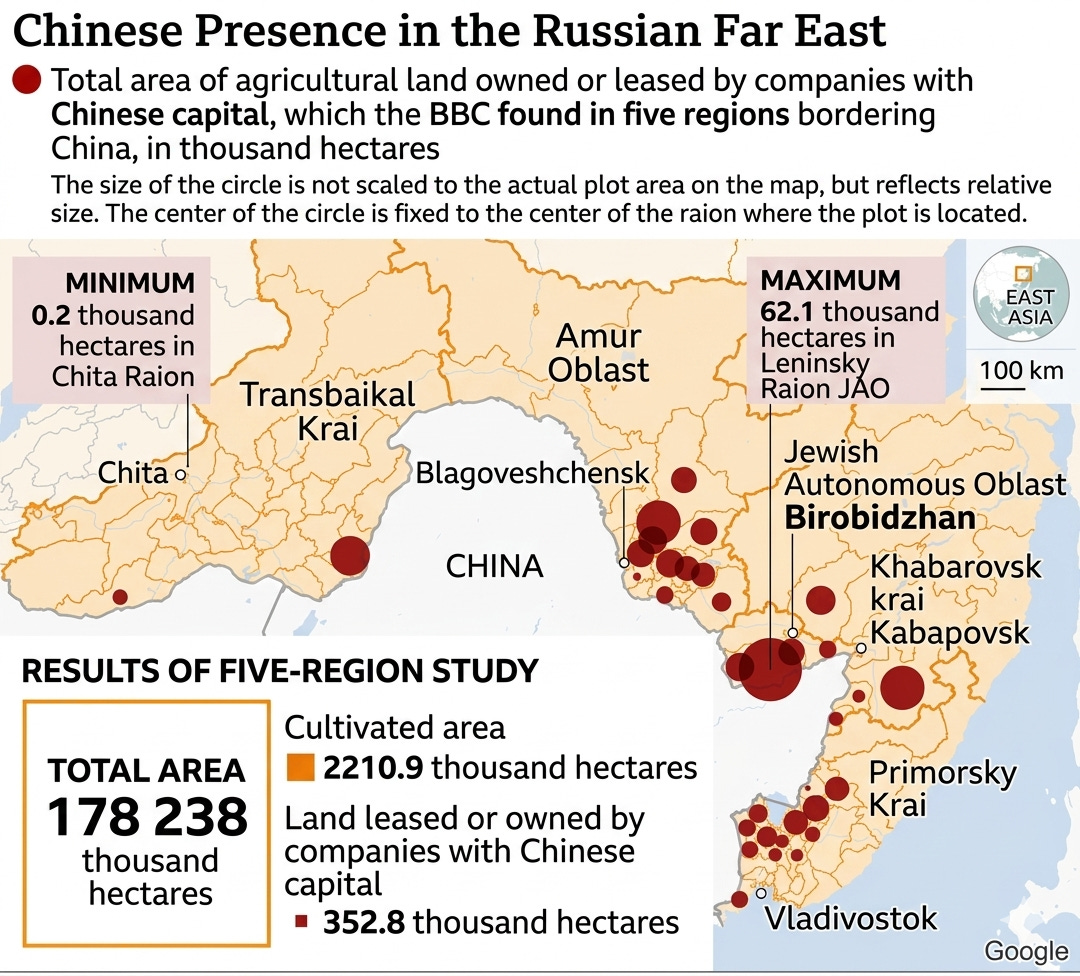
*Map source above: BBC Russian Service
Trade: Growth Accompanied by Asymmetric Dependency
As mentioned earlier, based on regional data, the Chinese share in the foreign trade of the Amur region has reached an overwhelming proportion not only in absolute volume, but what is more critical in terms of year-on-year (y-o-y) growth. For example, in 2025 local authorities reported a 50 percent y-o-y growth which points to an astounding scope of increase both in terms of actual growth and the pace of transformation. This trend has three major implications.
First, growing strategic dependency. From a structural perspective, this indicates that Amur Oblast is not merely increasing trade with China but is becoming economically dependent on a single partner. In some sectors, this trend is rapidly approaching near-record levels. For instance, in agriculture (which accounts for over 5 percent of local GDP), China’s share as a trading partner stands at a staggering 86 percent. This growing imbalance has prompted the federal center to begin cautiously discussing the need to diversify exports toward “other friendly markets.” Similarly, in 2025, Russian media sources in the Far East expressed deep concern over the possibility of China reducing imports of Amur-produced soybeans. This reflects a clear local awareness of the region’s vulnerability to fluctuations in Chinese demand, as well as the lack of viable alternative markets.
Second, an imbalanced economic partnership. The sheer composition of trade itself reinforces this dependency. While exports from Amur Oblast consist primarily of (unprocessed) agricultural products and other raw materials imports from China, by contrast, include machinery, electronics, and consumer goods (high added value products). Among others, this asymmetry reflects a deeply rooted difference in the division of labor where the Russian region supplies low-value commodities while China focuses on higher-value industrial products. Consequently, this structure places the Russian side at a significant economic disadvantage, capturing far less value while remaining dependent on technologically advanced imports from China, thereby mirroring a classic core–periphery pattern.
Third, intra-Russian competition facilitates Chinese advances. The post-2022 interim has illustrated a very important trend, namely: Russia`s Far Eastern regions have embarked on an unspoken (but clearly visible) internal competition for the right to emerge as “Russia’s window to China.” The political leadership of Amur Oblast appears to have gone further than that of any other Russian region in advancing this cause, as regional authorities have proposed that the Russian government establish a pilot zone in Blagoveshchensk, where the mutual use of the Russian Mir payment system and China’s UnionPay cards would be permitted in order to attract Chinese tourists. To facilitate cross-border trade and tourism connectivity, the minister for external relations and tourism in Amur, Ekaterina Kireeva, has proposed integrating Chinese and Russian messaging platforms – WeChat and Max – as part of those efforts. She has also called for the organization of the first international unmanned cargo delivery from Amur Oblast to China in 2026. Taken together, these initiatives run the risk of opening the door to a significant expansion of Chinese influence – not only in intermodal trade, but also in critical domains such as digital commerce and emerging logistics and transportation systems.
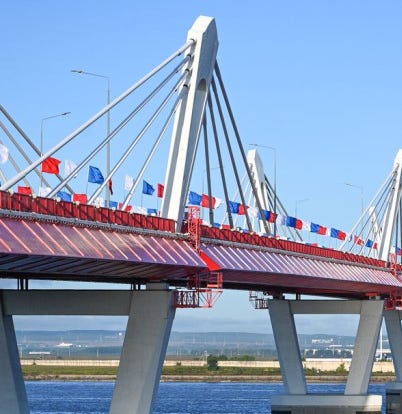
*Image above: The Blagoveshchensk–Heihe bridge
Dependency on China-Oriented Infrastructure Corridors
Given the spatial-geographic and demographic features of the Far East, infrastructure plays a critical role in the physical embeddedness of Amur Oblast within China-oriented economic corridors. For example, the Blagoveshchensk–Heihe bridge, which opened in 2022, represents the first permanent road connection across the Amur River. By 2024, it had facilitated more than 163,000 vehicle crossings, with passenger traffic between the two cities reaching approximately 760,000 crossings. This reflects a dramatic increase in cross-border mobility, which remains highly uneven in terms of the direction of regional movement.
Russian residents frequently travel to Heihe to purchase goods and services, while Chinese demand for Blagoveshchensk remains quite limited. Ultimately, this imbalance reflects broader structural differences: while Heihe functions as a production and logistics hub that is integrated into China’s domestic economy (a more advanced position in the value chain), and Blagoveshchensk operates primarily as a consumption and transit center.
Another notable infrastructure project is the Kani-Kurgan border checkpoint. It currently operates at a limited capacity of 190 trucks per day, but when fully completed, it is expected to handle up to 862 vehicles daily. Regional projections indicate that throughput could increase to 630 vehicles per day in the near term, with passenger traffic reaching up to 2 million people annually.
Finally, other additional projects being pursued are the construction of a “dry port” logistics hub in Blagoveshchensk, with additional plans for the creation of a cross-border cable car, which will further reinforce this infrastructure network. What is crucial to mention is that these infrastructural initiatives should not be seen as a random, selective project. Altogether, they form the core of the International Transport Corridor “Amur.” Inaugurated in 2024, the project is a major highway and logistics route that connects Siberia (Chita), the Russian Far East (Khabarovsk), and China (Heilongjiang Province).
These developments are transforming the region into a high-capacity transit corridor linking Russian production of raw materials and strategic commodities with Chinese markets, creating infrastructure lock-in. Regional transportation networks are become increasingly oriented toward one country – China, resulting in economic activity being channeled along specific routes. Over time, this reduces the feasibility of alternative trade patterns and reinforces dependence on Chinese supply chains. In practical terms, infrastructure is not merely facilitating trade, but rather structurally altering its strategic direction

*Chinese farmer developing Siberian land plot in the Russian Far East. Source: BBC.
The Tacit Sinicization of Siberian Agriculture
According to local authorities, by the end of 2024, China’s growing footprint in Amur Oblast had attracted over 950 billion rubles ($10.26 billion) in Foreign Direct Investment (FDI), with a dominant part coming from China. This is another demonstration that economic integration is moving beyond the trajectory of simple import-export trade but is evolving into a more complex form of market entry. In this regard, the realm of agriculture presents, perhaps, the most notable case study. Chinese agricultural exporters – especially Heihe Fangshengyuan Trading Co. Ltd. (黑河方盛源贸易有限公司 / 黑河方盛源商贸有限公司), a firm which is almost exclusively focused on exports to Russia and cross-border trade, have expanded cross-border operations, supplying fruits and vegetables to Russian markets through Amur Oblast.
These companies have primarily benefited from reduced transport costs and improved logistics following the opening of the Blagoveshchensk–Heihe bridge. At the same time, Chinese firms are investing directly in the agriculture-focused sector of the local economy. In 2024, an unnamed Chinese company announced plans to build a 100,000 square-meter agricultural processing facility (specializing in soybeans) in Amur Oblast, aimed at processing locally produced crops for export. This manifests a clear shift toward localized production aligned with meeting Chinese demand.
Another extremely sensitive issue for Moscow is leasing land to China. This topic is virtually non-existent in coverage by Russian media sources, especially given the post-2022 changes by the Kremlin as part of its strategic “no-limits” partnership with China. It is highly sensitive to Moscow when it concerns relations between China and the Amur Oblast and Chinese control over the region’s local arable lands. Arguably, China’s expanding role in agriculture in Amur Oblast is less about outright land ownership than about informal (but durable) control over land use. Russian experts allege that Chinese farmers often clandestinely operate through subleasing, creating joint ventures, and Russian-registered intermediaries, while making their presence difficult to quantify but structurally significant. This creates a system of de facto control without legal ownership.
On a broader scale, pre-2022 reporting in Russia has revealed that Chinese companies already utilize “hundreds of thousands of hectares across the Far East,” often through leasing schemes, whereas individual projects could reportedly involve tens of thousands of hectares. The strategic implication for Russia is not outright direct territorial loss but growing economic dependency on China and gradual erosion of control over border areas, which could pose actual risks undermining Moscow’s long-term strategic control over the area, especially if Russia might one day be dramatically weakened as a result of internal upheaval.
Conclusion
The case of Russia’s Amur Oblast increasingly illustrates a strategic trap of Moscow’s own making. By prioritizing rapid integration with China under conditions of limited alternatives – created due to the Kremlin’s own choices – Russian authorities are inadvertently transferring structural leverage to Beijing at the regional level. The case of Russia’s Amur Oblast increasingly illustrates a strategic trap of Moscow’s own making. By prioritizing rapid integration with China under conditions of limited alternatives—created by the Kremlin’s own choices—Russian authorities are inadvertently transferring structural leverage to Beijing at the regional level. The cumulative effect of trade concentration, infrastructure alignment, and production restructuring is not merely economic asymmetry, but a gradual reorientation of regional decision-making.
Over time, key variables shaping Amur’s development – such as demand, pricing, logistics flows, and even technological standards – risk being determined externally rather than domestically. This dynamic creates a paradox that is not unique to the oblast but is evident across other parts of the Far East: the more successfully Amur Oblast integrates with China, the less capacity Moscow retains to recalibrate that relationship. In the absence of counterbalancing policies, the region is already on its way to evolving into a functionally subordinated economic space, constraining Russia’s broader strategic autonomy in the Far East.
Thank you for your support! Please remember that The Saratoga Foundation is a non-profit 501(c)(3) organization. Your donations are fully tax-deductible. If you seek to support The Saratoga Foundation, you can make a one-time donation by clicking on the PayPal link below! You can also subscribe to our website to support our work.
https://www.paypal.com/donate/?hosted_button_id=XFCZDX6YVTVKA