
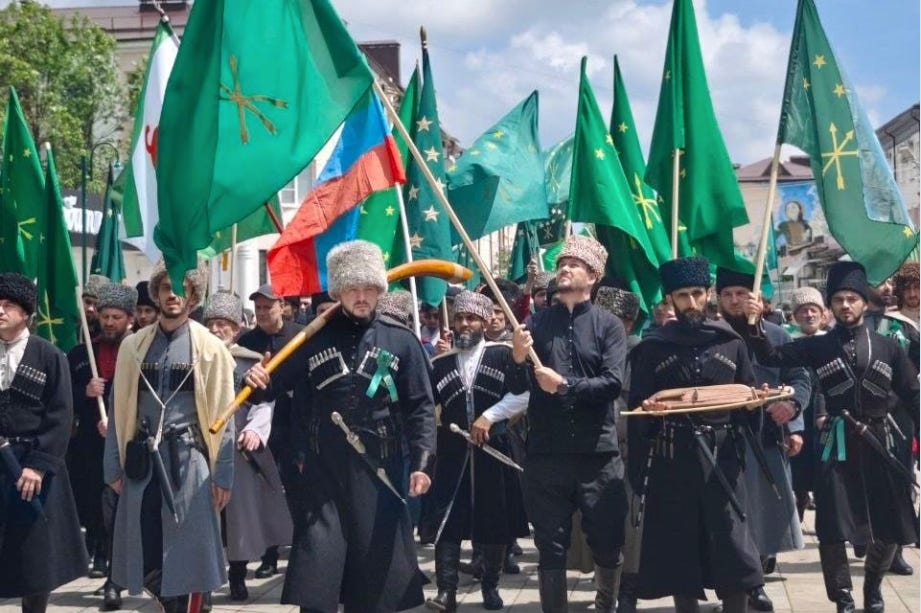
Moscow continues to try to make the Circassian issue disappear, not only by seeking to limit participation in Circassian events but also by seeking to reduce the amount of academic attention the Circassians receive. But any short-term successes it has had in either are increasingly being overwhelmed by failures of its own making and by the growing activism of Circassians alike, both in the North Caucasus homeland and in the diaspora. Indeed, it is now the case that just like at the end of Soviet times, Moscow is fighting the Circassians in ways like the case of the foolish man who tries to extinguish a grease fire with water alone, a tactic that invariably fails when the center is unwilling or unable to douse the flames with a sufficiently large amount of water to put them out – and which as a result ends by spreading that which it hopes to extinguish.
Two developments this month alone highlight this new reality. On the one hand, officials in the North Caucasus sought to have it both ways as far as demonstrations on the anniversary of the 1864 genocide, giving official permission to some of them but then sending out the siloviki (Russian security services) in advance to warn people against taking part, an approach that ensured more participation and caused even more attention to the event than Moscow could ever have wanted. And on the other hand, a North Caucasian historian, to be sure speaking on condition of anonymity, noted that Moscow had driven the discussion of Russia’s 101-year-long war against the North Caucasus and the genocide of the Circassians that came at its end out of academic discourse in the Russian Federation, a trend that has also had an impact on Western attention to this issue. But even as it did that, a Moscow internet portal celebrated that the Russian-based Yandex search engine has now created an online translator of Circassian into Russian, something that will make the study of Circassian issues, including the war and genocide, much easier and likely more frequently discussed - at least outside of the Russian Federation.
The Continuing Importance of the May 21 Anniversary
May 21 marks the anniversary of the day in 1864 when Russian imperial forces expelled the Circassians from their North Caucasian homeland at the end of 101 years of resistance to Russian rule in an act of genocide. Commemorating this event plays a pivotal role in keeping the national movement alive, both among the 700,000 Circassians remaining in the North Caucasus and the seven million-strong diaspora. During the period of relative freedom in the first decades after the collapse of the USSR, Circassian activists in the North Caucasus, often with the open support of officials in the republics where they lived, organized various public measures to commemorate the anniversary. These efforts brought them into closer alignment with Circassian communities abroad, who had never ceased to commemorate this memorial day.
Those links became especially disturbing to the Putin regime at the time of the Sochi Olympiad in 2014, an event that the Kremlin clumsily organized precisely on the territory from which its genocide of the Circassians took place. (On that process, see the 50 weekly articles preceding the Sochi Olympics in Window on Eurasia (Window on Eurasia, Feb. 7, 2014.) And since that time, Moscow has taken ever more steps to limit Circassian activism both inside Russia and outside (Saratoga Foundation, Dec. 12, 2025, and Saratoga Foundation, Dec. 12, 2024).
Over the last decade, since then, Moscow has generally sought to restrict or even ban any commemorations of May 21 in the North Caucasus and has arrested some who took part in the hopes that would intimidate them and others. But instead, these bans and arrests have had just the opposite effect, attracting international attention to Russian repression and convincing many Circassians that they needed to adopt even tougher policies in response lest their national movement be crushed. This year, Moscow tried a new approach, giving permission for small meetings to make it appear more tolerant and then not arresting those who took part so as not to give the Circassians martyrs and further energize their activities. That led to a decline in attention to the measure in international media as compared to earlier years when bans and arrests made better journalistic copy, but Moscow combined these moves with another that is simultaneously more disturbing and counterproductive as far as Russian leaders are concerned.
Russian Intimidation Efforts Backfire
In the days and weeks before May 21 this year, Russian officials and their agents in place in the North Caucasus dispatched police and security officials to warn Circassians and members of their families against participating, implicitly suggesting that those who did so or supported those who did would suffer serious consequences. That Russian effort did not have the effect Moscow hoped for. While a few Circassians may have been intimidated, many more nonetheless did take part – and what is more important, they told sympathetic outlets about what Moscow was now doing, further angering and energizing Circassians and ensuring that their national movement will continue to grow rather than disappear as Moscow had wanted.
A second and related development in Moscow’s campaign, one so far overshadowed by Russia’s pressuring the Georgian government to reduce the status of the Circassian Cultural Center in Tbilisi, is yet another example of how Moscow’s campaign against the Circassians continues to backfire. That concerns the Russian government’s efforts to reduce scholarly discussion of Russia’s war against the Circassians, an effort historians in the region say has had success in Russian institutions and has echoed in Western scholarship as well over the last decade.
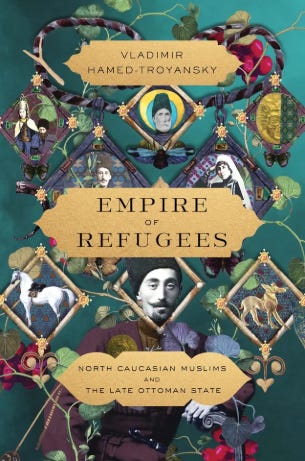
One of these historians, speaking on condition of anonymity, is blunt about this process. “In recent years,” he says, “the 19th-century Caucasian War has faded from the active agenda; all the discussions that resonated so loudly in the 1990s and 2000s have died down. Abroad, meanwhile, the study of the Caucasian War has, as a rule, never received much attention. Speaking of recent years, the only foreign work I can recall is Vladimir Hamed-Troyansky’s book: Empire of Refugees: North Caucasian Muslims and the Late Ottoman State, published by Stanford University Press in 2024.“
The decline in Western attention, he and other scholars in the North Caucasus suggest, is that the decline in Russian attention to this issue has meant fewer people in the West can do research on this topic because they know Russian but not Circassian or other North Caucasian languages.
That trend, of course, is exactly the one Moscow hopes for because declining attention to the Circassians and their national movement would seem to promise the Kremlin a real victory. After all, if Western scholars are not focusing on this, Western governments will not be as likely to either. There are some exceptions, most notably Lithuania and Ukraine, but Moscow’s hopes and intentions are clear.
Outlook
Unfortunately for the Kremlin but fortunately for the Circassians and all who care about the rights of minorities in the Russian Federation, Moscow is undermining its own goals in this regard by taking a step that quite likely will lead to more scholarship in the West about the Circassians, something that will help them maintain and grow their national movement in the face of Russian pressure. Even at the very time as the Russian authorities were unsuccessfully seeking to block Circassian commemorations of May 21, Moscow announced that Yandex, the Russian news portal, had added an online feature that would enable its visitors to translate Circassian into Russian.
This notable development should make it easier for Western scholars who know Russian but not Circassian to research the Russian advance into the North Caucasus in the eighteenth and nineteenth centuries, Circassian resistance then, and the revival of the Circassian national movement now. At the very least, this shows a lack of coordination within the Russian government, a strategic vulnerability that Circassians and their friends are likely to exploit. Consequently, this combination of Russian actions, instead of making the Circassian issue disappear, seems set to make it even more important in the future.
Thank you for your support! Please remember that The Saratoga Foundation is a non-profit 501(c)(3) organization. Your donations are fully tax-deductible. If you seek to support The Saratoga Foundation, you can make a donation by clicking on the PayPal link below! Alternatively, you can also choose to subscribe to our website to support our work.
https://www.paypal.com/donate/?hosted_button_id=XFCZDX6YVTVKA
Thank you. You brought to public attention the facts rarely seen by the Western audience.
Most people would not know who the Circassians are, let alone know about the genocide. I am sharing your piece.
The country that stole its own name can only survive by erasing the memory of all neighboring nations. This will never work:
https://nomadicmind.substack.com/p/the-country-that-stole-its-name
Thank you for your post on the Circassian Genocide.
Unfortunately it is little known despite its importance and implications.
It is among the reasons Vladimir Lenin called Russia the "prison house of nations" in his 1914 essay, "The Right of Nations to Self-Determination." He used it to describe how the Tsarist state functioned as a giant, oppressive jail for subjugated ethnic groups like Ukrainians, Poles, Finns, Georgians, and Central Asians.
Among the very first acts of the revolutionary government led by Lenin was to issue the:
"Declaration of the Rights of the Peoples of Russia," promulgated on November 15, 1917.
The heart of the proclamation established four foundational guarantees for all nationalities within the former empire:
—Equality and sovereignty of all the peoples of Russia.
—The right to free self-determination, up to and including secession and the formation of an independent state.
—The abolition of all national and religious privileges and restrictions.
—The free development of national minorities and distinct ethnographic groups inhabiting Russian territory.
It was the first time in history that such a perspective was put forward by a government. And the Bolsheviks began to lead a way forward for the peoples of the Caucuses.
Unfortunately that was cut short by Stalin's bloody counterrevolution, and a kind of new "prison house of nations" was reestablished in the Stalinist USSR.
Today Czar Putin once again presides over another Russian Empire and a brutal "prison house of nations" as we saw what was done to the Chechen people.
And that is why Putin hates Lenin so much, and admires Stalin. Lenin's perspective of freedom and equality of all peoples is anathema for a colonialist like Putin.
We can only desire a victory for Ukraine over the colonialist invasion by Russian imperialism. That would be the best help to the people of the Caucuses and all the oppressed peoples trapped in the Russian Empire.