
Hi everyone,
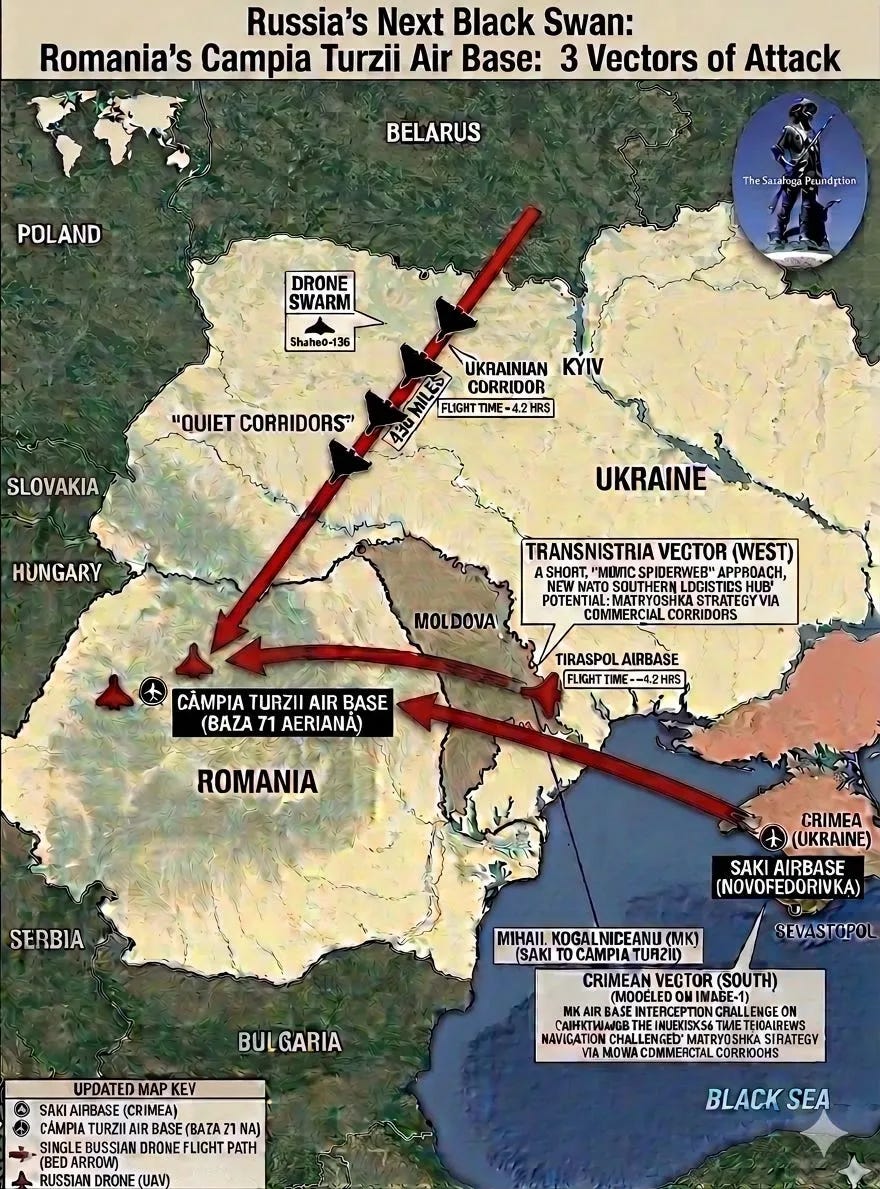
In light of repeated Russian drone intrusions into Romanian airspace in recent months, including an event last week, we would like to share a timely new policy paper: Russia’s Next Black Swan: Romania’s Câmpia Turzii Air Base. This paper was released as part of the New Strategy Centre’s annual Black Sea and Balkans Security Forum 2026, held in Bucharest from May 12-13. More than a dozen leading Black Sea security experts contributed to NSC’s new book: Black Swans in the Black Sea, which examined future scenarios for regional security.
Saratoga would like to extend its sincere thanks to NSC President and CEO George Scutaru, as well as LTG (Ret.) Ben Hodges, for the opportunity to join such a distinguished group of experts from across the Black Sea region.
To download the paper, please click here. For those pressed for time, here are some of the key takeaways from the book chapter:
Executive Summary:
The Rzeszów Precedent and the Russian Threat to NATO’s New Southern Logistical Hub to Ukraine
In September 2025, Russian drones blitzed many parts of Poland, specifically targeting NATO’s northern logistical hub at Rzeszów-Jasionka, known as RZE, as part of this attack. The Russian raid forced NATO to launch Operation Eastern Sentry, and a parallel “Black Swan” vulnerability is in danger of repeating itself along NATO’s Eastern Flank, targeting Romania’s Câmpia Turzii Air Base. In January 2026, Câmpia Turzii was announced as NATO’s new southern logistical hub for Ukraine, creating two logistical gateways - a northern and southern supply line corridor to wartime Ukraine.
In the past decade, Câmpia Turzii has emerged as a heavily modernized facility—backed by over $550 million in joint U.S. and Romanian investments—becoming NATO’s new southern logistical gateway to Ukraine, backed by the Prioritized Ukraine Requirements List (PURL) initiative by the United States. Due to its growing strategic importance, Câmpia Turzii stands to become a high-value target in Kremlin strategic planning, making it an inevitable focus of Russian probing operations or a potential asymmetric attack.
While Romania has historically shown restraint toward low-scale Russian drone incursions, Moscow’s proven use of complex, multi-type drone swarms in Poland demonstrates that Câmpia Turzii faces realistic, deep-penetration threats. Rather than viewing this facility purely as an inland sanctuary shielded by the Carpathian Mountains, NATO planners must look beyond Russia’s drone spillover flights into Romanian airspace from the Ukraine war and prepare for three distinct, non-traditional drone attack vectors.
The Three Vectors of a Potential Black Swan Event
A potential Russian drone blitz against Câmpia Turzii is uniquely dangerous because Moscow can exploit three distinct geographic and technical pathways, each presenting a different challenge to NATO’s Integrated Air and Missile Defense (IAMD) network in Romania:
1. The Saki Air Base (Crimean) Vector: A Russian drone strike launched from Saki Air Base in Crimea would span a total flight path of over 500 miles using Geran-2 drones, which would transit low over the Black Sea, enter Romanian airspace near the Danube Delta, and navigate the Carpathian Mountains via terrain-masking to evade ground-based sensors while avoiding the most heavily defended route located at Mihail Kogălniceanu (MK) Air Base. The Saki vector represents a direct, maritime stress test of Romania’s coastal air defense gauntlet.
2. The Tiraspol (Transnistrian) Vector: Câmpia Turzii is highly vulnerable to a short-range, asymmetric surprise attack from the former Soviet airbase at Tiraspol, located in Russian-occupied Transnistria, just 267 miles away. Mimicking Ukraine’s "Operation Spiderweb" and applying lessons from the 2025 Polish blitz, Moscow could use commercial trucks to covertly smuggle disassembled, low-signature “Geran-3” drones to launch an attack on Câmpia Turzii. This Black Swan vector would be explicitly designed to achieve tactical surprise and probe NATO and Romanian air defense networks, similar to the 2025 Russian drone attack on Poland.
3. The Belarusian Vector: This vector exploits a massive northern geographic loophole by launching drone swarms flying from inside Russia via Belarus, transiting through Western Ukraine’s less dense air defense zones to strike across the Carpathians and launch an attack on Câmpia Turzii. Such a threat could leverage Russian efforts to utilize Belarusian civilian mobile communication towers to act as radio beacons to reach Ukraine and strike the NATO supply node at Câmpia Turzii, similar to the Russian drone blitz over Poland last year.
Why These Vectors Matter
Any one of these scenarios could be leveraged as a Black Sea “Black Swan” to cause sudden tactical paralysis and a major public outcry in Romania, targeting one of NATO’s most important emerging supply nodes to Ukraine. Russian aims would be to force NATO to expend expensive interceptor missiles on cheap plywood mimics and decoys, allowing Moscow to conduct a “reconnaissance-by-fire” mission to map the exact electronic signatures and coordinates of the hub’s defense batteries.
Such an event could also bring about a change in government in Bucharest, similar to the recent downfall of the Latvian government, creating a domestic crisis inside a major NATO ally. If Bucharest fails to adjust its passive rules of engagement based on these multi-vector threats, Câmpia Turzii risks becoming a site of symbolic and operational success for Russia in the Black Sea.
Enjoy!

Thank you for your support! Please remember that The Saratoga Foundation is a non-profit 501(c)(3) organization. Your donations are fully tax-deductible. If you seek to support The Saratoga Foundation, you can make a donation by clicking on the PayPal link below! Alternatively, you can also choose to subscribe to our website to support our work.
https://www.paypal.com/donate/?hosted_button_id=XFCZDX6YVTVKA