
Hi everyone!
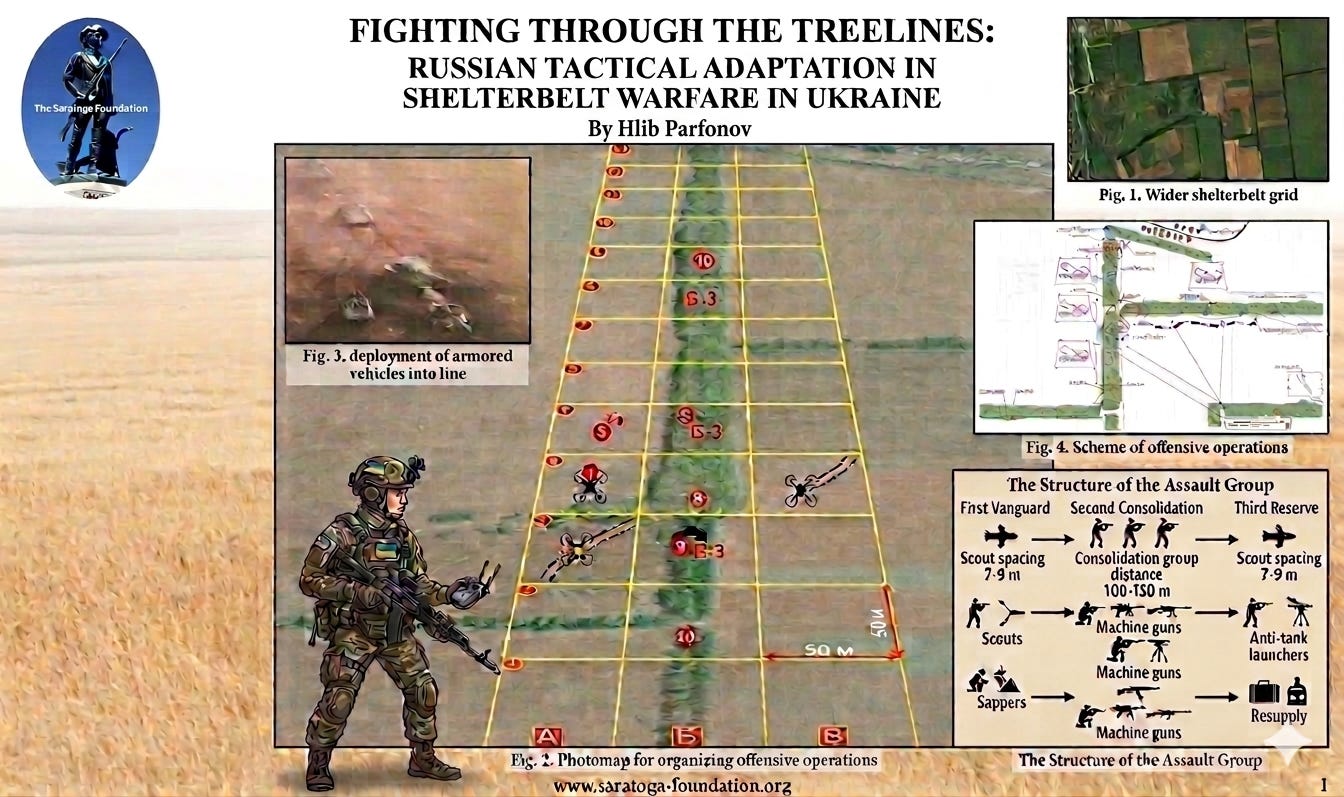
The Saratoga Foundation is delighted to announce the release of a timely new report, Fighting Through the Treelines: Russian Tactical Adaptations in Shelterbelt Warfare in Ukraine, which analyzes Russian filtration methods and techniques employed in eastern Ukraine. The report is based on the insight of Hlib Parfonov, who is an expert contributor to Saratoga on Ukrainian military and security affairs, and currently serves in the Ukrainian army.
IMO, Hlib writes with what Napoleon describes as the Coup d'œil militaire, ‘an eye for the battlefield’, and uniquely understands how Russian forces use terrain in Donbas to their advantage and the ways that Ukraine seeks to deter those techniques, an important lessons learned the United States and its NATO allies can take from the battlefields of Ukraine which might enhance American national security. Indeed, a lesson we should not ignore (hint 👉 such as Russian use of Iranian Shahed drones used against Kyiv for the past several years, which Tehran is using against the Gulf states in Gulf War III today). A lesson some ignored.
What Hlib describes in great detail in his ground-breaking report is that the conflict in Ukraine has generated an extensive body of tactical experience that Russian forces have sought to codify and disseminate within their own command structure. Among the most distinctive terrain challenges of the war for them has been the prevalence of “Shelterbelts,” which are defined as long, narrow strips of planted woodland that cross the open steppes of southern and eastern Ukraine.
Hlib goes into great detail on Russian approaches to offensive operations within and through these distinct linear features of the regional terrain, drawing on internally circulated tactical guidance from various Ukrainian operational commands. Moreover, his report analyzes the doctrinal framework that has emerged, the role of unmanned aerial systems in reshaping small-unit tactics, the structure and tasks of assault formations, and the broader implications for understanding Russian military adaptation used in sustained combined-arms warfare.
Lastly, a note on the sourcing. This paper is primarily based upon the author's firsthand participation in and observation of tactical operations in eastern and southern Ukraine, including direct engagement in the ‘Shelterbelt terrain’. Additional context is derived from his extensive consultations with Ukrainian Armed Forces officers and Non-Commissioned Officers (NCOs) who have operated in similar environments across multiple sectors of the Ukrainian frontlines.
You can download the report 👉 here!
Enjoy!

About the Saratoga Foundation
The Saratoga Foundation is a research and analysis organization focused on Eurasian security and geopolitical developments. Founded in 2023, the Foundation provides analysis on timely security issues shaping U.S. strategic interests related to the Eurasian chessboard.
Thank you for your support! Please remember that The Saratoga Foundation is a non-profit 501(c)(3) organization. Your donations are fully tax-deductible. If you seek to support The Saratoga Foundation, you can make a one-time donation by clicking on the PayPal link below! You can also subscribe to our website to support our work.
https://www.paypal.com/donate/?hosted_button_id=XFCZDX6YVTVKA