
Hi everyone,
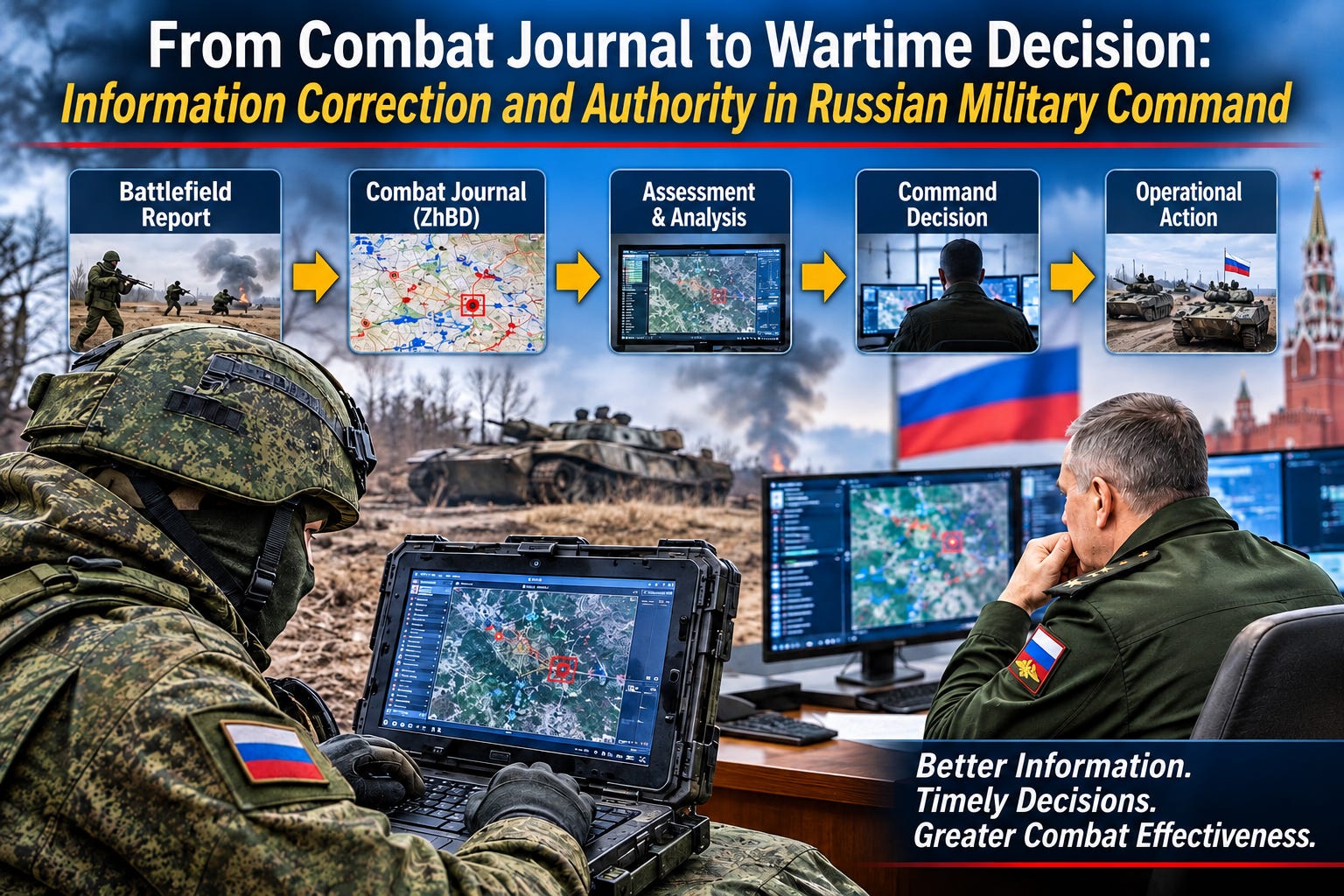
The Saratoga Foundation is pleased to release a new report by Senior Fellow Roger N. McDermott, entitled From Combat Journal to Wartime Decision: Information Correction and Authority in Russian Military Command.
This timely report examines a central question about Russia’s military digital transformation: Does faster access to battlefield information actually enable commanders to make better decisions, correct mistakes, and improve operational performance?
Using Russia’s combat journal (Zhurnal boevykh deistvii, or ZhBD) and the process of recovering damaged military equipment as case studies, McDermott explores how battlefield reports become official records, how assessments are reviewed, and how information must reach officers with the authority to act.
Below are eight major takeaways from the report:
1. Digital connectivity alone does not guarantee better command decisions.
The military value of digital integration depends on whether corrected battlefield information changes an authorized decision in time to affect the mission—not simply on how quickly information is transmitted.
2. Russia’s combat journal is an important institutional record.
The ZhBD documents significant events and provides a reference for operational assessment, accountability, and the study of combat experience. Its significance rests partly on the authority attached to its entries and the consequences that follow from accepting them.
3. Electronic journal use is documented, but the wider technical architecture remains unclear.
Military-court testimony confirms electronic combat-journal use in one Russian brigade. However, the available evidence does not establish a standardized military-wide system, the journal’s precise software architecture, or an automatic connection between journal entries and command decisions.
4. Correcting information requires more than updating a record.
Commanders and staff must be able to challenge an accepted assessment, resolve competing accounts, distribute the correction to relevant users, and reconsider decisions made on the basis of earlier information. A correction that arrives too late may have little operational value.
5. Equipment recovery illustrates the practical stakes.
Returning damaged equipment to service requires more than locating it. Russian forces must assess damage, identify repair requirements, allocate specialists and spare parts, arrange evacuation, and determine when equipment is genuinely available for a mission. Information systems can help coordinate these steps, but cannot create resources that are not available.
6. Russia’s newly created unified data interaction system, known as SVOD, needs to be evaluated for its operational effects on Russian military performance.
By introducing SVOD, the Russian military is seeking to provide Russian frontline units and headquarters with their own shared, secure digital workspace combining maps, satellite imagery, weather data, and battlefield reports. SVOD’s purpose is to improve coordination and accelerate decisions by providing a more current operational picture. However, its actual effectiveness under battlefield conditions remains unproven.
7. Institutional learning is different from recording combat experience.
Russia has mechanisms for collecting and analyzing battlefield experience and proposing changes to equipment and procedures. But reports, databases, and modernization decisions do not by themselves prove that changes reach operational units or improve subsequent performance. Learning must be demonstrated through implementation and measurable results.
8. Ukraine and NATO should assess whether digital integration restores combat power.
The key indicators are whether revised information reaches the responsible officer, changes a decision, and improves execution under battlefield conditions. For equipment recovery, this means examining whether Russia returns assets to service sooner and sustains operations more effectively with the forces actually available.
Why This Report Matters for Ukraine and NATO
Russia’s digital command capabilities since its full-scale invasion of Ukraine in February 2022 must be judged by their operational results, not connectivity alone. Improved information flow can help Russia restore damaged equipment faster and sustain its combat power in a long war of attrition. For NATO policymakers, the key question from this report is how quickly Russian formations can recover and resume missions after major combat losses and how are they trying to improve that learning process. McDermott’s report offers a practical framework for distinguishing a more connected Russian military from one that can translate information into timely decisions, restore combat power, and adapt its conduct of war.
Please read the full report 👉 here and consider its implications for understanding Russian military command and adaptation.
Enjoy the report!

Glen E. Howard
President
The Saratoga Foundation
Thank you for your support! Please remember that The Saratoga Foundation is a non-profit 501(c)(3) organization. Your donations are fully tax-deductible. If you seek to support The Saratoga Foundation, you can make a one-time donation by clicking on the PayPal link below! You can also subscribe to our website to support our work.
https://www.paypal.com/donate/?hosted_button_id=XFCZDX6YVTVKA