
Dear Colleagues
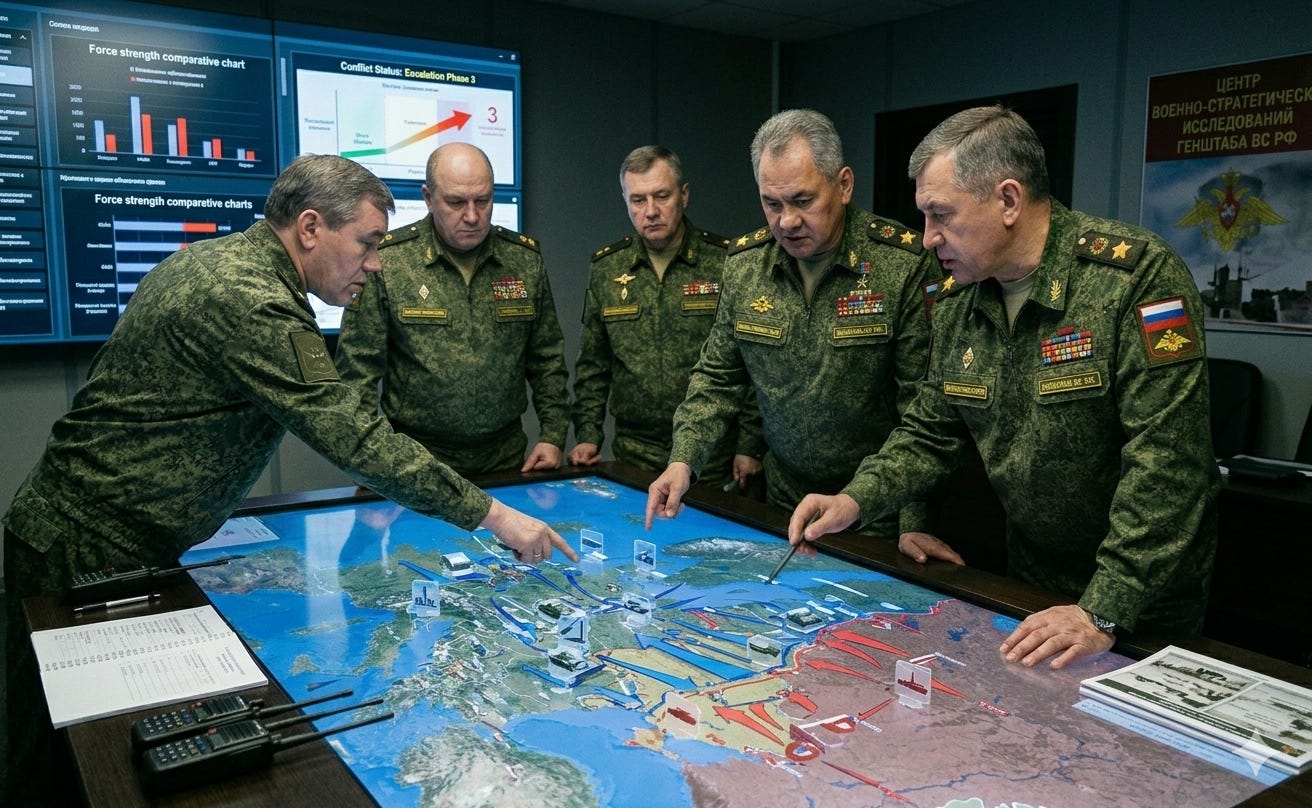
The Saratoga Foundation is pleased to announce the release of our latest report by Senior Fellow Roger N. McDermott, “How the Russian General Staff Conducts Wargames: Operational Rehearsal, Military Science, and the Politics of Strategic Learning.” The report is part of our ongoing project: The Kremlin and Strategic Failure in the Ukraine War. A list of all the previous reports can be found here.
In the wake of Russia’s full-scale invasion of Ukraine in 2022, Western analysts have struggled to reconcile the Russian military’s sophisticated theoretical framework with its stark operational failures on the ground. McDermott’s new report provides a unique - if not rare- window into understanding this paradox, demonstrating that Russian wargaming is not merely a technical exercise, but a complex mechanism of state military cognition. As McDermott notes:
“Russian wargaming is best understood not as a discrete exercise technique, but as a form of state military cognition... Its central paradox is that it can generate sophisticated operational knowledge while preventing that knowledge from challenging political authority. Russian wargaming is therefore strongest as operational rehearsal and weakest as strategic correction.”
Key Insights & Takeaways
The Central Structural Paradox: Russian General Staff wargaming integrates command-staff games, strategic exercises, mathematical modeling, and political-military signaling to make war intellectually manageable. However, it operates under a severe institutional constraint: it successfully disciplines tactical and operational assumptions but inherently prevents objective strategic feedback from challenging top-down political authority.
A Deep Historical Inheritance: This tension is structurally and historically rooted. From pre-1914 strategic games to the January 1941 map exercises, Russian wargaming has consistently structured operational directions while remaining blind to decisive vulnerabilities. Late-Soviet military-scientific innovations, such as Vitaly Tsygichko’s nuclear-war modeling, successfully produced analytical truths (e.g., that Soviet strikes would contaminate Warsaw Pact rear areas), but these findings were suppressed rather than institutionalized.
The Mirror of the Ukraine War: Contemporary exercises like Zapad effectively rehearsed complex, real-world operational problems—including aerospace defense, electronic warfare, counter-UAV measures, and river crossings. Yet, Russia’s governing “theory of victory” failed because the system could not test its assumptions against the structural realities of Ukrainian resistance, Western strategic support, ISR transparency, drone saturation, and the grueling endurance demands of a large-scale war.
Strategic Imperatives for NATO Red Teaming
McDermott concludes with a warning that NATO must stop dismissing Russian military exercises as merely scripted propaganda or empty theater. Instead, they should be decoded as operational texts embedded in a distinct force-planning culture. For effective Western Red Teaming, the report outlines a clear methodology:
Disaggregate and Invert: NATO must systematically isolate the hidden premises within Russian scenarios regarding political cohesion, warning times, Belarusian participation, and adversary adaptation—and then deliberately invert those premises.
Exploit the Protected Seams: Future NATO wargaming scenarios must target the specific institutional blind spots that Russian wargaming is designed to protect: prolonged logistics, sustained political resilience, industrial replacement rates, drone saturation, and progressive command degradation over time.
Please feel free to download the report: 👉 here.
Enjoy!

Thank you for your support! Please remember that The Saratoga Foundation is a non-profit 501(c)(3) organization. Your donations are fully tax-deductible. If you seek to support The Saratoga Foundation, you can make a donation by clicking on the PayPal link below! Alternatively, you can also choose to subscribe to our website to support our work.
https://www.paypal.com/donate/?hosted_button_id=XFCZDX6YVTVKA
This is a highly important report because it points to a deeper paradox in military learning.
Wargaming can discipline tactical and operational assumptions, but it does not automatically produce strategic correction. In highly centralized systems, the game may become less a mechanism for discovering uncomfortable truths and more a rehearsal space for politically acceptable assumptions.
That distinction matters. The failure is not necessarily in modeling, military science, or operational preparation. The failure occurs when institutional cognition is allowed to refine execution but not challenge the theory of victory itself.
This is why red teaming should not treat Russian exercises as mere propaganda or theater. They should be read as operational texts: revealing what the system can rehearse, what it can imagine, and—more importantly—what it is structurally unable to question.
The most dangerous blind spot in war is not ignorance. It is disciplined knowledge trapped inside an untouchable strategic assumption.