
Dear Colleagues,
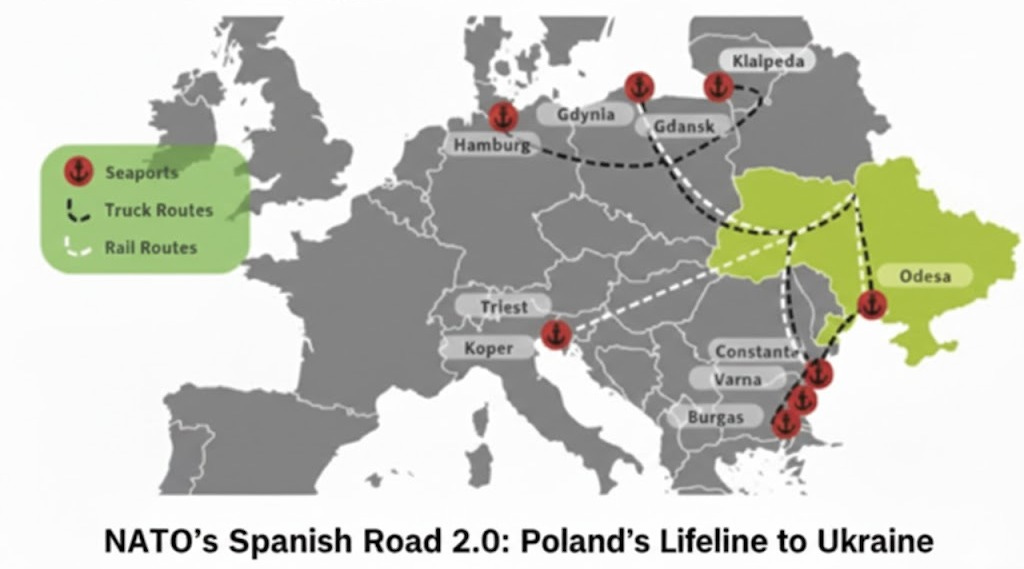
The Saratoga Foundation is pleased to announce the publication of our latest paper, NATO’s Spanish Road 2.0: Poland’s Lifeline to Ukraine,” by Saratoga President Glen Howard. This study forms part of our ongoing project, The Pontic Revolution: How the War in Ukraine is Transforming NATO’s Black Sea Flank, detailing the emergence of a new logistical corridor to Ukraine and its evolving role within NATO’s new map of East Central Europe.
At the center of this transformation stands the strategic rail and aerial hub at Rzeszów–Jasionka (RZE). NATO’s new logistical hub mirrors the 16th-century Habsburg supply line to Flanders known as the Spanish Road. Since the outbreak of the war in 2022, the Euro-Atlantic alliance has put in play a 1,400km, nearly 900-mile overland logistical network to help Ukraine sustain its war effort against Russia.
During this time, Rzeszów has emerged as the principal gateway for U.S. and NATO military aid to Ukraine, with as much as 95 percent of all Allied assistance going through the RZE hub. Altogether, this has led to a permanent restructuring of NATO’s operational depth in the East with Poland as the centerpiece of this strategy.
Key findings include:
The Baltic-Pontic Axis: Rzeszów serves as the indispensable fulcrum for a new strategic axis, linking the Baltic to the Ukrainian military theater as part of NATO’s new Eastern Flank Deterrence Line (EFDL).
RZE POLLOGHUB: The Rzeszów–Jasionka Airport has evolved from a commercial hub into the single most military and humanitarian lifeline for Western assistance to Ukraine, known as POLLOGHUB, or Polish Logistics Hub.
Port-to-Hub Mobility: The security of the eastern flank now depends on the seamless movement of heavy equipment from Polish ports like Gdynia to inland rail hubs. Gdynia is the Baltic’s new strategic gateway that reinforces the NATO concept of port-to-hub logistical access from Central Pomerania to Rzeszów.
Russian Threat Perceptions: Moscow views Rzeszów’s logistical role as NATO’s “critical jugular” and a “legitimate military target,” leading to an obsessive narrative of “preventative escalation” and Russian organized sabotage attacks against Polish railroad lines leading to the NATO supply hub.
Persistent Target in Russian planning: Rzeszów's importance is underscored by Russia’s major September 2025 drone attack on Poland. An estimated 26 percent of Russian UAVs used during the 2025 drone attack were directed at Rzeszów, a key goal of which was specifically designed to gauge NATO response times to defend the hub.
Toward a Polish “Iron Rhine”: The paper argues for institutionalizing the Gdynia RZE corridor through the creation of a dedicated high-capacity rail line similar to NATO’s Iron Rhine railway linking the key Baltic port to Rzeszów, formalizing what has already become NATO’s critical eastern interior lines of communication.
Lastly, Rzeszów’s logistical evolution demonstrates that NATO’s defense posture is becoming more Eurasian in orientation in an effort to sustain Ukraine’s defense posture. The Baltic–Rzeszów axis is no longer temporary—it is rapidly emerging as a permanent pillar of NATO’s eastern flank security and a Euro-Atlantic bridge to the Black Sea.
You can download the full report 👉 here.
I look forward to your thoughts and feedback on this analysis.
Enjoy!

Glen E. Howard
President
The Saratoga Foundation
Thank you for your support! Please remember that The Saratoga Foundation is a non-profit 501(c)(3) organization. Your donations are fully tax-deductible. If you seek to support The Saratoga Foundation, you can make a donation by clicking on the PayPal link below! Alternatively, you can also choose to subscribe on our website to support our work.
https://www.paypal.com/donate/?hosted_button_id=XFCZDX6YVTVKA