
Hi everyone,
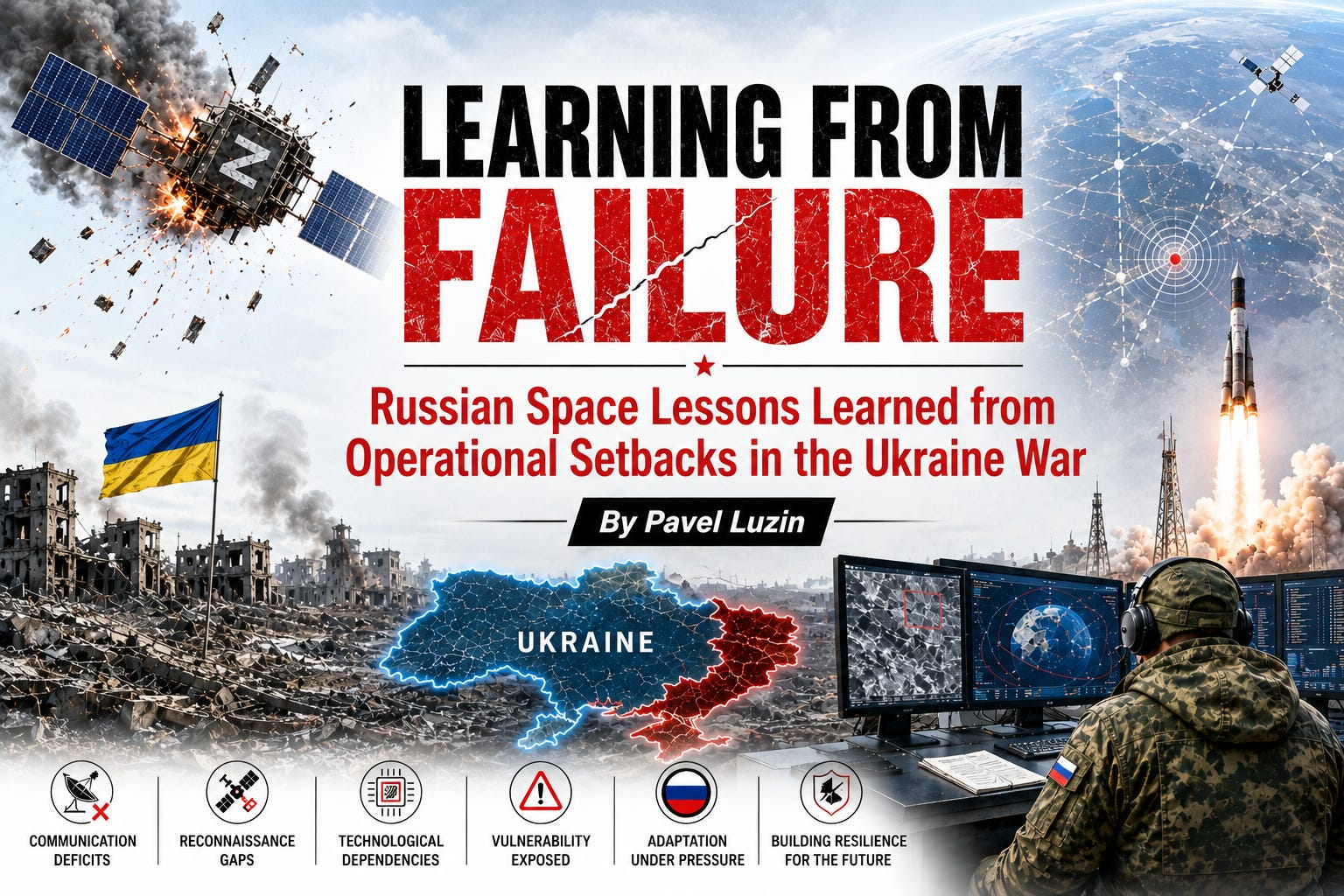
The Saratoga Foundation is pleased to announce the publication of a new report by Pavel Luzin: Learning from Failure: Russian Space Lessons Learned from Operational Setbacks in the Ukraine War.
Russia entered the full-scale war against Ukraine in February 2022 with significant weaknesses in its military space capabilities, particularly in satellite communications and reconnaissance. Four years of war have exposed these shortcomings and forced Moscow to adapt its approach to military space operations. Rather than simply attempting to rebuild Russia’s former status as a space power, Moscow is increasingly pursuing a more flexible, opportunistic, and asymmetric strategy.
Luzin identifies nine important lessons that Russia has drawn from its operational experience in Ukraine:
1. Russia’s military satellite communications were inadequate for high-intensity warfare.
The war demonstrated that Russia’s existing military and dual-use communications constellations could not support operations across a vast battlefield. Moscow has consequently been forced to seek foreign assistance, commercial space services, and alternative technologies—including efforts to develop its own Starlink-like capabilities.
2. Small satellites cannot completely replace large, traditional reconnaissance satellites.
Micro- and small satellites can provide high-resolution imagery and rapid revisit rates, making them valuable for tactical operations. But their narrow swath widths prevent them from providing the broad theater-wide picture required for large-scale military operations.
3. Russia’s shortage of reconnaissance satellites limits its ability to conduct precision strikes.
Without near-real-time intelligence, Moscow has struggled to track highly mobile Ukrainian forces and update targeting information. This has contributed to a greater reliance on attacks against known stationary targets and civilian infrastructure rather than on precision-guided strikes.
4. The boundaries between military, civilian, and commercial space systems are disappearing.
Russia is increasingly integrating military, government, civilian, commercial, and foreign space capabilities. Its recent experience with Starlink demonstrated both the importance of commercial space services and the vulnerabilities created by Moscow’s dependence upon foreign providers. Moreover, Russian military thinking is consequently moving toward an architecture that fuses information from multiple sources rather than relying exclusively on dedicated military satellites.
5. Space vulnerabilities are driving Russia toward terrestrial and atmospheric alternatives.
Moscow is pursuing ground-based navigation, mesh networks, relay UAVs, tropospheric communications, high-altitude balloons, and high-altitude pseudo-satellites as backups to vulnerable orbital systems. These alternatives cannot fully replace satellites, but they can offer additional resilience and support asymmetric approaches to space warfare.
6. Launch capacity may matter more than satellite production.
The ability to rapidly replace destroyed or degraded satellites depends not only on manufacturing but also on rockets, launch pads, and launch infrastructure. The war has exposed how susceptible Russian infrastructure is to drones, sabotage, and asymmetric attacks.
7. Electronic warfare is far less effective when employed in isolation.
Russia’s experience demonstrates that ground-based systems designed to jam satellite communications and navigation cannot by themselves neutralize modern space capabilities. Moscow is therefore moving toward integrating electronic warfare with space-based intelligence, communications intelligence, and other capabilities to improve the precision of counter-space operations.
8. Russia is likely to rely increasingly on gray-zone and deniable counter-space operations.
Luzin argues that Moscow can exploit on-orbit concealment and ambiguity to conduct counter-satellite activities while maintaining plausible deniability. The objective may be less the physical destruction of satellites than the degradation of an adversary’s communications, navigation, command-and-control, and reconnaissance capabilities.
9. Russia’s relative dependence on space may make it more willing to accept extreme risks.
Because Russia is less dependent on space-based systems than the United States and its allies, Moscow may calculate that it can tolerate greater disruption and take greater risks. This has contributed to Russian military discussions of increasingly radical counter-space options, including the possibility of using nuclear weapons against large commercial satellite constellations.
Taken together, these nine lessons suggest that Russia’s future military space strategy will be less about restoring uncontested great-power status and more about taking risks, learning to adapt, deepening Russian resilience, maintaining dependence on foreign systems, commercially integrating, while leaning more on asymmetric disruption. In sum, Luzin concludes that Russia’s approach has become considerably more flexible and opportunistic than during the period from 1992 to 2021—and that this approach is likely to continue into the 2030s.
Please download the full report 👉 here:
Enjoy the report!

Glen E. Howard
President
The Saratoga Foundation
Thank you for your support! Please remember that The Saratoga Foundation is a non-profit 501(c)(3) organization. Your donations are fully tax-deductible. If you seek to support The Saratoga Foundation, you can make a one-time donation by clicking on the PayPal link below! You can also subscribe to our website to support our work.
https://www.paypal.com/donate/?hosted_button_id=XFCZDX6YVTVKA