
Hi everyone!
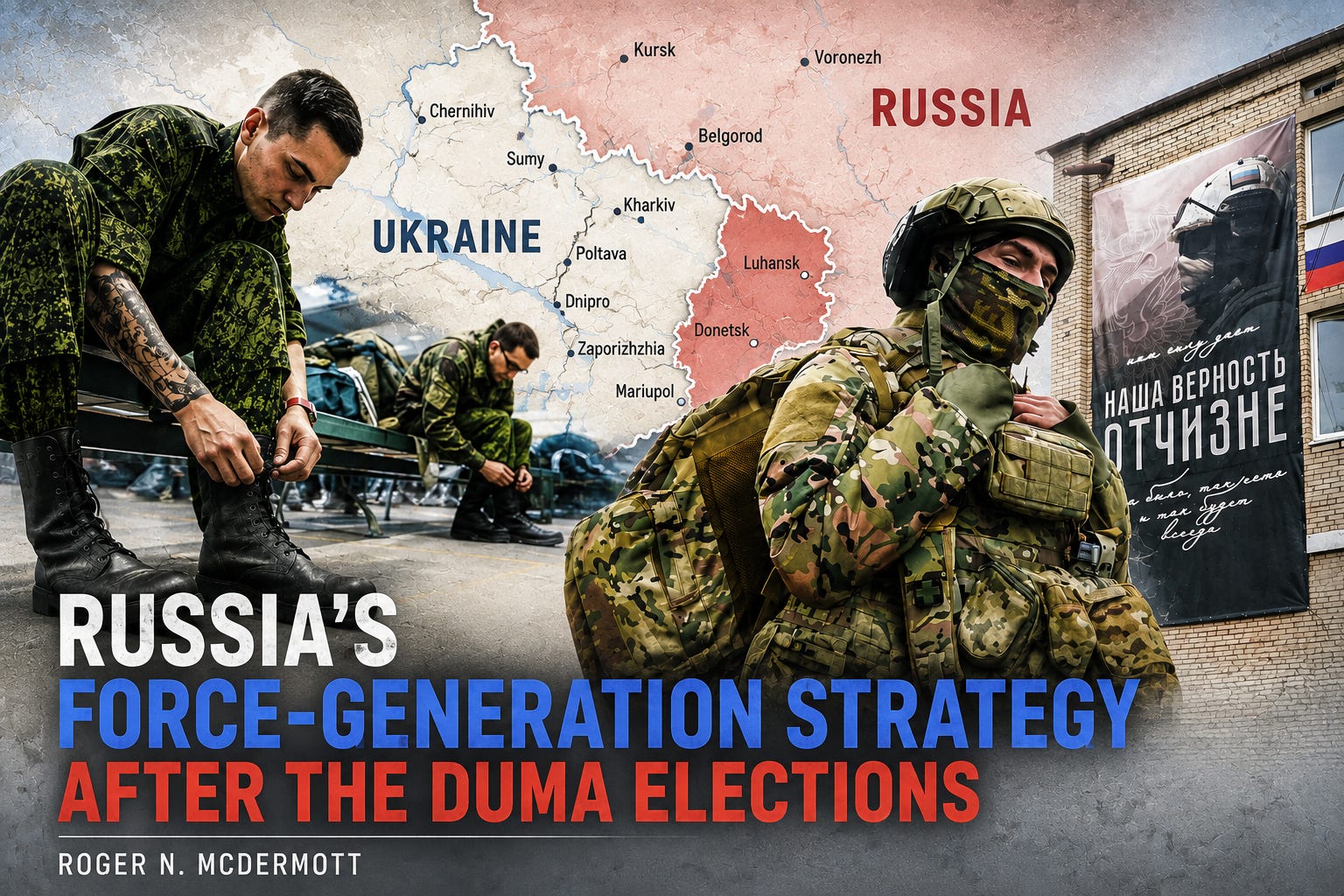
As Russia prepares for the upcoming State Duma (parliament) elections from September 18–20, 2026, tremendous speculation exists as to whether Moscow will initiate a nationwide military mobilization to mount one final effort to defeat Ukraine in the fifth year of Putin’s war, while Russia moves closer to exhausting its manpower base.
In our new special report, “Russia’s Force-Generation Strategy After the Duma Elections,” Senior Fellow Roger N. McDermott evaluates the trajectory of Moscow’s military recruitment pipeline, the viability of a post-election call-up, and the long-term outlook for Russian force generation as Moscow struggles to find enough military personnel to offset its battlefield losses, now estimated to be 1.4 million, killed, wounded and missing through June 2026.
Key Takeaways & Findings
Post-Election Mobilization Dynamics: While an immediate post-election announcement in September is politically sensitive, a post-ballot decision implemented during October or late autumn is far more credible. However, Moscow is more likely to intensify its current model of “mobilization by other means”—combining targeted compulsory measures, financial incentives, regional targets, and administrative pressure—rather than declaring an open nationwide draft of 300,000–500,000 men.
Force-Generation System Under Strain: Russian volunteer recruitment saw a sharp drop in Q1 2026 (70,500–71,200 new contracts, or ~800/day) before recovering slightly to ~1,000/day (see graph below). While the system has not failed, its efficiency is rapidly declining. Municipalities, employers, bailiffs, and prison officials are constantly pressured to sustain manpower intake to replace battlefield losses rather than building substantial net force growth.
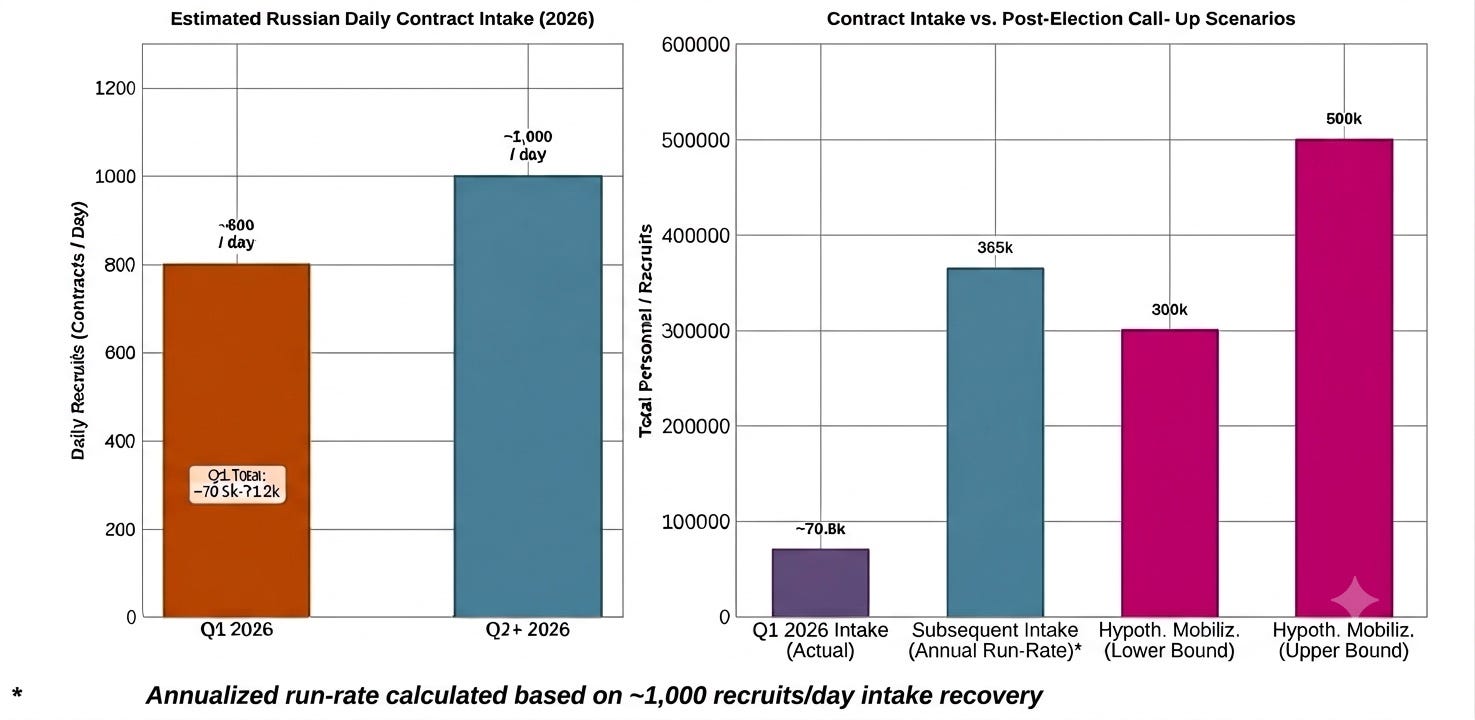
Military Impact vs. Immediate Effect: A potential public target of 300,000–500,000 personnel should be understood as a phased program spanning several months aimed at rotational relief, filling rear-area roles, and building operational depth for 2027. Bottlenecks in training capacity, equipment, junior leadership, and Ukrainian interdiction risks prevent such a force from rapidly converting into immediate combat power before winter.
Evaluating the Evidence: While digital registry reforms, administrative updates, and local decrees confirm that the Russian state has significantly enhanced its technical capacity for a call-up, there is currently no evidence confirming that President Vladimir Putin has authorized a final mobilization plan, quota, or official execution date.
It is critically important to understand the real mechanics of Russia’s force generation in terms of assessing the long-term sustainability of Moscow’s ongoing military operations and operational dynamics going into 2027, which will likely be a decisive year in the war. Please download the full report: 👉 here.
Sincerely,

Glen E. Howard
President, The Saratoga Foundation
Thank you for your support! Please remember that The Saratoga Foundation is a non profit 501(c)(3) organization. Your donations are fully tax-deductible. If you seek to support The Saratoga Foundation, you can make a one-time donation by clicking on the PayPal link below! Alternatively, you can also choose to subscribe on our website to support our work.
https://www.paypal.com/donate/?hosted_button_id=XFCZDX6YVTVKA