
Hi Everyone!
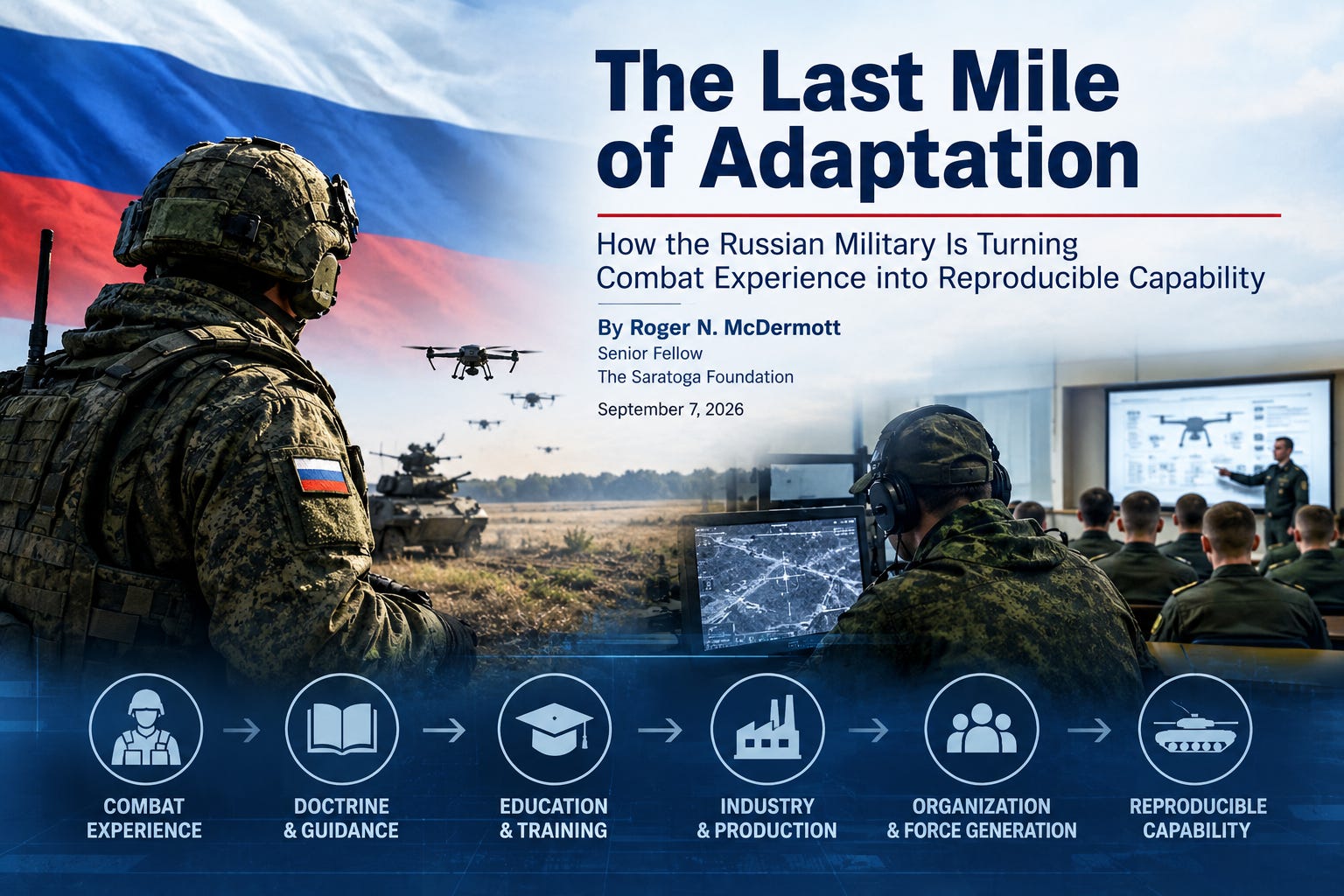
We are delighted to announce the release of a new special report by Senior Fellow Roger N. McDermott: “The Last Mile of Adaptation: How the Russian Military Is Turning Combat Experience into Reproducible Capability,“ which examines how the Russian military is attempting to institutionalize lessons learned from the war in Ukraine to bridge the “last mile of adaptation.”
Ten takeaways from the report include:
Reproducibility is a separate strategic variable. Innovation, diffusion, and codification are intermediate states; the decisive test is whether new people and formations can regenerate the military effect without the original innovators.
Russia is building four overlapping mechanisms of force reproduction. Procedural, human, organizational, and material pathways connect battlefield experience to guidance, education, permanent structures, industry, maintenance, and force generation.
The Russian lessons system is a network, not a single pipeline. Redundant links among command bodies, scientific committees, research institutes, universities, training organs, and industry can make learning uneven but resilient and difficult to suppress at one node.
Human transmission remains the critical bottleneck. Combat-experienced instructors, mentors, specialists, and commanders carry tacit knowledge that documents cannot fully preserve, while casualties, rotation, and rapid technological change continually erode it.
The “Last Mile of Adaptation:” Combat experience alone does not equal durable power. The central strategic challenge for Moscow is whether it can detach wartime knowledge from individual commanders and reproduce those military effects across new personnel, doctrine, and force generation.
Reproducibility as a Strategic Variable: A military achieves true institutional capability only when it can regenerate battlefield innovations following heavy casualties, rotation, and organizational turnover. Without this, even sophisticated tactical advances remain institutionally fragile.
Institutional Architecture for Learning: Russian General Staff leadership—led by Colonel General Vasiliy Trushin—is using military-scientific committees as “transmission belts” to systematically collect, study, and convert frontline experience into force-wide guidance and updated military science.
Massive Scale of Adaptation Efforts: Since February 2022, Moscow has issued over 450 methodological recommendations and amendments to combat regulations, conducted more than 400 military-technical experiments under combat conditions, and analyzed roughly 500 weapon types to modernize over 190 systems.
Force Generation & Education as the Critical Test: Following directives from Defense Minister Andrei Belousov, Russia is mandating combat experience across all officer training programs, doubling faculty battlefield placements, and introducing new military specialties to shorten the gap between frontline lessons and institutional training.
NATO should develop force-generation intelligence. The most useful warning indicators increasingly lie in schools, training centers, curricula, instructor pipelines, qualifications, organizational standards, and the performance of newly generated formations: the institutions that determine what Russia can reproduce after the war.
You can download the full report here 👉 here.
Enjoy!

Glen E. Howard
President, Saratoga Foundation
Thank you for your support! Please remember that The Saratoga Foundation is a non-profit 501(c)(3) organization. Your donations are fully tax-deductible. If you seek to support The Saratoga Foundation, you can make a one-time donation by clicking on the PayPal link below! You can also subscribe to our website to support our work.
https://www.paypal.com/donate/?hosted_button_id=XFCZDX6YVTVKA