
Hi everyone,
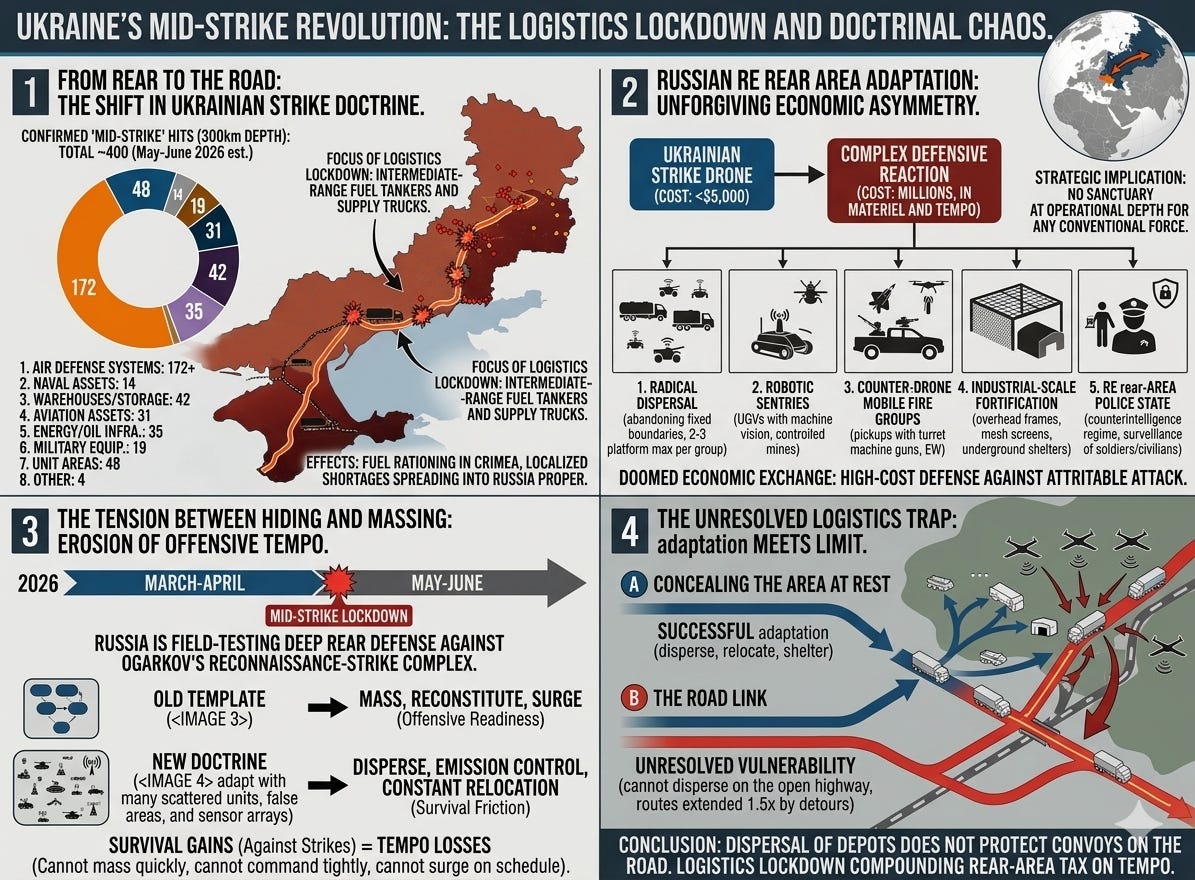
Something significant and unexpected is unfolding in the war in Ukraine: Russia’s critical land bridge linking the Russian-occupied land areas in southern Ukraine known as “Novorossiya” that runs to occupied Crimea along the R-280 highway is increasingly becoming a battlefield in its own right. Once considered a secure Russian logistical artery, the network of roads and rail lines running through occupied Ukrainian territory is now under sustained attack by explosive-laden drones.
Kyiv’s new mid-range drone campaign against Russian military transport routes is turning the Donetsk–Mariupol corridor and the R-280 “Novorossiya” highway into a ‘Mad Max’ death zone where Russian fuel trucks, supply vehicles, and logistical convoys are being hit daily - hundreds of kilometers from the front line. Ukrainian officials have described the campaign as a “logistics lockdown.” Russia’s southern military grouping and its forces in Crimea depend heavily on this overland network to receive daily shipments of food, fuel, ammunition, and reinforcements.
In our new report, The Vanishing Rear: How Ukraine’s Middle-Strike Revolution Is Rewriting Russian Disposition Doctrine on the R-280, Ukrainian security expert Hlib Parfonov addresses these developments as the grinding new reality along the R-280 is forcing a major reassessment within the Russian military over how to counter these attacks.
Key takeaway:
👉 By targeting the connective tissue of Russian logistics, Ukraine is exploiting a fundamental vulnerability of modern warfare: a military force may maintain strong defensive positions at the front while remaining exposed along the arteries that sustain it.
Facing this new reality, Moscow is reaching a stark conclusion about the modern battlefield: troops, equipment, and supply nodes once considered safe in rear areas are now vulnerable to precision strikes conducted by increasingly capable Ukrainian unmanned systems. The response has been a push toward radical dispersal, the abandonment of fixed rear-area assumptions, the deployment of mobile counter-drone teams and robotic surveillance systems, and a new counterintelligence posture designed to withstand persistent observation and attack.
Yet this adaptation reveals a deeper contradiction. Russia is attempting to solve a problem rooted in a traditional conception of the battlefield — protecting static formations and rear-area concentrations — while Ukraine’s drone campaign has shifted the contest onto the roads, logistics networks, and movement corridors that connect the battlefield. In effect, Russia is now confronting the very reconnaissance-strike complex that its own military theorists anticipated decades ago. The result is a transformation of warfare in which mobility, concealment, and logistics resilience may prove as decisive as firepower itself.
In his new report, Hlib argues that Russian military thought has reached a candid conclusion about the modern battlefield: troops in assembly areas hundreds of kilometers behind the front are no longer safe, and their losses may now exceed those of forces in direct contact. The corrective taking shape — radical dispersal, the abandonment of fixed area boundaries, robotic sentries, mobile counter-drone groups, and a counterintelligence regime imposed over the rear — amounts to the deepest revision of Soviet-rooted disposition doctrine in three generations. It is a response to a pressure Ukraine is actively generating: a deep-strike campaign reaching 300 kilometers into the Russian rear that has shifted from hunting air defense to strangling fuel and transport that could undermine Russia’s ability to remain in the occupied areas of “Novorossiya.”
According to Hlib, the deeper irony is that Russia is now rewriting its defensive manual for the reconnaissance-strike complex its own military theorists first prophesied — and that the doctrine answers a stationary problem, concealing a force at rest. At the same time, the threat has migrated to the R-280 highway, where dispersal cannot follow.
To read the report, please click 👉 here.
Enjoy!

Thank you for your support! Please remember that The Saratoga Foundation is a non-profit 501(c)(3) organization. Your donations are fully tax-deductible. If you seek to support The Saratoga Foundation, you can make a donation by clicking on the PayPal link below! Alternatively, you can also choose to subscribe to our website to support our work.
https://www.paypal.com/donate/?hosted_button_id=XFCZDX6YVTVKA