
Dear Colleague,
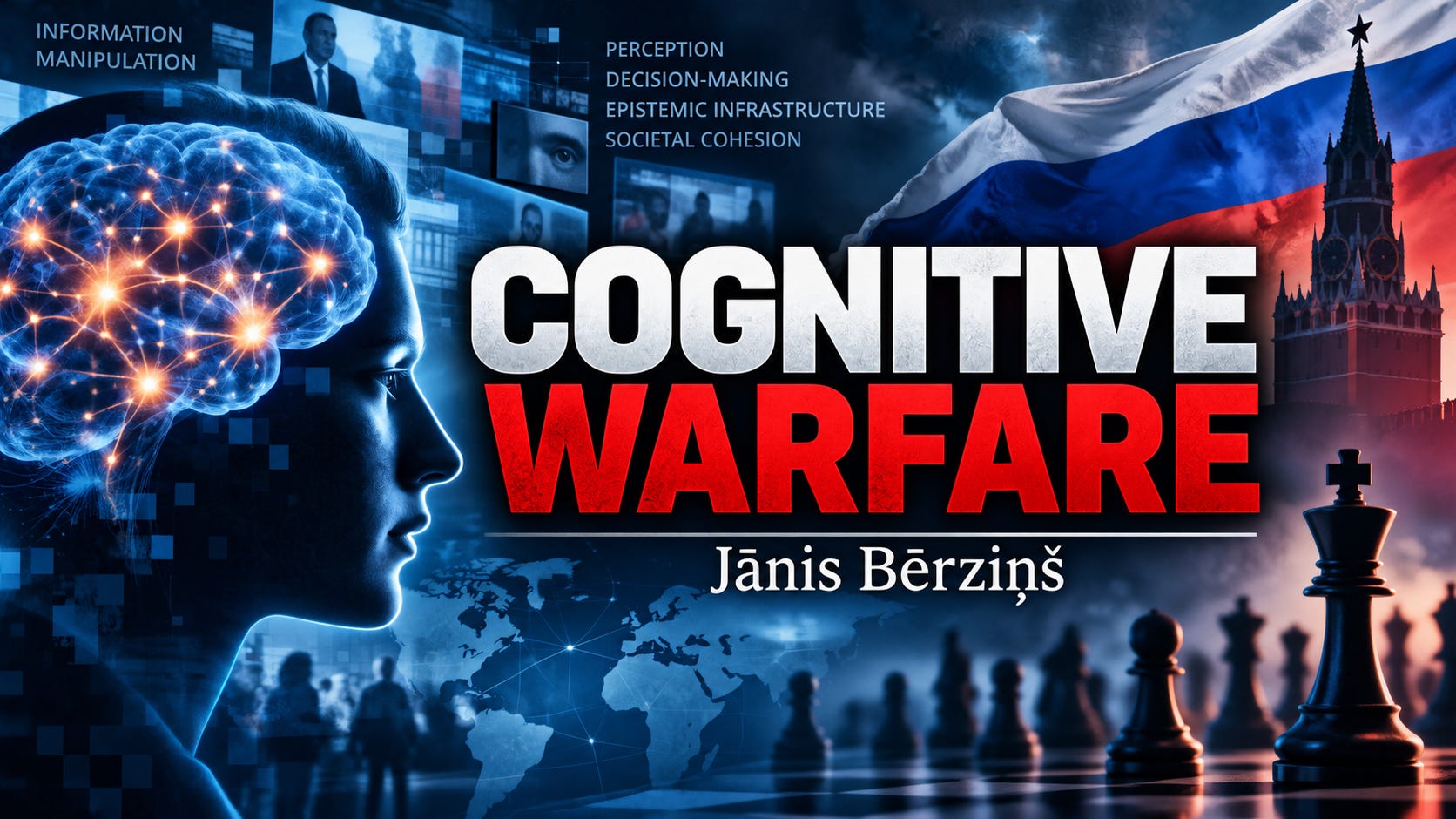
The Saratoga Foundation is delighted to announce the creation of a new research series exploring Cognitive Warfare by Senior Fellow by Senior Fellow Jānis Bērziņš.
As strategic competition evolves, cognitive warfare has become an increasingly popular buzzword that explains everything and nothing. NATO’s own workshops reveal that the Alliance lacks a common understanding of how it differs from traditional information warfare. For defense planners, this ambiguity presents a critical vulnerability: extended deterrence rests on societal cohesion and political will, which cannot be defended if the threat itself remains undefined.
Below is the executive summary and key takeaways from Part 1 of the three part series.
Enjoy!

Glen Howard, President and Chairman
Executive Summary
Cognitive warfare has become a term that explains everything and nothing. NATO’s own 2022 workshop found that the Alliance had no common understanding of what it is, how it differs from psychological operations and information warfare, and where it becomes something qualitatively different. This matters for American planners because extended deterrence in Europe rests on allied societies that trust their institutions and can sustain political will, and a threat to that cohesion cannot be assessed or planned against if it cannot be defined.
The article below, which will be the first in a series of three pieces on Cognitive Warfare discussing what the term means, where its boundary lies, and what that boundary implies for defense planning, proposes a definition drawn from the Russian military literature, which treats the manipulation of perception as a way to alter a political order without contesting material reality by force. Cognitive warfare is defined by its object, the capacity of individuals and institutions to process reality, rather than by the instruments it uses. By that test, much of what is currently called cognitive warfare is strategic communications and counter-disinformation under a new name. NATO’s own documents show how this happened. Both remain essential, but renaming them hides what they are for and leaves the real problem without a name.
Key Takeaways
· Cognitive warfare targets epistemic infrastructure, the processes by which people and institutions construct knowledge and reach decisions. Propaganda targets beliefs, psychological operations target behavior, disinformation targets content. Cognitive warfare targets the mechanism underneath all three.
· The distinction is between processing reality and receiving information. A target whose beliefs are attacked can revise them when better information arrives. A target whose capacity to judge is attacked cannot.
· Russian military writing separates Reflexive Control, aimed at decision-makers, from Mental Warfare, aimed at whole societies over long timeframes. Western doctrine makes no such distinction of levels.
· The boundary is set by the object, not the instruments. Propaganda, psychological operations, disinformation and strategic communications can all be used in cognitive warfare, but none of them is cognitive warfare. Artillery is used in a siege; artillery is not siege warfare.
· NATO’s Chief Scientist report describes cognitive warfare as the convergence of PsyOps, InfoOps and cyber operations. Under Allied Joint Doctrine, the first two are the components strategic communications exists to integrate, and strategic communications already holds responsibility for the cognitive dimension. The concept was described in terms of work that community already did.
· A description built from existing capabilities names no object of its own. That is why the concept cannot be settled, and why the institutional response defaults to counter-messaging, which corrects false narratives but does not protect the capacity to judge.
· Strategic communications and the work against disinformation remain necessary. They do not need a new name. Calling them cognitive warfare does not make them more effective, and it leaves the actual threat undefined.
The Policy Problem
In 2022 the NATO Science and Technology Board recognized cognitive warfare as a strategic research challenge. In November of that year a workshop at the Norwegian Defence Research Establishment brought together over seventy-five participants from sixteen nations. It concluded that, despite broad agreement that the cognitive dimension is a critical strategic challenge, the Alliance still lacked a common understanding of what cognitive warfare is and is not, how it relates to psychological operations and information warfare, and where it becomes something qualitatively different. Participants warned that the term risked following the trajectory of the “Gerasimov Doctrine”[1] and “Hybrid Warfare,”[2] which explain everything and nothing at the same time.
The warning should be taken seriously. The technological advancements of the past fifty years, particularly in information and communication technologies, have made it possible to employ well-established methods of warfare in innovative ways. As warfare’s primary objective is political, with military instruments serving as a means to that end, the struggle for hearts and minds has become a crucial aspect of contemporary warfare. Rather than relying solely on conventional military instruments, adversaries have increasingly focused on exploiting the West’s systemic vulnerabilities to achieve political victories by gaining control over cognitive processes, influencing perceptions, behavior, and decision-making at both individual and collective levels.
This is why it matters for American planners. U.S. extended deterrence in Europe rests on allied societies that trust their own institutions, back NATO commitments and can sustain political will under pressure. An ally whose population no longer trusts its own government cannot mobilize, cannot support forward defense, and cannot resist coercion below the threshold of Article 5. If the Alliance cannot define the threat to that cohesion, it cannot assess it, allocate against it, or build it into deterrence planning.
The Russian Approach to Cognitive Warfare
Russian military literature analyzes the same phenomena and organizes them differently. The Western approach does not differentiate between levels of effect, so cognitive warfare may refer to operations targeting individuals, groups, or entire societies without distinction. Russian military writing divides the cognitive factor between Reflexive Control and, more recently, Mental Warfare. Reflexive Control is the technique of providing an opponent with specially prepared information to induce them to make, voluntarily, a specific decision predetermined by the controller. It operates on decision-makers, whether an individual or a group. Mental Warfare seeks to reshape the cognitive processes of social collectives to alter their social consciousness, undermining spiritual and moral values, traditions, and the cultural and historical foundations of the state. It operates on whole societies over long timeframes. Neither is a subset of what Western doctrine calls information operations.
Propaganda targets beliefs. Psychological operations target behavior and morale. Disinformation targets the specific content of what people take to be true. Strategic communications is different. It is not an instrument with an object of its own. NATO doctrine describes it as a staff function whose purpose is to inform and influence an audience’s attitudes and behaviors. These are what propaganda and psychological operations already target. Strategic communications coordinate the two. Cognitive warfare targets something underneath all of these: epistemic infrastructure, the processes by which individuals and institutions construct knowledge and reach decisions.
Thus, the distinction is between processing reality and receiving information. If beliefs are attacked, the target can revise them when better information arrives. If the mechanism is attacked, better information has no effect, because the capacity to recognize it as better is no longer there. This is the difference between deceiving a commander about the position of a unit and destroying that commander’s ability to know what is happening at all. This marks the ontological divide between the two traditions. The Western approach rests on a liberal-rationalist epistemology which assumes that supplying correct information produces correct beliefs. The Russian approach, rooted in Marxist dialectics and historical materialism, holds that if material reality cannot be changed, the perception of it can be reshaped, and through that reshaping the political superstructure can be altered.
That premise is the source of the boundary. Cognitive warfare is the deliberate, strategically directed manipulation of the relationship between material reality and its perception, conducted at scale, with the objective of reshaping an opponent’s political superstructure without having to contest the material base by force. This definition does not exclude propaganda, psychological operations, disinformation or strategic communications as means. Each of these can be used in cognitive warfare. It excludes them as equivalents. Artillery, for example, is used in a siege, but artillery is not siege warfare. A campaign is cognitive warfare when its object is the target’s capacity to judge, whatever instruments it uses.
But how is cognitive warfare becoming the next “Gerasimov Doctrine” or “Hybrid Warfare”? A significant part of the cognitive warfare literature has been produced by people who came to the field based upon their experience in strategic communications. In recent years, much of their work (often in government) was on disinformation and how to counter it until the term disinformation became a politically contested topic in the United States. Since this issue is urgent and relevant, instead of abandoning the subject, they renamed it. What was strategic communications, influence operations, and counter-disinformation became, with little more than a change of vocabulary, cognitive warfare. A common argument is that we must move beyond disinformation because the real danger lies deeper, in identity, belonging and narrative. Yet the object of analysis did not change. It remains narratives, public opinion and persuasion, which is what strategic communications has always studied. Only the frame is new, and the new frame is the brain.
NATO’s Definition
NATO’s Chief Scientist report describes cognitive warfare as representing “the convergence of PsyOps, InfoOps, and cyber operations with the advancement of Artificial intelligence/Machine learning networks.” Set that beside Allied Joint Doctrine. AJP-10 defines strategic communications as the integration of the communication capabilities and the information staff function with other military activities. The communication capabilities are military public affairs and psychological operations. The information staff function is information operations.
Psychological operations and information operations are therefore not neighboring fields to strategic communications. They are the capabilities strategic communications exists to integrate. In this description, cognitive warfare is the convergence of two components of strategic communications with the addition of cyber and artificial intelligence. An early NATO paper by Bernard Claverie and François du Cluzel describes the concept in the same terms. It places cognitive warfare at the intersection of two existing fields: psychological and influence operations on one side, and cyber operations on the other.
A second reason is that NATO doctrine already makes strategic communications responsible for the cognitive dimension. Since 2023, AJP-10 has given it the task of making sure that every NATO activity is planned with its effect on the cognitive dimension in mind. In this way, the instruments are those of strategic communications, while the cognitive dimension is its responsibility.
As a result, cognitive warfare looks like a new name for work strategic communications already does. A conceptual analysis of the NATO ACT exploratory concept reaches a similar conclusion. It classifies the concept as a maximalist approach whose current empirical applicability may be limited, and notes that a unified understanding of the concept has not yet been reached. Moreover, a description built this way cannot carry the weight placed on it. It lists capabilities and names an effect, influencing decisions, which the listed capabilities already produce. It does not identify an object of its own.
The operational cost falls on the planners. If the phenomenon is classified as a subset of information operations, the institutional response defaults to counter-messaging and strategic communications. These instruments correct false narratives. They do not protect the capacity to judge. None of this makes strategic communications or the work against disinformation less important. Both are necessary. False narratives must be corrected, and governments must explain what they do and why. These tasks do not need a new name to justify them. Calling them cognitive warfare does not make them more effective. It hides what they are for, and it leaves the real problem without a name of its own.
Stated this way, much of what is currently called cognitive warfare turns out to be something entirely else.
Part 2 of this three-part series will test the boundary against three cases, one of which is not cognitive warfare at all.
Author Bio
Dr. Berzins is a Senior Fellow at The Saratoga Foundation and the former director of the Center for Security and Strategic Research (CSSR) at the National Defense Academy of Latvia. He is also Latvia’s principal member of the NATO STO SAS panel. His work focuses on the juxtaposition between the theoretical developments of Russian Military Thought and the operational reality on the ground, and cognitive warfare. Dr. Berzins has lectured as a guest in the United States, Sweden, Norway, the Netherlands, Singapore, Belgium, Brazil, Estonia and Lithuania at various academic and defense institutions.
[1] The term “Gerasimov Doctrine” was first coined by Mark Galeotti in a 2013 blog post, when trying to make sense of an article by Valery Gerasimov, Chief of the Russian General Staff, in the newspaper Voenno-promyshlennyi kur’er. Since then, Galeotti has withdrawn it: “It doesn’t exist. And the longer we pretend it does, the longer we misunderstand the real, but different, challenge Russia poses.”
[2] The well-known expert Frank Hoffman defined “Hybrid Warfare” in 2007 as wars that “incorporate a range of different modes of warfare, including conventional capabilities, irregular tactics and formations, terrorist acts including indiscriminate violence and coercion, and criminal disorder,” coordinated within the same battlespace. He based it on Hezbollah and its war against Israel in 2006. After 2014 the term started being applied to Russian operations in Crimea and the Donbas, and from there it was stretched to cover disinformation, energy coercion, cyber-attacks, and election interference, until it meant any hostile act short of open war.
Thank you for your support! Please remember that The Saratoga Foundation is a non-profit 501(c)(3) organization. Your donations are fully tax-deductible. If you seek to support The Saratoga Foundation, you can make a one-time donation by clicking on the PayPal link below! You can also subscribe to our website to support our work.
https://www.paypal.com/donate/?hosted_button_id=XFCZDX6YVTVKA