
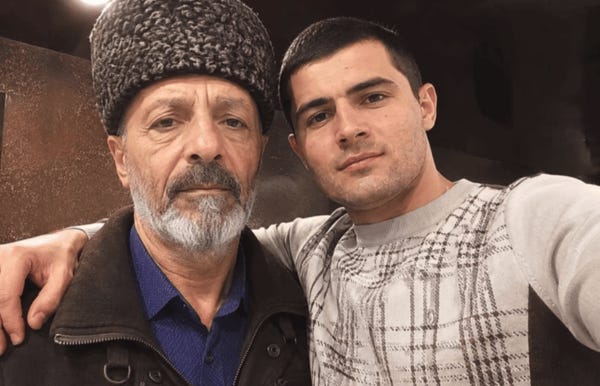
*Image above: Khalid Qaraf and his son Nurdin shortly before his conscription into the Russian army
Moscow has launched a major conscription effort in the North Caucasus to recruit more soldiers there in the hopes of refilling the rapidly depleting ranks of its invasion force in Ukraine to avoid declaring a general mobilization or involving more ethnic Russians in the fighting. This represents a major change in Kremlin policy, not only because it focuses on the North Caucasus, a region that has largely escaped Putin’s disproportionate use of non-Russians since he launched his expanded war against Ukraine, but also because Moscow is using the military itself to carry out this impressment campaign rather than rely upon local officials to enforce this drive. That combination is now at risk because of the death of Nurdin Qaraf, a Circassian repatriant who died after being forced to serve in the Russian army—a development whose impact has been exacerbated by the threatening behavior of Russian security services against his family.
As a result, Moscow may be forced to double down or quit—either sending more Russian troops to the North Caucasus at the expense of pulling some units out of Ukraine, or scaling back this campaign entirely. Otherwise, what might have appeared in the Kremlin to be a natural extension of existing policies could spark a violent explosion in the North Caucasus and lead to the undermining of Russian influence across the Middle East, where millions of Circassians live and are extremely well-organized, particularly in Türkiye.
Since Putin launched his expanded war against Ukraine in February 2022, the Kremlin leader has disproportionately used troops drawn from poorer ethnic Russian regions and non-Russian republics. That has been widely reported, but what is much less well-known, although it has definitely been documented, is that this policy has adversely affected the North Caucasus, which in fact has sent far fewer troops to Ukraine and suffered far fewer deaths there than most have assumed.
Moscow’s Manpower Dilemma in the North Caucasus
Multiple factors explain this trend. First, Russian commanders long have been opposed to using North Caucasians as troops, worried that providing them with military training could give the North Caucasians the skills needed to one-day challenge Moscow. Indeed, from the end of Soviet times to 2014, the Russian government refused to draft North Caucasians; and it has continued to have fewer of them in the military than their share in the prime military-service age cohorts would suggest. Second, more than in any other non-Russian section of the Russian Federation, the North Caucasus has been the site of anti-war demonstrations since the beginning of the expanded conflict four years ago, an indication that people there harbor opposition to Putin’s war and reject serving in it. And third, there are today growing indications that even the most Kremlin-loyal leaders in the region, including Chechnya’s Ramzan Kadyrov, do not want to see their young men fighting in what they increasingly view as “Russia’s war.”
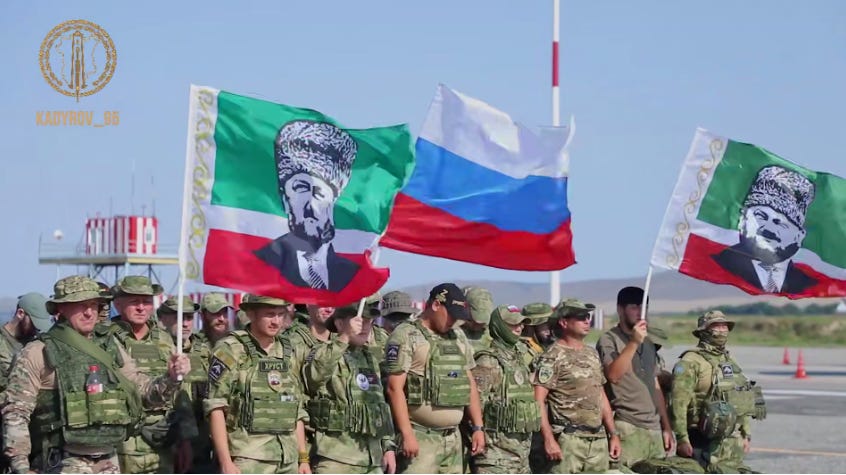
*Image: Kadyrov units serving in the Russian Army
But now, as Putin’s war in Ukraine grinds into its fifth year and Russian forces are suffering ever greater losses, the Kremlin appears to have concluded that it has little choice but to find new ways to raise more men for its army. Going after North Caucasians who had escaped such service more frequently per capita than other non-Russians in the past is an obvious choice, and the one the Kremlin has made. But clearly aware of the problems such a recruitment campaign would face, Moscow decided to use its own military forces rather than rely upon the normal military recruitment system, which often lies in the hands of local people, to ensure that its campaign would be more effective.
To that end, earlier this year, Moscow began sending more predominantly ethnic Russian troops into the North Caucasus from which it had pulled units earlier to fight in Ukraine. In addition, Russian authorities appear to have focused their efforts on groups like the Circassians, a nation Moscow has worked to divide and which it would like to keep from uniting, given that there are currently 700,000 ethnic Circassians across the North Caucasus and more than seven million abroad, many of whom are interested in returning. Those two choices, using the Russian military and focusing particularly on the Circassians, have combined to generate severe difficulties that may jeopardize the entire Russian effort.
This assessment arises from a single incident—one largely overlooked in Moscow and the West, yet is drawing significant attention from Circassians both in their North Caucasus homeland and abroad. Earlier this year, Nurdin Qaraf, a Circassian who had returned to the North Caucasus from Syria, was compelled to join the Russian military. His family did not know of his fate and thought he was living with friends or relatives in Moscow. But when his father attempted to find his son after not hearing from him for more than six months and even appealed to Russian officials for assistance, the family was finally told that Nurdin had been killed. The officials provided no details or access to the body and at the same time warned his father Khalid that if he did not stop his efforts to learn about his deceased son, he would suffer the same fate. In addition, Russian propagandists launched a campaign to claim that Nurdin had fought proudly for his recovered country just as have many other Circassian repatriants.
Not surprisingly, neither Nurdin’s family nor Circassians more generally accept the Russian version of events. Instead, they believe, Moscow’s new effort to recruit Circassian returnees into the Russian army has three main goals. First, it seeks to reduce the number of Circassians in the North Caucasus both by having some of them killed in the war and by discouraging others from trying to come. Second, it helps Moscow with its war by providing the Russian army with cannon fodder. And third, and this may be especially important in Moscow’s calculations now, it is intended to sow discord between the Circassians and the Ukrainians who have increasingly shown greater interest in the fate of the Circassians and support for the effort of that nation to gain international recognition of the Russian genocide against their nation.
Outlook
The Qaraf case will greatly compound Moscow's problems among Circassians, not just in the North Caucasus but also in its vast overseas diaspora, where ever more people are paying attention to the recent development. However, the impact of this tragedy is not limited to these two groups. Instead, it is affecting other nations in the North Caucasus, like the Chechens, who can easily see that what the Russian government is imposing on the Circassians is a prelude to what it is likely to inflict on them. As a consequence, both Circassians and other non-Russians in the North Caucasus are becoming radicalized in their opposition to Moscow, something that could spark new violence there and jeopardize Russian control.
To avoid such outcomes, Moscow will likely deploy more military units into the North Caucasus to maintain stability there, something it is loath to do given the scarcity of Russian manpower to fight in Ukraine, or it will altogether have to scrap this project. Putin may prefer the former course to the latter, but either option is fraught with difficulties for the autocratic leader given that both highlight the weakness of the center brought on by the war in Ukraine, something cooler heads in the Russian capital might have recognized in advance but that Putin failed clearly to foresee.
Thank you for your support! Please remember that The Saratoga Foundation is a non-profit 501(c)(3) organization. Your donations are fully tax-deductible. If you seek to support The Saratoga Foundation, you can donate by clicking on the PayPal link below! Alternatively, you can also choose to subscribe to our website to support our work.
https://www.paypal.com/donate/?hosted_button_id=XFCZDX6YVTVKA
I wondered when this would happen. This maybe the black swan that starts Putin demise