
by George Vișan
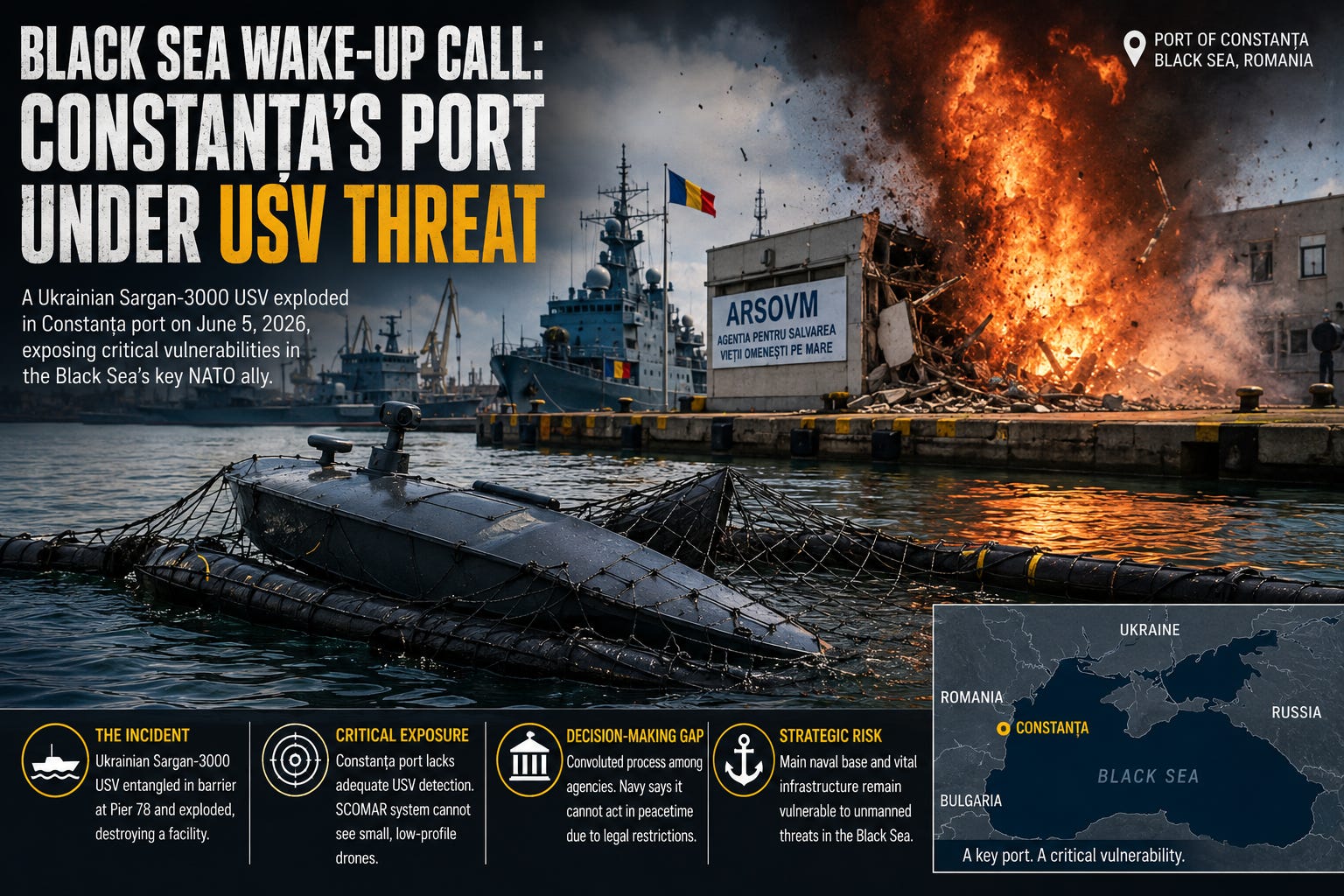
In the early hours of June 5, 2026, a Ukrainian Sargan-3000 USV was discovered inside the Romanian Black Sea port of Constanța. The USV became entangled in a protection barrier on Pier 78 (Dana 78) in close proximity to facilities operated by the National Agency for Saving Human Life at Sea (ARSOVM), Romania’s maritime search and rescue service. The Ukrainian USV was likely part of a swarm of four sea drones en route to attack the Russian naval base at Novorossiysk from their home base in Odesa. The Ukrainian sea drone likely lost course as a result of Russian Electronic Warfare (EW) countermeasures, which disabled the USV. Following the Constanța drone incident, it should be noted that the Ukrainians hit Novorossiysk again using a similar Sargan-3000 USV after the June 5 incident, failing in their first attempt to sink a Russian patrol boat but later succeeding on July 14.
Romanian authorities attempted to disarm the Ukrainian drone in Constanța’s harbor after quickly establishing contact with their Ukrainian counterparts. However, around 10:30 am the drone exploded inside the harbor. Fortunately, the Ukrainian authorities warned their Romanian counterparts in time that the USV would self-destruct, and the Explosive Ordnance Disposal (EOD) team tasked with the drone’s neutralization had enough time to evacuate. The subsequent explosion destroyed an ARSVOM facility and lightly damaged the pier, and as a result, no one was injured.
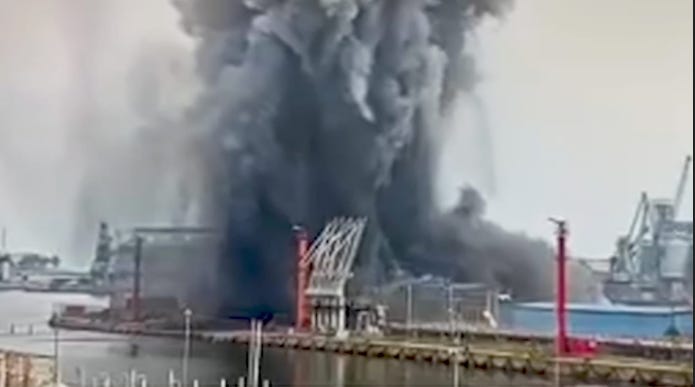
*Image above: Ukrainian drone explosion at Port of Constanța on June 5
The Importance of Constanța
Despite the positive outcome, the incident was extremely serious. The Port of Constanța is Romania’s biggest Black Sea port and handles, on a regular basis, oil and energy-related products, as well as chemical fertilizers, including a major oil terminal. One of Romania’s recently announced new naval priorities is to extend its military port facilities at Constanța by creating a new naval base to replace the outdated facility located deep inside the harbor. These plans are linked with Romania’s ongoing process of modernizing its naval forces and securing its maritime interests in the Black Sea. Efforts to create a new naval base are a welcome long-term development that would increase the capabilities of the Romanian Naval Forces. However, steps should be taken immediately to improve harbor security in the Port of Constanța due to the harbor’s vulnerability to the threat of unmanned systems.
Constanța is also the main operating base for the Forțele Navale Române (Romanian Naval Forces). Vessels with weapons systems on board are frequently moored at the main naval pier as ships regularly enter and leave the port. The risk of a large explosion remains high. The recent incident with the Ukrainian Sargan USV demonstrates the vulnerability of ports and harbors to unmanned systems. Both Ukraine and Russia have used unmanned naval systems to regularly infiltrate and strike targets within ports and naval bases up and down the Black Sea coast.
The Lack of Anti-USV Defenses
What is particularly concerning about the protection of the port of Constanța is that, at the time of the June 5 incident, it lacked an adequate system for detecting USVs. However, it did have an operational system for detecting and jamming UAVs, but it proved ineffective against USVs. Romania’s coastal surveillance system, SCOMAR, is not designed to detect sea drones. Its mission is optimized for law enforcement, to detect smugglers or vessels that fish illegally in Romanian waters. The system cannot detect surface targets smaller than 6 meters in length, and given their low profile and hulls built mostly of composites, USVs are practically invisible. SCOMAR is operated by the Ministry of the Interior and not by the Ministry of Defense.
A further consequence of the June 5 incident is that it revealed a complex - if not convoluted - decision-making process among different Romanian governmental agencies and ministries that deal with Constanța’s port security. For example, following the incident, the Romanian Ministry of Defense issued a statement claiming that the navy cannot protect maritime infrastructure during peacetime and that no legislation is in place that would authorize the military to intervene to resolve similar incidents or deal with potential grey zone activities.
Naval Basing Options & Constraints
Romanian Naval Forces are small and mostly obsolete despite past and current efforts to bring them into the 21st century. Currently, the Romanian Navy is divided between the ports of Constanța and Mangalia, which have dedicated military port facilities, while the nascent naval air arm is based at Tuzla, a small locality situated between the two ports.
The 53rd Frigate Flotilla and the 146th Mine Warfare Squadron are homeported in Constanța, along with a number of auxiliaries (tugs, logistics ships, diver support ships and school ships). The 150th Missile Squadron and the 50th Corvette Squadron are homeported in the military harbor in Mangalia. Its ability to host large surface combatants is hampered by a road bridge that connects it to the rest of southern Dobruja and to the border crossing with Bulgaria. Mangalia is particularly important because it has a naval shipyard at Șantierul Naval 2 Mai that is used for maintenance and repair.
The Romanian Navy has always shared the port of Constanța with the merchant marine and the civilian operator of the port. However, the need to create a separate naval base from the civilian infrastructure was not considered a high priority. Historically, the navy has always been the smallest branch of the Romanian armed forces and is usually treated as an afterthought when it comes to funding. Usually, military vessels have been assigned to Pier O (Dana Zero) of the Port of Constanța. As the port was developed by the government and owned by the state, this situation never posed a problem.
In 1937, an attempt was made by the government to build a separate naval base for the navy and another commercial port on Lake Tașaul, which lies a few kilometers north of Constanța. The project did not progress beyond the groundbreaking ceremony due to a shortage of funding and the start of the Second World War. During World War II, the Royal Romanian Navy used the port of Constanța as its main base, and the Soviet Air Force and Soviet Navy repeatedly bombed the port, seeking to destroy both civilian and military shipping, in an effort to make the port’s infrastructure unusable. After the war, the project to build a separate naval base was abandoned and instead, in 1975, a refinery and oil terminal were built at the mouth of Lake Tașaul.
During the communist era, Romania’s small Black Sea fleet primarily used the ports of Constanța and Mangalia. As the state owned both the ports and the shipyards, the need for dedicated facilities for the maintenance of military vessels was not required. The Romanian Navy would simply use the civilian shipyard facilities for complex maintenance operations. Additionally, shipyards in both ports constructed new surface combatants for the Romanian Navy as commissioned by the communist regime.
The fall of communism changed all that. While the ports remain government-owned, the shipyards have been privatized. For maintenance operations that cannot be handled by the Navy’s logistics bases, a complex procurement process should be conducted, with a single shipyard ultimately selected to perform the work
Inaction on the New Naval Base
In 2025, the Romanian Ministry of Defense announced plans to expand the military port of Constanța. These plans include the development of a new military pier near the southern sea wall of the port. Selected for its accessibility and proximity to the strategically vital Danube-Black Sea Canal, this location offers significant operational advantages. The base’s connectivity streamlines logistical support, enabling seamless joint operations with the Romanian Land Forces alongside interagency cooperation with the Ministry of the Interior and the Lower Danube Authority. Moreover, the new military pier will facilitate docking operations for Romanian navy ships as well as allied vessels that plan to visit the port. It will also host new infrastructure to help improve naval operations for deployments to not just the Black Sea, but also the Danube as well.
Despite being announced in 2025, no additional information has been published about the project, and so far no acquisition procedure has been launched to begin development of the new naval base. If completed, the extension of the military facilities at the Port of Constanța would greatly assist in the modernization and development of the Romanian Naval Forces and enhance its ability to project power to protect the offshore Neptun gas field. The new base would move some units of the Romanian Navy from their current location deep inside the harbor to a central point near the entrance, significantly enhancing its response time to sea-borne threats emanating from the Black Sea.
In light of these developments, two important pieces are missing from the government plans announcing this project. As the project has initially been presented, it does not have repair facilities, dry docks and/or floating docks needed to perform maintenance operations on the ships of the fleet. Such infrastructure would obviate the need to procure maintenance services from civilian shipyards, with the exception of complex maintenance procedures.
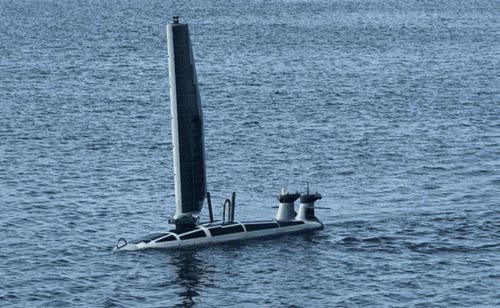
*Image above: Unmanned Underwater Vehicle (UUV)
The second key issue concerns port security. The port of Constanța is extremely vulnerable to sea drone attacks, not only USVs, as evidenced by the June 5 explosion. If a Ukrainian USV were jammed or hacked by Russian Electronic Warfare (EW) countermeasures, then it could easily end up in Romania’s biggest port. Any well-planned sea drone attack involving a swarm of USVs could do extensive damage to port facilities and the military vessels moored inside it. The port is even more vulnerable to Unmanned Underwater Vehicles (UUVs) than to USVs, as UUVs can infiltrate undetected if a port lacks adequate defenses and subsurface sensors. The difference between a USV and a UUV is that a UUV operates entirely beneath the water's surface (like a submarine or submersible), while a USV navigates on top of the surface, similar to a jet ski.
The port’s vulnerability to underwater unmanned vehicles (UUVs) is even higher than that posed by USVs, because UUV’s would have the specific ability to infiltrate without being detected in any port that is not protected and lacks adequate sensors to deal with unmanned systems.
Countering the USV Threat
To prevent a similar breach from occurring again, a network of early-warning sensors should be installed. Following the drone incident, an interim solution was considered for early warning against further potential USV infiltration incidents. Two Ocean Aero Triton autonomous underwater and surface vehicles (AUSV) were acquired and are now being used by the Coast Guard for surveillance missions outside the Port of Constanța.
Romanian authorities have yet to offer any public solutions to how to counter the threat posed by USVs. On August 28, 2025, Russian sea drones launched a surprise attack inside the Danube sinking the Ukrainian intelligence ship Simferopol. Moscow will in all likelihood continue to search for ways to infiltrate Romanian port facilities due to its previous success. What Romania urgently needs, before implementing any plans of expanding its military port facilities in Constanța is the creation and deployment of a sensor network to detect unmanned systems.
Acoustic sensors, FLIR sensors, LIDAR, and radar should be deployed in proximity to the ports of Constanța, Mangalia, and at the Danube River distributaries (mouths). This sensor network should be under the command of the Romanian Naval Forces and complement the existing Integrated Maritime Surveillance System (SCOMAR). Destruction of the unmanned systems once detected should be achieved using drone interceptors, air assets (helicopters, Unmanned Aircraft System, or UAS), air defense systems and surface combatants. Without adequate means to protect maritime infrastructure, Romania risks losing access to the sea as well as its navy.
Outlook
Efforts to develop military facilities in the Port of Constanța will greatly contribute to the development and modernization of the Romanian navy. However, securing the current port facilities should be prioritized and strongly reinforced in the near term as a result of the emerging threat posed by USVs. The threat matrix in the Black Sea has evolved exponentially over the past 18 months as the array of sophisticated threats grows due to the widening use of sea drones in naval warfare. Losing access to the sea and to the global markets can be achieved not only through blockade but also by destroying port infrastructure and Romania’s efforts to create a new naval base in the Port of Constanța will need to keep this factor in mind.
About the Author:
George Vișan is an expert on Romania and Black Sea Security and works as an expert on issues of peace and war for the Romanian Diplomatic Institute. He holds both undergraduate and postgraduate degrees in Political Science and International Relations from the University of Bucharest, and has published extensively on Romanian security and defense policy. From February 2022 to February 2024, he served as an advisor to the State Secretary for Strategic Affairs at the Ministry of Foreign Affairs (MAE). His opinions and research in this article are his own and do not reflect the official positions of the Romanian Diplomatic Institute nor the Ministry of Foreign Affairs of Romania.
Thank you for your support! Please remember that The Saratoga Foundation is a non-profit 501(c)(3) organization. Your donations are fully tax-deductible. If you seek to support The Saratoga Foundation, you can donate by clicking on the PayPal link below! Alternatively, you can also choose to subscribe to our website to support our work.
https://www.paypal.com/donate/?hosted_button_id=XFCZDX6YVTVKA