
By Alexander Melikishvili
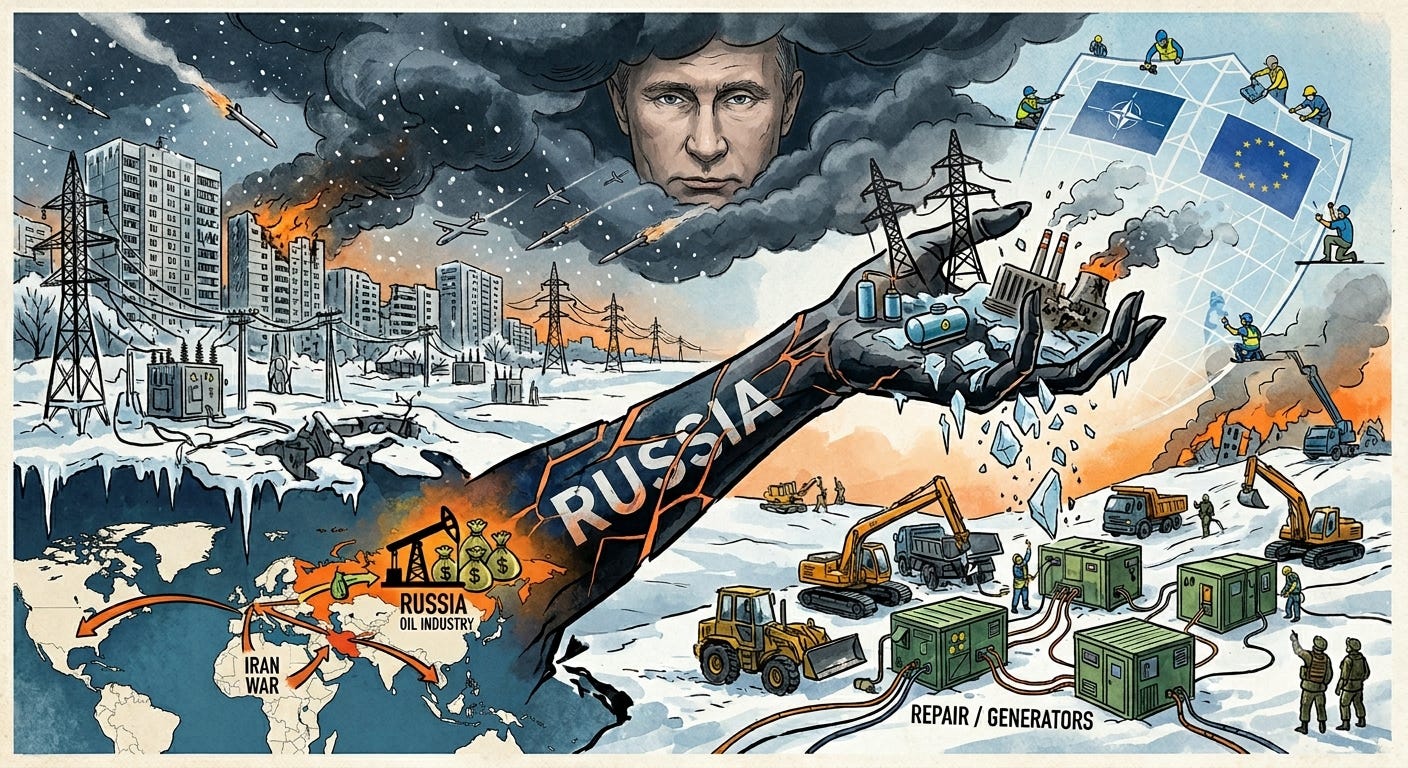
The US-Israeli war against Iran has had several second-order effects on Ukraine since it commenced on February 28. Most importantly, it has applied upward pressure on oil prices in global energy markets, benefiting Russia’s hydrocarbon-dependent economy. According to the Russian Finance Minister Anton Siluanov, the increase in oil price could result in an additional $2.73 billion in revenues for the state budget. This will, in turn, provide the Putin regime with more financial resources to continue to wage war against Ukraine.
President Zelensky acknowledges this in his open letter to Putin, in which he cites “intelligence reports” indicating that the Russian leader is “considering plans to continue the war into 2027 and 2028.” Russia’s position is further strengthened by the political anxieties in the Trump administration over continued increases in the price of oil. This fear resulted in the US Department of the Treasury’s repeated issuance of 30-day waivers from sanctions on Russian oil starting from March (the latest one dates back to 18 May and is due to expire on 17 June).
The US-led war of choice with Iran also spurred Ukraine to intensify its bombing campaign targeting Russia’s oil and gas sector to deny the Kremlin the windfall profits from soaring oil prices. The Ukrainian military has been relentless in its deep strikes against oil refineries across Russia, forcing Deputy Prime Minister Novak to grudgingly admit the drop in oil production on the sidelines of the St Petersburg International Economic Forum on June 4. In March, Reuters estimated that due to Ukrainian drone strikes on Russia’s strategically important oil export terminals on the Baltic (Ust-Luga and Primorsk) and Black (Novorossiysk) Seas, and the disruption of oil flow via the Druzhba pipeline caused by a Russian drone attack, Russia’s oil export capacity was reduced by 40%.
Ukraine’s “kinetic sanctions” have not been limited to Russian oil refineries, as maritime attacks against the Kremlin’s so-called “shadow fleet” indicate. Vessels carrying Russian oil in contravention of international sanctions have been regularly targeted by Ukraine not only in the Black Sea but as far away as the southern Mediterranean. For example, the tanker Qendil was struck off the coast of Libya in December 2025.
Russia Again Aims for Winter
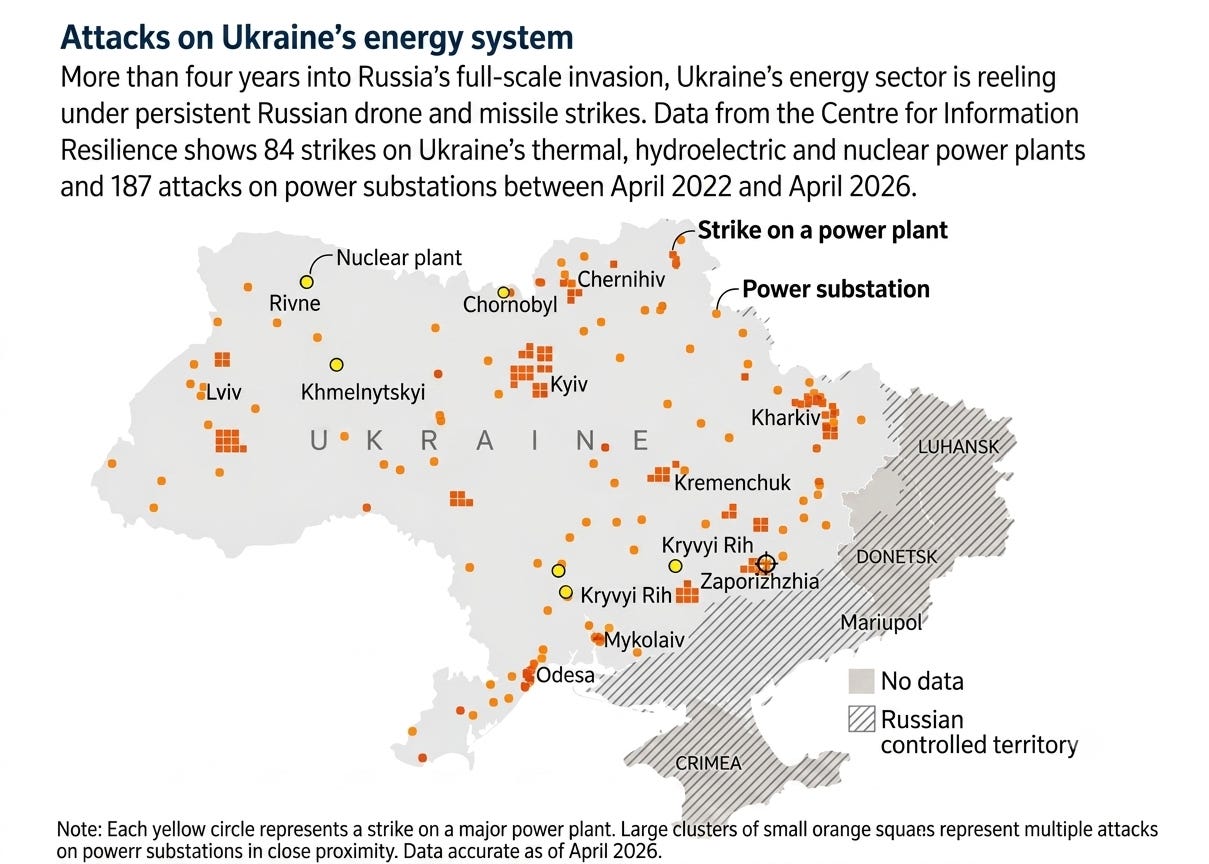
Owing to the combination of extremely cold weather (coldest in the last 15 years) and persistent Russian strikes against Ukraine’s critical energy infrastructure, this past winter was the hardest for Ukraine since the war began in February 2022. Unable to achieve a major breakthrough along the frontline, which, according to General Oleksandr Syrskyi, the Commander-in-Chief of the Armed Forces of Ukraine, stretches over 1,200 km, Russia is increasingly resorting to massive volleys of drones and missiles launched against Ukrainian electrical supply and production facilities. For example, the June 2 attack included 73 missiles and 656 drones, causing power outages in Kyiv and across six regions (Kyiv, Donetsk, Dnipropetrovsk, Kharkiv, Sumy, and Cherkasy).
Moscow’s overarching objective is to degrade Ukraine’s national power grid by destroying the high-power transmission lines and substations that connect its electrical-generation facilities, which are mainly concentrated in the south and west of the country, to industrial demand in the east. As early as January, President Zelensky acknowledged that, because of the Russian attacks, Ukraine’s electrical-generation capacity could cover only 60% of the country’s needs.
*Image above: Naftogaz Facility Struck by Russian missiles in Chernihiv
Russian strategy is ruthlessly methodical, and it is multi-pronged, as it also entails the destruction of Ukraine’s oil and gas infrastructure. In January–April alone, the facilities of Ukraine’s national oil and gas champion, Naftogaz, were struck 96 times, according to its CEO, Serhii Koretskyi. This forced Ukraine to import 2.21 billion cubic meters (bcm) of gas in January–April, which is 2.1 times as much as during the same period in 2025, according to data from the Ukrainian oil and gas consultancy ExPro. Considering that the Iran war increased gas prices in Europe to USD 500–600 per 1,000 cubic meters (compared to below $400 before the war), the debt-laden Naftogaz would need $1.3–1.5 billion to purchase the planned 2–2.5 bcm before the start of the heating season (31 October–31 March), based on Ekonomichna Pravda’s estimates.
The Ukrainian government’s baseline scenario for 2026–2027 envisions having 14.6 bcm in underground storage facilities by the start of the heating season. As of May 25, Ukraine had 10.7 bcm in storage, including 4–5 bcm that must remain in the system for technical maintenance, according to S&P Global Energy CERA. Although Ukraine boasts a network of twelve underground storage facilities (mainly concentrated in the western regions) with a total storage capacity on the order of 31 bcm, the largest in Europe, they have come under repeated attacks. In January, the Bilche-Volytsko-Uherske underground gas storage facility in Stryi district of Lviv region, the largest in Ukraine, was attacked by what the OSCE Parliamentary Assembly’s Parliamentary Support Team for Ukraine described as “a missile of the ‘Oreshnik’ type with separate warheads.”
Outlook
The impending disbursement of the two-year EUR 90 billion EU loan (approximately $104 billion), slated for mid-June, provides welcome relief to the Ukrainian government as it ramps up preparations for winter. President Zelensky stated that at least EUR 30 billion ($34 billion) from this loan will be spent on direct budgetary support, which presumably also implies funds allocated for urgent repairs to critical energy infrastructure. However, Ukraine will be racing against time, as Russian attacks targeting the oil and gas sector, the electricity grid, electricity generation, and heat production will probably escalate to previously unseen levels as the heating season approaches.
With Russian combat operations effectively stalled due to the 10–15 km-wide drone-patrolled “kill zone” on both sides of the frontline, Putin’s options are limited. They could include another mobilization in the autumn, as suggested by the Russian MP Gurulev, but that would be deeply unpopular with the Russian public, which is already seething with anger from noticeably increased Ukrainian attacks deep inside Russia. Instead, chipping away at Ukraine’s critical energy infrastructure with massive drone and missile volleys presents a more palatable choice, one that is virtually guaranteed to yield tangible results both in terms of incapacitating Ukraine’s defense industry and exacerbating war fatigue among the population without incurring losses on the battlefield.
In such a context, the provision of interceptor missiles (particularly PAC-3s for Patriot batteries) for Ukraine’s air defenses via the Prioritized Ukraine Requirements List (PURL), a US-NATO procurement mechanism, becomes absolutely critical. But here again, the harmful impact of the Iran war is felt strongly as the US balances its priorities with Israel and Gulf allies in mind, stoking European concerns. In the absence of adequate American commitments, it will fall on Europe to make difficult trade-offs that will have to entail drawing down stocks of munitions in some countries.
Speaking at the European Parliament in January, NATO Secretary General Rutte urged member states that “are sitting on large piles of interceptors” to transfer them to Ukraine. Without robust air defense to protect the ongoing repairs to energy infrastructure, Ukraine is destined to face another grueling winter that could strain the war-ravaged country to the breaking point.
About the Author:
Alex Melikishvili is a senior country risk analyst with more than a decade of experience working in the private sector (S&P Global, IHS Markit) with a focus on Eurasian security. Alex holds a master’s degree in International Affairs from the George Washington University’s Elliott School of International Affairs.
Thank you for your support! Please remember that The Saratoga Foundation is a non-profit 501(c)(3) organization. Your donations are fully tax-deductible. If you seek to support The Saratoga Foundation, you can make a one-time donation by clicking on the PayPal link below! You can also subscribe to our website to support our work.
https://www.paypal.com/donate/?hosted_button_id=XFCZDX6YVTVKA