
By Alexander Melikishvili
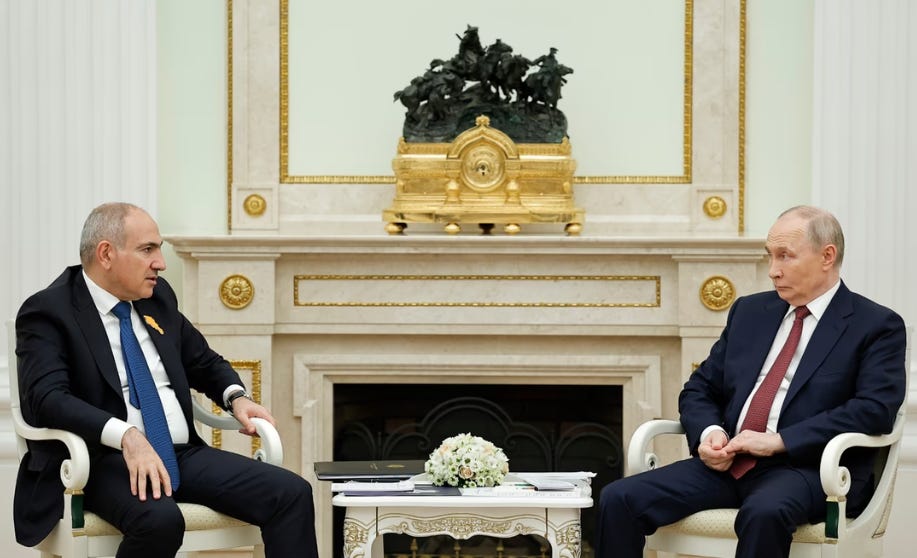
President Putin chose the press briefing on 9 May, the day Russia celebrates the end of World War II, to deliver a veiled threat to Armenia over its stepped-up efforts to pursue closer ties with the EU. He reminded the press pool that the war in Ukraine started with the latter’s attempt to do the same. He then added, “Therefore, they [Armenia] should not take it to the extreme.” Putin’s comments also included a suggestion to hold a referendum in Armenia, the outcome of which could potentially lay the groundwork for “a gentle, intelligent and mutually beneficial divorce.” Putin proposed discussing this topic at the upcoming Eurasian Economic Union (EEU) summit, which will be held in Astana, Kazakhstan, from May 28 to 29.
Armenian Prime Minister Pashinyan was quick to respond. At an impromptu huddle with the media on May 11, in the Erebuni district of Yerevan, he defiantly disagreed with the divorce metaphor and stated that he saw no need to hold a referendum on relations with the EU, while issuing assurances that his government had no intention of harming Russian interests. Pashinyan expressed “great respect” for the EEU but announced that he would be skipping the summit due to being preoccupied with campaigning ahead of Armenia’s crucial parliamentary election on June 7. Deputy Prime Minister Mher Grigoryan will be representing Armenia in Astana.
If Putin’s remarks were relatively measured, other representatives of the Russian government were more explicit. Their ire was caused by the presence of Ukrainian President Zelensky at the 8th summit of the European Political Community (EPC), which, for the first time, was held in Yerevan on May 4. Maria Zakharova, the spokeswoman for the Russian foreign ministry known for her vitriolic tirades, declared at a press briefing on May 7 that the Ukrainian leader’s visit “showed the citizens of Armenia what kind of future the EU has prepared for them.” Mikhail Kalugin, the senior Russian diplomat overseeing relations with the CIS states, pointed out that “integration requires systemic work that is hardly compatible with an approach according to which membership in the EEU is viewed as a temporary measure for the period of search or the process of accession to an alternative association. To put it simply, sitting on two chairs won’t work.”
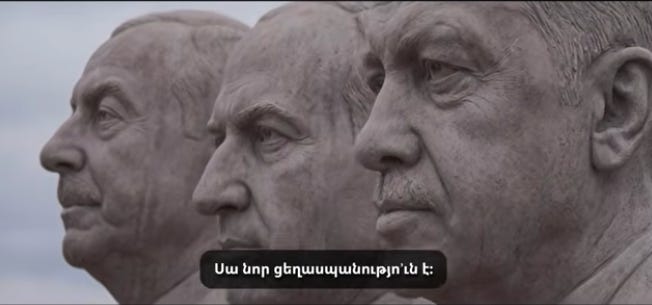
*Image above is a Russian AI-generated image mocking Armenian Prime Minister Pashinyan, flanked by Azerbaijan’s President Ilham Aliyev, and Turkish Prime Minister Tayyip Erdogan in a Mount Rushmore-like sculpture taken from the YouTube channel (@notowa1) of the Armenian popular movement “No to Western Azerbaijan” that opposes Armenia-Azerbaijan-Türkiye rapprochement.
Russia Launches Disinformation Campaign in Earnest
Ahead of the general elections, Pashinyan is significantly hobbled by his principled position regarding the normalization of relations with both Azerbaijan and Turkey, which is very unpopular among a sizable segment of the Armenian electorate, especially Karabakh refugees. In addition, Pashinyan’s campaign against alleged corruption in the Armenian Apostolic Church, including calls for the resignation of Catholicos Karekin II, has made him the target of criticism from religious conservatives and the pro-Russian opposition. According to the public opinion poll results released in April, although Pashinyan’s Civil Contract party garnered the biggest share of supporters (33.6%), leaving far behind Narek Karapetyan’s Strong Armenia (11.4%) and ex-President Robert Kocharyan’s Armenia Alliance (4.2%), respondents who refused to answer or did not know whom they would vote for accounted for 23.3% and 13.7%, respectively, indicating that many voters are still undecided.
Against this backdrop, Russia unleashed an online disinformation campaign targeting Pashinyan due to his pro-Western policies, which is replete with AI-generated videos and images. According to the Russian investigative outlet The Insider, the Matryoshka bot network commenced its operations in October 2025, or eight months before the elections, which underscores the importance the Kremlin attaches to Armenia. In comparison, Matryoshka’s disinformation campaigns in the United States (presidential elections) and Moldova (parliamentary) began three and a half and five and a half months before the election dates in 2024 and 2025, respectively. In terms of content, it is a toxic mix of familiar Kremlin tropes and outright lies, including accusations that Pashinyan is planning to drag Armenia into conflict with Russia, that he is selling out Armenia’s national interests for the sake of normalizing relations with Azerbaijan and Turkey, and that his pursuit of closer relations with the EU threatens “traditional values” in Armenia.
Russian election interference is further confirmed by the Swedish investigative organization Blankspot, which alleges that it has obtained a confidential document entitled Programme for Work in the ‘Anti-Pashinyan’ Direction for 2026. Blankspot claims that the document was obtained from “a person operating within the Russian intelligence services” after he or she “was hacked by a third party before March 2026.” It identifies the main objective as the “minimization of electoral results of the ‘Civil Contract’ and political forces allied with it.” This is to be accomplished through a number of means, including framing the elections as a referendum on confidence in Pashinyan personally.
Outlook
Russia does not lack levers of influence over Armenia, economic or otherwise. Suffice it to mention that Russia owns Armenia’s critical infrastructure, including its railway grid and gas distribution network. Armenia is vitally dependent on the gas it receives from Russia via Georgia at a steep discount, which Putin reminded Pashinyan of at their rather uneasy meeting in Moscow on April 1st. However, so far, it appears that the Kremlin’s strategy is limited to “soft” measures, including arbitrary trade restrictions such as the prohibition on selling imported Armenian mineral water in April. Given Pashinyan’s precarious domestic position, it is likely that Putin’s regime calculates that the disinformation campaign will be enough to unseat him.
Furthermore, the presence of the Russian military in Armenia provides Putin with other options as well. The passage by the State Duma of the draft law allowing the use of force to protect Russian citizens abroad on May 13, after it goes through the legislative process (approval by the Federation Council followed by Putin’s signature), will give Moscow a legal pretext for potential military intervention in Armenia, where, as of December 2025, 43,536 Russian citizens held residence permits, according to the Armenian interior ministry. On May 14, Pashinyan responded to the passage of this law by stating that he was not concerned and expressing his confident expectation that the Russian 102nd military base in Gyumri, “irrespective of what laws are in place in the Russian Federation, must function within the framework of Armenian laws and powers.” Nonetheless, under an extreme scenario, the Russian troops deployed in Armenia could be employed to carry out a coup to install a more Russia-friendly regime.
Armenia’s fate hangs in the balance as it is unclear how effective the deployment of the EU’s Hybrid Rapid Response Team to counter foreign information manipulation and interference (FIMI), in response to the Armenian government’s request, has been in limiting the impact of the Russian disinformation campaign ahead of the elections. Similarly, it is very unlikely that further institutionalization of EU-Armenia relations (through the establishment of the EU Partnership Mission in Armenia with a two-year mandate in April) will stave off potential Russian military intervention should Putin decide to use force to bring Armenia to heel.
About the Author:
Alex Melikishvili is a senior country risk analyst with more than a decade of experience working in the private sector (S&P Global, IHS Markit) with a focus on Eurasian security. Alex holds a master’s degree in International Affairs from the George Washington University’s Elliott School of International Affairs.
Thank you for your support! Please remember that The Saratoga Foundation is a non-profit 501(c)(3) organization. Your donations are fully tax-deductible. If you seek to support The Saratoga Foundation, you can make a one-time donation by clicking on the PayPal link below! You can also subscribe to our website to support our work.
https://www.paypal.com/donate/?hosted_button_id=XFCZDX6YVTVKA
…sure, go ahead Vova, what are you will going to war in Armenia with?
…you scraping the bottom of your recruiting capacity, you have no fucking tanks and other means to go to another war and this time you will not going to have that much help from your “near abroad” system you been relying on last time, so just SIT DOWN and SHUT THE FUCK UP
…you can still bark, but you lost your teeth to bite and Ukraine is just started and will escalate with its drone operations exponentially depriving your mafia state off its money for profit and money for war you wanted so much and very war will see to your own demise, ironic isn’t it…. “3 day SPECIAL operation” my ass!