
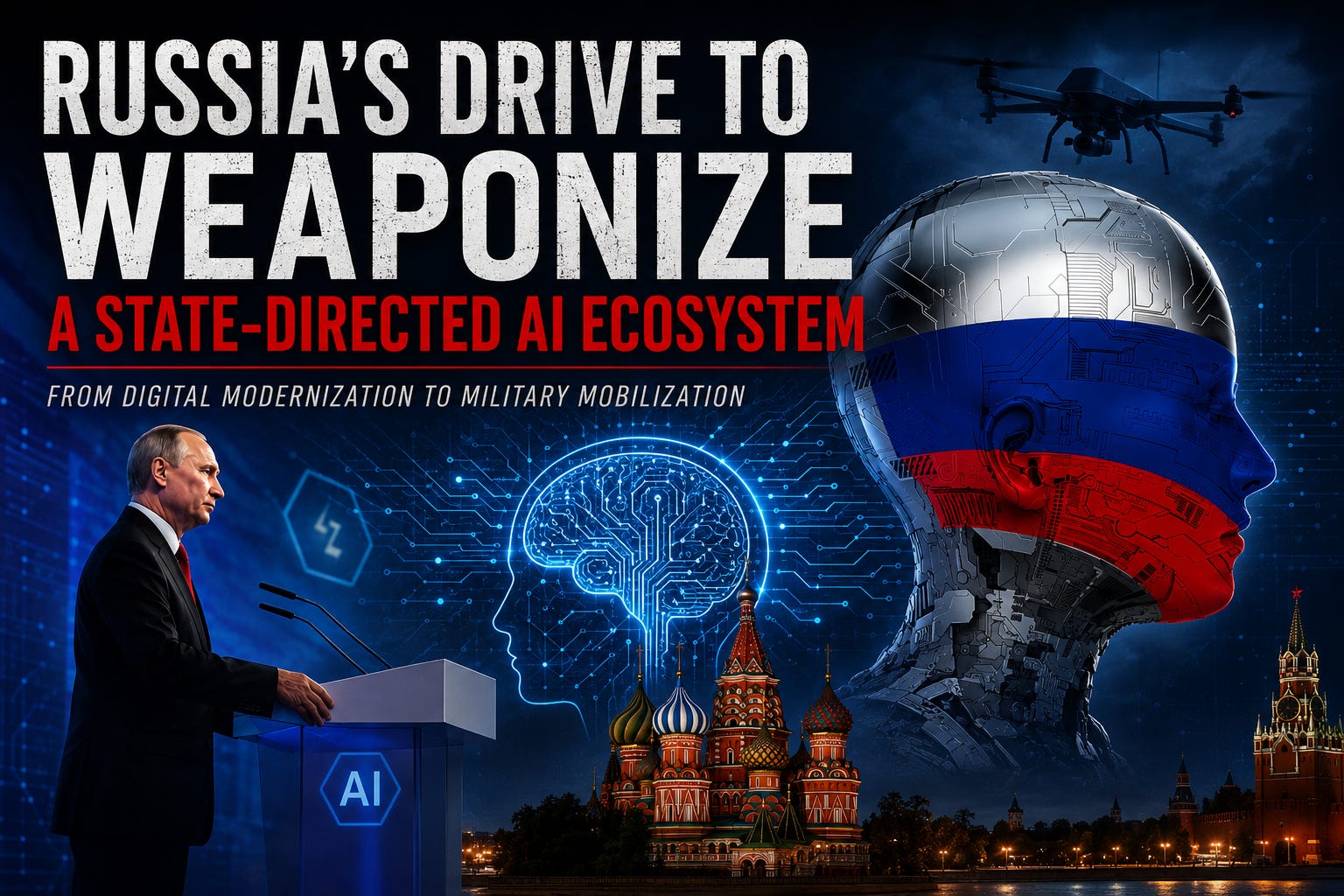
In June 2026, Defense Minister Andrei Belousov stated that the Russian Armed Forces were integrating AI, robotics, and automated command systems into military management. The statement reflects a broader shift in Russia’s AI policy since the full-scale invasion of Ukraine. Whereas the original National Strategy for the Development of Artificial Intelligence framed AI primarily as an instrument of digital modernization and economic development, wartime priorities have increasingly repositioned it as a strategic enabler of military effectiveness, technological sovereignty, and state resilience. This evolution is reflected in the revised National Strategy for the Development of Artificial Intelligence until 2030, approved in February 2024, which places substantially greater emphasis on technological sovereignty, domestic software development, and reducing dependence on foreign digital infrastructure. Taken together, these developments suggest that AI has become an integral component of Russia’s wartime mobilization strategy, with civilian AI initiatives increasingly serving as a foundation for military innovation by strengthening the country’s data infrastructure, software ecosystem, and human capital.
This analysis proceeds as follows. First, it examines the institutional and legislative shifts that have altered the trajectory and centralized AI governance since February 2022. Second, it considers how civilian AI development across business, healthcare, education, and infrastructure has become increasingly tied to Russia’s broader sovereignty agenda. Third, it assesses the primary military applications of AI, specifically command-and-control, reconnaissance, drones, logistics, and battlefield management. Finally, it explores Russian writings on the role of AI in information-psychological operations, concluding with an analysis of what Russia’s post-2022 AI trajectory reveals about the relationship between technological sovereignty, military adaptation, and long-term confrontation with the West.
Institutional and Legislative Changes After February 2022
In the post-2022 period, implementation of Russia’s AI strategy has become increasingly centralized. For instance, the Government Sub-commission on the Development and Implementation of Artificial Intelligence has emerged as the principal coordinating body responsible for synchronizing AI policy across ministries, regional governments, state corporations, and research institutions. Unlike many Western AI governance frameworks, the Russian model prioritizes centralized coordination and state-led implementation.
This shift became particularly evident at the AI Journey conference in late 2025. Speaking at the event, President Vladimir Putin argued that Russia should move beyond isolated AI projects toward a comprehensive national implementation plan spanning ministries, industries, and regions. He maintained that AI should become integrated into “virtually every management and production process” by 2030 and presented it as essential for preserving Russia’s technological competitiveness under conditions of geopolitical confrontation. Putin also emphasized that dependence on foreign AI systems creates strategic vulnerabilities, reinforcing technological sovereignty as a central objective of AI policy. AI is thus increasingly framed not simply as an economic technology but as an instrument of national sovereignty and resilience.
As in other strategic sectors, AI development is expected to rely on strong state coordination and financial support. Discussing Russia’s “new digital leap“, Izvestiya argued that AI should become the technological foundation of the country’s next phase of economic development while emphasizing that success depends on coordinated government policy, investment in domestic infrastructure, and strategic state support. Similarly, experts interviewed by Rossiyskaya Gazeta argued that sustained AI development requires stronger mathematics education, expanded domestic supercomputing capacity, increased public investment in research, and support for domestic software ecosystems, drawing parallels with Soviet approaches to strategic technological development. Together, these institutional developments indicate that Moscow increasingly treats AI as a state-directed sovereignty project rather than a conventional modernization program.
Civilian AI: Trends and Changes
Although Russia’s AI strategy increasingly prioritizes national security, military modernization does not operate independently from civilian technological development. Rather, one of the defining characteristics of Russia’s post-2022 AI policy is the gradual erosion of boundaries between civilian and military innovation. Moscow increasingly treats healthcare, education, public administration, logistics, and industrial modernization as components of a broader AI ecosystem capable of supporting long-term strategic competition. Three civilian domains illustrate this trend. These areas matter not because they are military in a narrow sense, but because they build the data, personnel, software, and institutional infrastructure on which military AI adoption ultimately depends.
First, business and economic development. Following the introduction of Western sanctions, the Russian government increasingly identified AI as a mechanism for offsetting labor shortages, improving productivity, and supporting import substitution across strategic industries. The Yakov & Partners report, published in late 2025, estimated that AI could contribute between 7.9 and 12.8 trillion rubles annually to the Russian economy by 2030 while improving productivity across manufacturing, finance, transport, healthcare, and public administration—sectors facing acute labour shortages. The report also found that more than 70 percent of surveyed companies had already deployed generative AI in at least one business function, while nearly half had begun experimenting with AI agents, suggesting that AI adoption has moved beyond pilot projects into mainstream business operations. Similarly, Russian business media present an optimistic outlook. According to RBC, Russia’s AI market could reach approximately $2.1 billion in 2025 while maintaining annual growth rates approaching 45 percent. These projections should be treated cautiously, but they show the weight assigned to AI in Russian industrial policy despite sanctions and hardware constraints.
Second, healthcare has emerged as one of the fastest-growing civilian applications of AI. According to Vedomosti, Moscow’s digital healthcare platform has connected nearly 2,000 medical organizations across more than 70 regions, enabling AI systems to assist physicians in analysing medical images and improving diagnostic accuracy. Beyond healthcare itself, these applications expand Russia’s domestic AI ecosystem by generating large datasets, improving machine-learning models, and strengthening national computational infrastructure.
Third, education and human capital occupy a strategic position within Russia’s AI agenda. Rather than emphasizing digital literacy alone, Russian policy increasingly treats education as a prerequisite for technological sovereignty. The Yakov & Partners report identifies shortages of qualified specialists as a principal constraint on AI development and argues for closer cooperation between universities, state institutions, and technology companies. It recommends expanding mathematics, computer science, and engineering education while strengthening university-industry partnerships to sustain Russia’s AI ecosystem under conditions of international isolation.
Since 2022, given internal developmental trajectory, even nominally civilian AI sectors have moved closer to civil-military fusion. In Russia’s wartime setting, healthcare data, education, software ecosystems, robotics, cryptography, and drone technologies increasingly feed into the same sovereign AI infrastructure that the armed forces can draw upon.
Military AI: Areas of Application
While civilian AI provides the foundation of Russia’s sovereign AI ecosystem, the armed forces have increasingly become its principal destination. Official statements and military publications indicate that the war against Ukraine has reshaped Russian AI priorities – rather than pursuing fully autonomous weapons as an end in themselves, Moscow has concentrated on integrating AI into command-and-control systems, battlefield management, logistics, reconnaissance, and drone warfare. During a meeting of the Military-Industrial Commission in April 2025, President Vladimir Putin argued that “whoever begins using AI in military affairs faster will enjoy enormous – indeed colossal – advantages on the battlefield” and called for accelerating domestic software development for automated command systems alongside expanded production of unmanned aerial systems. This emphasis continued in June 2026, when Defence Minister Andrei Belousov stated that the Russian Armed Forces were actively integrating AI technologies, robotics, and automated command systems into military management, indicating that AI has moved beyond experimental projects to become part of Russia’s broader military modernization agenda.
The modernization of command systems has become the principal area of AI integration with lessons from the war in Ukraine underscoring the importance of rapid data processing, sensor fusion, and real-time situational awareness. Following Belousov’s inspection of tactical command modernization in July 2025, Moskovskii Komsomolets reported continuing efforts to integrate digital communications, automated battlefield management, and AI-assisted command support capable of combining information from drones, reconnaissance assets, electronic warfare units, and artillery into a common operational picture. Similarly, an article published by APNI argues that AI should strengthen tactical command by processing battlefield data, identifying operational patterns, supporting target prioritization, and improving coordination among different branches of the armed forces. One example of practical implementation of this approach is the AI platform Svod, reportedly designed to collect and synthesize operational information from multiple sources to provide commanders with integrated situational awareness rather than raw intelligence streams, illustrating Russia’s preference for decision-support systems over autonomous command architectures.
The war has also accelerated interest in AI-enabled navigation, computer vision, swarm coordination, and autonomous target recognition. According to Arsenal Otechestva defence magazine, future combat effectiveness will increasingly depend on integrating AI with robotics, precision-guided weapons, and unmanned systems capable of operating under conditions of electronic warfare, suggesting that AI will reshape not only individual weapons but also the organization of military operations.
Russian military writing after 2022 presents AI primarily as a decision-support technology rather than a substitute for commanders. Romashkina argues that AI’s main value lies in processing battlefield information, improving logistics, strengthening cyber defence, supporting reconnaissance, and assisting operational decision-making (Romashkina, N. P. “Iskusstvennyi intellekt v voennom dele: vozmozhnosti, ugrozy, perspektivy.” Voprosy kiberbezopasnosti, no. 6 (70) (2025): 158–165). A related study titled “Artificial Intelligence in Military Affairs: Essence, Problems of Development and Operation, Main Areas of Application” advocates a “human-in-command“ model in which AI helps construct digital representations of the battlefield, prioritize threats, model alternative courses of action, and prepare operational orders, while final authority remains with human commanders. Both studies argue that AI should function as a force multiplier embedded throughout command-and-control processes rather than as an autonomous decision-maker. Another analysis broadened this argument by treating AI as a strategic technology and introducing the concept of “cognitive weapons“: tools designed to degrade adversary AI systems through poisoned data, adversarial inputs, or attacks on software and hardware. This moves the discussion beyond AI-enabled weapons to AI itself as a contested battlespace. In other words, Russian military thinkers increasingly view AI systems not only as tools for enhancing combat effectiveness, but also as targets that can be deceived, degraded, or manipulated. Thus, the analysis postulates an idea that Russia must invest not only in military AI capabilities but also in protecting AI systems against manipulation, reinforcing the view that AI will increasingly shape military competition and international power relations.
The clearest articulation of this emerging Russian view appears in an article by Col. (ret.) V. Orlianskii and Col. (ret.) P. Dulniev in the Russian military journal Voyennaya Mysl (Military Thought), which links battlefield lessons from Ukraine directly to the need for AI-enabled command systems and a more flexible force structure. The authors argued that the experience of the war in Ukraine since 2022 demonstrates that Russia’s traditional, fixed organizational model is no longer adequate for high-intensity, technology-driven warfare. The principal lesson is that tactical units must become dynamically organized, capable of being reinforced in real time with drones, artillery, aviation, electronic warfare, and other assets according to rapidly changing battlefield conditions rather than relying on permanently assigned force structures. They contend that the speed of modern combat, the ubiquity of drones, and the transparency of the battlefield have shifted the decisive advantage toward forces able to process information faster, adapt organizational structures more rapidly, and coordinate multi-domain assets with minimal delay.
To achieve this transformation, the authors advocate integrating artificial intelligence into a unified automated command-and-control system spanning tactical, operational, and strategic levels. AI is presented not as a replacement for commanders but as a decision-support tool capable of processing massive volumes of reconnaissance data, identifying targets, modelling courses of action, allocating reinforcement assets, coordinating joint operations, and continuously updating decisions in near real time while leaving final authority with human commanders. They further argue that AI-enabled command systems should underpin a transition to “dynamic force organization,” improve reconnaissance, logistics, and electronic warfare, facilitate the employment of robotic and directed-energy systems, and ultimately reshape Russian military art. At the same time, the authors acknowledge that this vision faces major obstacles, including deficiencies in Russian computing power, microelectronics, software development, data quality, and AI expertise, warning that overcoming these technological shortcomings is essential if Russia is to avoid falling behind the United States and China in the next generation of warfare.[1]
Information-Psychological Confrontation and AI
Military modernization represents only one dimension of Russia’s expanding AI strategy. AI has also become an increasingly important instrument supporting Moscow’s information operations abroad. While AI has not fundamentally transformed Russian influence activities, it has increased their speed and scale, even if its practical effectiveness remains uneven. A revealing example emerged during Hungary’s parliamentary campaign. According to The Moscow Times, Russian political strategists developed a disinformation campaign – which turned out to be a failure – intended to strengthen Prime Minister Viktor Orbán by portraying him as the defender of Hungarian sovereignty while simultaneously discrediting his political opponents. Subsequent investigations by Reuters found that coordinated Telegram networks amplified these narratives while increasingly relying upon AI-generated content and localized messaging. The pattern resembles earlier Russian influence operations such as the Doppelgänger campaign targeting European audiences – rather than replacing human operators, generative AI enables faster production of fake news articles, manipulated imagery, multilingual social media posts, and synthetic videos.
In this regard, Russian military thought is paying growing attention to AI’s role in gray-zone and sub-threshold operations. An article titled “Teoriya «Myatezhevoyny» E.E. Messnera kak instrument osmysleniya prirody sovremennykh voennykh konfliktov” (”E.E. Messner’s Theory of ‘Subversive Warfare’ as an Instrument for Understanding the Nature of Modern Military Conflicts) in a recent issue of Voyennaya Mysl’ (Military Thought) argues that Evgeny Messner’s concept of “global insurgent warfare” retains significant explanatory value for understanding 21st century conflicts. The authors contend that digital technologies, social media, and artificial intelligence have transformed myatezhevoyna into a “digital-ideological” form of confrontation, in which information, narratives, and collective consciousness become primary targets of strategic competition. They conclude that contemporary national security must protect not only territory and infrastructure but also the state’s cognitive and value space, reflecting the growing importance of non-military instruments in achieving strategic objectives.[2]
Another article, “Doktrinal’nye transformatsii v sfere psikhologicheskikh operatsiy SShA i NATO s tochki zreniya vozmozhnykh posledstviy dlya bezopasnosti Rossii” (Doctrinal Transformations in the Sphere of US and NATO Psychological Operations from the Perspective of Potential Consequences for Russia’s Security) published in the same journal, argues that recent U.S. and NATO doctrinal changes in psychological operations (PSYOP) represent an expanding threat to Russian national security. The authors contend that Washington’s return to the concepts of PSYOPs, combined with increased funding and broader operational scope, signals an intensification of psychological pressure against Russian society and the Armed Forces. Particular attention is devoted to artificial intelligence, which is portrayed as a force multiplier capable of generating persuasive synthetic content in real time, enabling unprecedented penetration of Russia’s information space. The article also argues that AI-enabled micro-targeting, supported by big data analytics, substantially enhances the effectiveness of Western information campaigns by allowing tailored influence operations against vulnerable social groups. Overall, the authors present AI as a critical enabler of next-generation psychological warfare and gray zone competition rather than merely a technological innovation.[3]
Taken together, these developments suggest that AI is becoming an increasingly important enabler of Russia’s information-psychological confrontation rather than a revolutionary new instrument of influence. While generative AI has expanded the speed, scale, and adaptability of disinformation campaigns, Russian military thought increasingly views AI in broader strategic terms – as a tool for shaping Western perceptions, protecting the state’s cognitive space, and countering perceived psychological operations organized by the West. This perspective complements Russia’s wider post-2022 AI strategy, in which technological sovereignty, military modernization, and information confrontation are treated as mutually reinforcing components of a single state-directed effort to strengthen national resilience under conditions of prolonged geopolitical competition.
Outlook
Russia’s post-2022 AI trajectory suggests that Moscow is not trying to win the global AI race on the terms set by Silicon Valley or China’s largest technology firms. Instead, it is building a sovereign, state-directed AI ecosystem shaped by wartime pressure, sanctions, and long-term confrontation with the West. The significance of this shift lies less in frontier-model competition than in the way Russia is integrating AI into command systems, logistics, battlefield management, drones, education, healthcare data, and information operations. This does not mean Russia has overcome its technological constraints. Access to advanced chips, computing power, and globally competitive commercial platforms remains limited. It does mean, however, that Russia may gain practical advantages from selective, state-coordinated AI adoption. This marks an important evolution from the pre-war logic of digital modernization – AI is no longer treated primarily as a tool for improving economic efficiency or public administration; it is increasingly understood as infrastructure for wartime governance, military adaptation, and strategic autonomy. The key implication is that Russian AI strategy is assuming the form of a resilience strategy – one designed to preserve military adaptability, state capacity, and informational reach under conditions of prolonged geopolitical confrontation. Judging by repeated statements from President Putin and Russia’s military-political leadership, this confrontation is viewed not as a temporary phase but as a long-term strategic condition likely to endure for the lifetime of the current political system.
[1] Voyennaya Mysl (Military Thought), No. 2 (February 2026), pp. 10 – 27).
[2] Voyennaya Mysl (Military Thought), No. 6 (June 2026), pp. 152–158).
[3] Voyennaya Mysl (Military Thought), No. 6 (June 2026), pp. 77 – 89).
About the Author
Dr. Sergey Sukhankin is a Senior Fellow at The Saratoga Foundation specializing in Russian military and security affairs, as well as Russo-Chinese relations. He is also an Advisor at Gulf State Analytics (Washington, D.C.) and Fellow at the North American and Arctic Defense and Security Network (Canada).
Thank you for your support! Please remember that The Saratoga Foundation is a non-profit 501(c)(3) organization. Your donations are fully tax-deductible. If you seek to support The Saratoga Foundation, you can make a one-time donation by clicking on the PayPal link below! You can also subscribe to our website to support our work.
https://www.paypal.com/donate/?hosted_button_id=XFCZDX6YVTVKA