
👉 The National Interest
By: Ray Wojcik and Sebastian Meitz
Poland has long been a model US and NATO ally. It should have a permanent US military presence.
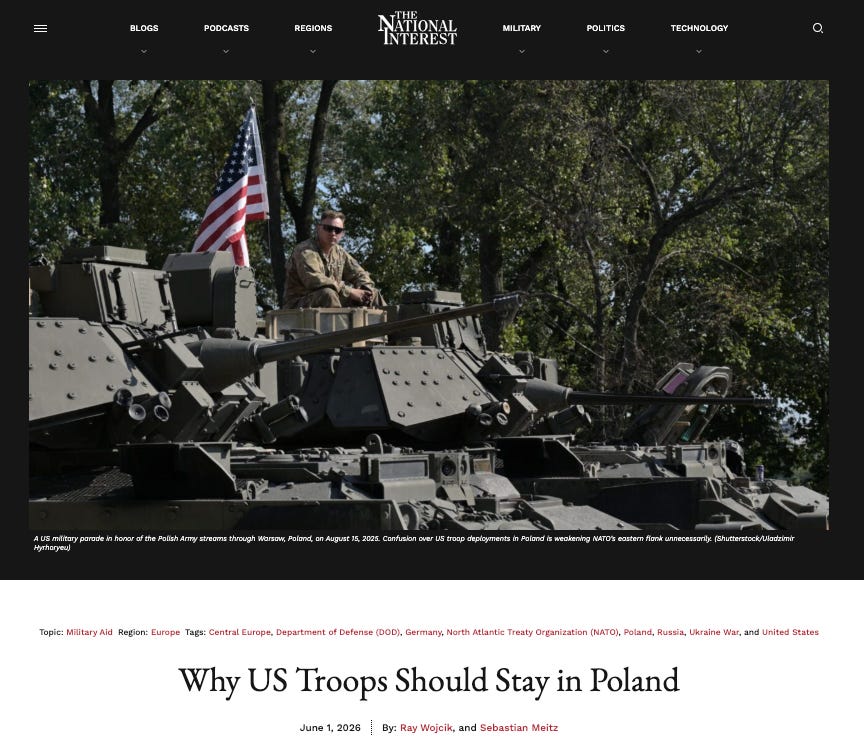
In less than three weeks, Washington sent a series of confusing signals about its military posture toward two important allies in Central Europe: Germany and Poland. No serious observer questions the need to review the US strategic posture in Europe. The problem is the method observed in recent days, which has created confusion, uncertainty, and renewed doubts about the predictability of American assurances to some of its most loyal allies. Yet this moment also presents an opportunity: to move from a model in which America deploys rotational forces in and out of its most reliable eastern ally toward a permanent force presence, for permanent deterrence, against a permanent threat to NATO’s eastern flank.
The Confusion Over US Military Deployments in Germany and Poland
The sequence began with German Chancellor Friedrich Merz’s statement in April that the United States had been “humiliated” by Iran. Those words, part of the broader German tendency to criticize or distance itself from key policies of President Donald Trump’s administration, were followed by Washington’s announcement on May 2 that it planned to reduce its military presence in Germany by 5,000 troops, amid uncertainty over a previously planned deployment of precision missiles to Germany. Some in Poland saw this as an opening to strengthen the presence of US forces on NATO’s eastern flank. Then came the Pentagon’s announcement on May 13 that a planned rotation of an armored brigade to Poland would be halted. It came as a shock not only to Poland but also to many US officials and observers focused on European security.
The sequence and the comments from senior US officials created confusion among allies, legislators, and various elements of the defense establishment. It revealed the strategic reality in which Poland operates. Deterrence on the eastern flank cannot be maintained with abrupt changes and improvised explanations.
Even more concerning was that the canceled deployment concerns a region bordering Ukraine, where Russia’s full-scale invasion continues; Belarus, which continues hybrid attacks on Poland, and where Russian nuclear weapons are based; and Kaliningrad, where Russian strike forces include nuclear-capable systems. The discussion is therefore not only about troop numbers, although numbers matter. It is about predictability and the ability to rely on the key guarantor of deterrence in this part of the world: the United States.
The fact that the decision seemed to be made at the last minute, while advance elements were already deploying to Poland, created the impression of haste and pressure. Even if presented as part of a broader force posture review, the move stood in stark contradiction to repeated declarations from President Trump’s administration that Poland is a model ally: a nation that spends a higher percentage of GDP on defense than any other NATO member, is undertaking a massive modernization effort oriented on American war-fighting doctrine and equipment, and is willing to assume greater responsibility for regional security. This is exactly the kind of allied behavior the United States says it wants from Europe.
One should also not ignore the optics. First, the White House pressured Germany and told Berlin that it would withdraw US troops from its territory. Then, there was an open discussion about relocating American forces farther east. Finally, the most visible immediate effect was the suspension of the deployment of 4,000 US troops to Poland.
Germany remains a key component of the US military presence in Europe. Its role in logistics, infrastructure, air power, medical support, and command networks is significant. But one cannot deny that the political and military center of gravity of deterrence has moved east. The model of US forces heavily based in Germany made sense during the Cold War and for a different Europe. Today, Europe’s frontline runs from Finland to Bulgaria, and is anchored in the center by Poland. The question is not whether Germany matters, as it obviously does. The question is whether Germany should remain the default answer to America’s key basing questions in Europe today. It should not.
It is important to highlight that Poland is among the European countries least dependent on China and has consciously chosen to link itself strongly to the US defense industrial base. Meanwhile, China is heavily invested in Germany’s most strategic sectors: telecommunications, rail, and ports, including strategic rail networks and ports needed for allied reinforcement during crises and war.
Poland’s Centrality to the Defense of Eastern Europe
Poland stands in stark contrast to Germany. It is the most pro-American country in Europe, despite broader anti-American trends across the continent. Poland is a steadfast US and NATO ally and a state willing to assume increasing responsibility for the defense of the region. It is a leader in burden-sharing and has strengthened its position within NATO. This was recently underscored by NATO placing Poland in rotational command of Allied Joint Force Command Brunssum. Under President Karol Nawrocki, and despite the strongly pro-European orientation of Prime Minister Donald Tusk’s government, Poland is looking for ways to strengthen its importance to US strategy in Europe. This matters as Washington adjusts global priorities.
Poland already hosts key US capabilities, including two Army headquarters, equipment for an armored brigade, and ballistic missile defense. Under the US-Poland Enhanced Defense Cooperation Agreement, Poland provides significant funds for infrastructure upgrades to support US forces, which could reach $500 million in 2026, with projects including barracks, rail links, fuel storage, airbase upgrades, and reception infrastructure.
Of note, Poland’s support for US forces is significantly higher than Germany’s. Official government data shows that Warsaw’s annual support is roughly $15,000 per US soldier, bringing the cost of hosting a contingent of 10,000 troops to more than $150 million per year (on top of host-nation infrastructure spending). Washington should recognize this for what it is: burden-sharing with a key ally that fully understands its mission and “puts its money where its mouth is,” with increasing responsibilities. Moreover, Poland’s determination to provide such support to US forces is a clear signal of Warsaw’s commitment to America.
Permanent assignment of US forces to Poland is more effective, more credible, and less costly than the current rotational model. Permanent basing will turn episodic deployments into enduring combat power. Units will not lose time repeatedly relearning terrain, infrastructure, host-nation, and operating procedures. Instead, they will build “ready-to-fight-tonight” capabilities with coherent command relationships, prepositioned equipment, and logistics in place. The result will be higher readiness and faster decision cycles for Polish and American forces.
Because Moscow calculates risk differently, it is highly unlikely to test an ally when US units are visibly and permanently present rather than constantly cycling in and out. Permanent presence reduces recurring costs associated with transatlantic deployments, reception, onward integration, temporary basing, and repeated unit handovers.
The continuity of dedicated US military forces creates conditions for real military integration with the Polish Armed Forces. Instead of restarting relationships every nine months, US and Polish forces can move to new capability levels within US military doctrine: Joint All-Domain Operations (JADO). Moreover, Poland is NATO’s hub for lessons learned from Russia’s war on Ukraine, which will be incorporated into US-Poland JADO integration and help Poland transform into a near-peer US ally.
Another key element is human capital. Thousands of Polish officers have attended US training courses, and tens of thousands more Poles have served in combat operations shoulder-to-shoulder with Americans. Poland is rapidly modernizing with state-of-the-art US-interoperable systems: Abrams tanks, HIMARS precision rocket artillery, Javelin anti-tank systems, Patriot air and missile defense systems, fifth-generation F-35 fighters, Apache attack helicopters, and upgrades to its F-16 fleet (to name a few).
Clearly, Poland is in its own league as a host nation and is ready to raise its game to near-peer level alongside US forces. This is the strategic logic behind permanent presence, resulting in permanent integration of US and Polish forces. America needs an ally in Europe able to operate at the highest levels, as seen with the crucially important operational integration of US forces with Israeli and South Korean allies. Poland is ready, willing, and able to assume that role in Europe. Such a development will have a ripple effect across the region, and NATO, as other allies, mirror Poland.
The Case for a Permanent US Military Deployment in Poland
Permanently assigning US forces to Poland may seem counterintuitive to some, yet it is fully consistent with Washington’s own stated expectations toward allies. The United States expects allies not only to spend more on defense but also to assume greater responsibility for their own security and, by extension, for the security of their regions. Poland is not shrinking from this responsibility. On the contrary, by investing heavily in its own defense, resisting Chinese penetration, and accepting real strategic risk, Poland is responding precisely to what Washington has asked of Europe. America should capitalize on these trends in Poland, providing Poland with additional means not to replace its responsibility but to reinforce it. Poland’s leadership and military transformation will reduce the risk of a far more costly conflict and long-term American involvement.
Thus, America should permanently assign to Poland a force array centered on the full V Corps headquarters in Poznań, along with a heavy US Army division equipped with Abrams tanks, drone and counter-drone capabilities, and at least one—preferably more—F-35 fighter squadron. Such a posture will provide a standing command structure for the defense of NATO’s eastern flank, place credible armored combat power closer to the alliance’s most exposed front, and deepen crucial integration with Polish forces.
It will significantly strengthen deterrence against Russia and accelerate Poland’s emergence as a near-peer ally by integrating its rapidly modernizing military with US commands, doctrine, sustainment networks, and high-end combat capabilities. It will reinforce Poland’s evolution into America’s principal maintenance, repair, and overhaul hub in Europe. It will also make Poland an even more important ally in US defense-industrial cooperation and a key transatlantic defense supply-chain partner.
A permanently stationed heavy division will significantly shorten readiness timelines while F-35 squadrons will strengthen allied air dominance, intelligence collection, and rapid response across the Baltic-to-Black Sea corridor. Permanent US forces in Poland will also present unmatched opportunities to train at scale alongside NATO’s most capable frontline state, exercising and developing JADO, refining theater logistics. Importantly, this not only prepares Poland for high-level combat and fosters similar developments across the region, but also better prepares US forces for war, no matter where a future conflict may occur. Together, it will signal America’s enduring commitment, while rebooting conventional deterrence against Russia.
Some may argue that Warsaw just dodged a bullet because Washington has indicated it may increase military presence in Poland. But the key questions are not just about how many troops will be present. They are about ensuring the right mix of US forces is permanently, not rotationally, based in Poland. After the developments of the last three weeks, there is no better time to address these questions.
We have seen how quickly uncertainty spreads when troop decisions are abruptly announced, adjusted, clarified, and reversed. This is not an exaggerated Polish perception but a consequence of Poland being a frontline state, constantly pressured by Russia and its proxies, and living under the growing threat of further instability in the region. Warsaw, and by extension, many US allies, have seen that even a model ally can be treated as a variable unless it is embedded more deeply in American planning. There is no question that Moscow, always looking to exploit allied vulnerabilities, has also observed the developments of recent weeks.
The United States should follow its own strategic logic. It should move east and stay east. It should take advantage of generational developments in Poland, making Poland the permanent anchor of American deterrence on NATO’s front line. Poland has delivered what Washington has long demanded from Europe. It is time for America to make that reality permanent. That’s America and Poland First. If followed through on, this will become a cornerstone of America’s strategy of peace through strength.
About the Authors:
Ray Wojcik is a Senior Research Fellow at The Saratoga Foundation and a defense expert and consultant with the Kosciuszko Chain. Mr. Wojcik is the former director of the Warsaw office for the Center for European Policy Analysis. During three decades in the US Army, he served as a soldier, non-commissioned officer, and officer in aviation, intelligence, infantry, special operations, and as a foreign area officer.
Sebastian Meitz is an expert in defense and foreign policy at the Sobieski Institute. He held scholarships at Ludwig-Maximilians-Universität in Munich and the London School of Economics, and is an alumnus of the Leadership Academy for Poland and the European Academy of Diplomacy. He was affiliated with the Sobieski Institute in 2006–2007 and has been again since 2025.
Thank you for your support! Please remember that The Saratoga Foundation is a non-profit 501(c)(3) organization. Your donations are fully tax-deductible. If you seek to support The Saratoga Foundation, you can make a donation by clicking on the PayPal link below! Alternatively, you can also choose to subscribe to our website to support our work.
https://www.paypal.com/donate/?hosted_button_id=XFCZDX6YVTVKA