
By Vasif Huseynov
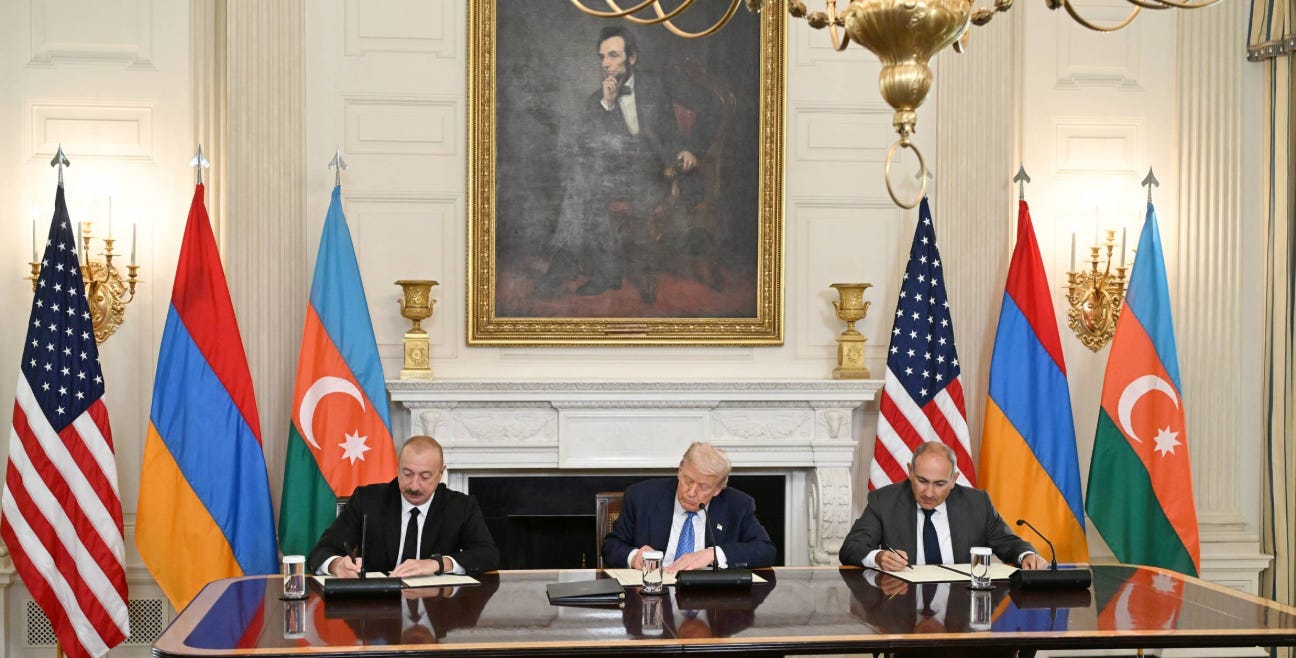
On November 10, 2020, a trilateral statement ended the 44-day Second Karabakh War. Six years later, Azerbaijan and Armenia are no longer negotiating the end of a conflict but the terms of coexistence. The Washington Joint Declaration of August 8, 2025 saw both leaders initial the text of a peace agreement at the White House, and less than a month later the OSCE Ministerial Council closed the Minsk Process by consensus, a closure completed on November 30, 2025.
The treaty, however, remains unsigned. At the CICA summit in Baku on October 15, President Ilham Aliyev warned: “This peace is still fragile, and it must be protected and strengthened.” Currently, the process now runs along four tracks: Armenia’s constitution, border delimitation, transport links and bilateral trade. Against this backdrop, officials in Baku contend that the next move lies with Yerevan, which they believe should act quickly or lose the historic momentum created by the end of the conflict, sustained US engagement and an unusually favorable regional environment.
Armenia’s Constitution: The Remaining Legal Barrier
Of the two conditions set by Baku in March 2025, only one remains: the Minsk Group is dissolved, but the Armenian constitution remains unchanged. President Aliyev said in Munich in February that Azerbaijan could sign an agreement “the very next day” once Armenia removed what Baku regards as territorial claims. Foreign Minister Jeyhun Bayramov repeated this point on October 30, noting that Yerevan must take the necessary political and legal steps.
The dispute concerns a single cross-reference. Armenia’s constitution does not mention Karabakh, but its preamble invokes the 1990 Declaration of Independence, which in turn cites the 1989 decision on the “reunification” of Soviet Armenia and “Nagorno-Karabakh.”
Baku’s demand rests on sound legal logic: a peace treaty binds the governments that sign it, whereas a constitution binds every government that follows, so a future government in Yerevan could invoke the current reference to Karabakh’s unification with Armenia to challenge the treaty. Removing it would give the peace a solid legal basis that does not depend on whoever holds power in Yerevan. Ireland, for example, set a clear precedent in 1998, when, under the Good Friday Agreement, more than 94 percent of voters approved amending Articles 2 and 3 of the constitution to drop its territorial claim on Northern Ireland, a step that made Dublin a credible guarantor of the settlement rather than weakening its sovereignty. Germany did the same in 1990, amending its Basic Law under the Two Plus Four Treaty before signing its border treaty with Poland.
The obstacle now boils down to simple arithmetic rather than diplomacy. Armenia’s Minister of Justice Srbuhi Galyan has said the draft has been ready since March, and the Constitutional Reform Council must approve it by December 30, 2026, ahead of a referendum planned for 2027. But putting it to a vote requires a two-thirds majority in parliament, which Civil Contract lost in the June 7 election, and both opposition blocs reject changes they see as imposed under Azerbaijani pressure. On October 22, Pashinyan raised the possibility of holding another snap election to break the deadlock.
Borders and the Enclave Question
The least visible track has been the most consistent. At their 13th meeting in Aghveran on April 29, the state commissions led by Deputy Prime Ministers Shahin Mustafayev and Mher Grigoryan agreed on guidelines covering expert groups, delimitation maps and the publication of results, the procedural scaffolding without which no line can be drawn.
The substantive question is the Soviet-era enclaves. On October 14, Pashinyan proposed that Armenia’s territory of 29,743 square kilometers be delimited based on the 1991 Alma-Ata Declaration, that enclaves be eliminated through exchanges of equivalent territory, and that both states renounce all claims against each other. However, his deputy said two days later that no agreement on an exchange exists, and Baku has said only that the issue should be resolved within the delimitation process.
TRIPP Moves from Agreement to Implementation
Meanwhile the Trump Route for International Peace and Prosperity (TRIPP), linking mainland Azerbaijan with Nakhchivan through Armenia’s Syunik province, crossed a major threshold on October 28, when Armenia’s National Assembly ratified the Armenian-American framework agreement by 63 votes to 32. A joint development company will manage the route, with the United States holding 74 percent and Armenia 26 percent for an initial 49 years.
On October 21, an Armenian government delegation visited Syunik to launch design work on the railway, road and power lines. Armenian Prime Minister Nikol Pashinyan declared the project to be entering its implementation phase while the Armenian ambassador to the United States Narek Mkrtchyan announced that he expects the groundbreaking for TRIPP to begin in early 2027. On November 6, the project acquired its first trilateral working mechanism. In a joint statement issued by the three governments, US Assistant Secretary of State Brendan Hanrahan and Deputy Foreign Ministers Elnur Mammadov of Azerbaijan and Vahan Kostanyan of Armenia launched technical planning groups on transport and electricity transmission, tasked with resolving complex technical issues and preparing the next phases of implementation, including connections to other regional infrastructure.
Regardless, TRIPP should not be viewed merely as a transportation project. A functioning route through Syunik would create daily, practical cooperation between two states that were at war six years ago, embedding customs, border and security procedures that require constant coordination. It would also give Armenia transit revenues and access to regional markets after three decades of closed borders, turning peace into a tangible economic interest for Armenian society rather than only a commitment of its government. Every kilometer built reduces the risk of any return to confrontation.
TRIPP is also the one element of the settlement that gives all three parties, including the United States, a material stake in its success. From Baku’s perspective, with ratification complete and the trilateral groups in place, officials in Yerevan should maintain the project’s positive momentum. Design studies are no substitute for actual construction, given that Washington’s commitment to unimpeded connectivity has existed on paper for over a year.
The regional environment around the route, however, is less settled than the progress on paper suggests. Iranian opposition has hardened. In an article in the Tehran daily Ettelaat on November 5, Ali Akbar Velayati, adviser on international affairs to Iran’s Supreme Leader, called Yerevan’s approval of TRIPP “blind submission to the interests of the West,” describing any change of borders in the region as an Iranian red line to be defended “by any means,” and recalled warning the Armenian ambassador that “if Trump and his allies want to cross this Iranian red line, we will break their legs.”
Russia’s stance is more ambiguous. Speaking in Baku after the CICA summit on October 15, Foreign Minister Sergey Lavrov said Moscow had “not yet received any requests” to join the project, while stressing that Russia is ready to take part and pointing to the concession under which Russian Railways operates Armenia’s rail network. Neither Tehran nor Moscow, in other words, has yet come to terms with a transportation route being built with American participation on their doorstep.
Neither position should be allowed to slow the project down. TRIPP is a matter for the sovereign decision of Armenia and Azerbaijan, the two states through whose territory and for whose benefit the route will run, and no third country should hold a veto over infrastructure that two neighbors agree to build. Nor does the route alter any borders, which is Tehran’s stated concern. It connects them.
For Yerevan, this is a further argument for speed, since every month of delay gives outside actors more room to raise the project’s political cost.
The Trade Dimension: Symbolic, Small, but Lopsided
The most tangible change in relations has come in commerce. On October 21, 2025, President Aliyev announced that Azerbaijan had lifted all restrictions on cargo transit to Armenia. On December 18, 1,220 tons of Azerbaijani gasoline left for Armenia, the first such delivery in over three decades, and by the anniversary of the Washington summit, close to 60,000 tons of goods had moved to and from Armenia through Azerbaijan.
In September, trade became two-way when Armenia shipped aluminium foil to Azerbaijan. While symbolically important, trade figures remain small: Azerbaijani exports to Armenia reached $23.45 million in the first nine months of 2026, about 0.1 percent of the country’s total exports, against Armenian exports of just $96,460. Much of the flow still travels by rail through Georgia, as no direct border crossing has opened yet.
The political significance, however, is considerable. By lifting transit restrictions before any treaty was signed, Azerbaijan demonstrated a remarkable gesture of good will toward Armenia and showed Armenians the concrete benefits of peace: cheaper fuel, new transit options and access to wider markets. Pashinyan himself has argued that economic ties will substantially strengthen the peace.
Outlook
As Azerbaijan makes progress in signing a treaty with Armenia that would settle borders and other claims, it would not close the moral chapter of the conflict. For nearly three decades, Karabakh and seven surrounding districts were occupied, hundreds of thousands of Azerbaijanis were displaced, and towns such as Aghdam and Fuzuli were left in ruins. On October 26, presidential aide Hikmet Hajiyev said every displaced Azerbaijani “expects an apology from Armenia”, while Pashinyan has urged both sides to stop looking for Armenia in Azerbaijan and vice versa.
From Baku’s perspective, an apology by the Armenian government for the occupation would be the next logical step. In December 1970, for example, West German Chancellor Willy Brandt knelt before the Warsaw Ghetto memorial on the day he signed the treaty recognizing Poland’s western border, a turning point in German-Polish reconciliation. In 1995, Japanese Prime Minister Tomiichi Murayama offered a “heartfelt apology” for Japan’s colonial rule and aggression. The presidents of Serbia and Montenegro and of Croatia exchanged apologies in 2003, and in 2010 the Serbian parliament adopted a declaration condemning the Srebrenica massacre.
None of these acts was easy: half of West Germans rejected Brandt’s gesture, and Serbia’s declaration passed with a bare majority. Yet each side helped turn a legal settlement into a durable relationship. For Armenia, a sincerely acknowledgement of the cost of the occupation would reassure Azerbaijani society that peace is not merely a pause, making the treaty far more credible to those who lost their homes.
Six years after the war, the question is no longer whether Armenia and Azerbaijan can stop fighting, but whether a peace that already exists in practice can become a durable peace, binding in law before the political window that produced it closes. The answer will be written over the next eighteen months, and lies largely in the hands of the Armenian parliament and at the ballot box.
Author’s Bio:
Dr. Vasif Huseynov is the head of the Western Studies department at the Center for Analysis of International Relations and Multiculturalism (AIR Center) in Baku, Azerbaijan.
Thank you for your support! Please remember that The Saratoga Foundation is a non-profit 501(c)(3) organization. Your donations are fully tax-deductible. If you seek to support The Saratoga Foundation, you can make a one-time donation by clicking on the PayPal link below! You can also subscribe to our website to support our work.
https://www.paypal.com/donate/?hosted_button_id=XFCZDX6YVTVKA