
By Alexander Melikishvili
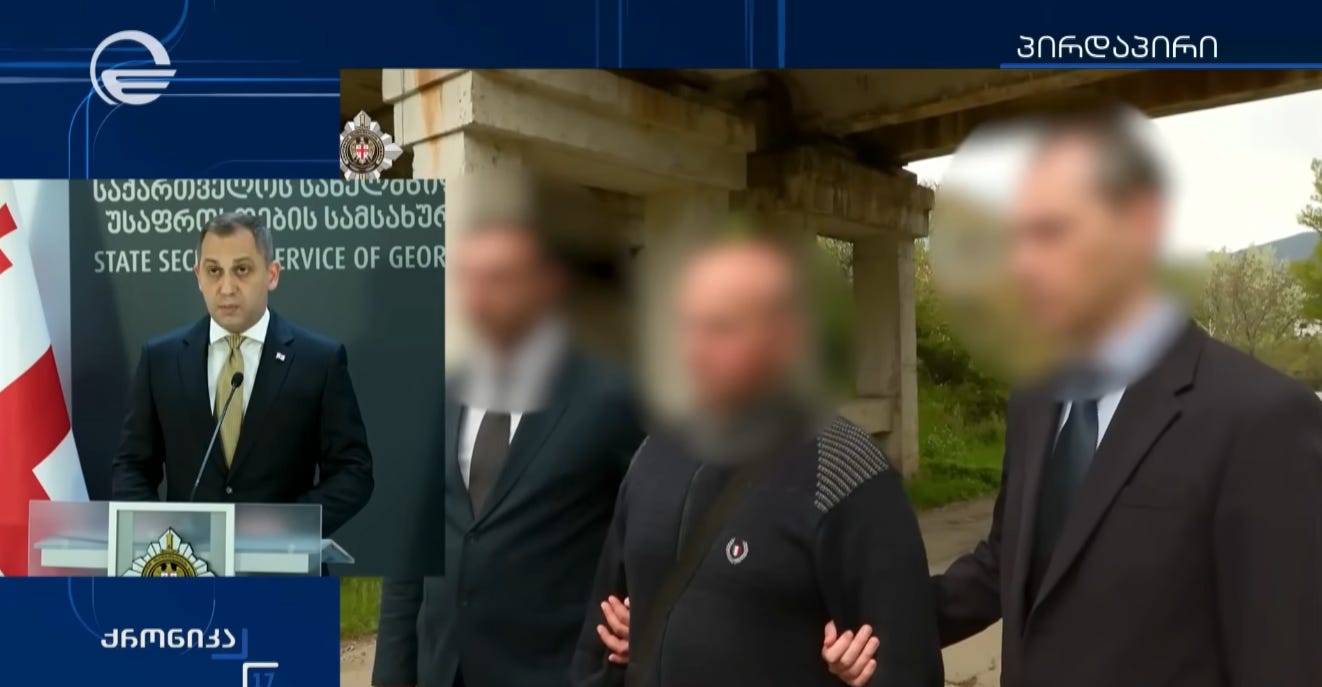
Georgia’s State Security Service (SSS) has not captured any foreign intelligence operatives since 2012, so it came as a great surprise when, on April 22, it announced the arrest of Tamaz Goloev (Goloti). According to the SSS First Deputy Head Lasha Magradze, a representative of an unidentified foreign intelligence service recruited Goloev, who was allegedly tasked with collecting information on the SSS, the Ministry of Internal Affairs, and the Ministry of Defense, including their forces and assets, which he was to monitor (photo and video surveillance).
Similarly, Goloev was tasked to collect information on Georgia’s critical infrastructure, including bridges, highways, and railroads. Magradze also mentioned that two other Georgian citizens were involved as well, but they were not in Georgia, prompting the SSS to charge them in absentia and request international arrest warrants for both from Interpol. On April 24, the Tbilisi City Court held closed hearings and ordered Goloev to remain in pre-trial detention for two months. If convicted, he faces 8–12 years in jail under Article 314 (Espionage) of Georgia’s Criminal Code.
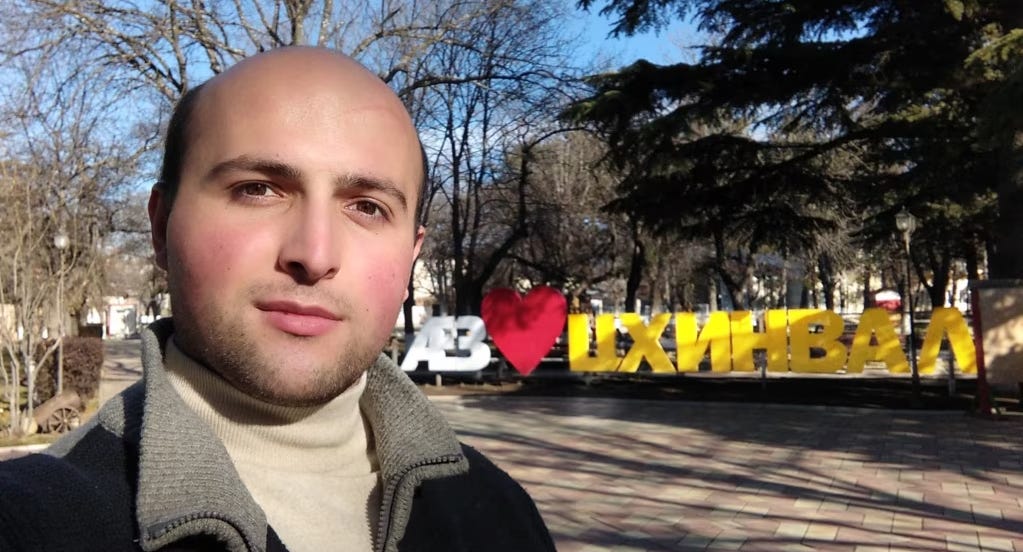
*Picture of alleged Russian spy Tamaz Goloev taken from his Facebook page
Goloev is a native of the town of Akhalgori, which is located in the Russian-controlled breakaway region of South Ossetia. He is from a mixed (father – Ossetian, mother – Georgian) family. Prominent Georgian human rights defender Tamta Mikeladze (NGO Social Justice Center) claimed that Goloev was known to Georgian civil society because he was keen to maintain connections to Georgian society and visited Tbilisi regularly. Mikeladze questioned the spying allegations, while former Human Rights Ombudsman Ucha Nanuashvili emphasized that the investigation must produce convincing evidence of Goloev’s guilt or risk being seen as scapegoating him. The separatist authorities in Tskhinvali confirmed that Goloev entered Georgia via the Odzisi (Razdakhan) checkpoint on April 21 and was arrested in Tbilisi a day later. They condemned Goloev’s arrest and demanded his release via the Incident Prevention and Response Mechanism (IPRM), which is facilitated by the European Union Monitoring Mission in Georgia (EUMM) and the OSCE.
Another State Minister Without Staff
These developments are taking place against the backdrop of a major personnel reshuffle in Georgia’s law enforcement and intelligence communities. On April 21, the de facto* Prime Minister Irakli Kobakhidze outlined the changes, according to which SSS Head Mamuka Mdinaradze would assume the newly created position of State Minister for Coordination of Law Enforcement Bodies and also become Deputy Prime Minister. With no prior experience in security or intelligence, Mdinaradze, who is a lawyer by trade, has been in charge of the SSS only since September 2025, but this did not prevent his meteoric rise through the ranks (from lieutenant to major general) in this time span.
In announcing the personnel changes, Kobakhidze heaped praise on Mdinaradze, whose tenure at the SSS he assessed as “very successful.” Mdinaradze was also not shy about taking credit—in a late-night interview with the pro-government TV channel Imedi on April 22, he noted that, owing to his efforts, the SSS now collects more information than before, including through an increased number of court-approved wiretaps.
The procedural committee of the rubber-stamp parliament, dominated by the ruling party Georgian Dream (GD), formally ended Mdinaradze’s mandate as SSS Head on April 27. He is replaced by Gela Geladze, who has been the Minister of Internal Affairs since May 2025. Geladze, in turn, is replaced by Sulkhan Tamazashvili, who has been the Chairman of the Government of the Autonomous Republic of Adjara since April 2025. It should be noted that in December 2024, the British government placed Tamazashvili under sanctions for his role in the violent dispersal of peaceful protesters in Tbilisi. At the time, Tamazashvili was the Director of the Tbilisi Police Department. It is unclear who will be in charge of the government in Adjara. Georgia’s de facto legislature approved the new appointments of Mdinaradze and Geladze on 28 April without holding any parliamentary debates.
Mdinaradze will be the second member of Kobakhidze’s cabinet with the title of State Minister (after Tea Akhvlediani, who is the State Minister for Reconciliation and Civic Equality). He will have no staff of his own and will work out of the Administration of the Government of Georgia (formerly the State Chancellery). While Mdinaradze’s exact remit will be spelled out in a forthcoming special government decree, he will coordinate the work of the Ministry of Internal Affairs, the SSS, and the Special State Protection Service. He will also cooperate with the State Audit Service, the Prosecutor’s Office, and the Ministry of Justice, as explained by the Parliamentary Secretary of the Government, Vakhtang Bachiashvili, who noted that this will be a temporary position based on current policy priorities.
Outlook
The GD government’s refusal to identify the foreign intelligence service on whose behalf Goloev purportedly worked is consistent with its broader policy of avoiding actions that might irritate Russia. However, Goloev’s arrest does not represent a change in the SSS modus operandi toward more counterintelligence activities. It is more likely that this episode has been staged as part of the GD government’s Public Relations (PR) campaign to burnish Mdinaradze’s credentials and justify his transition to the new role for a domestic audience.
Notwithstanding the vague official explanations about the need to improve the efficiency of security services and law enforcement, Mdinaradze’s new appointment probably has more to do with Kobakhidze’s efforts to find a suitable niche for him in the Georgian government. Before his SSS appointment, Mdinaradze served as the leader of the GD parliamentary majority and was one of the key GD figures known for abrasive media appearances in which he often made provocative statements, accusing the “deep state” in the West of trying to drag Georgia into war with Russia and castigating the “radical opposition” in Georgia.
As for Goloev, once his trial ends this summer and public attention to this case wanes, it is quite likely that he will be quietly exchanged for any number of Georgian citizens who are routinely detained by separatist militia and Russian border guards along the de facto border separating the South Ossetian enclave from Georgian-controlled territory.
*Editorial Note: Because Georgia’s 2024 parliamentary elections were rigged, it is important to emphasize that the Georgian Dream government is not legitimate. Neither is the parliament of Georgia. As such, this lack of legitimacy must be reflected by certain qualifiers preceding the titles. For instance, one can say, “the Georgian Dream Prime Minister Kobakhidze” or “de facto Prime Minister Kobakhidze.”
About the Author:
Alex Melikishvili is a senior country risk analyst with more than a decade of experience working in the private sector (S&P Global, IHS Markit) with focus on Eurasian security. Alex holds a master's degree in International Affairs from the George Washington University's Elliott School of International Affairs.
Thank you for your support! Please remember that The Saratoga Foundation is a non-profit 501(c)(3) organization. Your donations are fully tax-deductible. If you seek to support The Saratoga Foundation, you can make a one-time donation by clicking on the PayPal link below! You can also subscribe to our website to support our work.
https://www.paypal.com/donate/?hosted_button_id=XFCZDX6YVTVKA
Very astute & timely reporting --- thank you.