
By Fuad Shahbazov
Since the United States imposed a near-total blockade of Iran’s major southern ports to stop the exports of Iranian crude oil, Tehran has increasingly turned to northern routes to circumvent the Gulf blockade and maintain a certain level of crude oil exports as well as imports of key commodities, such as grain. Indeed, since August, the Iranian economy has been severely affected by the American naval blockade, as relatively few Iranian oil tankers have managed to escape the Persian Gulf. As a result, China received 980,000 barrels per day of Iranian oil in August but only 475,000 in September, with no arrivals since September 26. In the long term, the collapse of Iranian crude oil exports has boosted spiraling inflation inside Iran, taking a heavy toll on domestic social spending programs.
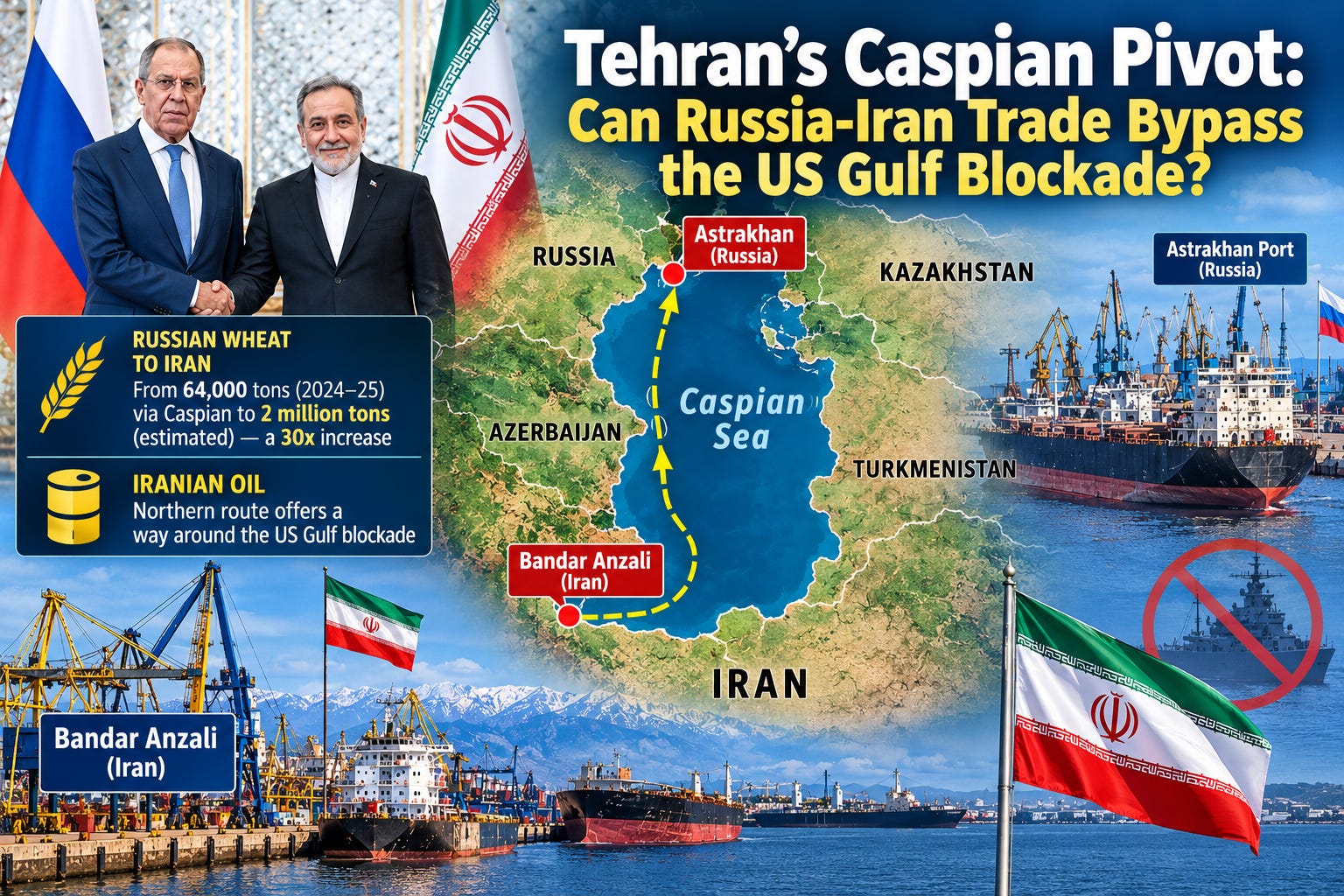
In this vein, Iran is increasingly looking to alternative northern trade routes, particularly the Caspian corridor, to facilitate oil exports and secure imports of essential goods. However, given that the country’s principal export infrastructure and energy terminals are concentrated along its southern coastline, a meaningful northward shift would require substantial adjustments to existing transportation, logistics, and supply-chain networks. Nevertheless, at this stage, Iran’s Caspian route remains the only viable route for moving large volumes of cargo without American interdiction.
Iran Turns Northward to Bandar Anzali
Following the outbreak of war with the United States in February 2026, and the extensive missile strikes that severely disrupted Iran’s transportation and maritime infrastructure, Tehran accelerated its efforts to modernize and expand its northern port facilities, particularly Bandar Anzali and other Caspian ports, intending to reroute essential food imports and strategic cargo through the Caspian corridor. Indeed, Russia appears to be the main partner of Iran in this regard. According to the RusIranExpo company, two million tons of Russian wheat previously shipped annually via the Black Sea are now transiting the Caspian instead. According to earlier data, during the 2024–2025 agricultural season, Russia exported approximately 1.3 million tons of wheat to Iran, of which only 64,000 tons passed through Caspian ports, while approximately 1.2 million tons went through Black Sea ports. Therefore, the potential redirection of 2 million tons of Russian wheat through the Caspian corridor would represent more than a thirtyfold increase over the previous season’s Caspian wheat shipments. This illustrates the scale of the proposed logistical shift and the growing strategic importance of the Caspian corridor to Iranian food security and trade connectivity.
Consequently, the Caspian corridor has assumed both commercial and strategic significance for Moscow and Tehran, serving not only as a conduit for oil exports and essential goods imports but also as a channel for the transfer of military-related components, including drone technology, aimed at supporting Iran’s efforts to restore its offensive capabilities amid the ongoing conflict. The Iranian Economy Minister Ali Madanizadeh, during his visit to Moscow on September 6, 2026, emphasized this point by reiterating his country’s commitment to activate its northern borders, while scaling down trade operations but not fully abandoning Iranian commercial activity along its southern littoral.
Nevertheless, one critical question remains unanswered: whether Iran’s northern ports have sufficient capacity to handle this shift amid regional geopolitical volatility. In other words, bringing goods into northern Iran does not automatically provide the terminals, pipelines and shipping arrangements needed to move Iranian crude to international buyers, as the northern ports only have approximately 30 million tons of capacity. In this context, the key question is not whether Iran’s Caspian ports can operate as trade hubs, but whether the northern route route can serve the same economic purpose at a comparable scale as the southern ports on the Persian Gulf. Moreover, in September, Masoud Polmeh, secretary-general of the Shipping Association of Iran, told state-linked media that Iran’s northern ports, which could once handle vessels weighing up to 6,000 tons, can now handle only 4,000-ton vessels, which is likely due to reduced water levels in the Caspian.
Tehran’s ongoing efforts to restore its oil export capacity through alternative and relatively secure northern routes indicate a broader strategy aimed at mitigating the geopolitical risks and sustaining crude oil exports, albeit at reduced volumes. Despite Iran’s recent agreements with Pakistan, Afghanistan, Iraq, and Tajikistan to expand overland trade connectivity, these corridors remain costly and constrained by limited transportation capacity, making the diversion of large volumes of trade from traditional maritime routes both economically inefficient and logistically challenging.
Considering these dynamics, Iran is increasingly seeking to deepen its partnership with Russia in order to expand trade volumes through the Caspian corridor. Recent trends underscore the growing importance of this route: shipments from Russia across the Caspian have risen steadily since the spring, with the number of active Russian- and Iranian-flagged vessels increasing by 21% year-on-year in August, while general cargo capacity expanded by an estimated 36%.
This surge in trade reflects Tehran’s growing reliance on northern transit routes. However, the Caspian corridor is unlikely to accommodate export volumes comparable to those traditionally handled through Iran’s southern ports due to the landlocked nature of the Caspian Sea, limited port infrastructure, and a shortage of maritime vessels. These structural constraints not only restrict the overall volume of cargo that can be transported but also narrow the range of goods that can be traded, crude oil and petroleum products that require larger shipping capacities.
Outlook
To bolster their trade connectivity Iran and Russia must urgently modernize their Caspian port infrastructure if they seek to significantly expand bilateral trade and facilitate larger volumes of crude oil shipments. This would require substantial investment in port and transport infrastructure, including the construction of a dedicated container terminal at Astrakhan, the replacement of largely Soviet-era cargo-handling equipment, and the expansion of rail connectivity linking Russian ports with Iran’s northern gateways, particularly Bandar Anzali.
From Moscow’s perspective, Tehran’s growing dependence on the Caspian corridor provides it with additional political and economic leverage, as the Kremlin understands that Iran currently possesses few viable alternatives for sustaining large-scale trade flows. Moreover, the prospect of replacing maritime oil exports with land-based transportation remains economically and logistically unrealistic. While a single large crude tanker can transport between around 2 million barrels of oil, replicating such capacity by road would require thousands of tanker trucks, highlighting the continued indispensability of maritime routes for Iranian energy exports.
In the final analysis, the Caspian route is emerging as the key link between the Moscow-Tehran axis, while challenging the West, namely the US, by demonstrating how this maritime corridor can be used to restore Iran’s military capacity and oil exports despite long-standing sanctions. These dynamics would enable Russia to further deepen its strategic partnership with Iran, even though it is suffering from a huge budget deficit and growing international pressure.
About the Author:
Fuad Shahbazov is a political scientist and analyst focused on regional security in Eurasia and the Middle East. He holds a master’s degree in Political Science from Vytautas Magnus University, a professional master’s degree in Terrorism and Countering Religious Radicalization from the University of Bergamo, and a master’s degree in Defense and Diplomacy from Durham University.
Thank you for your support! Please remember that The Saratoga Foundation is a non-profit 501(c)(3) organization. Your donations are fully tax-deductible. If you seek to support The Saratoga Foundation, you can make a one-time donation by clicking on the PayPal link below! You can also subscribe to our website to support our work.
https://www.paypal.com/donate/?hosted_button_id=XFCZDX6YVTVKA
Can anyone explain why the US is sanctioning Iran?