
By Vasif Huseynov
On November 15, 2017, on the sidelines of the seventh Regional Economic Cooperation Conference on Afghanistan in Ashgabat, Afghanistan, Turkmenistan, Azerbaijan, Georgia and Türkiye signed an agreement establishing the Lapis Lazuli transport corridor. The project, with an estimated budget of $2 billion, took its name from the semi-precious stone that traders carried from Badakhshan to the Caucasus and Europe more than two thousand years ago. Nine years later, the corridor is back on the regional agenda. On November 17, the Baku-based Center for Analysis of International Relations and Multiculturalism (AIR Center) and Afghanistan’s Center for Strategic Studies held a roundtable in Baku whose first panel was devoted to aligning the Middle Corridor with the Lapis Lazuli route.
The renewed interest is no coincidence. Afghanistan’s traditional outlets to the sea have narrowed and transit cargo through Azerbaijan is reaching its highest level in five years. Moreover, new rail links in the South Caucasus promise to shorten the path between the Caspian and Türkiye. For Azerbaijan, Lapis Lazuli is less a separate project than a southern branch of the transit architecture it has been building for the past two decades.
How the Route Works
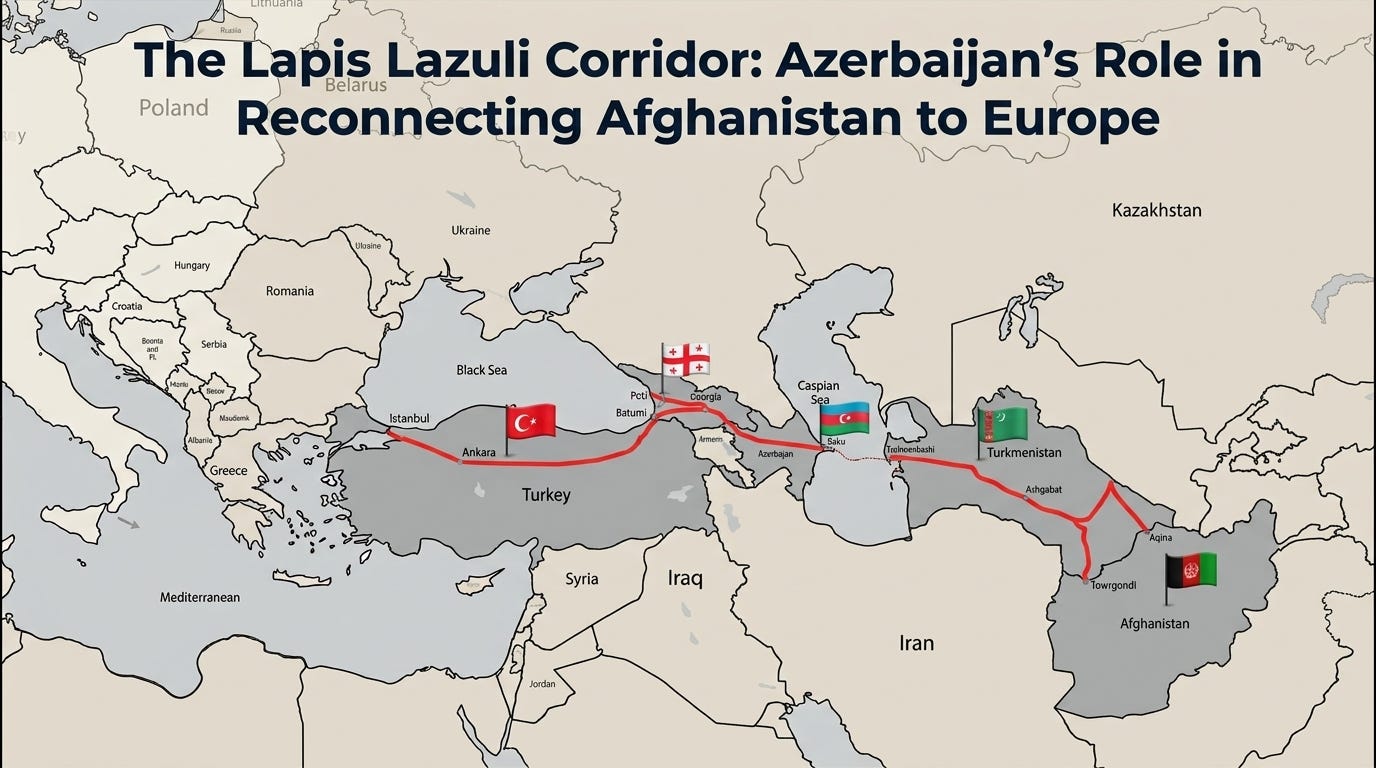
The corridor begins at the Afghan border points of Aqina in Faryab province and Torghundi in Herat province, crosses Turkmenistan to the port of Turkmenbashi, and continues by ferry across the Caspian Sea to Baku. From there, cargo moves by rail through Georgia on the Baku-Tbilisi-Kars (BTK) line toward Türkiye, the Black Sea and the Mediterranean.
Azerbaijan’s contribution lies in the two segments that make the route commercially meaningful: the Baku International Sea Trade Port at Alat and the BTK railway. The first test came in December 2018, when nine trucks carrying 175 tons of Afghan goods left Herat on December 13 and arrived in Baku on December 25. At a trilateral videoconference with the leaders of Turkmenistan and Afghanistan in July 2020, President Aliyev noted that once the route was connected to the BTK railway in 2018, Afghan goods began moving through Turkmenistan and Azerbaijan to the West. He also proposed the creation of working groups on each side to address energy security, tariffs, customs rules and investment. In January 2021, the three countries signed a roadmap for cooperation on the route.
The Emerging New Momentum
According to Afghanistan’s Ministry of Industry and Commerce, the country’s trade with the Central Asian states reached $1.278 billion in the first five months of 2026. Military escalation in the Middle East has added further risk to the southern routes, which, as some observers have noted, makes the Lapis Lazuli corridor a viable alternative to help Afghanistan gain greater access to global markets.
The corridor is already carrying such cargo. In March 2026, Afghanistan’s Ministry of Transport and Civil Aviation dispatched eight export consignments of dried fruit, jam, pressure cookers and energy drinks through Torghundi. The goods were routed across the Caspian to Baku and onward via Georgia to Türkiye, with final destinations in Saudi Arabia, the United States, Australia and the Netherlands. The volumes were modest, but the shipments demonstrated that the route can connect Afghan producers to markets on several continents.
From Baku’s perspective, the logic is straightforward. The Lapis Lazuli Corridor adds a South Asian feeder to the Middle Corridor, whose Azerbaijani segment is growing quickly. According to official statistics, the Port of Baku handled 100,000 TEU in the first nine months of 2026, 29 percent more than in the same period of 2025, and Middle Corridor cargo through the country rose by 20 percent to 4.1 million tons. The port’s current annual capacity of 15 million tons is expected to rise to 25 million tons and 500,000 TEU once the ongoing expansion is complete. Afghan cargo would therefore enter a system designed for far larger volumes than it carries today.
The corridor also fits Azerbaijan’s broader turn toward Central Asia. Addressing the Consultative Meeting of the Heads of State of Central Asia in Tashkent in November 2025, where Azerbaijan was admitted as a full participant of the format, President Aliyev said that Azerbaijan and Central Asia “form a single geopolitical and geo-economic region.” Turkmenistan is the indispensable link in this chain, since without the Turkmenbashi crossing there is no Lapis Lazuli. In February 2026, the heads of the railway sectors of Azerbaijan, Georgia, Uzbekistan and Turkmenistan met in Ashgabat to discuss expanding cooperation on the Middle Corridor, a format into which Afghan cargo can be readily integrated.
A third consideration is the South Caucasus itself. President Aliyev has said that the new railway forming part of the Zangezur corridor, with an initial throughput capacity of 15 million tons, will become an important artery of the Middle Corridor. Once the route through Armenia’s Syunik province, known as the Trump Route for International Peace and Prosperity (TRIPP), is built and mainland Azerbaijan is connected by rail with Nakhchivan and Türkiye, Afghan cargo arriving at Alat will gain a second westward path alongside the BTK line. This would make the whole chain more resilient and reduce its dependence on a single crossing.
Finally, the route underpins Azerbaijan’s pragmatic approach to Afghanistan, which rests on engagement and cooperation. At the Baku roundtable, Farid Shafiyev, Chairman of the Board of the AIR Center, said that “Azerbaijan supports Afghanistan’s sovereignty and its right to independent decision-making,” and highlighted Baku’s education and scholarship programs for Afghans. The interest is mutual. In July 2025, when he came to Azerbaijan for the Economic Cooperation Organization summit in Khankendi, Afghanistan’s Deputy Prime Minister for Economic Affairs Abdul Ghani Baradar discussed the corridor with Prime Minister Ali Asadov in Baku, who, according to the Afghan side, expressed readiness to increase exports and imports with Afghanistan. Baradar also visited the Port of Baku, where Azerbaijan Railways expressed readiness to facilitate deliveries of Afghan goods to European markets.
What Holds the Corridor Back?
Political will is not the corridor’s main obstacle. Its major weaknesses are infrastructure related. Cargo moving from Herat to Istanbul changes mode several times, from road or rail to ferry and back to rail, and each transfer adds cost and time. Afghan officials themselves acknowledge the gap between intention and performance. In August 2026, during talks with Turkmenistan’s National Leader Gurbanguly Berdimuhamedov, Baradar called for resolving obstacles to the reactivation of the Lapis Lazuli corridor and for facilitating Afghan transit goods at Turkmenbashi. The rail link on the Afghan side is also incomplete, as the railway of about 120 kilometers between Torghundi and Herat, which Kazakhstan and Afghanistan have been working on, still remains in the planning stage.
Tariffs are the other obstacle. Freight owners compare the full cost of a route, and a corridor that crosses five customs regimes and the Caspian Sea must compete with shorter alternatives. This is why the tariff question that President Aliyev placed on the agenda in 2020 remains central six years later. The most useful steps now would be a through tariff agreed upon by all five states, coordinated ferry schedules between Turkmenbashi and Alat, and digitalized customs procedures that would allow Afghan consignments to cross the Caspian under a single transit regime.
Outlook
The Lapis Lazuli Corridor will not replace Afghanistan’s southern routes, nor does it need to. Its chief strategic value lies in offering Afghanistan a reliable alternative trade route while giving Azerbaijan, Turkmenistan, Georgia, and Türkiye a share of commerce that would otherwise bypass them. For Baku, it is a logical extension of the Middle Corridor and of major investments already made in Alat, the BTK railway, and, soon, the Zangezur route. Infrastructure on the Azerbaijani side is ready to handle larger volumes. What the corridor now needs is commercial discipline from all five partners so that the route agreed upon in Ashgabat nine years ago finally carries the cargo it was designed for.
Bio:
Dr. Vasif Huseynov is the head of the Western Studies department at the Center for Analysis of International Relations and Multiculturalism (AIR Center) in Baku, Azerbaijan.
Thank you for your support! Please remember that The Saratoga Foundation is a non-profit 501(c)(3) organization. Your donations are fully tax-deductible. If you seek to support The Saratoga Foundation, you can make a one-time donation by clicking on the PayPal link below! You can also subscribe to our website to support our work.
https://www.paypal.com/donate/?hosted_button_id=XFCZDX6YVTVKA