
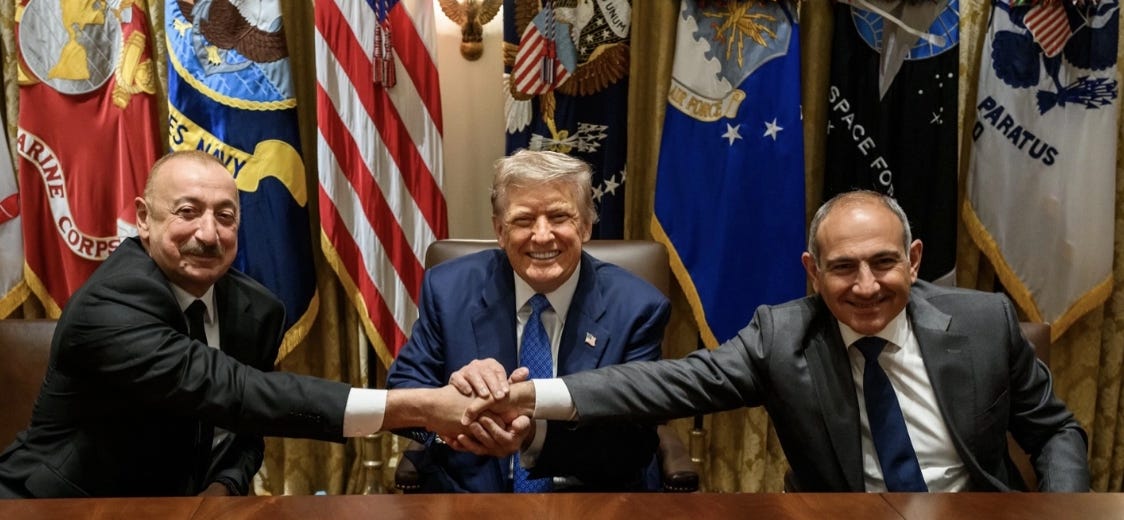
On January 14, U.S. Secretary of State Marco Rubio and Armenian Foreign Minister Ararat Mirzoyan signed the Implementation Framework for the Trump Route for International Peace and Prosperity (TRIPP). This step marked the most concrete outcome to date of Washington’s effort to anchor the Armenia–Azerbaijan normalization process in regional connectivity rather than abstract political commitments. The framework builds on the trilateral Joint Declaration signed on August 8, 2025, by Azerbaijani President Ilham Aliyev, Armenian Prime Minister Nikol Pashinyan, and U.S. President Donald Trump, alongside the initialing of the peace treaty by the foreign ministers of the two South Caucasian republics. That declaration resolved one of the most contentious post-war issues by committing Armenia to guarantee unimpeded connectivity between mainland Azerbaijan and its Nakhchivan Autonomous Republic through its territory.
The newly agreed TRIPP Implementation Framework between Armenia and the United States provides intricate details on how this connectivity agenda will be executed. According to the agreement, Armenia will grant the U.S.-managed TRIPP Development Company exclusive rights to plan, design, construct, operate, and maintain multimodal transit infrastructure – including railways, roads, energy, and digital networks – along the designated route for a minimum of 49 years, with the option of a further 50-year extension. The ownership structure allocates 74 percent control to the United States and 26 percent to Armenia, with Armenia’s share set to increase to 49 percent in the event of an extension. Crucially, the framework explicitly affirms that Armenia’s sovereignty, jurisdiction, and authority over border and customs controls are “absolute and nonnegotiable,” addressing longstanding Armenian concerns over loss of control.
In this sense, TRIPP should be seen less as a standalone initiative than as the logical continuation of the Washington Summit of August 8. That meeting brought the Armenia–Azerbaijan peace treaty process close to legal finality through the initialing of the peace treaty. The TRIPP framework reinforces this approach by anchoring peace in infrastructure and trade, thereby raising the costs of renewed confrontation and reducing the space for spoiler behavior in a volatile regional environment marked by Russia’s war against Ukraine and escalating tensions in the Middle East.
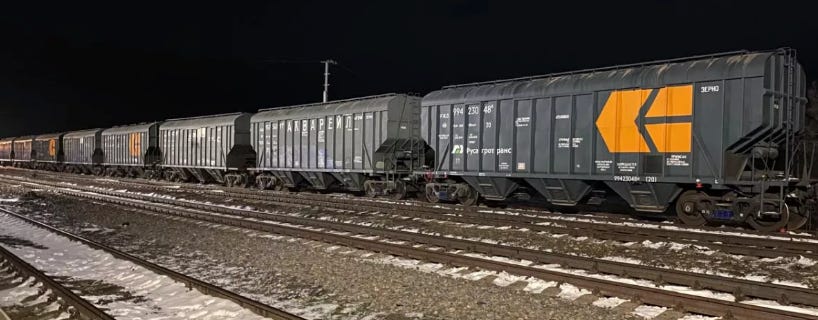
*Image is the first load of Kazakh wheat shipments to Armenia to transit via Azerbaijani territory.
Energy and Food Diplomacy
Since the Washington Summit, a series of developments between Armenia and Azerbaijan have demonstrated that normalization is no longer confined to diplomatic statements. Instead, it is gradually being translated into practical cooperation across economic, institutional, and societal domains. One of the clearest indicators of this shift was Azerbaijan’s decision in October 2025 to lift all restrictions on the transit of goods to Armenia last October that had been imposed since the occupation of Azerbaijani territories in the early 1990s. Announcing the move during a joint press conference with Kazakhstan’s President Kassym-Jomart Tokayev, President Ilham Aliyev emphasized that the first shipment – a consignment of Kazakh grain – symbolized peace “not only on paper, but also in practice.”
Armenia’s response was equally significant. Prime Minister Nikol Pashinyan publicly welcomed the decision and expressed gratitude to President Aliyev, describing the lifting of transit restrictions as a highly important step toward regional connectivity and institutionalized peace. The reopening of transit routes quickly moved beyond symbolism. By December 2025, Russia had resumed shipping wheat to Armenia via Azerbaijani territory, reviving a rail corridor that had been dormant since the 1990s.Energy cooperation has further reinforced this trend. In December 2025, Azerbaijan began direct shipments of petroleum products to Armenia, with the first delivery consisting of 1,220 tons of AI-95 motor fuel. In January, a second, larger batch followed in January 2026, including gasoline and diesel fuel, which were transported by rail. These deliveries were made possible by Azerbaijan’s earlier decision to lift transit restrictions and reflect a pragmatic understanding in Baku that economic interdependence can serve as a stabilizing force in post-conflict relations. For Armenia, access to Azerbaijani fuel supplies carries both economic and political significance, signaling a readiness to normalize trade relations between the two countries.
Importantly, this emerging economic relationship is not one-directional. Armenian officials have confirmed that discussions are underway regarding potential exports from Armenia to Azerbaijan. Economy Minister Gevorg Papoyan has outlined a preliminary list of goods that could be supplied to the Azerbaijani market, including aluminum foil, ferromolybdenum, textiles, and agricultural products such as tomatoes, peppers, and flowers. While timelines for these exports remain undefined, the very fact that such negotiations are taking place reflects a qualitative change in bilateral relations.
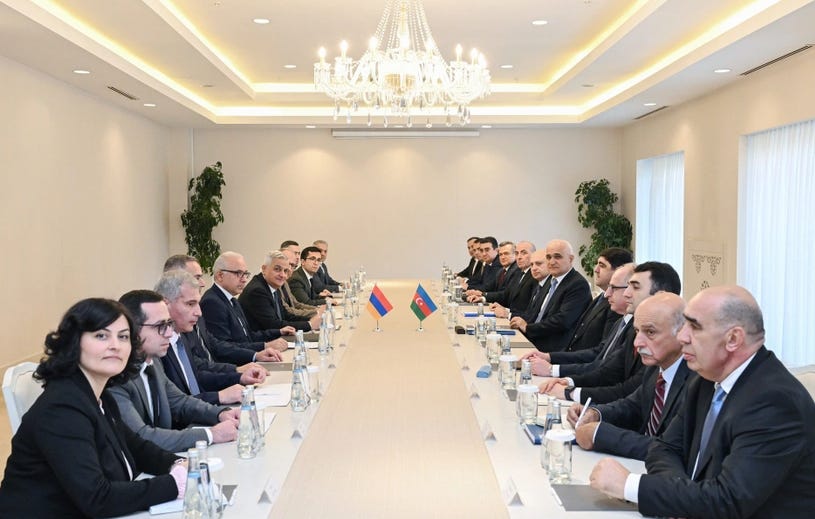
**Picture taken above is from the 12th meeting of the State Commission on the delimitation of the state border between the Republic of Azerbaijan and the Republic of Armenia.
Border Delimitation
Beyond trade and energy, institutional cooperation has also advanced. In November 2025, for the first time in the post-Soviet period, Azerbaijan hosted the Armenian delegation for an official bilateral meeting when the 12th meeting of the joint state commissions on border delimitation took place in the city of Gabala. Co-chaired by the deputy prime ministers of both countries, the meeting focused on technical and organizational issues related to comprehensive border delimitation, building on an earlier agreement to begin work from the northern tripoint with Georgia and proceed southward toward the Iranian border. The two sides agreed to hold the next meeting of the commissions in Armenia.
At the societal level, normalization has been supported by renewed engagement from civil society. Under the “Bridge of Peace” initiative, Armenian and Azerbaijani civil society representatives held reciprocal meetings in Yerevan and Baku in late 2025. These discussions addressed a wide range of issues, from humanitarian cooperation to media engagement and expert exchanges, and were explicitly linked to the Washington Declaration of August 8. While such initiatives cannot substitute for formal agreements, they play a complementary role by broadening the constituency for peace and reducing the risk that normalization remains a government-driven process detached from society.
Outlook
Taken together, these developments suggest that the Armenia–Azerbaijan peace process has entered a phase of accelerated implementation. The Washington Summit provided the political and legal framework; TRIPP has supplied an infrastructural and economic backbone; and subsequent steps – transit liberalization, fuel shipments, trade talks, border negotiations, and civil society exchanges – have begun to fill that framework with substance. This progress is unfolding despite a broader regional environment characterized by geopolitical uncertainty and great-power rivalry.
Yet the direction of travel is clear. The post-August 2025 period demonstrates that peace between Armenia and Azerbaijan is no longer a hypothetical concept. It is being constructed incrementally through decisions that alter incentives, normalize interaction, and embed cooperation into everyday economic and institutional practices. Whether this momentum will culminate in the formal signing and ratification of a peace treaty remains contingent on the removal of territorial claims against Azerbaijan from Armenia’s state constitution, which is expected to happen through a constitutional reform following Armenia’s parliamentary elections scheduled for June 2026. Still, the trajectory since the Washington Summit suggests that both sides are moving steadily toward a new regional reality grounded in territorial integrity, sovereignty, connectivity, and negotiated peace.
About the Author
Dr. Vasif Huseynov is the head of the Western Studies department at the Center for Analysis of International Relations (AIR Center) in Baku, Azerbaijan. He is a faculty member at Khazar University in Baku. Dr. Huseynov had previously worked for the Center for Strategic Studies (SAM) and Public Administration Academy (DIA) in Baku. He holds a Bachelor of Arts degree in International Relations from the Academy of Public Administration in Azerbaijan, a Master of Arts degree in Global Political Economy from the University of Kassel in Germany, and a PhD in Political Science from the University of Göttingen, also in Germany. His MA and PhD studies were supported by full scholarships of German Academic Exchange Service (DAAD). He has authored several op-eds, articles, and academic publications, including a book titled “Geopolitical Rivalries in the ‘Common Neighborhood’: Russia’s Conflict with the West, Soft Power, and Neoclassical Realism”, which was published by Ibidem Press in 2019 and distributed by Columbia University.
Thank you for your support! Please remember that The Saratoga Foundation is a non-profit 501(c)(3) organization. Your donations are fully tax-deductible. If you seek to support The Saratoga Foundation, you can make a donation by clicking on the PayPal link below! Alternatively, you can also choose to subscribe on our website to support our work.
https://www.paypal.com/donate/?hosted_button_id=XFCZDX6YVTVKA
Thanks for reading! This post is public, so feel free to share it.