
On the weekend of November 14–15, 2026, Russian drones struck four commercial vessels within 24 hours near the Danube Delta off the Sulina channel—including the Palau-flagged cargo ship Larissa 1 inside Romania’s territorial waters, prompting the Romanian Air Force to scramble F16 fighter jets twice. This brazen attack inside the territorial waters of Romania underscores how Moscow’s maritime campaign is escalating on the Black Sea coast of a major NATO ally. These latest strikes represent a dangerous new phase in a strategy Russia has pursued since the start of its full-scale invasion in 2022 as part of its efforts to choke off Ukraine’s economic lifeline by imposing a maritime blockade and attacking any vessels that try to circumvent it.
Before the start of the full-scale Russian invasion of Ukraine in 2022, approximately 60–65% of Ukraine’s total foreign trade turnover was transported through Ukrainian ports. At the same time, 85–90% of Ukraine’s agricultural products (grains, oilseeds, and vegetable oil) were transported by sea, and more than 95% of container traffic was handled by sea. Subsequently, any form of blockade, followed by the seizure of Ukrainian ports, was and remains one of the main objectives of Russian aggression in the Black and Azov Seas. After several unsuccessful attempts to land troops in Odesa at the onset of the war in March 2022, Russia has continuously sought to block Ukrainian efforts to resume commercial shipping from its Black Sea ports through the Bosporus Strait.
Ukraine’s 2023 “Humanitarian Corridor”
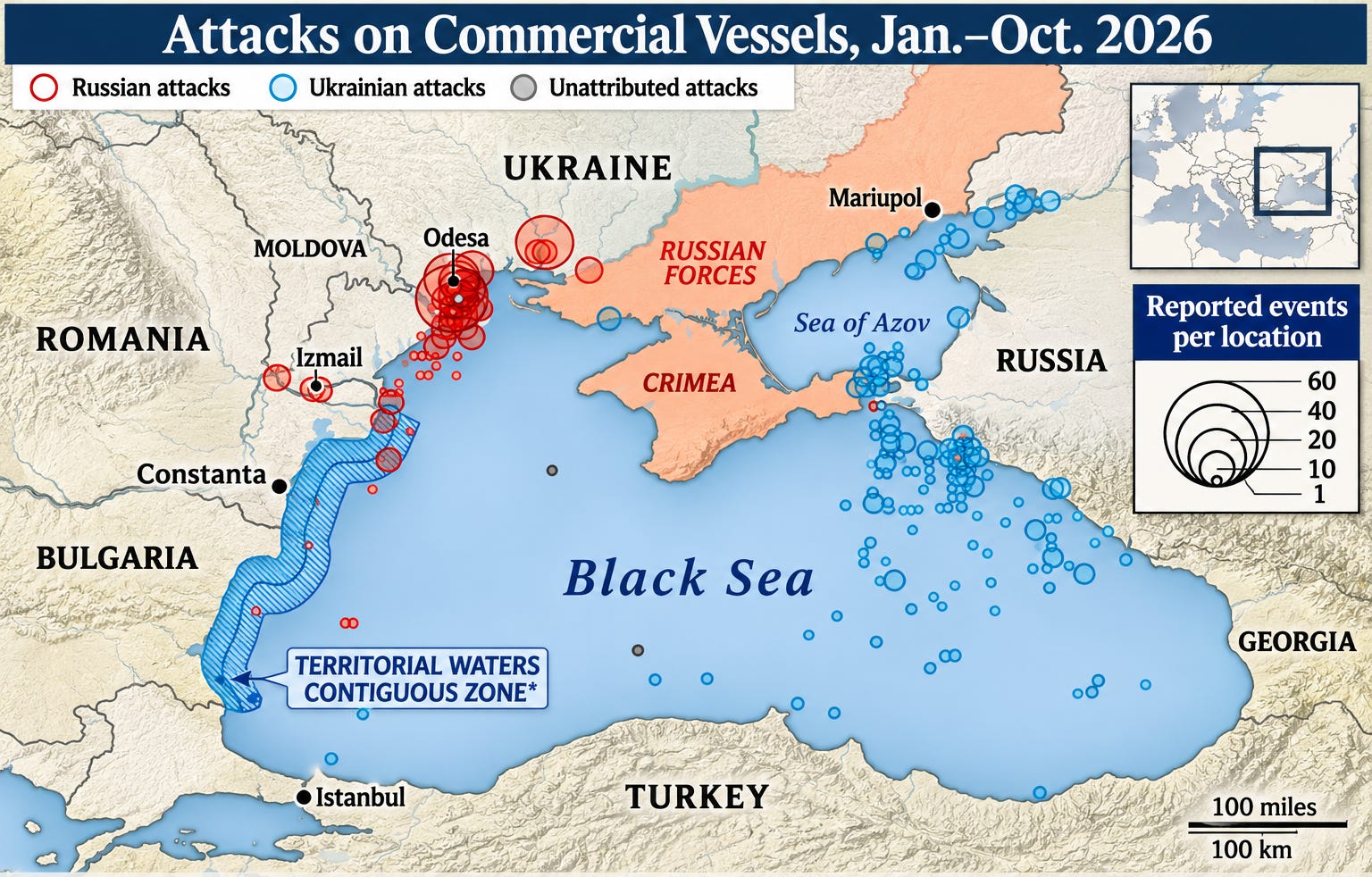
To break that blockade, and later replace the UN-brokered grain deal after Moscow withdrew from it in July 2023, Kyiv had first to dismantle Russian naval dominance in the northwestern Black Sea. This became militarily possible beginning with the April 2022 sinking of the Black Sea Fleet flagship Moskva by Ukrainian Neptune anti-ship missiles, which stripped Russian vessels of long-range air cover and enabled the liberation of Snake Island that June. Ukraine’s introduction of Uncrewed Surface Vehicles (USVs) and missile strikes forced Russia’s remaining warships to retreat toward eastern Crimea, allowing Kyiv to unilaterally establish a coastal “humanitarian corridor” in August 2023, following Moscow’s withdrawal from the UN-brokered grain deal.
Having degraded the Russian Black Sea Fleet’s operational reach in the western Black Sea through sustained naval drone and missile strikes, Kyiv moved unilaterally to reopen its sea lanes. In August 2023, Kyiv created a “humanitarian corridor” operating from its three principal southern ports: Odesa, Chornomorsk, and Pivdennyi. Ukraine independently secured safe passage for vessels along this route—stretching from Odesa to the territorial waters of Bulgaria and Romania. It did so by deploying mine countermeasures, naval patrols, air defense, and counter-sabotage operations. To sustain these efforts, the Ukrainian Navy even formed a dedicated maritime task force.
Under this new corridor, maritime shipping from Odesa no longer required Russia’s political consent, unlike the UN- and Türkiye-brokered “grain corridor” of 2022–2023. Commercial vessels began traveling exclusively within the territorial waters and exclusive economic zones (EEZs) of Ukraine, Romania, Bulgaria, and Türkiye, avoiding deep-water areas where Russian combat assets operate. As a result, in 2024 and 2025 alone, more than 140 million tons of cargo were transported from the Greater Odesa ports.
Since then, Ukraine’s coast, port infrastructure, anchorages, and narrow sections of its maritime shipping routes have been reasonably well protected from Russian aerial threats and drones, including Russian-made Shahed-type drones, as well as ballistic and cruise missiles, primarily by relying upon Ukraine’s well-layered air defense systems and mobile counter-drone teams operating along its Black Sea coast.
To protect its shipping routes, Ukraine regularly surveys its territorial waters, conducting operations to sweep and scan channels with sonar to detect drifting Soviet-pattern moored mines and bottom mines dropped from aircraft. Also important for the maritime economy was the fact that state guarantee funds and insurance mechanisms backed by the London insurance market provide protection for shipowners and cargo against threats associated with missile strikes and naval drones.
Russia’s Post-July 2026 Surge in Shipping Attacks
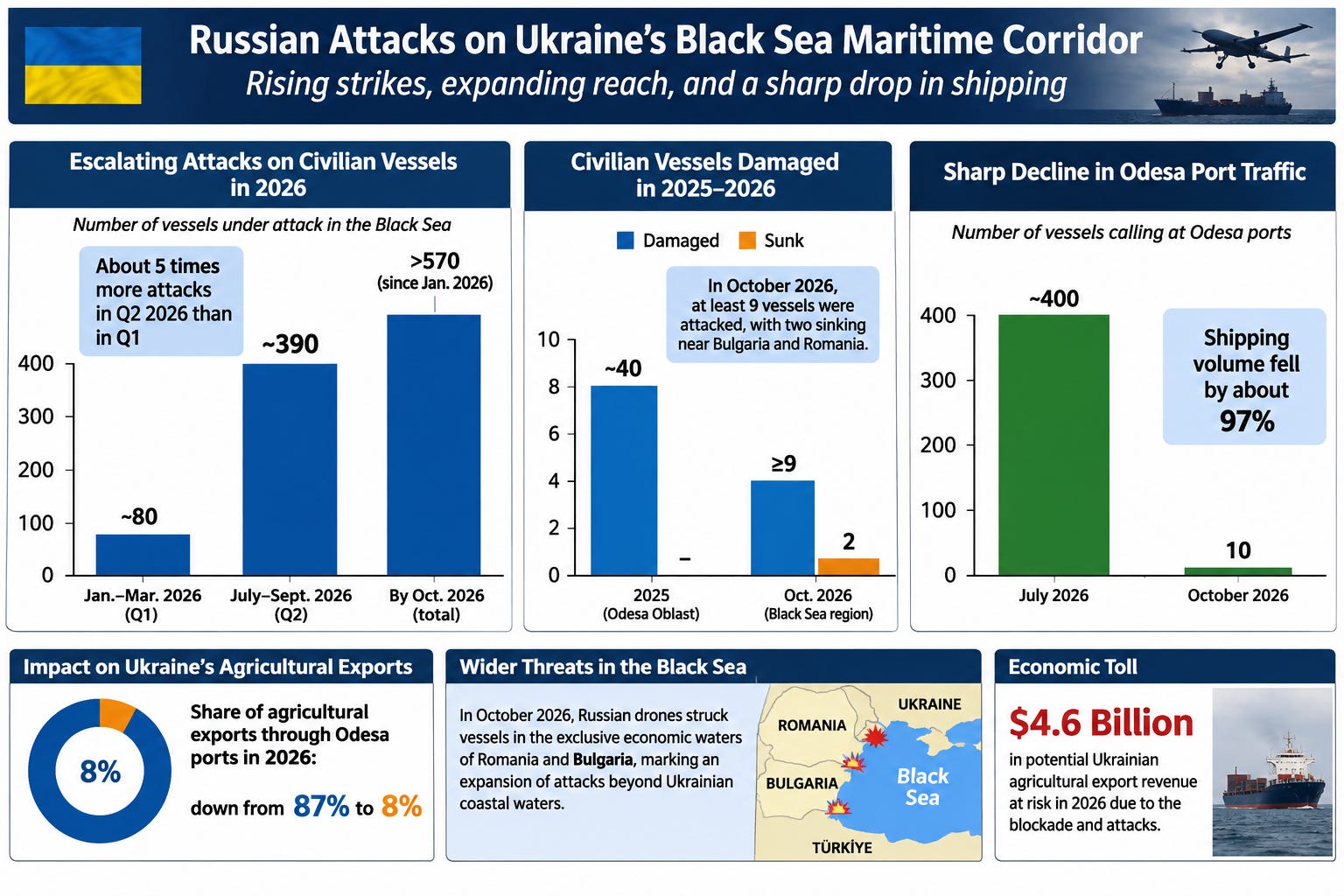
In operation since 2023, Ukraine’s one-way humanitarian corridor has increasingly experienced an intensifying series of Russian aerial drone attacks against commercial shipping operating in the western part of the Black Sea. In 2025, for example, 20 confirmed attacks directly targeted merchant vessels in Odesa Oblast ports and adjacent Black Sea waters, damaging approximately 40 civilian vessels while loading or at anchor.
By 2026, however, the intensity of attacks along the maritime corridor reached its highest level since the start of the war. Since the beginning of the year, more than 570 attacks on civilian vessels and port facilities have been recorded across the Black Sea basin, killing 40 crew members. The sharpest spike occurred in the third quarter (July–September 2026), when roughly 390 vessels came under fire—five times the rate recorded at the start of the year.
Alongside this surge in volume, Russia significantly expanded the geographic reach of its strikes after July 2026, targeting vessels within the exclusive economic zones of Romania and Bulgaria along the route to Türkiye’s Bosporus Strait. In October 2026 alone, Russian drones struck at least nine civilian vessels and tankers near Bulgarian and Romanian waters, critically damaging several and sinking two. Simultaneously, Russia kept up strikes on Odesa Oblast ports; in early October, an attack on a Liberian-flagged vessel killed one crew member.
Russia’s sustained offensive on Black Sea shipping has severely disrupted Ukraine’s maritime trade, causing a significant fall in port volume. While approximately 400 vessels called at Greater Odesa ports in July, only 10 did so in October. Consequently, the share of Ukrainian agricultural exports shipped through Odesa plunged from approximately 87% to 8%. Left unchecked, this renewed blockade and continued strikes on the humanitarian corridor threaten to cost Ukraine’s agricultural sector an estimated $4.6 billion in lost export revenue.
What Alternative Routes Exist to Replace Maritime Shipping?
One of the key questions to emerge from the upsurge in attacks is whether a viable alternative exists to replace this sea corridor. For example, could a land corridor through Moldova ensure grain exports to offset the maritime route via Bulgaria and the Black Sea? The answer is yes. But only as an additional route, not as a full replacement for the use of Ukraine’s deep-water ports. A land corridor through Moldova by rail, such as the reopened Basarabeasca–Berezino section, as well as logistics hubs at the Moldovan Port of Giurgiulești, can handle around 10% of Ukraine’s grain exports (approximately 600,000–1,000,000 tons over a given period).
The Port of Giurgiulești is Moldova’s only port accessible to seagoing vessels and is located on the Danube River and sits at the exact confluence where the Prut River flows into the Danube. Its main berths and terminals sit directly along the northern bank of the Danube River (about 133 km from the Black Sea), giving it deep-water access for both river barges and seagoing vessels.
A standard Handymax vessel carries 35,000 to 50,000 tons of cargo, and moving that volume by rail would require hundreds of railcars. The overland route through Moldova to the Romanian port of Constanța or the Danube adds approximately €50–90 ($55 to $95) per ton to the transit costs, significantly reducing farmers’ profits compared with direct maritime loading in Odesa.
Western rail crossings bolster the transport total up to 2.0–2.6 million tons per month, which is the physical limit of their throughput capacity by rail. Danube ports can handle up to 20% of total export volumes but lack sufficient capacity to replace the deep-water ports.
NATO’s Response to Black Sea Shipping Attacks
Russian mass attacks on Black Sea shipping in October in the immediate vicinity of and within the territorial waters of Romania and Bulgaria prompted a strong response from NATO member countries. Romanian F-16 fighter jets began patrolling and intercepting drones, while Bulgaria and Romania deployed additional satellite reconnaissance and air defense/counter-drone systems. In addition, the EU announced additional funding of up to €50 million ($55 million) and accelerated the establishment of a Joint Maritime Security Center in the Black Sea. First announced in 2025 as part of the EU’s Black Sea Strategy, the EU’s Maritime Security Center has lagged in implementation, and it was not until the intensification of the recent attacks in the Black Sea that the EU moved forward with the creation of the Black Sea maritime security hub.
On November 11, while visiting Denmark, Ukrainian President Volodymyr Zelenskyy announced that cooperating together with officials in Copenhagen, Kyiv would begin work on a project to escort ships in the Black Sea using various types of drones to protect against Russian attacks. Zelensky noted that: “Today, as you know, the Black Sea is blocked. For agriculture, it is extremely important to ensure the escort of ships….we are discussing and working on organizing the escort of ships using various types of drones,” he said.
Due to the strong NATO response, the Kremlin's policy faced the risk of direct military escalation with NATO member countries over the maritime attacks on shipping. Meanwhile, Ukraine began implementing initiatives to protect vessels with maritime drones and aerial escort (drones and aircraft), which have significantly hindered the Russians’ unimpeded use of drones in the western part of the Black Sea.
As it has become increasingly difficult to strike moving vessels in waters covered by NATO countries’ air defenses, the Russian forces are again shifting the main focus of their air attacks directly to the port and logistical infrastructure in and around Greater Odesa and the Danube region, striking warehouses, terminals, and berths.
Outlook
Several promising ways exist to restore navigational safety in the western Black Sea, including organizing vessels into a “humanitarian convoy” from Odesa to the Bosporus. One option under consideration is for Ukraine to route ships strictly within the 12-nautical-mile territorial waters of NATO littoral states, placing them inside Alliance territory and affording these cargo vesselsf some corresponding protection. This vulnerability continues to persist because commercial ship captains sometimes lose sight of the maritime threat along the Black Sea coast and frequently drift outside the 12-nautical-mile territorial sea, and then come under attack.
In many cases, these incidents stem from navigational errors or ship captains disregarding official maritime safety guidance—specifically NAVAREA III # 0034/23 and NAVTEX # 124/23. Issued under the Navigational Area (NAVAREA) system—an international maritime safety framework coordinated by the International Maritime Organization (IMO) and the International Hydrographic Organization to broadcast urgent hazard warnings across 21 global sea regions (with Area III covering the Mediterranean and Black Seas). Alongside automated coastal NAVTEX safety broadcasts, these notices outline recommended coastal transit corridors and war-risk advisories for commercial vessels. Consequently, these errors and lack of vigilance, this accounts for the surge in recent attacks off the coast of Romania and Bulgaria in recent weeks as Russian military planners take advantage of these discrepancies in navigation.
Another potential option to restore navigational safety is to task NATO and the national armed forces of its member states in the Black Sea with conducting coordinated maritime and aerial reconnaissance patrols—using both manned aircraft and unmanned systems—to detect approaching surface and aerial drones in advance and also change the rules of engagement for Romanian F-16s involved in deterring the Russian aerial and drone attacks on shipping
One approach being considered by Ukraine is for it to deploy mobile armed security teams aboard Black Sea commercial vessels to counter the Russian drone threats, an arrangement that would require bilateral agreements with countries along the western Black Sea coast. Navigational safety could be strengthened by deploying electronic warfare systems along the shipping corridor to sever Russian command-and-control links, preventing its drones from operating effectively in this western quadrant of the Black Sea.
Taken together, these layered measures would help re-establish a secure maritime lifeline for Ukraine’s economy and regional trade to deter further Russian attacks. This can be done through a combination of Air, Land, Sea deployed manned and unmanned assets in a combat network capable in advance of timely detection, identification and neutralization of threats to shipping. As a result of Ukraine’s experience in dealing with this threat along its own maritime seaboard, it should with its NATO partners the lessons learned from creating its own deterrence architecture, such as integrated coastal radar / creating a drone-interceptor perimeter around Odesa, to help Romania develop its own anti-air and anti-surface capabilities in the maritime domain.
About the Author
Captain (ret.) Andrii Ryzhenko is an expert on Russian naval forces and naval strategy. He is a former officer in the Ukrainian Navy and retired from the Armed Forces of Ukraine with the rank of Navy Captain. Captain Ryzhenko served over 35 years at sea and ashore: aboard surface warships, at Ukrainian Navy HQ on maritime tactics and PfP exercises, and as a defense and strategic planner. He also worked on Ukrainian Navy transformation to Euro-Atlantic standards and on contributions to NATO-led operations and NATO Response Forces. He served in NATO on partner nation units’ evaluation methodology (OCC E&F) at Supreme Allied Headquarters Europe (SHAPE) (Mons, Belgium), and he developed maritime aspects of the National Security Strategy in Ukraine. Capt. Ryzhenko is currently a strategic expert at the defense and logistics consulting firm, Sonata.
Thank you for your support! Please remember that The Saratoga Foundation is a non-profit 501(c)(3) organization. Your donations are fully tax-deductible. If you seek to support The Saratoga Foundation, you can make a donation by clicking on the PayPal link below! Alternatively, you can also choose to subscribe on our website to support our work.
https://www.paypal.com/donate/?hosted_button_id=XFCZDX6YVTVKA