
By Alexander Melikishvili
For the first time since July 10, Russian authorities issued permits for vessels to depart from the ports of Temryuk and Kavkaz in the Sea of Azov, according to a Bloomberg report on October 28. Three industry sources quoted by the news agency claim that the Azov Sea Port Administration began issuing permits on October 26 and that at least one ship had passed through the Kerch Strait and entered the Black Sea. The report was corroborated by Reuters, as quoted by The Moscow Times, also on October 28. Seven industry sources told Reuters that the permits would be issued only until November 15, and two of them added that the ships would be protected in the Black Sea by a Russian naval escort.
This announcement appears to have caught the Ukrainian side by surprise. Ukraine’s Minister of Agrarian Policy, Taras Vysotskyi, stated that his agency was verifying the information about the resumption of grain shipments by Russia via the Sea of Azov, Interfax-Ukraine reported on October 29. The Ukrainian military has issued no statements indicating that it would unilaterally stop attacking Russian ships in the Black Sea or the Sea of Azov in the absence of reciprocal commitments from Russia. Prior to the deterioration of the security situation in the northern part of the Black Sea due to tit-for-tat attacks targeting commercial navigation by Russia and Ukraine, about one-third of Russia’s wheat exports passed via the Sea of Azov, reflecting its strategic importance.
In the absence of a comprehensive ceasefire or moratorium on naval attacks in the Black Sea, a one-off resumption of maritime traffic by Russia, even if true, does not resolve Moscow’s main problem, which is finding ways to export its bumper grain harvest that is forecast to reach 140 million tons in 2026. Even though Ukraine has repeatedly expressed a readiness to halt its attacks, Russia has demonstrated no willingness to reciprocate. Speaking at the annual Valdai Club meeting on October 1, Putin rejected the proposal for a limited truce in the Black Sea. Kremlin spokesperson Dmitry Peskov further confirmed this position on October 2, when he stated that “piecemeal arrangements” could not bring about “a peaceful settlement.” Russia links the cessation of its attacks against Ukraine-bound ships and Ukraine’s critical energy infrastructure not only to Kyiv’s halt of attacks on Russian refineries but also to the lifting of Western sanctions on Russian oil exports.
Looking North and East
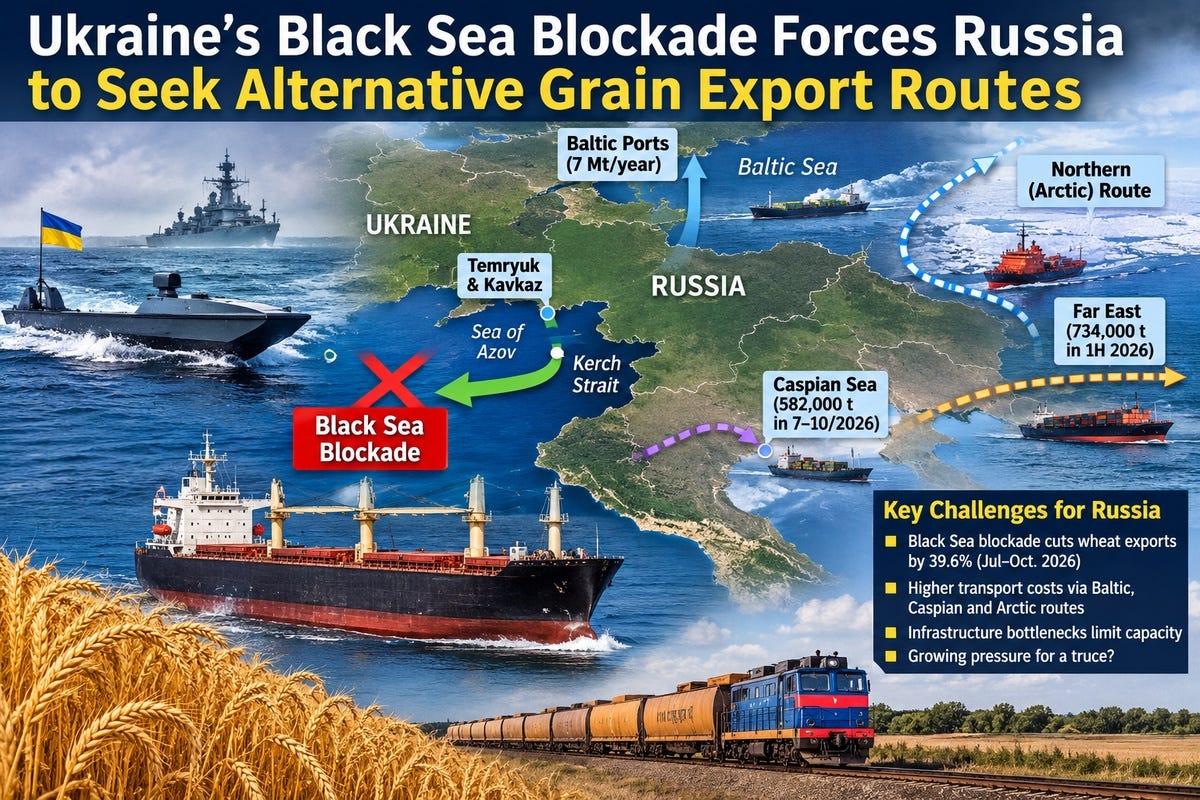
The double blockade of the Black Sea forces Russia to seek alternative routes to transport grain, but these efforts are seriously restricted by geopolitical factors and infrastructure constraints. A good example of the former is Estonia’s decision to ban the transit of Russian and Belarusian grain, as announced by its foreign minister, Margus Tsahkna, on October 1. Moreover, on October 9, Latvia, Lithuania, and Estonia proposed introducing a European Union-wide ban on all Russian grain transit via the EU. Russia has five ports on the Baltic Sea (Ust-Luga, Primorsk, St. Petersburg, Vysotsk, and Kaliningrad). Still, their aggregate throughput capacity is limited to only 7 million tons of grain per year. Although work is underway to expand port infrastructure to handle more grain, this will take some time and require considerable investment. In addition, grain will have to compete with other bulk dry cargo shipments, including coal and fertilizer.
As a result, Russia began exploring the northern or Arctic route. On October 28, it was reported that the port of Murmansk had received its first shipment of grain, amounting to 3,400 tons. This is likely intended for the Barbados-flagged dry bulk carrier New Born, which is scheduled to deliver 28,000 tons of wheat to Morocco, according to The Moscow Times. Russia has other ports along its vast northern coast, but Murmansk is the only one that remains ice-free throughout the year. In addition, other major northern ports are highly specialized in handling specific outbound cargo shipments (for example, Sabetta handles mostly LNG, while Dudinka handles metals and coal), and retrofitting their infrastructure to become multimodal is simply not economically feasible.
On September 12, Russian Agriculture Minister Oksana Lut told the Russian media that although the ports in the Far East had not been used for grain exports before, steps had been taken to “actively develop this direction,” without providing any details. She also denied that Russia was experiencing any problems with grain exports and noted that talks were underway with China to safeguard the transit of Russian grain for export to markets in Southeast Asia. Since then, however, there have been no reports in Russian media about Russian grain transits via China. Meanwhile, according to Forbes.ru, the volume of grain exported via Russian ports in the Far East, including Vladivostok, reached only 734,000 tons in the first half of 2026.
Overland transit via Kazakhstan would seem like another option, but transporting grain in this direction is severely hampered by mutual disagreements over tariffs for grain transit to countries outside the Eurasian Economic Union. Russia and Kazakhstan also have conflicting policy priorities, with the latter keenly interested in using Russian seaports to double its grain exports by 2028. Due to Ukraine’s Black Sea naval blockade, Russia naturally prioritizes its grain shipments rather than accommodating Kazakh grain exports. This has already resulted in Russia rejecting Kazakhstan’s request to transport its grain via Russian railroads to the Estonian ports in October. Russia justified its refusal on the grounds of insufficient capacity in its railroad network.
Ukraine’s blockade of the Black Sea resulted in a 39.6% contraction in Russian wheat exports in July–October 2026 compared to the same period in 2025, as reported by Kommersant on October 30. Similarly, Russian barley and corn exports declined by 25% and 5.4%, respectively, during the same period year-on-year. Russia is mainly rerouting grain exports via its Baltic seaports, which now absorb 38.3% of wheat exports. The Caspian direction is also steadily growing, but there, again, infrastructure constraints do not allow for large volumes—the Russian analytical center Rusagrotrans estimates that only 582,000 tons of wheat were transported for export via the Caspian Sea in July–October 2026.
Outlook
Leaving aside the infrastructure bottlenecks at Russia’s northern, northwestern, and eastern seaports stemming from insufficient throughput capacity, rerouting grain exports substantially increases transportation costs, which ultimately must be borne by buyers or sellers. For example, freight charges for river-to-sea vessels transporting grain from Russia to Iran via the Caspian Sea increased by 2.3–2.4 times. As of September 25, it cost $110-115 per ton to transport grain from Astrakhan to Iran (compared to $47 per ton in 2025).
Similarly, shipping grain from Russia’s Baltic ports to Morocco now costs $42 per ton—a 40 percent year-on-year increase. Measures offered by the Russian government to grain traders are insufficient because of increased transportation costs. Already in July, the Russian Ministry of Agriculture offered to subsidize 90% of rail costs, but because the full tariff for transporting grain from Russia’s Southern Federal District to Baltic ports is $80-120 per ton, even the remaining 10% ($8-12 per ton) represented a heavy burden on farmers.
The aggregate volume of announced state purchases of grain in 2026 is only on the order of 3 million tons, which also offers little relief given the size of the bumper crop. Russian authorities commenced state purchases on October 29, according to UkrAgroConsult, but farmers’ participation in trading sessions was limited due to a combination of systemic factors, including a shortage of storage silos, increased transportation costs, and red tape associated with obtaining approval to participate in auctions. As a result, only four trading sessions were organized instead of the eight scheduled.
The president of Russia’s Grain Union, Zlochevsky, estimates that if its southern ports continue to remain idle, close to 40 million tons of grain will be stranded. Moreover, he adds that, under the best-case scenario, if all alternative routes are employed to the maximum, this will only allow compensation for the losses of not more than half of this volume. Overhauling port infrastructure to accommodate sharply increased grain volumes will take both time and money, which means that Russia is left with no short-term options.
Mounting logistical and economic pressures increase Moscow’s incentive to seek an accommodation, but it remains unclear whether the Kremlin will compromise on its broader strategic objectives (such as lifting Western sanctions or addressing ‘root causes’) in exchange for restoring maritime trade. Nevertheless, the growing costs of the Black Sea blockade could eventually make a limited truce an increasingly attractive option for Moscow. Following Zelensky’s weekend visit to Türkiye, this might even result in the revival of the Black Sea Grain Initiative from which Russia withdrew in 2023.
About the Author:
Alex Melikishvili is a senior country risk analyst with more than a decade of experience working in the private sector (S&P Global, IHS Markit) with a focus on Eurasian security. Alex holds a master’s degree in International Affairs from the George Washington University’s Elliott School of International Affairs.
Thank you for your support! Please remember that The Saratoga Foundation is a non-profit 501(c)(3) organization. Your donations are fully tax-deductible. If you seek to support The Saratoga Foundation, you can make a one-time donation by clicking on the PayPal link below! You can also subscribe to our website to support our work.
https://www.paypal.com/donate/?hosted_button_id=XFCZDX6YVTVKA