
by Andrew McGregor
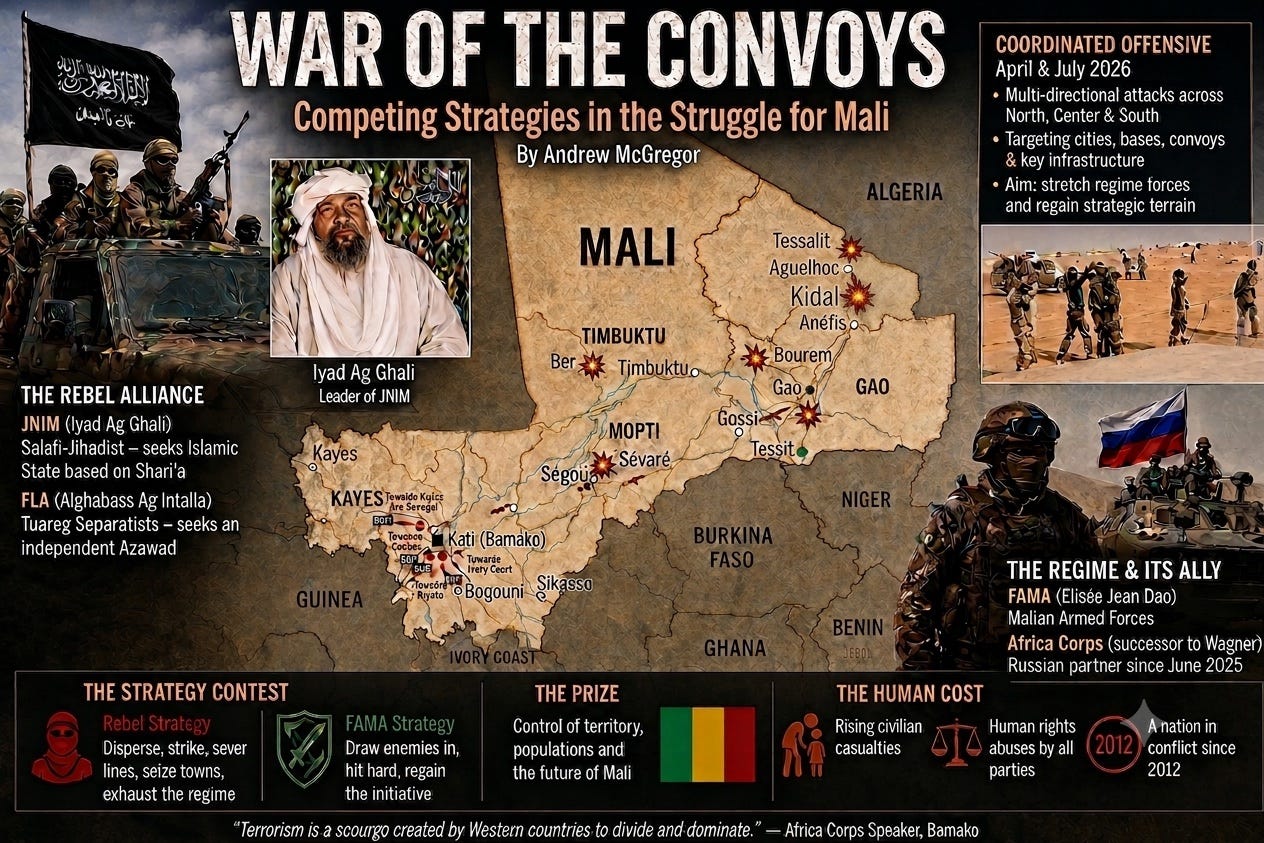
In the latest phase of an insurgency that began in 2012, the ability of Mali’s military regime to fend off a rebel insurgency has been sorely tested by a rebel offensive that began in April with coordinated attacks across Mali’s 479,000 square miles (by comparison, Texas covers a total area of 268,596 square miles).
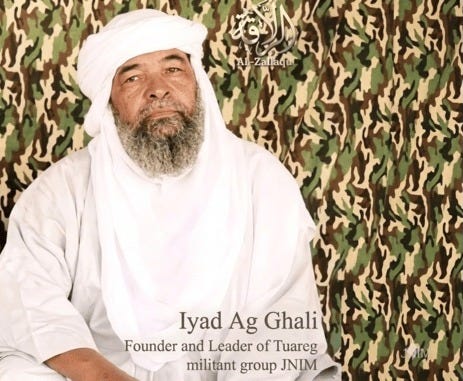
The offensive is being carried out by an unlikely partnership of two Tuareg-dominated groups – the Salafi-Jihadist Jama’at Nusrat al-Islam wa’l-Muslimin (JNIM, led by Iyad Ag Ghali) and the separatist Front de Libération de l’Azawad (FLA, led by Alghabass Ag Intalla). Though the latter seek the creation of Azawad, an independent state in northern Mali, Ag Ghali and his followers seek the transformation of Mali into an Islamic State based on Shari’a. For the purpose of operations, the two groups work closely together in northern Mali, while operations in the Central and Southern regions of Mali are often carried out by JNIM alone.
Mali’s military regime is defended by the Forces Armées Maliennes (FAMa, led by Chief of the General Staff of the Armed Forces Élisée Jean Dao) and their Russian partners, the Africa Corps, which succeeded the Russian Wagner Group in June 2025. The Wagner “withdrawal” (many Wagner personnel in Mali simply switched over to the new Africa Corps) was accompanied by a significant uptick in JNIM and FLA attacks, most notably in regions of Mali where the militant groups had not previously operated. There is significant friction between FAMa and the Russians, who tend to operate independently while helping themselves to FAMa arms and equipment. The Russian military presence has been accompanied by a sharp increase in human rights abuses and civilian casualties, though all parties to the conflict have demonstrated little respect for civilian life.
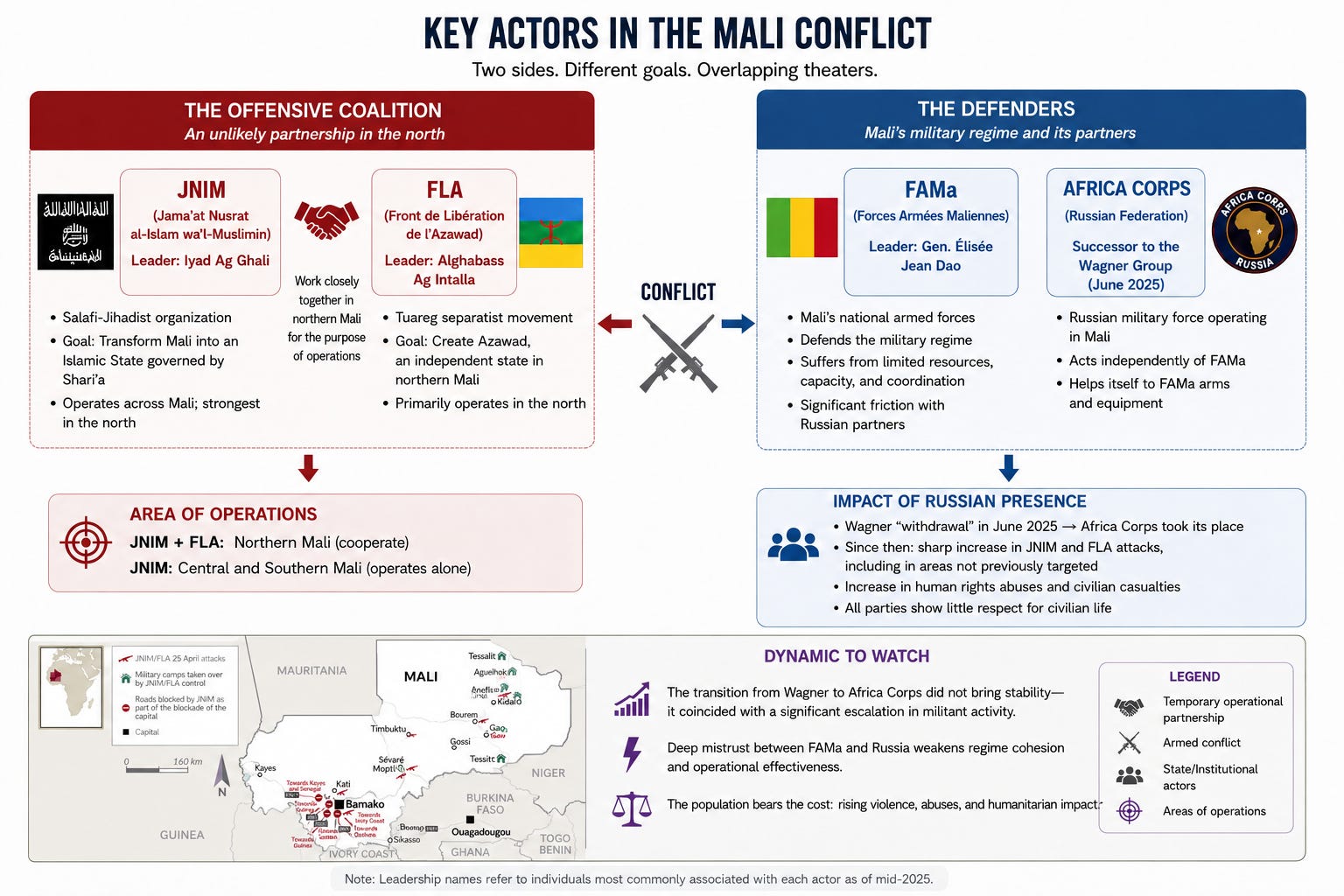
The coordinated attacks in April (which included strikes in the capital itself) shook the Malian regime and led to the loss of a number of population centers in the north, including Kidal, Aguelhoc and Tessalit in the Kidal region, Ber in the Timbuktu region, and Tessit in the Gao region. The loss of Kidal came as a shock to the Africa Corps, which had proclaimed its role in taking the rebel stronghold in November 2023 by raising a Russian flag over the city. The insurgents also succeeded in killing FAMa commander Sadio Camara during an attack on the Kati military base outside Bamako.
Rebel Offensive – July 2026
On July 4, the FLA and JNIM launched coordinated attacks in Aguelhoc (retaken by government forces after April), Anéfis, and Gao in the north, Sévaré in the central region (home to a large army base and an airport), and at the prison at Kéniéroba in the south (46 miles from Bamako), where many opposition figures are held (the latter attack failed to free any prisoners). The dispersed July attacks followed similar the pattern used in April. Airstrikes were carried out against JNIM/FLA fighters concentrated at Aguelhoc in the northeast, where the latest insurgency began with the slaughter of the Aguelhoc FAMa garrison by jihadists under the command of Iyad Ag Ghali in 2012.
Anéfis has a small population of 8,000 residents, but is strategically located and home to a base used by both FAMa and the Africa Corps. Most of Anéfis was taken by the rebels on July 4, but parts of the Malian/Russian garrison continued to fight, with the Russians defending their position with drones. Intense fighting followed at Anéfis on the 5th and 6th as rebel reinforcements poured in on 4x4 trucks. By July 7, FAMa drones and fighter jets began taking a toll on attackers. As fighting continued on the 8th, a Malian/Russian relief column of 60 vehicles left Gao for Anéfis, with air cover provided by helicopters and surveillance drones.
The militants inflicted a devastating July 9 attack on the relief convoy. Military assistance was required from Niger and Burkina Faso to relieve the attack on the Russian/Malian column. Nonetheless, FAMa issued a proclamation that declared the situation had stabilized. Before switching to regional sweeps, FAMa claimed the elimination of 330 “terrorists” and the re-occupation of Anéfis. During a ceremony in Bamako celebrating the FAMa/AC “victory” in Anéfis, an Africa Corps speaker declared “Terrorism is a scourge created by Western countries to divide and dominate.”
The FAMa Strategy
FAMa commander Elisée Jean Dao led Mali’s National Guard (the“Brown Berets”) in the January 2013 Battle of Konna (the first significant reverse for Iyad Ag Ghali and the jihadist coalition) and the retaking of Gao from the Islamists. After advanced military training in France in 2015, Dao supported Colonel-Major Assimi Goïta’s post-coup junta in 2020. Dao served as ambassador to Gabon and China before becoming Mali’s Chief of General Staff of the Armed Forces in May 2026. His appointment in May came at a time of continuing purges of senior FAMa officers suspected of ties to opposition figures and would-be mutineers.
General Dao insisted on July 11 that FAMa and its Russian partners had delivered a severe blow to the insurgents by allowing them to “concentrate their forces” in Anéfis before launching a coordinated counter-offensive that inflicted heavy losses. According to Dao, this strategy allowed government forces to target rebel military assets rarely caught out in the open, including armored vehicles and heavy weapons, as well as large numbers of the usual motorcycles and “technicals” that provide mobility for the insurgents. According to the general, one thousand rebels were “neutralized” at a cost of 30 soldiers killed and 60 wounded in the relief operation.
In the jubilation that followed FAMa’s expulsion of the insurgents from Anéfis, General Dao also spoke at length about the strategy that enabled the “victory.” The general began by describing the government’s April loss of the cities of Kidal and Tessalit as “a ruse” that brought the insurgents “within range.” Anéfis, in a “truly flat terrain,” was held as “a kind of bait” to draw out the enemy’s armored vehicles, anti-aircraft missiles, anti-tank guns and artillery for destruction, a method of bypassing the insurgents’ concealment skills: “Operation Anéfis was part of a comprehensive strategy for us that allowed us to gradually reduce the enemy’s capabilities, and well, they let themselves be caught, hoping to gain control…”
Financial incentives are another part of the regime’s strategy; a reward of 2 billion CFA francs ($3.5 million) was offered in June by Mali’s government for information leading to the “capture or neutralization” of JNIM leader Ag Ghali. Further rewards were offered for Ag Ghali’s Fulani deputy, Amadou Koufa, and Tuareg separatist leader Alghabass Ag Intalla.
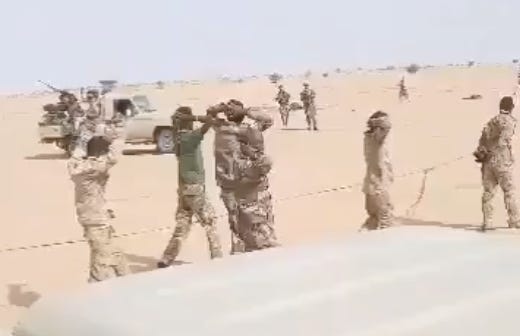
*Image above: 50 Captured FAMa Soldiers After JNIM Convoy Attack
July 18 Ambush
Only days after General Dao proclaimed the success of the regime’s strategy, a FAMa convoy leaving Anéfis for Gao was ambushed near Tabankort by the jihadists and separatists on July 18, with over 50 soldiers and allies from pro-government militias killed and 24 taken prisoner. A convoy of Africa Corps personnel was reported to have left earlier for Gao; some reports claim no Russians were involved in the July 18 ambush, while others claim some Russians were with the FAMa convoy and among the known dead. Echoing the ruthless and demoralizing slaughter of bound FAMa prisoners at Aguelhoc by Ag Ghali’s Ansar al-Din movement in 2012, it appears that many of the prisoners taken in the latest ambush were massacred. Several armored vehicles were reported to have been taken intact, replacing earlier rebel losses.
The Role of Algeria
An Africa Corps statement claimed that that two leading Tuareg militants were eliminated during the fighting; FLA military leader Mbarek Ag Akli and JNIM military planner ‘Abd al-Rahman Zaza (Ag Akli was later seen alive on video discussing the battle). An unconfirmed local report alleged that Iyad Ag Ghali was seriously wounded in the battle and was transported with other wounded militants to an Algerian military hospital in the Saharan city of Tamanrasset. Malian authorities have frequently accused Algeria of harboring Tuareg militants over several decades, even though Algiers has a long record of acting as a mediator between Bamako and Tuareg rebel movements in northern Mali.
Mali’s relations with Algeria began to improve in July, a year after Algeria took down a Malian surveillance drone allegedly operating in its airspace. The sudden rapprochement is viewed as benefitting Algeria and Russia while further weakening French influence in the region and forestalling American efforts at a rapprochement with Mali. Russia favors the revival of the never fully implemented 2015 Algiers Accord as a means of restoring peace and security to the restless north after years of warfare and Russian military intervention has failed to provide a military solution.
Foreign Interference?
According to General Dao, the type of weapons FAMa is now encountering in the field are more suggestive of those held by a state rather than a rebel group, a situation the general believes is indicative of foreign support for the insurgents. Regime-friendly media in Mali attributes FAMa and Africa Corps difficulties to the entry of “battalions of mercenaries” into the conflict, including Algerians, Polisario fighters and Ukrainian instructors, all under the supervision of French legionnaires.
It was further claimed in the Malian press that the July 4 offensive was committed by “terrorists in the pay of Western powers” led by French president Emmanuel Macron “and some neighboring countries,” notably Algeria and Mauritania, who are alleged to be “awaiting the green light” from Paris before launching attacks against FAMa positions.
Ag Ghali, meanwhile, has called the cooperation of Mali’s ruling military council with “Russian proxies” traitorous, and has cited it as a reason to reject any negotiations with the state.
Outlook
The expansion of insurgent operations to Central and Southern Mali as well as the massive Northern province has forced FAMa to spread its forces across the nation rather than address the rebellion in the north alone, the traditional pattern. The joint insurgent strategy involves pulling Malian and Russian military resources in several directions at once, exposing convoys rushing to one hot-spot or another to ambushes in unfamiliar country.
Despite promoting a Salafist religious belief foreign to most Tuareg Muslims, Iyad Ag Ghali not only survives, but grows in power and influence every year. This is attributed to his strategic understanding of the Sahel conflict, one that has brought ideologically opposed Tuareg separatists under his leadership.
Does Ag Ghali seek the creation of a Chad-type situation, where a tiny desert minority (in Chad’s case, the Zaghawa) controls a large and diverse nation by force of arms and exclusion of other groups in the power structure? Given that the Tuareg are as divisive as the Zaghawa (both rebels and rulers in Chad hail from the same group), the main challenge to a Tuareg-led Islamist government in Mali would inevitably come primarily from rival armed Tuareg groups, including not only the separatists but also those (mostly from the vassal class) still loyal to Bamako. Unless Ag Ghali believes he can actually replace the existing government with that of an Islamic State, then it is likely that the growing number of attacks in the center and southern provinces and the blockade of fuel destined to Bamako are designed less to seize territory than to destabilize Mali’s military regime by exposing its weaknesses, internal rivalries and reliance upon an unpopular and erratic military partner, the Russian Africa Corps.
About the Author:
Dr. Andrew McGregor is director of Aberfoyle International Security, a Toronto-based consultancy specializing in the security issues of Africa and the Islamic world.
.
Thank you for your support! Please remember that The Saratoga Foundation is a non-profit 501(c)(3) organization. Your donations are fully tax-deductible. If you seek to support The Saratoga Foundation, you can make a one-time donation by clicking on the PayPal link below! You can also subscribe to our website to support our work.
https://www.paypal.com/donate/?hosted_button_id=XFCZDX6YVTVKA