
As Russia enters 2026, many Russian opposition figures, especially those living in exile, have suggested that Putin is leading their country to disaster; even though, to this day, most Russians instinctively dismiss those who advance such views as renegades or even traitors. A new commentary, however, more sweeping and damning than theirs was offered last week by retired Russian Colonel General Leonid Ivashov in response to Putin’s direct line television program held on December 19.
Ivashov is someone whom all Russians recall as the hero of Pristina. In 1999, General Leonid Ivashov, as a senior Russian military official, led a rapid deployment of Russian forces into Pristina ahead of NATO troops blocking their advance in an effort to assert Russian influence during the Kosovo conflict. His act heightened tensions with NATO, signaling Moscow’s willingness to challenge Western operations and complicating alliance coordination in the region.
Ivashov is now appearing once again in a different form, this time emerging once again to challenge Russian President Putin, predicting Russian defeat in its war with Ukraine. While the aging Ivashov – now 82 – has previously criticized Putin and his policies, most notably in 2022 when he denounced the war in Ukraine and even called on Putin to resign, his remarks this past week came immediately after Putin’s live call-in address.
The retired general’s comments represent his most sweeping condemnation of both Putin and the war to date from within Russia. If Ivashov avoids sanction for this renewed criticism, it could prompt segments of the Moscow elite already uneasy about Russia’s trajectory to connect the dots and potentially coalesce into a more serious and consequential opposition.
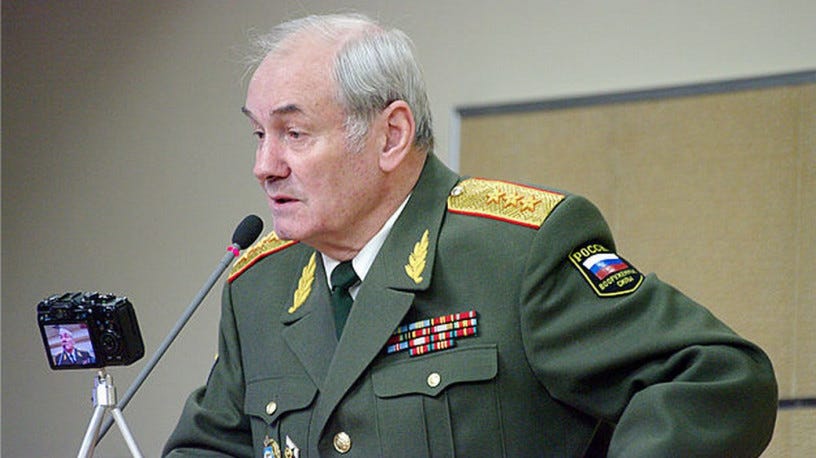
Ivashov Details Demise of Russia
Ivashov begins his remarks by saying “we are in trouble” abroad because Russia has isolated itself as a result of its invasion of Ukraine, with only a few remaining friends at the United Nations and retains almost no influence over the former Soviet republics which Moscow has long viewed as part of its sphere of influence. At home key Russian industries are in shambles, corruption is widespread, and food and medicine are in increasingly short supply - all things that recall the final days of the Soviet Union and make one wonder what is ahead for Russia.
During his online statement Ivashov offered a long laundry list of things that were failing inside Russia:
* Planes: “We can’t build our own passenger jets. We’re basically cannibalizing old Boeing’s for spare parts.”
* Space: Ivashov describes how the last working manned launchpad at Baikonur was accidentally destroyed due to poor maintenance. Russia in effect can no longer deploy men into space.
* Food: Ivashov warns that the food available in Russians stores is becoming extremely harmful because it is filled with palm oil because the economy is so constrained.
* Corruption: He mentions that 11 trillion rubles ($1.2 trillion) were allegedly stolen by the Russian Ministry of Defense. He points out that almost every major corrupt official is a member of the ruling party.
Economic & Demographic Decline
General Ivashov then turns to address Putin’s “direct line” performance this year during his live call in program held on December 19. He mocks Putin by noting the Russian leader “put on a superb theatrical performance” in which everything was staged, all questions and answers were clearly rehearsed, and in which he dodged questions from foreigners with jokes or dismissive remarks. And Ivashov points out that while Putin was beaming to his audience and telling everyone how well the Russian economy was doing, even Moscow television showed scenes of people in Russia’s federal subjects begging for water, road repair, and money for medicines.
Ivashov declared that he and many others really are worried that the Russian people are simply dying out with the fertility rate – the number of children per woman per lifetime – far below replacement level, and that the Putin regime is not doing anything serious to correct the situation. Indeed, the retired general says, Putin excuses the Kremlin’s inaction on this point by arguing that it is “simply part of a global trend.” That may be true, but it can’t be a real justification for doing nothing, Ivashov argues.
But it is about Putin’s war in Ukraine that the retired general is the most critical. In a direct jab at the Russian Chief of the General Staff Valerii Gerasimov, and the way he has conducted the war, Ivashov says, the Russian High Command is not impressing anyone, and Putin remains stuck at “the tactical level,” talking about taking this or that tiny village or even a single house, noting that Ukraine, backed by NATO tech and satellite intel, is hitting Russia where it hurts (oil refineries and airfields), while Russia is just firing off its weapons at easy targets like apartment blocks and schools rather than militarily significant ones.
Ivashov sums up his conclusions in the following way: “Look, I’ve been a professor, a general, and a student of geopolitics for decades. I watched [Putin’s] whole 4-hour show, and I didn’t see a leader, a commander, or a protector of the people. I just saw a guy living in a fairy tale while the rest of the country is struggling to survive on 16,000 rubles [$130] a month.”
One reason Ivashov’s comments are likely to gain traction, especially among Russian elites, is that they are confirmed by Russian investigations and commentaries and by what they see around them, including those pieces that do not draw conclusions or point blame. That can be seen again and again in recent months. (On Russia’s loss of influence abroad, see ridl.io/ru/sosedi-strategicheskoj-vazhnosti/; on rising poverty even as Putin says people are living better and better, see tochno.st/materials/risk-bednosti-u-semei-so-skolnikami-pocti-vdvoe-vyse-srednego-naibolsii-u-nepolnyx-semei; on Russia’s demographic problems and Moscow’s failure to address them, see tochno.st/materials/v-2025-godu-v-rossii-iscezli-140-datasetov-i-perestali-obnovliatsia-425-pokazatelei-bolse-vsego-postradala-demograficeskaia-statistika and on the tactical versus strategic approach of Moscow’s military policy in Ukraine, learn more here.)
Yet another and perhaps even more compelling reason for making that assumption is the sense many Russians have that the situation in their country is rapidly deteriorating and that 2026 will be worse than 2025. Indeed, one Russian observer this week even recalled the old Soviet joke about the pessimist and the optimist, where the former gloomily says “it can’t get any worse,” and the latter joyfully replies, “Oh yes, it can!”
Outlook
When Russians return from their nearly two-week-long winter holiday ten days from now, they will be compelled to face all this; and when they do, at least some in the Russian elites are likely to focus on what Ivashov has said and wonder whether the time for correcting things has come or instead has already passed. Moreover, the dire warning coming from the retired general is yet another reminder to the Russian public that Putin’s war against Ukraine, entering its fifth year after February, is now longer than Stalin’s war against Nazi Germany. It is also a harbinger of more difficult days ahead in Russia as opposition to the war resurfaces again with a stern warning from the hero of Pristina.
Thank you for your support! Please remember that The Saratoga Foundation is a non-profit 501(c)(3) organization. Your donations are fully tax-deductible. If you seek to support The Saratoga Foundation, you can make a donation by clicking on the PayPal link below! Alternatively, you can also choose to subscribe on our website to support our work.
https://www.paypal.com/donate/?hosted_button_id=XFCZDX6YVTVKA
Thanks for reading! This post is public, so feel free to share it.
The war isn’t yet truly affecting the twin cities of St. Petersburg and Moscow. As long as that center holds, VVP will likely be allowed to keep shoveling humans to their deaths along the western front by the general public.
The co-dependent relationship VVP has with his kleptocratic clique / entourage may be getting tested but honestly, the west could do a lot more to make life for the oligarchs a lot less fun. Better sanctions control, less freedom to travel, freezes of foreign assets, etc. would sharpen the cost/benefit rationale of the folk around VVP.
The west continues to fail at doing this, much of it likely due to corruption and cooption. And so this war has dragged on much longer than it should have, extracting a terrible toll at the front and at home.
Great. I don’t see how a country with 0 innovation can compete in any way