
By Emil Avdaliani
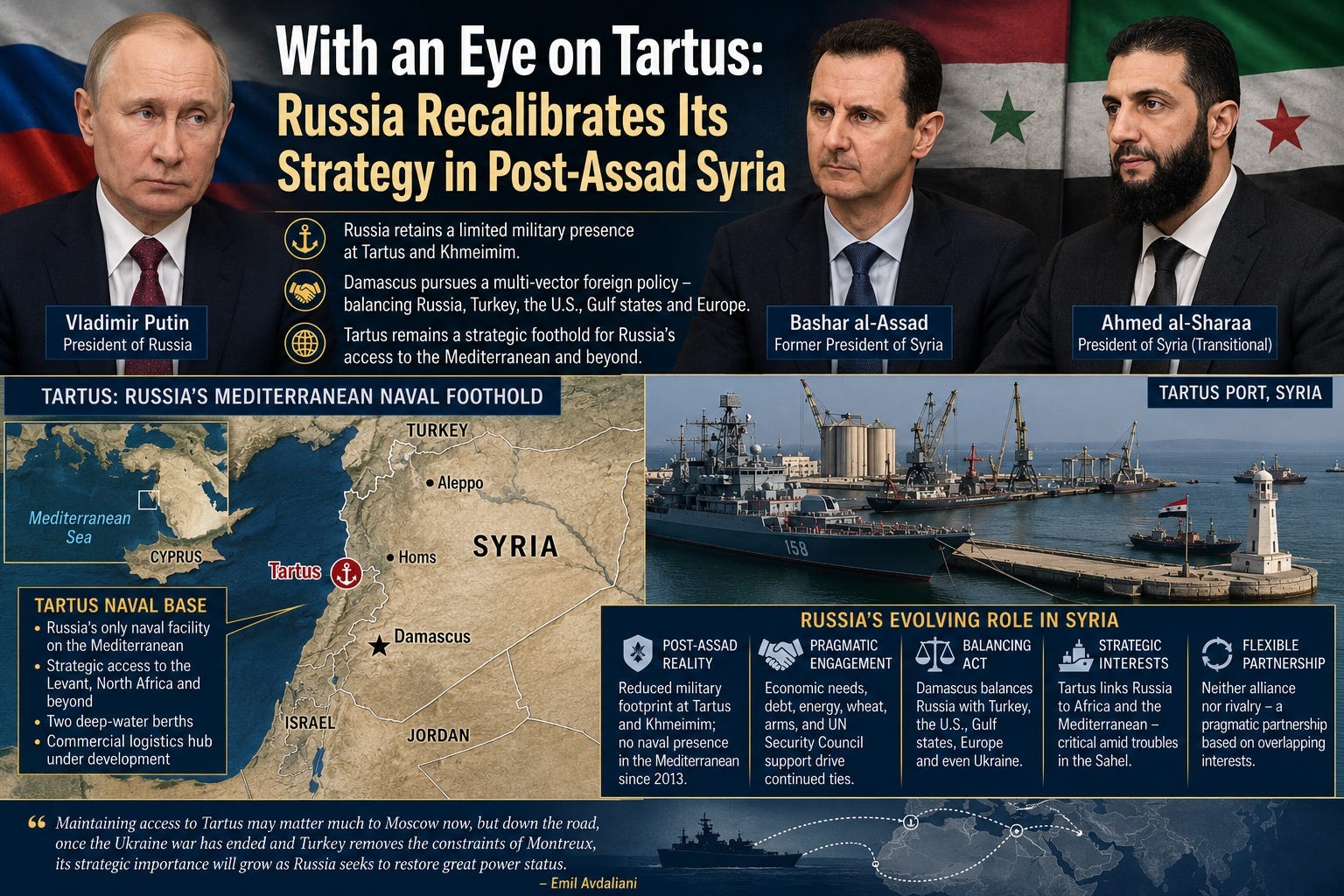
Since the fall of the Assad dynasty in late 2024, the Russian military presence has remained a major mystery as to what Moscow’s future will be in Syria. Following Assad’s flight to Moscow on December 8, 2024, Russia has significantly scaled back its presence at its two principal facilities on Syria’s Mediterranean coast: the Tartus naval base and its strategic air base at Khmeimim, located in the Syrian province of Latakia. Russia’s future stay in Syria became even more uncertain after the new government in Damascus terminated the 49-year commercial port management concession granted to the Russian engineering construction business Stroytransgaz.
Russia has also pulled out from Qamishli Airport located in northeastern Syria and restricted its patrolling missions along the border with Israel. This reduced presence has coincided with Moscow’s ever-demanding war effort in Ukraine and the deterioration of Russia’s position in the Middle East following the weakening of its key regional partner – Iran. In fact, for the first time since 2013, Russia currently has no naval presence operating in the Mediterranean Sea.
Yet, over the past several months, Syria’s new leadership has not only maintained working ties with Moscow but even attempted to revive and expand the relationship. This has come as a surprise to many given that the interim government of Ahmed al-Sharaa, once in power, severed Syrian ties with Assad’s other allies such as Iran and Hezbollah. When it comes to Russia, however, the interim Syrian leader has twice visited Moscow: first on October 15, 2025, and then on January 28, earlier this year.
Preserving Russia’s Syrian Footprint: Khmeimim and Tartus
After these visits, the new Syrian government allowed Moscow to maintain a scaled-down military presence in its former Mediterranean bases. The Russian newspaper Kommersant has closely tracked Russian activity, reporting in April that Damascus intended to change the operation of Russian facilities to a non-military role by converting the Khmeimim airbase into a “training and humanitarian facility” for Syrian forces, noted one Syrian official. The move would effectively mean an end to the base’s military functions, and Moscow and Damascus would end up jointly operating the facility. Such a change in terminology would allow Russian sources to continue using Khmeimim airbase, which Kommersant noted is a vital staging area for Russian forces operating in Africa.
To this should be added more recent developments such as the reports in early July when Moscow announced it would get a commercial logistics hub up and running in one of two berths in Tartus. The revelation followed the June 6 announcement by the Russian-Syrian Business Council that Moscow would establish an assembly and distribution center for Russian goods in the strategic port.
In light of these recent developments, when it comes to relations with Russia, Damascus seems to have its own specific logic for how it interacts with Moscow. Firstly, it is about Syria’s economic situation. The Arab country owes around $1.2 billion in Assad-era debt to Russia. More importantly, Syria is in dire need of a large inflow of foreign investments to rebuild the country, and Damascus believes that Russia could be one of those investors. Russian expertise is also of critical importance when it comes to the operation of three large dams on the Euphrates River, which were either built or designed with Soviet assistance. Given the poor condition of these massive structures today, their rehabilitation is far more likely to occur with Russian help than with Turkish or European support.
Russian familiarity with Syria’s needs accumulated throughout decades of close cooperation, as evidenced by how Damascus handled the country’s currency printing issue. In 2025, Syrian authorities extended cooperation with the Russian company Goznak, which had long enjoyed a monopoly in the printing of Syrian currency.
Equally critical is the issue of oil and wheat, of which Russia is a leading exporter into Syria. If during the Syrian Civil War, Iran was Syria’s major oil supplier, the rupture in relations with Tehran left Russia as the primary exporter covering nearly half (46 000-60 000 barrels) of all Syrian oil demand. When it comes to wheat, Moscow’s influence is less decisive given Damascus’s arrangements with other countries. Nevertheless, Russia remains an important supplier of wheat to the Arab country.
The Russia Factor in Syrian Diplomacy
Another issue driving Syrian rapprochement with Moscow is Russian diplomatic power. Russia retains veto power in the United Nations’ Security Council, where it played a critical role in shielding former Syrian leader Bashar al-Assad during the early stages of the Syrian uprising and after his violent crackdown on Syrian opposition forces. For Damascus, it will be difficult to completely sever ties with Russia also because the latter was the biggest exporter of weaponry into the country before the downfall of Assad. Despite close ties with Türkiye and the United States, Damascus is unlikely to replace Russian technologies any time soon, which means that the Syrian armed forces will need continued access to Russian weaponry, spare parts as well as technical services.
Equally significant, a wider geopolitical calculus is driving Russo-Syrian rapprochement that factors into the equation for Damascus. A weak Syria that emerged since the civil war broke out in 2011 was a boon to Israel, which has throughout its history opposed the emergence not only of coalitions of Arab states, but also that of a single strong player in its immediate neighborhood. No wonder then that Israel has engaged in an intermittent aerial campaign against military targets in Syria once a new government was formed following the fall of the Assad regime.
A fractured Syria has been unable to counter Israel’s regional ambitions due to the lack of military capabilities and diplomatic support. It is in this context that Russia’s lingering presence in Syria serves as a mitigating factor, a tool to temper Israeli actions in the region, and one that Damascus likely values. Moscow is also perfectly well suited to serve as a mediator between Damascus and Tel-Aviv, which was particularly effective during the Assad regime.
Ties with Russia are also part of Syria’s effort to diversify its foreign partnerships portfolio well beyond its close relations with Türkiye and the improving ties with the United States and Europe. The rapprochement with Russia, however, does not mean that Syria would not try to keep the balance. Indeed, even on issues such as the war in Ukraine, Damascus has simultaneously forged good relations with Ukraine, developing security (primarily drone expertise) cooperation with Kyiv as exemplified by President Zelenskyy’s recent visit to Syria this past April.
Damascus’ approach can thus be characterized as a multi-vector foreign policy balancing Russia, Türkiye, the Gulf states, Europe and the United States. However, this places limits on what Russia can achieve in Syria. Moscow knows that it no longer enjoys the privileged position it once had with the Assad regime. Instead, it now has to compete alongside other external powers for influence within a more diversified Syrian foreign policy. The United Arab Emirates (UAE), for example, is especially pertinent given its seeming ambition to fully control the port of Tartus. Indeed, once Stroytransgaz left, Damascus signed a 30-year concession with DP World, worth an estimated $800 million.
Outlook
Moscow is keen on retaining a military presence in Syria given that the country geographically serves as a mid-point between Russia itself and the African continent where the notorious Wagner Group transformed itself into the Africa Corps. Experts should keep in mind that military facilities in Syria have become all the more important given the troubles the Africa Corps is experiencing in the Sahel region, especially in Mali where the Tuareg rebels led by the Azawad Liberation Front (FLA) have been pressing on the capital Bamako. Moreover, the bases’ strategic value has further increased following the deterioration of Russia’s relations with Europe and NATO.
At the same time, major tensions remain in Russia-Syrian relations that should not be overlooked. The most significant unresolved issue remains the status of former President Bashar al-Assad. Syrian authorities continue to seek legal accountability for senior figures associated with the previous regime and have repeatedly expressed interest in Assad’s extradition to stand trial for his crimes. Moscow, however, continues to provide political asylum for the former Syrian leader and has shown no indication that it is prepared to reconsider this position. Another area of mutual concern involves the activities of former Assad-era political, military and intelligence figures now residing abroad. Syrian officials remain concerned that remnants of the previous regime could attempt to undermine domestic stability through external financing or political organization. Russian authorities have publicly emphasized that their territory will not serve as a platform for destabilization against the new Syrian government.
Though these differences remain politically sensitive, both governments have deliberately prevented them from dominating broader bilateral relations. Instead, discussions increasingly focus on future cooperation rather than lingering disputes. Syria is thus trying to reshape Russia’s presence in the country in a way that suits Damascus’ interests. It was within this effort that al-Sharaa first pressed against an extensive Russian military presence in the country but then has allowed a limited presence in exchange for greater concessions from Moscow.
The relationship today is neither an alliance nor a rivalry. Instead, it represents a careful partnership based on overlapping strategic interests, with both governments recognizing that cooperation remains more beneficial than confrontation. The elasticity of Russian-Syrian relations underscores Moscow’s broader capacity to adapt to changing political realities in the Middle East.
Although Russia suffered a major strategic setback with the collapse of the Assad regime, it has avoided complete marginalization by recalibrating its objectives and accepting a more limited but potentially more sustainable role in Syria as it struggles to retain its last major strategic foothold in the Middle East. Maintaining naval access to Tartus may matter less to Moscow now, but down the road, once the Ukraine war has ended and Türkiye has removed the constraints of the Montreux Convention, then the strategic importance of accessing Tartus will matter greatly when Russia tries to restore its great power status.
Author Bio
Emil Avdaliani is a Professor of International Relations at the European University in Tbilisi, Georgia, and a scholar of the Silk Roads. He can be reached on Twitter/X at Erifili Gounari
Thank you for your support! Please remember that The Saratoga Foundation is a non-profit 501(c)(3) organization. Your donations are fully tax-deductible. If you seek to support The Saratoga Foundation, you can make a one-time donation by clicking on the PayPal link below! You can also subscribe to our website to support our work.
https://www.paypal.com/donate/?hosted_button_id=XFCZDX6YVTVKA