
By Alexander Melikishvili
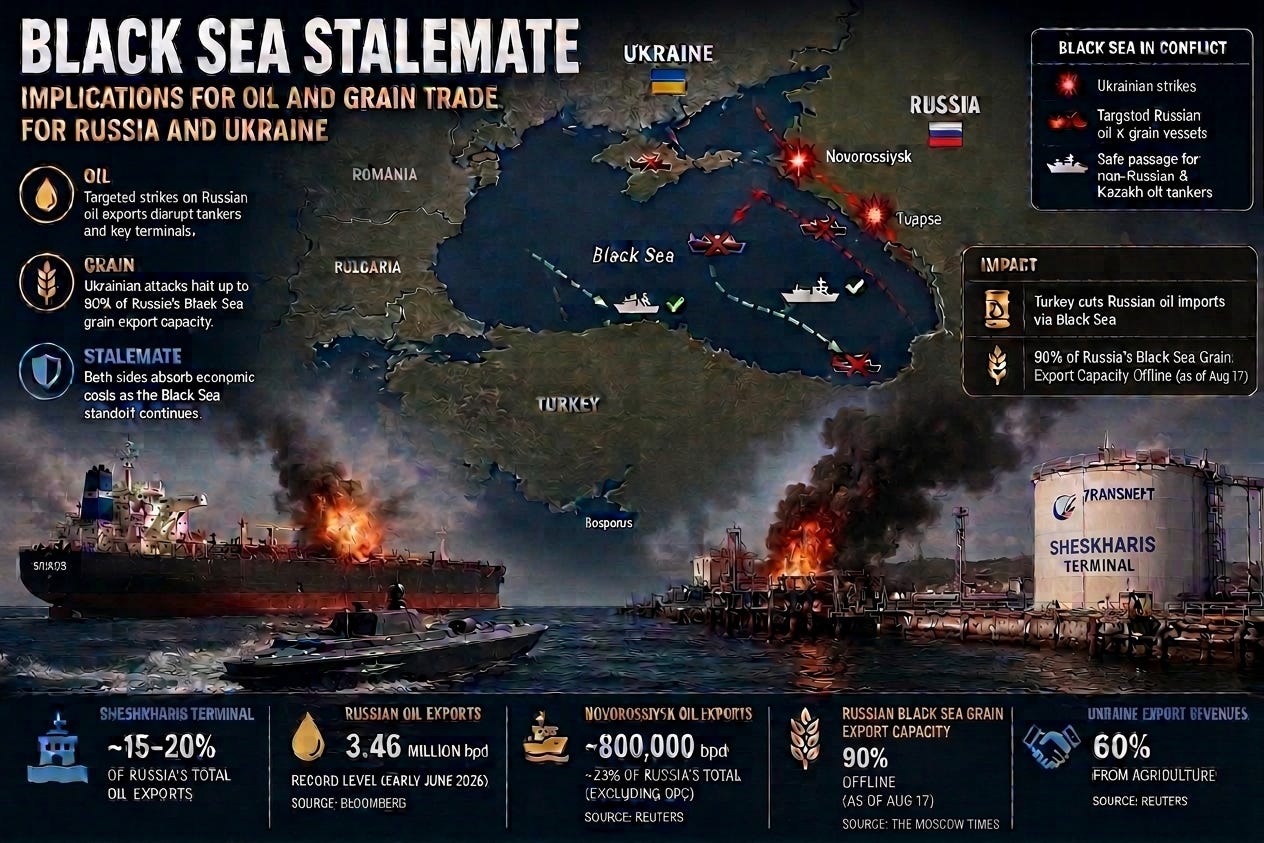
Following Ukraine’s pledge not to target the Caspian Pipeline Consortium (CPC) infrastructure, which is vital for Kazakhstan’s oil exports (see: Kazakhstan’s Novorossiysk Crisis), or non-Russian oil tankers in the Black Sea, the Ukrainian military has demonstrated precise target differentiation in its recent attacks. On August 17, the Greek-owned, Liberian-flagged Suezmax-class tanker Skiros (capable of carrying up to one million tons of oil) came under attack after loading Russian crude at the CPC terminal in Novorossiysk. Although the CPC terminal primarily handles Kazakh oil, Russian crude still accounts for 5–10% of its total export volume.
The attack caused no oil leakage, and the tanker continued on its journey, but the selective targeting of the vessel indicated that the Ukrainian military possessed key intelligence that allowed it to identify vessels carrying specifically Russian oil. This is likely attributed to the creation of new communication channels set up by Ukrainian authorities to interact with commercial shippers and selectively ensure safe passage. It should be noted that the attack on the Skiros took place only a day after the Ukrainian Foreign Minister, Andrii Sybiha, held a phone call with his Greek counterpart. The official readout suggests that most of the call was devoted to discussing Black Sea security.
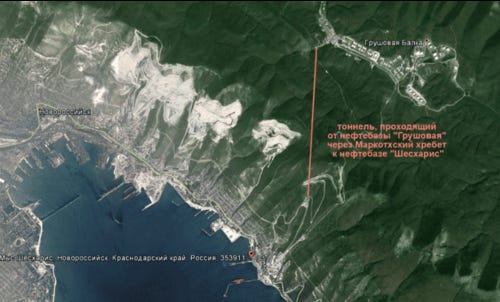
*Image above: The Sheskharis Oil Terminal near Novorossiysk
On the same day, another Greek-owned vessel, the dry bulk carrier ANNA S (sailing under the Liberian flag), was hit five times by UAVs that almost destroyed it, forcing the evacuation of the crew, including a Romanian captain and 20 Filipino sailors. The vessel was attacked when it was 20 nautical miles off the coast of Novorossiysk, where it was supposed to load barley. It is noteworthy that the crew of ANNA S was rescued by another Greek-owned ship, Elina B (sailing under the Maltese flag), which itself came under attack but continued its journey toward the Bosporus with 56,000 tons of wheat it had received while at the port of Novorossiysk.
On August 18, three additional dry bulk carriers were attacked while carrying or en route to load Russian grain: the Russian-flagged Victoria V, struck while docked at Novorossiysk before loading; the Marshall Islands-flagged Fehu, hit while departing Novorossiysk with wheat but able to continue sailing; and the San Marino-flagged Necibe, attacked at the port of Tuapse after loading 20,000 tons of wheat.
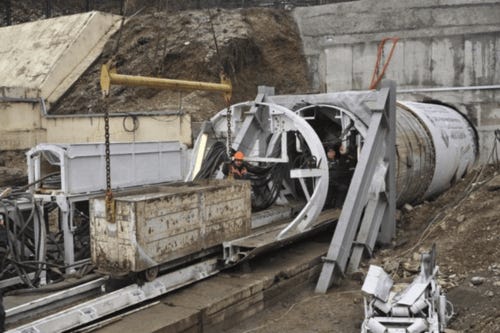
Image above: The Strategic Sheskharis Tunnel (Source Transneft)
Sheskharis in the Crosshairs
On August 12, Ukraine launched its largest combined attack against Novorossiysk since the war began. According to President Zelensky, the strike involved Palianytsia jet-powered attack UAVs, Neptune missiles, and seaborne USVs. As a result, Russia’s Transneft-owned Sheskharis terminal in Novorossiysk temporarily suspended operations on August 14. It remains unclear what specific damage Sheskharis sustained, but the attack damaged the highly strategic tunnel (see above) connecting the terminal to the Grushovaya oil depot, which is located inland, 6 kilometers from the port. Sheskharis is a strategically important facility, as it accounts for roughly 15-20% of Russia’s total oil exports. It is also important for Kazakhstan, as about 6 million tons of Kazakh oil (KEBCO blend) pass through the terminal for export annually. However, Sheskharis is far less significant for Kazakhstan than CPC, which transported 63 million tons of Kazakh oil (CPC blend) in 2025.
Although Sheskharis resumed operations on August 16, the relentless pace of Ukrainian attacks targeting tankers carrying Russian crude has forced Türkiye to reduce its imports of Russian oil via the Black Sea, which was previously the primary conduit for Russian oil exports. Türkiye remains heavily dependent on Russian oil — in 2025, for example, Russia accounted for almost half (15 million tons) of Türkiye’s total oil imports (32 million tons). With the northern part of the Black Sea under a de facto Ukrainian blockade, Türkiye can only hope to receive Kazakh oil from both CPC and Sheskharis, since tankers carrying it will not be targeted, but the volumes will be insignificant, as most of the Kazakh oil is already committed to European markets (Italy in particular).
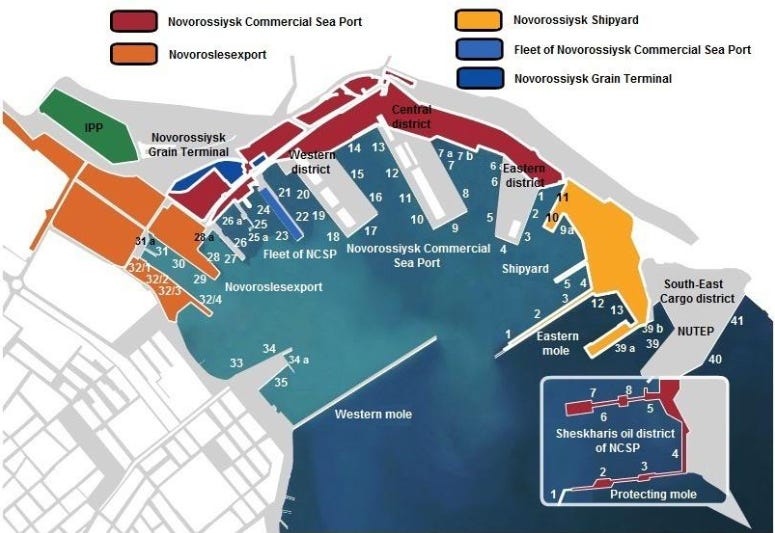
*Image above: World Bank Map of Novorossiysk
This leaves Türkiye in a difficult position, which explains why, on 8 August, the Turkish Foreign Minister, Hakan Fidan, proposed to Russia and Ukraine that they introduce a moratorium on attacks against commercial navigation in the Black Sea. On August 14, the Russian foreign ministry spokeswoman, Maria Zakharova, rejected the Turkish proposal, stating that there were “no grounds” for a mutual truce. Ukraine, on the other hand, itself offered Russia a similar proposal, and its ambassador in Turkiye, Nariman Dzhelyal, voiced support for the Turkish initiative on August 24.
Outlook
The tit-for-tat attacks in the Black Sea are hurting both Russia and Ukraine economically, but to different degrees, given the disparity between the two respective economies. For Ukraine, agricultural exports make up 60% of its export revenues, 90% of which are usually transported via the Black Sea. Ukraine’s central bank projects that disruption of seaborne export routes could cost the Ukrainian economy $2.5 billion in losses in 2026.
For Russia, the situation is much different, as the share of agricultural products in Russia’s total exports reached 12% in 2025. Russia is also heavily dependent on Black Sea ports to export its farm products, especially grain. As of August 17, because of the Ukrainian attacks, 90% of Russia’s grain export capacity in the Black Sea was taken offline.
The double blockade of the Black Sea threatens this year’s harvest in both countries, as silos are either filled or nearing capacity, while alternative routes to transport grain simply cannot accommodate such large additional volumes. Against this backdrop, the Russian agriculture minister, Oksana Lut, even suggested using excess grain as animal feed to mitigate the crisis.
Concerning oil exports, the Black Sea’s importance for Russia is somewhat limited. According to Bloomberg, as of early June, Russia’s daily oil exports averaged 3.46 million barrels per day (bpd), which is a record level since the war started in 2022. In June, Reuters reported that Russian oil exports from Novorossiysk, including KEBCO blend but excluding CPC, were on the order of 800,000 bpd, or roughly 23% of Russia’s total oil exports. As for Ukraine, since 2022, it has imported oil by land and not by sea.
Under these circumstances, Russia and Ukraine can potentially continue their standoff in the Black Sea despite mounting economic costs. Ukraine will probably offset them by tapping into the €90 billion ($105 billion) support loan from the EU. The Ukrainian Ministry of Agrarian Policy estimates the initial package of compensation to farmers suffering from the Russian naval blockade to be €220 million ($256 million), as this was the estimated figure with which it approached the EU for a grant, which was denied because it is already included in the aforementioned support loan.
Russia, too, can absorb the costs, as it is considering a slew of measures to mitigate the crisis, including state purchases of excess grain, preferential loans, and subsidies. Despite significantly drawing down its gold reserves in January-July to their lowest level since 2020, the Russian government’s financial position remains robust, with the central bank reporting that, as of August 14, Russia’s aggregate sovereign reserves stood at $755.6 billion. This allows Russia to continue its brinkmanship in the Black Sea, even as doing so will exacerbate food insecurity for poor countries that rely on grain imports. The World Food Programme has warned that at least 45 countries will be in particularly dire straits this year due to the harmful impact of the cyclical El Niño climatic anomaly.
About the Author:
Alex Melikishvili is a senior country risk analyst with more than a decade of experience working in the private sector (S&P Global, IHS Markit) with a focus on Eurasian security. Alex holds a master’s degree in International Affairs from the George Washington University’s Elliott School of International Affairs.
Thank you for your support! Please remember that The Saratoga Foundation is a non-profit 501(c)(3) organization. Your donations are fully tax-deductible. If you seek to support The Saratoga Foundation, you can make a one-time donation by clicking on the PayPal link below! You can also subscribe to our website to support our work.
https://www.paypal.com/donate/?hosted_button_id=XFCZDX6YVTVKA