
By Michael Horton
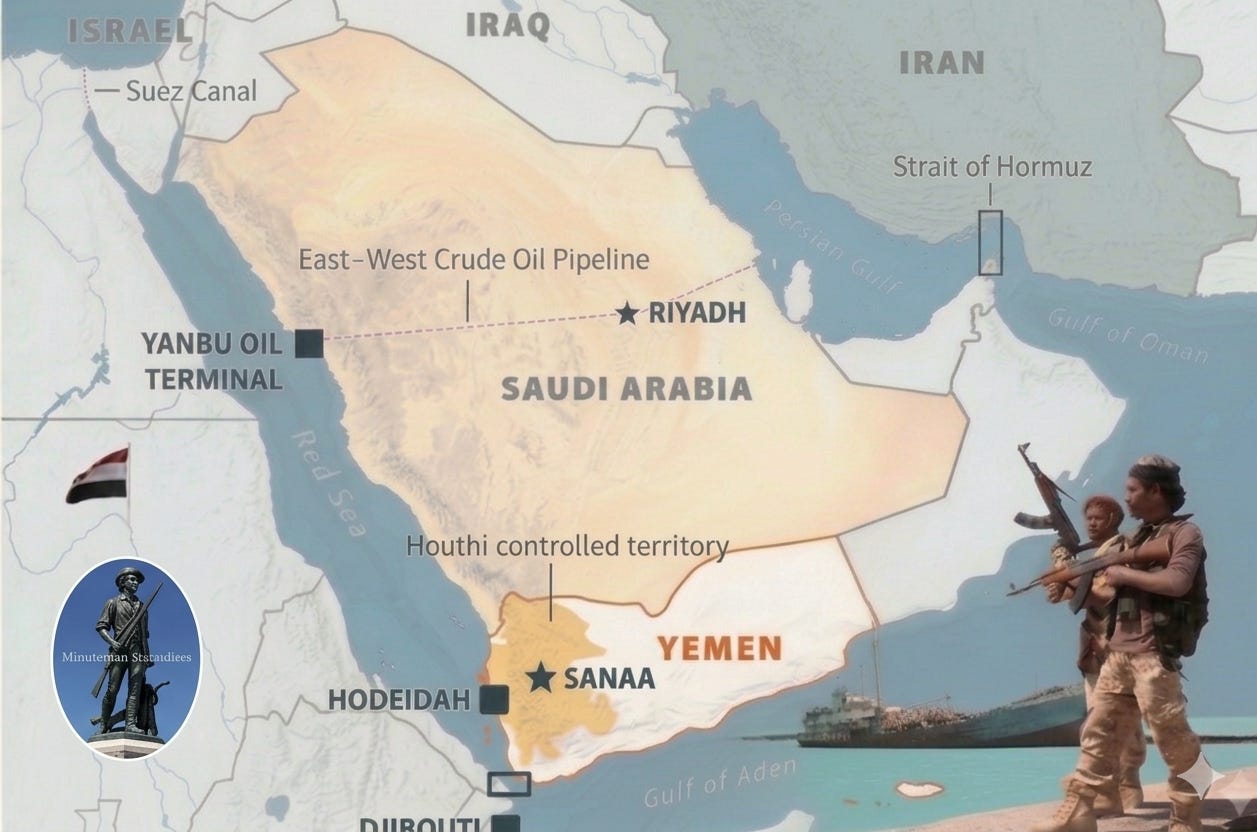
On February 28, 2026, hours after U.S. and Israeli strikes on Iran, the Houthis announced they would resume attacks on Red Sea shipping and Israel. Abdul-Malik al-Houthi, the group’s leader, warned that his forces had their fingers on the trigger. Bahrain and the UAE were warned they would be the first to pay if they aided operations against Tehran. Closure of the Bab el-Mandeb, the strait connecting the Red Sea and the Gulf of Aden, was described as likely if the assault on Iran continued.
In the weeks that followed, the Houthis launched ballistic missiles toward Israel on March 28th, March 30th, April 1st, and April 2nd. As yet, the Houthis have not launched any attacks on maritime targets or on GCC states. The strait remains open. The disparity between the Houthis’ rhetoric and actions is a product of lessons learned from two years of conflict following Hamas’ October 7 attack on Israel, mounting domestic concerns, inter-organizational tensions, and curbs on Iranian-sourced materiel.
Always quick to learn and adjust to changing political and martial realities, the Houthis are pursuing a well-calibrated policy of conditional deterrence.
Lessons Learned
Operation Rough Rider, which ran from March 15th to May 6th, 2025, struck more than a thousand Houthi targets across Houthi-controlled northwest Yemen in roughly seven weeks. Supply depots were hit. Missile launchers were targeted, and some of the infrastructure that supports drone and missile production and assembly was destroyed. Major General Zakaria Abdullah Yahya Hajar, who ran the Houthis’ drone force, was killed in a March strike on a headquarters north of Sana’a, along with Major General Mohammed Khaled Yahya al-Haifi, chief of missile-force operations, and several other senior commanders — deaths the Houthis concealed for nine months before quietly acknowledging them in December. The campaign cost the United States an estimated two billion dollars or more. The Houthis shot down seven MQ-9 Reaper UAVs during the campaign, and one F/A-18E Super Hornet fell overboard when the USS Truman was forced into evasive maneuvers after an incoming Houthi ballistic missile. The Houthis absorbed the attacks, derived operational lessons from them, and largely fought the U.S. to a standstill.
On May 6th, the U.S. and the Houthis agreed to an Omani-brokered ceasefire in which the Houthis agreed not to target American vessels and not to impede shipping through the Bab al-Mandeb. Both sides declared victory. Reporting by the New York Times, based on interviews with over a dozen U.S. officials, confirmed that the Trump Administration ended the campaign because the strikes were not achieving their objectives. The Houthis were explicit that the agreement did not include the cessation of attacks on Israel. After the end of Operation Rough Rider, Israel continued to target infrastructure in Houthi-controlled areas, and the Houthis continued to launch missiles and drones toward Israel.
Each side’s reading of the outcome helped shape what came next. For the Houthis, the March to May hostilities confirmed something they had been testing since late 2023: a mass maritime campaign draws a military response that degrades real capabilities, while a calibrated campaign does not. Consequently, in 2024, they struck commercial shipping roughly 150 times. In 2025, this dropped to seven attacks, even as they continued operations against Israel. This shift shows the Houthis became far more selective and measured in targeting maritime assets. The leadership seemingly realized that the threat of attacks could act as a kind of strategic reserve.
Operation Rough Rider also reinforced lessons the Houthis had absorbed during the Saudi-led coalition air campaign that began in 2015 and lasted, with brief interruptions, until the 2022 ceasefire. Concealment of weapons, materiel, and signals hygiene is paramount. Northwest Yemen’s rugged mountain terrain favors concealment. The Houthis have modernized and deepened Saleh-era underground depots and have dug new ones. They also located drone and missile production and assembly infrastructure in densely populated areas. These facilities are dispersed with multiple backup sites to compensate for any losses.
While the U.S. and Israel were able to successfully target some Houthi commanders and lower-level leadership, the Houthis are quite adept at minimizing their electronic emissions. Following strikes on their leadership, the Houthis launched an internal purge to root out suspected informants and doubled down on organizational security. It is likely that the group uses runners for communication with top-tier leaders, carrier pigeons (a method used by al-Qaeda in the Arabian Peninsula, or AQAP), and possesses a hardwired internal communication system in areas around Sana’a.
A Wasting Asset
Another crucial factor behind the Houthis’ strategic restraint is a material challenge. Their missile program still depends on key components sourced from Iran. Although the Houthis have successfully diversified supply chains for their drone programs, they continue to struggle with finding alternatives for critical missile parts. Leadership understands that each missile launched will be harder to replace going forward. Continued war with Iran will almost certainly further constrain these Iran-linked supply chains.
The Houthis’ missile supply gives them considerable leverage over regional powers, namely Saudi Arabia and the UAE, as well as over their domestic foes. The Houthis can easily target command centers and any concentration of forces in areas controlled by the recognized government of Yemen. With the closure of the Strait of Hormuz and the East-West pipeline now running at full capacity to export Saudi oil via the Red Sea port of Yanbu, the Houthis’ leverage has increased sharply. Closing the Bab al-Mandeb or striking the pipeline and Yanbu’s port infrastructure would directly threaten Saudi Arabia’s primary remaining oil export route. The Houthis have already demonstrated the capability: a Houthi drone strike temporarily shut down the East-West pipeline in May 2019.
While UAVs can target all of these sites, the Houthis’ more sophisticated missiles pose a greater challenge to Saudi and Emirati air defenses and have a higher chance of inflicting serious damage. The same limited supply of missiles poses a threat to the U.S. base at Camp Lemonnier in Djibouti and Emirati installations near Berbera in Somaliland.
Domestic Pressure
The Houthis are also contending with growing domestic pressures stemming from a moribund economy, declining revenue from formal and informal taxes, and the sale of refined petroleum products. These pressures have intensified due to attacks on port infrastructure by Israel in 2025, as well as U.S. sanctions that followed the formal redesignation of the Houthis as a Foreign Terrorist Organization by the State Department on March 4, 2025, pursuant to an executive order Trump signed on January 22nd. As a result, the once-significant revenue the Houthis derived from taxing and selling imported refined petroleum products has eroded. The Houthis depend on this revenue not only to fund their government and military, but also to sustain a vital patronage network.
The Houthis’ power rests on the continued compliance, forced or otherwise, of northwest Yemen’s tribes. While the Houthis have worked to infiltrate and compromise tribal power structures across the northwest, much of the compliance is still bought. Former Yemeni president Ali Abdullah Saleh also relied on patronage networks to maintain his grip on power. Corruption, declining oil exports, and his heavy-handed prosecution of six wars against the Houthis between 2004 and 2010 all contributed to the erosion of his authority and his eventual removal during the Arab Spring uprisings. Just as the Houthis have learned lessons from Operation Rough Rider, they are keenly aware of how Saleh lost power. Another extended bombing campaign by the U.S. and or Israel will not displace them, but it will further impede their ability to buy the compliance of key tribal allies.
Inter-Organizational Tensions
Running through all of this is a factional argument about what the Houthis are, and what they owe Iran. On one side, what can be called pragmatists are rooted in the movement’s Yemeni political tradition. The pragmatists have long resisted full subordination to Iran’s Axis of Resistance framework. These figures are by no means pacifists; most fully backed and helped prosecute the Red Sea campaign and missile launches toward Israel. But they understand that further escalation — the kind that invites another sustained bombing campaign, or that depletes inventory the group cannot easily replace — does not serve their goal of maintaining power and slowly expanding their political influence across Yemen. Many of these men also have personal fortunes to protect and are likely more interested in business than in sustaining a war that will slowly erode Houthi control.
On the other side are the maximalists, figures for whom the war with the United States and Israel is an ideological obligation that cannot be so easily weighed against domestic calculations. Many of these men are part of the younger generation that came of age during the last years of the Saleh government. While many are undoubtedly wealthy due to corruption and the war economy, they have not amassed the personal fortunes that many in the older generation have. They have less to lose, and it is largely through war that a Houthi commander can prove himself and advance within the organization.
Tehran’s position complicates any simple reading of this contest. The Iranians want the Houthi threat activated and credible — a second front that disperses American and Israeli attention and keeps Saudi Arabia in particular in check. But Tehran does not want the Houthis to be degraded by a serious escalation. Iran’s preferred outcome, a Houthi posture of maximum menace with minimal commitment, aligns, at least for now, with what the pragmatists are already arguing.
The Bab al-Mandeb
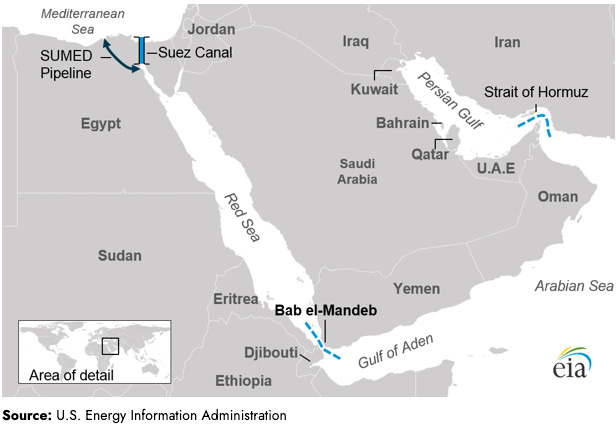
The Bab el-Mandeb carries, in normal times, between 10 and 15 percent of global seaborne trade. With the Strait of Hormuz now largely closed to non-Iranian vessels, its strategic weight has increased further still. The Houthis hold parts of its eastern shore, and they have the weapons — anti-ship ballistic missiles, drones, and naval mines — to make transit through it prohibitively dangerous. They have said, on the record, that closure is likely if the assault on Iran escalates further, especially if there are U.S. boots on the ground in Iran.
The arithmetic of the Houthis’ restraint is clear. Closing the Bab al-Mandeb ends the threat because it produces a response from the United States and Israel that will not displace the Houthis but will degrade them militarily and further stress their ability to fund patronage networks. Escalation by the Houthis could also provoke Saudi Arabia into backing ground operations by forces allied with the Government of Yemen (GOY). While such an operation is unlikely to dislodge the Houthis, GOY-allied forces are better organized and more capable than they have been for years.
The Houthis, and for now Iran, benefit more from holding the threat to close the Bab al-Mandeb and attack oil handling infrastructure in reserve. It is also highly likely that Saudi Arabia, which has maintained backchannel communications with the Houthis since at least 2022, is ensuring that the group receives some economic support. Reports indicate that Saudi salary transfers to Houthi-controlled areas helped shape the timing of the Houthis’ entry into the current conflict. If accurate, this underscores Riyadh’s continued interest in managing — rather than confronting — the Houthis directly.
What Comes Next
The Houthis will continue launching missiles at Israel — enough to maintain the appearance of solidarity with Iran and the Axis of Resistance — but not enough to deplete an inventory they cannot easily rebuild. Maritime threats will continue at a frequency calibrated to sustain elevated insurance rates and keep some U.S. naval assets committed to the region. However, barring U.S. troops on the ground in Iran, the Houthis are unlikely to cross the threshold that would provoke another sustained bombing campaign. The Bab el-Mandeb will remain open and threatened.
The danger in this situation is not that the Houthis will rationally decide to close the strait. It is that they will not have to decide. Miscalculation is not a failure of intent; it is what happens when multiple actors are moving simultaneously up an escalation ladder, none of whom can see to the top. A single exchange — a vessel sunk, a naval asset struck, a threshold crossed by one of the other parties — can produce an escalatory loop that removes the option of restraint before any party has specifically chosen to abandon it.
The Houthis have endured six Saada wars, seven years of Saudi-led military intervention, successive Israeli campaigns to decapitate their leadership, and two American bombing operations. They are not a movement that makes decisions from desperation. They make them from a precise, if sometimes ruthless, accounting of what they possess, what they stand to lose, and what price their adversaries are prepared to pay. That accounting currently argues for continued restraint.
About the Author:
Michael Horton is the co-founder of Red Sea Analytics International (RSAI) and a contributing author at Eurasia Outlook. He has two decades of experience as an analyst and researcher in Yemen and the Red Sea region. Michael has written policy briefs and conducted briefings and seminars for the US National Security Council, the British Foreign Ministry, the British Ministry of Defense, the US State Department, and senior members of the British Parliament and the US Congress. He has written extensively about the region for The Saratoga Foundation, Jane’s Intelligence Review, the Combating Terrorism Center at West Point, Oxford Analytica, and The Economist,.
About the Saratoga Foundation
The Saratoga Foundation is a research and analysis organization focused on Eurasian security and geopolitical developments. Founded in 2023, the Foundation provides analysis on timely security issues shaping U.S. strategic interests related to the Eurasian chessboard.
Thank you for your support! Please remember that The Saratoga Foundation is a non-profit 501(c)(3) organization. Your donations are fully tax-deductible. If you seek to support The Saratoga Foundation, you can make a one-time donation by clicking on the PayPal link below! You can also subscribe to our website to support our work.
https://www.paypal.com/donate/?hosted_button_id=XFCZDX6YVTVKA