
By Vasif Huseynov
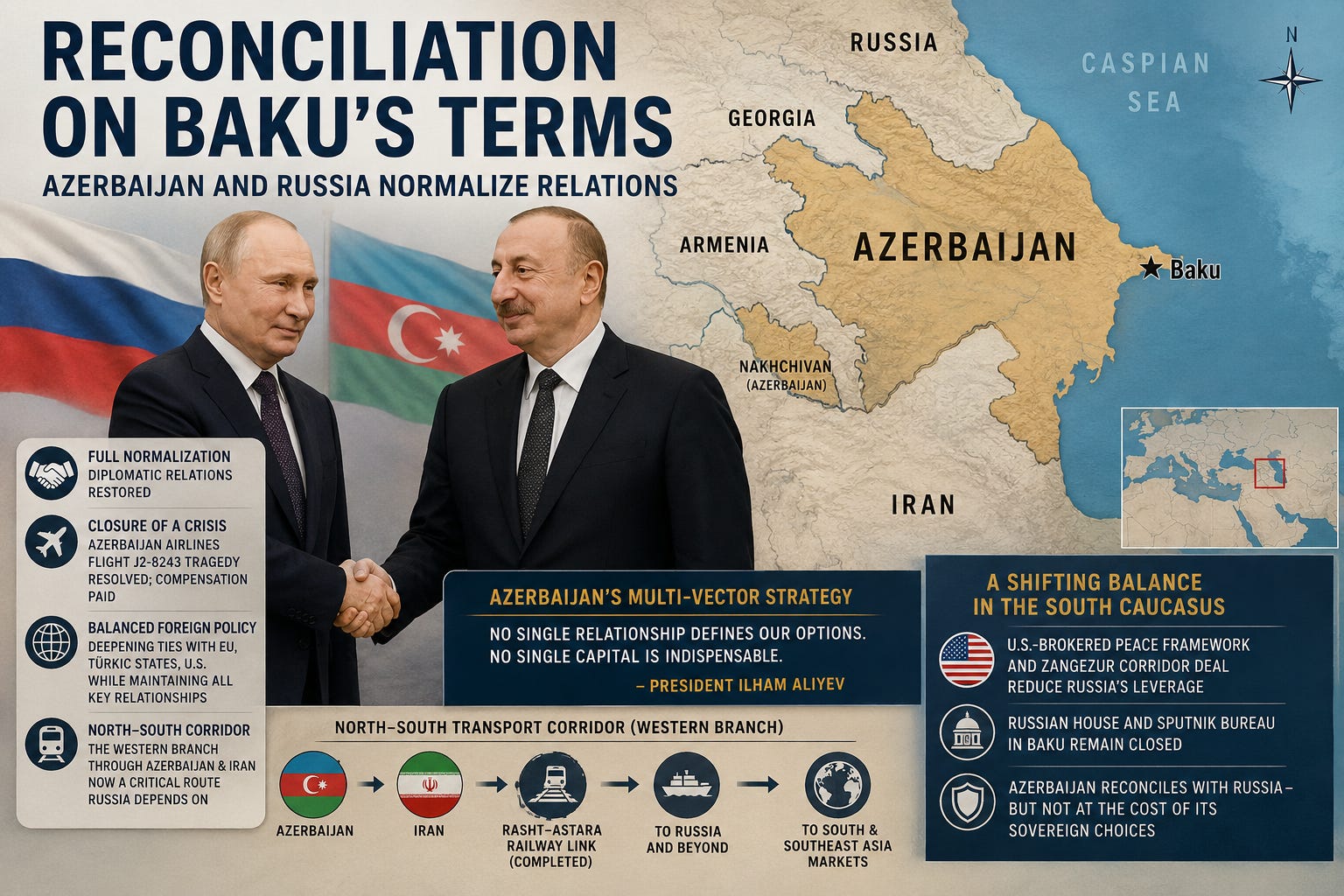
On July 16, Azerbaijani Foreign Minister Jeyhun Bayramov arrived in Moscow for a two-day official visit, holding talks with his Russian counterpart Sergey Lavrov on July 17. The two ministries used the occasion to sign a Plan of Consultations for 2026–2027 and to review the full range of bilateral relations — political dialogue, trade, transport, the Caspian, and the South Caucasus. On paper, this was a scheduled diplomatic reset. In substance, it marked the closing chapter of a year-and-a-half-long standoff in which the pace and conditions of reconciliation were largely set by Baku.
A few days earlier, at the fourth Shusha Global Media Forum on July 13, President Ilham Aliyev had already previewed this outcome. When asked about the state of ties with Moscow, Aliyev said: “Relations between our countries are developing very positively. You mentioned the difficulties. Yes, we all know about them. But what is important is that this period is now behind us. I would say that our relations have been fully normalized.”
That formulation, however, was not left to stand on its own. In Moscow four days later, Bayramov used almost the same identical language, telling Lavrov’s press conference that the two states had overcome their difficult period and fully normalized the entire spectrum of bilateral relations. Lavrov, for his part, stopped short of using the phrase himself, merely noting that Moscow had taken note of Aliyev’s statement and shared Baku’s understanding of the current situation — a small but telling asymmetry in how each side chose to characterize the same reconciliation.
A Crisis Moscow Could Not Simply Talk Its Way Out Of
To understand why the sequencing of Russia-Azerbaijan rapprochement matters, it is worth recalling how deep the rupture had been. On December 25, 2024, an Azerbaijan Airlines Embraer 190 flying from Baku to Grozny was struck by Russian air defenses as Ukrainian drones entered Russian airspace, then diverted across the Caspian and crashed near Aktau, Kazakhstan, killing 38 of the 67 people aboard. Moscow’s initial explanations — including theories about a bird strike or an onboard gas cylinder explosion — were dismissed by Aliyev at the time as absurd theories unbecoming of the response he expected from Moscow. Baku’s position was clear and sequential: acknowledgment of responsibility, an apology, accountability for those responsible, and compensation.
It took until October 9, 2025, when Putin met Aliyev in Dushanbe, for the Russian president to explicitly acknowledge that Russian air defense missiles had detonated near the aircraft, and to commit to compensation. Even then, it took another six months of technical negotiations before the two foreign ministries jointly confirmed, on April 15, 2026, that all outstanding issues — including the payment of compensation — had been resolved, with the crash attributed to an unintentional action of an air defense system in Russian airspace. Russian Deputy Foreign Minister Mikhail Galuzin, asked shortly afterward to confirm the settlement, said only that all issues linked to the tragedy’s aftermath had been resolved, declining to discuss specifics out of consideration for the victims’ families. No compensation figures were ever disclosed. But the sequence itself is instructive: full normalization did not proceed until Baku’s conditions had been met.
Baku’s Balanced, Multi-Vector Foreign Policy
What followed the Moscow talks reinforced the fact that reconciliation was never intended as a return to dependency. Days later, Aliyev traveled to Germany for an official visit, where he and Chancellor Friedrich Merz signed a joint declaration establishing a strategic partnership spanning energy, transport, green hydrogen, digital transformation, and industrial modernization. Aliyev used the occasion to highlight Azerbaijani gas flowing to ten EU member states and recent visits by European Council President António Costa and Commission President Ursula von der Leyen to Baku. Restoring dialogue with Moscow and deepening ties with Berlin within the same week is a fairly clear illustration of what a genuinely multi-vector foreign policy looks like in practice: no single relationship is allowed to define the country’s options, and no single capital is treated as indispensable.
This is the frame through which the Russia file is best read — not as a standalone bilateral story, but as one strand in a foreign policy that has spent several years methodically diversifying. Azerbaijan has hosted senior European Union officials, expanded the Middle Corridor and Trans-Caspian energy links, deepened the Organization of Turkic States framework, forged closer ties with the United States, including a visit by the Vice President of the United States, and positioned itself as a facilitator during the U.S.-Iran war, all the while keeping its channel to Moscow open. Restoring ties with Russia does not reverse that trajectory so much as complete it, by resolving the one relationship that had been operating in crisis mode while every other vector continued to move forward.
Moscow’s Weakened Hand in the South Caucasus
Another development shaping Russian rapprochement with Azerbaijan is that in the past eighteen months since the crash Russia’s position in the South Caucasus has rapidly eroded, which went far beyond Moscow’s bilateral standing with Baku. The clearest marker came on August 8, 2025, when the United States brokered a peace framework between Armenia and Azerbaijan at the White House, under which Washington secured a long-term arrangement to develop the transit corridor through Armenia’s Syunik province linking mainland Azerbaijan to its Nakhchivan exclave. Branded the Trump Route for International Peace and Prosperity (TRIPP), the arrangement gave the United States a direct operational role in a corridor that, for decades, Russia had assumed it alone would help secure this axis.
Analysts have described the deal as effectively pushing Russia out of key processes in the South Caucasus, noting that Moscow’s traditional role as the region’s principal security guarantor was, for the first time, taken up by an outside power operating on Armenian soil. Simultaneously, this shift coincides with a broader overall decline in Russia’s standing in Armenia itself, where Yerevan has pursued its own diversification away from Moscow-centered security arrangements in favor of Western - and US-facilitated frameworks. In Azerbaijan, the retrenchment of Russian influence has been visible in a different way. In the weeks following the plane crash, Baku moved to close the Russian House in Baku, the local representative office of Rossotrudnichestvo, Russia’s state cultural and soft-power agency, after Azerbaijani authorities said the center had failed to register as a legal entity and had breached local law.
Around the same time, Azerbaijan also shut the Baku bureau of Sputnik, part of the Rossiya Segodnya media group, permitting the outlet only a single accredited correspondent going forward. As of this year, Rossotrudnichestvo’s own leadership was still describing the situation as unresolved: in February 2026, agency head Yevgeny Primakov said Moscow was seeking acceptable options to resume the Russian House’s operation in Baku as soon as possible, noting that the 1997 intergovernmental agreement on cultural centers technically remained in force. Neither institution has reopened yet.
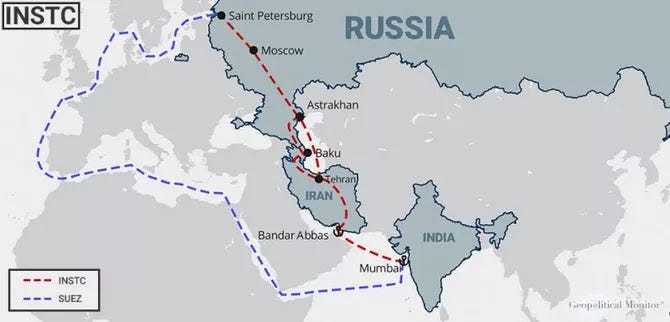
*Map: The International North-South Corridor (INSTC) Versus the Persian Gulf
Moscow’s Strategic Urgency: The North-South Corridor
Against this backdrop, it is worth noting where the balance of need now sits on infrastructure Russia itself greatly depends upon. At his joint press conference with Bayramov, Lavrov was notably direct about why the North-South Transport Corridor’s western branch — running through Azerbaijan and Iran — has become urgent for Moscow specifically. With the Strait of Hormuz crisis dragging on and disrupting global transport routes, Lavrov said the corridor’s importance had grown accordingly. He noted that Iran had finally completed land allocation for the long-delayed Rasht-Astara railway link, the corridor’s last missing segment, and that railway officials from Russia, Azerbaijan, and Iran had already met to discuss the practical steps needed to begin construction, expressing confidence that progress was now within reach.
Read plainly, this is Russia describing a route it desperately needs, not one it is doing Azerbaijan a favor by using. With Western sanctions foreclosing most alternative paths to South and Southeast Asian markets, and a key maritime chokepoint in the Gulf now unreliable, the overland corridor through Azerbaijani and Iranian territory has become one of Moscow’s few dependable arteries southward. Azerbaijan’s own foreign minister noted that Baku has coordinated this project from its inception and is on schedule to raise freight volumes on its section to five million tons by 2028, a reminder that Azerbaijan is not merely a transit host but a central party whose cooperation the corridor’s Russian branch now desperately needs to preserve its relations with Iran.
Outlook
None of this suggests that Baku and Moscow have resolved every point of friction, or that the underlying grievances have fully receded. What the record shows instead is a reconciliation that was carefully calibrated and developed in stages as it restored political and diplomatic channels, while the institutions Russia once used to project cultural and media influence inside Azerbaijan remain closed. Moreover, Moscow’s broader position across the South Caucasus, particularly around the Zangezur corridor, has continued to recede even as bilateral ties with Baku improve. Azerbaijan’s return to dialogue with Russia has come without a return to the pre-2024 status quo, and largely on terms that Baku itself defined.
About the Author
Dr. Vasif Huseynov is the head of the Western Studies department at the Center for Analysis of International Relations (AIR Center) in Baku, Azerbaijan. He is a faculty member at Khazar University in Baku. Dr. Huseynov had previously worked for the Center for Strategic Studies (SAM) and the Public Administration Academy (DIA) in Baku.
Thank you for your support! Please remember that The Saratoga Foundation is a non-profit 501(c)(3) organization. Your donations are fully tax-deductible. If you seek to support The Saratoga Foundation, you can make a one-time donation by clicking on the PayPal link below! You can also subscribe to our website to support our work.
https://www.paypal.com/donate/?hosted_button_id=XFCZDX6YVTVKA